What is an AI app builder like Lovable?
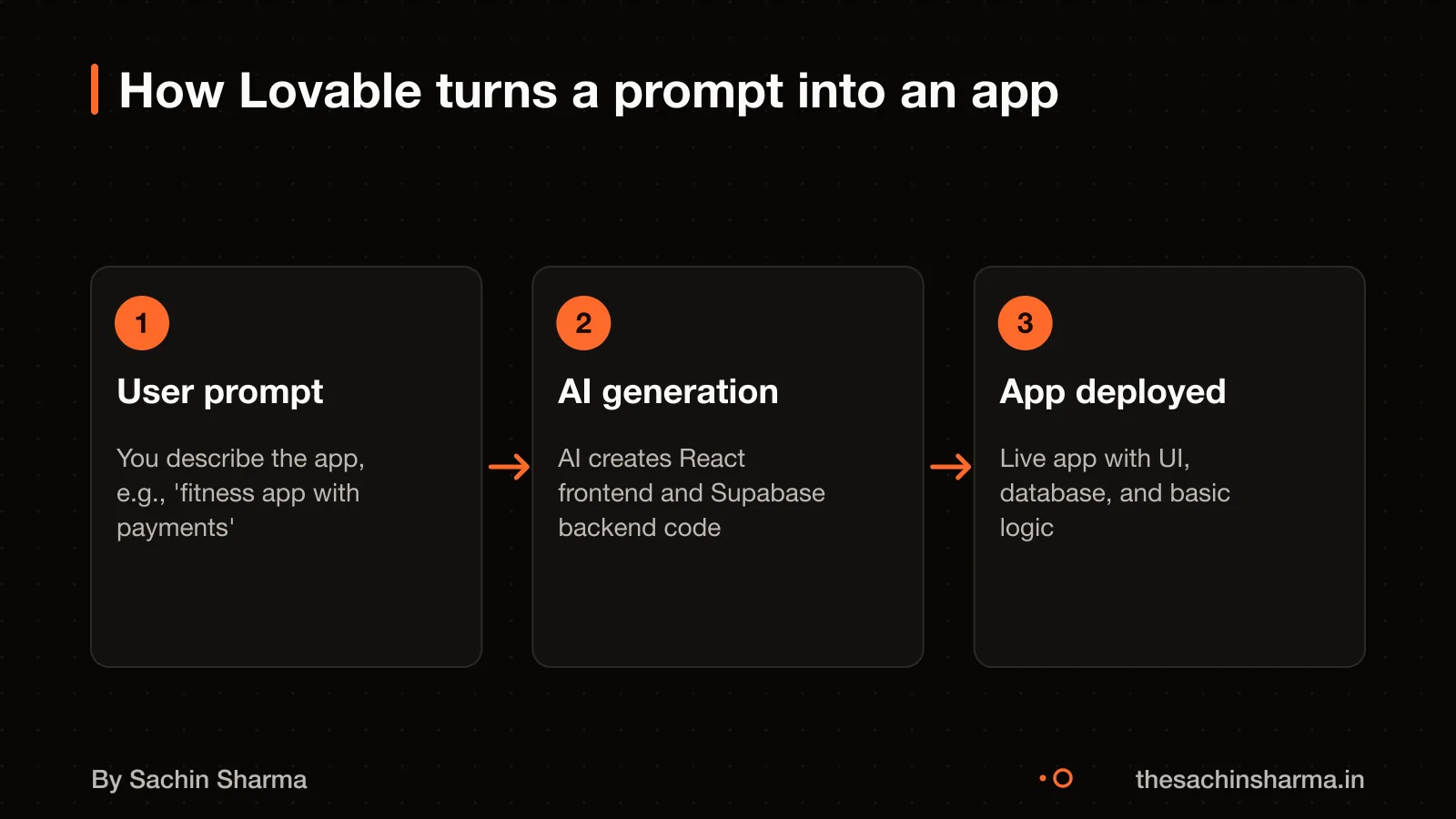
An AI app builder like Lovable turns plain English prompts into working web apps using React for the frontend and Supabase for the backend. It sets up user login, database tables, and file storage automatically if you ask for them. The app runs on Lovable’s own managed hosting, which includes custom domains, HTTPS, and preview environments for testing changes.
Supabase is a backend platform that handles data storage, user accounts, and file uploads. React is a common tool for building interactive web pages. You do not manage servers or databases yourself.
As part of the setup, Lovable wires these parts together so the app can save data and recognise users. You get a live URL and can share the app right away. For more options, see this Replit Agent alternative that also builds full-stack apps from prompts.
When it is safe to stay on an AI app builder
It is safe for testing ideas, internal tools, or simple customer portals with public data. These tools let anyone build working prototypes without coding skills.
For example, a local fitness coach can use it to make a booking app for trial sessions. A small tutor can set up a form for student registrations. A creator can launch a simple directory of free resources.
Lovable provides hosting, custom domains, HTTPS, and a built-in backend with authentication and storage. This covers basic needs for early-stage apps. But if you add payments, health records, or personal data, this setup is no longer safe or compliant.
The limits are clear: no real transactions, no sensitive data, and no high user trust. If your app grows beyond a prototype or touches regulated areas like health or finance, you must switch to a developer. For secure handling of health data, see how to Hire a developer for a diagnostics lab app.
When to switch to a developer
Switch to a developer when you have paying customers, handle sensitive data, or need custom logic. These are the main triggers that an AI app builder cannot safely support. Once money or trust is involved, you need more control and security than AI tools offer.
Payments require a developer because AI builders do not give full control over transaction flow or compliance. If you collect fees, even from a few users, you must ensure data safety and audit trails.
Sensitive data, such as personal details or business records, also demands a developer. AI platforms may store data on shared servers, increasing risk. A developer can build with privacy-first tools and local storage, as in an app that checks duplicates without uploads.
Custom logic, like approval workflows or role-based access, is another trigger. AI builders use fixed templates. When your rules go beyond forms and buttons, a developer writes code that fits your process. For example, if you run a coaching institute and need admin, teacher and student roles, a developer can build that structure. See how to Hire a developer for a coaching institute app.
But common issues include slow performance at scale, missing integrations, and inability to fix bugs. When the tool limits growth, it is time to switch.
Cost: AI builder vs developer
An AI app builder costs $40 per month. This is cheap for testing a simple idea fast. A developer, on the other hand, charges upfront: freelancers ask $2,000 to $40,000 (₹1.7 lakh to ₹33 lakh). Agencies charge $15,000 to $150,000 (₹12.5 lakh to ₹1.25 crore). As an estimate, a basic custom app in India starts around ₹3 lakh, depending on features and complexity.
But AI builders have hidden costs. If your app grows, you may need a full rebuild later to handle more users or add key features. A shaky start can cost you three months of rework or more. You also pay monthly forever, and some tools lock your data or code, making it hard to move.
In contrast, a developer gives you full ownership and a solid base that can grow. You pay more at first, but avoid long-term fixes. For small, simple apps with no payments or personal data, an AI builder saves money. For anything serious, a developer is cheaper over time.
App development cost in India covers what drives prices and how to plan your budget.
Want a number for your idea? Send one line on WhatsApp. I reply with what drives the cost and what to cut.
Message me on WhatsApp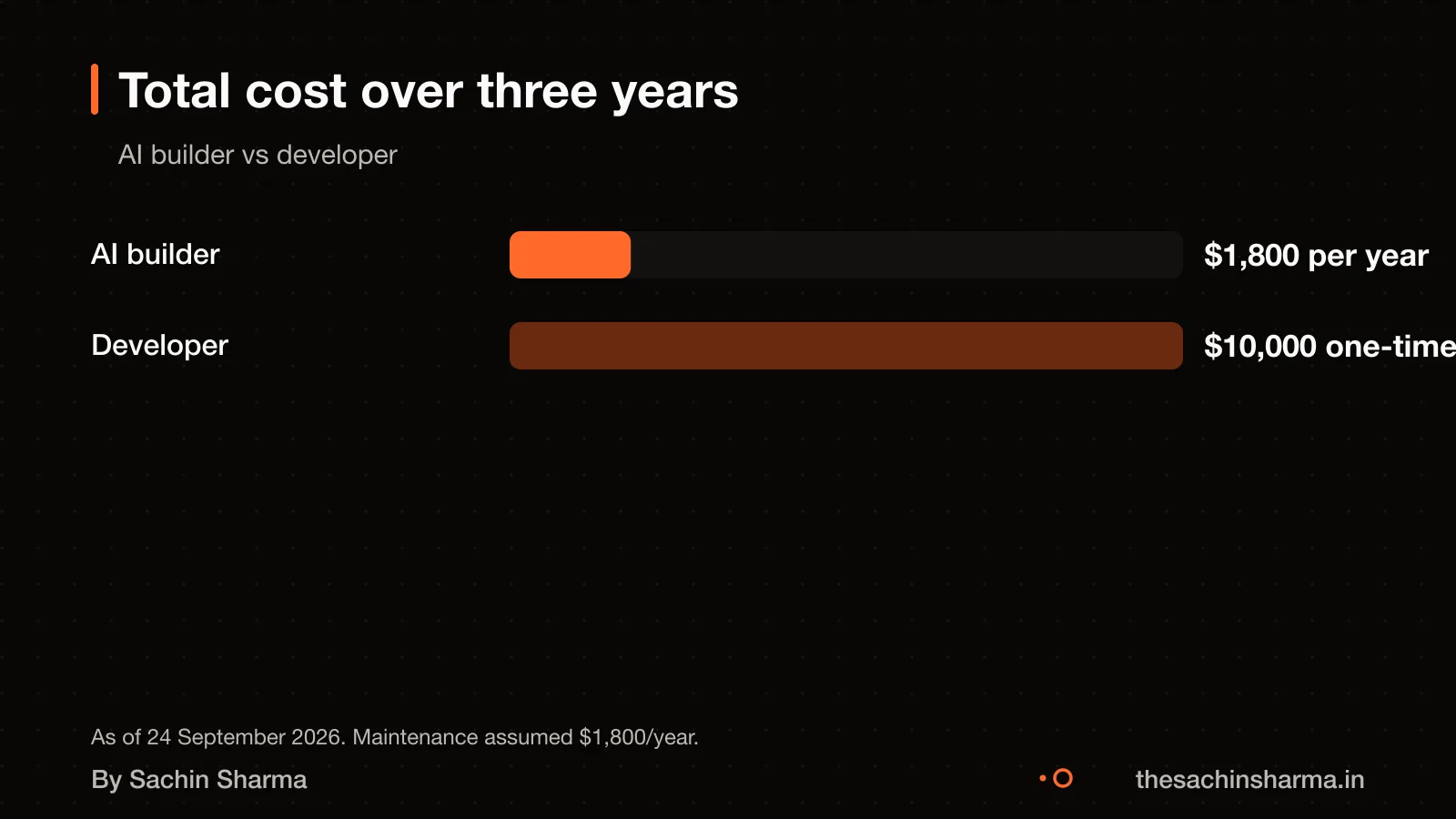
Time to build: AI vs developer
You can launch an app in minutes with an AI builder. A developer-built app takes weeks and may be better for long-term growth. AI can build simple prototypes quickly. Sachin Sharma is an India-based software developer: Flutter / mobile, Next.js / full-stack, AI-assisted products. AI can speed up early development by generating basic screens and flows. But it does not replace a developer for complex features or performance tuning.
If you need to ship fast but plan to scale, consider using an AI builder just for mockups, then hand the spec to a developer. Some platforms like DronaHQ let you edit the generated React code, giving a middle path. Still, most AI-generated apps need a full rebuild before handling real users or payments. For a balance of speed and control, Bolt.new alternative lets teams launch fast without locking into AI limits.
How long to hand over to a developer
Moving your code and accounts from an AI app builder to a developer can take as little as one day. But rebuilding the knowledge behind the app takes longer. It depends on how complex the app is and how well you documented your choices. For example, if you built a customer portal with five screens and clear notes, a developer can follow it faster. If the logic is tangled or unrecorded, it will take more time to understand.
Handover is complete only when the new developer can make a change, release it. Roll it back if needed, without asking you for help. This ensures they fully control the app. Until that point, you remain a bottleneck.
To speed this up, use an App brief template that captures your app’s purpose, user flow, and key features. It helps the developer get up to speed without guessing.
How to hand over from AI builder to developer
You must give the developer the code, data, accounts, operational knowledge, and responsibility for maintenance. A complete handover happens only when ownership, knowledge, and responsibility have all moved to the developer.
Ownership includes the source code, user data, and all service accounts such as cloud, domain, and API keys. Without these, the developer cannot take control.
Knowledge means the purpose of the app, the business rules it follows, and the reasoning behind unusual behaviours or workarounds. Share notes, user feedback, or past decisions that shaped the app.
Responsibility covers who deploys updates, who gets alerts when the app fails, and who can restore data from backups. This ensures someone is always accountable.
The handover package should include: the app’s purpose, key business rules, a system map. A list of secrets (like API keys), the current release process, and known bugs or flaws. It does not need to be long; it needs to be true.
For a smooth transition, link this to the next step: Hire a developer for a field-staff app when you need to pass on operational context.
Have a quote in hand? Send it to me and I will mark what is missing.
Message me on WhatsApp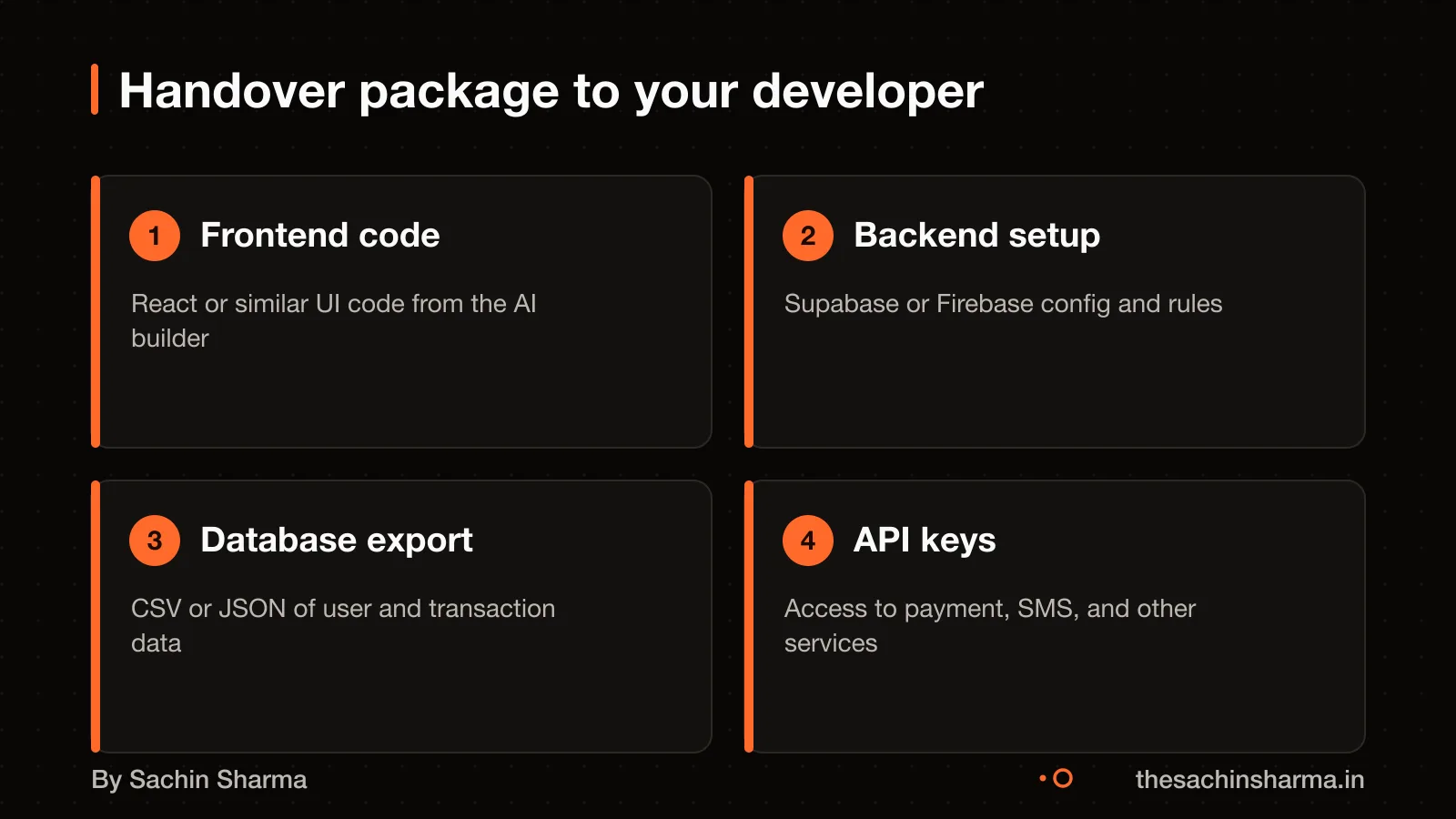
Risks of using an AI app builder
AI app builders carry real risks around security, platform dependence, and performance under load. You should know these before relying on one for a business app.
Security risks exist because AI builders can generate apps without proper checks. Lovable, for example, could be misused to create phishing sites if prompts are not controlled. All AI-generated apps need human review for data safety and logic flaws.
If the platform shuts down, your app may stop working. Most AI app builders host your app on their infrastructure. If they close or change pricing, you could lose access.
Under heavy use, AI-built apps often fail. They usually have limited backend logic and cannot scale well. Custom workflows, complex calculations, or high user traffic may break the app.
Security and compliance
Your data is not fully safe in an AI-generated app. AI builders often lack full backend control and need human oversight for security. AI tools may not be suitable for tasks requiring custom logic, scale, or sensitive data. AI tools may lack full audit control or data flow documentation. Hiring a developer is recommended for handling sensitive data or compliance.
App store rules are also hard to meet with AI-built apps. Apple requires accurate metadata, no beta versions on the store, and full access for review including demo accounts. AI apps may hide features, as Apple Developer rules say they should not include hidden, undocumented features. If your app is rejected, fixing it without deep code access becomes difficult.
For example, a health-tracking app built on an AI platform might collect personal data. But not let you add proper consent logs or data export tools. That breaks both DPDP and App Store rules. A developer may be needed to ensure compliance with data and platform rules.
If you are handling user data or launching on app stores, a developer ensures compliance. Use Best app developer in Raipur to find someone who follows Indian data laws and platform rules.
Code ownership and export
You can download the codebase as a.zip file under a paid plan. This means you can export your code, migrate your data, self-host parts or all of your stack. Or move to another provider at any time. The app is built on open-source frameworks.
To move your app, you need three things: the exported codebase, your data, and access to any third-party services it uses. Lovable is designed to work with many hosting and infrastructure setups.
However, owning the code does not mean you fully control it. The quality, structure, and security of AI-generated code can vary. A developer may need to review and refactor it before it is safe to run in production. Also, how to check for hidden flaws or licensing issues in the generated code is not clearly documented.
Can I get the source code of my app? to confirm ownership terms before building your app.
When this advice is wrong
AI app builders are safe to stay on for MVPs, internal tools, and simple SaaS. Internal tools for staff use, simple customer portals with public data, or proof-of-concept apps also fit this safe zone. In these cases, the speed and low cost outweigh the risks.
Investors may push you to stay on an AI builder to show fast progress, even when a developer is the better long-term choice. AI app builders are not enough for payments, sensitive data, or scale without a developer.
But always get a legal check for data and financial rules.
Next step: message me on WhatsApp with what you want to build. No forms, no sales team.
Message me on WhatsAppShould you switch?
AI app builders like Lovable help you test ideas fast. But some projects need a developer’s control. This page tells you when to switch.
Tick each one that is true for your app
Where each side wins
Where builders win
Speed to a clickable demo, and low cost at the start.
Where developers win
Data safety, custom rules, stable code, and full control.
Where both lose
An idea nobody wants. Test that first, with either path.
Questions people ask
01How do AI app builders and custom apps differ under load?
AI app builders may require a rebuild to scale. A shaky foundation in an AI builder can lead to a full rebuild if you scale.
02What does it cost to migrate from an AI builder to a developer?
There is no fixed cost to migrate, as the code from AI builders often needs a full rebuild. A tool costing $40 a month can still cost three months of developer time to replace. The real cost is in lost time and rework.
03What fails first in an AI-generated app?
Backend logic, security, and data handling fail first in AI-generated apps. These tools limit custom backend code and need human oversight for data safety. One review found Lovable could generate malicious apps if prompts are misused.
04Can I use UPI with an AI app builder?
Yes, you can use UPI with an AI app builder if it supports Stripe or Razorpay. Stripe added UPI support for payments in India. Check that your platform enables this payment method.
05Do I need a developer for a simple booking app?
No, you do not need a developer for a simple booking app if it does not take payments or store sensitive data. Tools like Jotform let small businesses build such apps without code. Use a developer when you add user accounts or payments.
06What if my AI app builder does not support Indian languages?
If your AI app builder does not support Indian languages, check if the payment or hosting platform does. Stripe supports UPI, which works with local users, but language support depends on the builder's frontend tools. Build custom UI if needed.
07Can I hire a developer just to fix parts of an AI-built app?
It is not known whether a developer can fix only parts of an AI-built app. Many may recommend a full rebuild due to hidden flaws. The cost and effort often match a new build. Check with a developer for your specific case.