
What is a native app vs a cross-platform app?
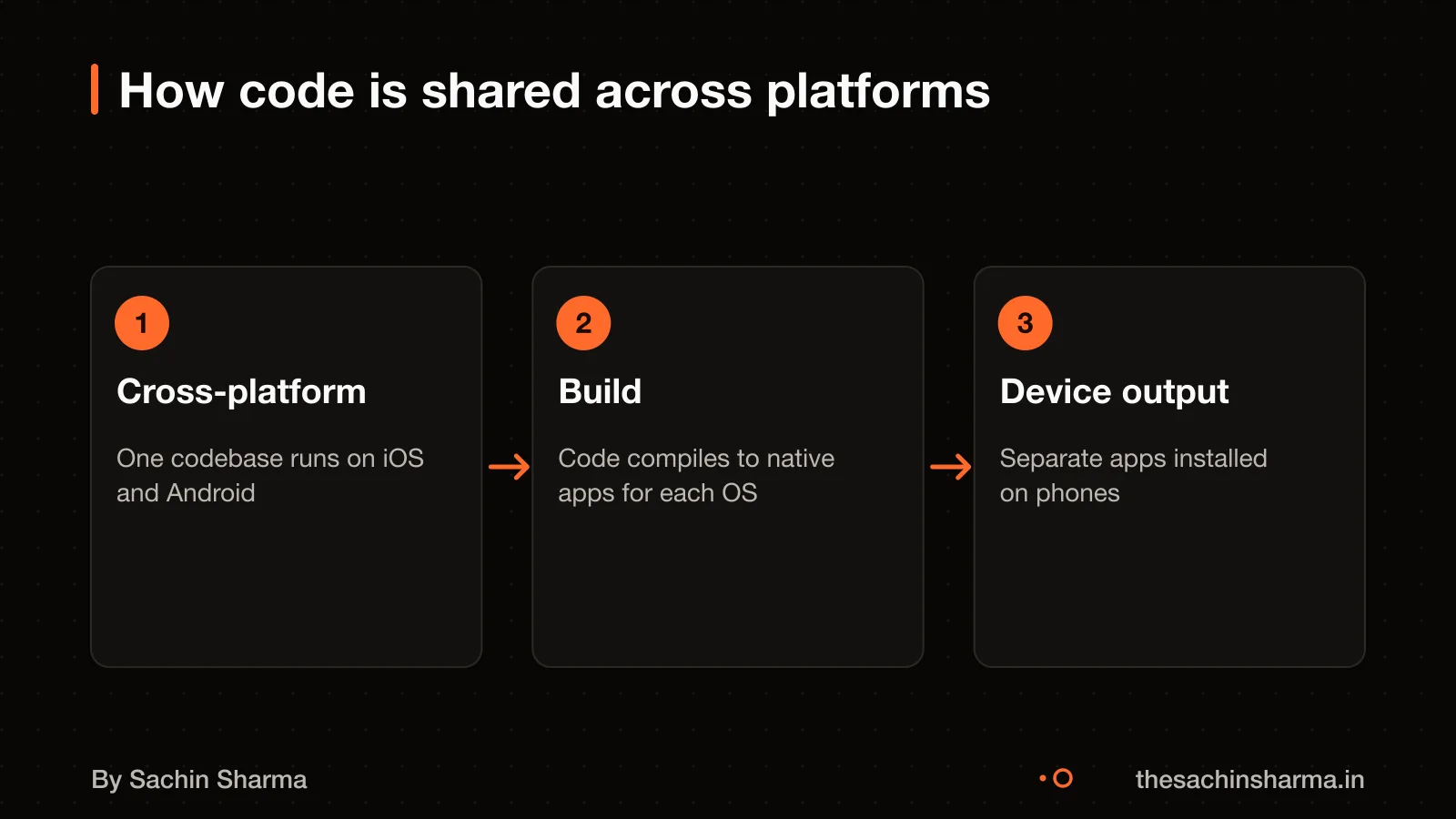
A native app is built for just one operating system, such as Android or iOS, using platform-specific tools and languages. This means separate codebases are needed for each platform. In contrast, a cross-platform app runs on both iOS and Android using a single, shared codebase. The key technical difference is code reuse: cross-platform apps write once, run on multiple platforms. Flutter, which I use, allows building for multiple platforms with one shared source codebase. For example, my habit tracker Loopin and legal platform Legease are built in Flutter and work on both platforms. If you want to know more, read about What is a cross-platform app?.
Is cross-platform the same as hybrid apps?
No, cross-platform apps are not the same as hybrid apps. Hybrid apps like Cordova or Ionic wrap a web app inside a native container. Run it in a WebView, using web technologies like HTML, CSS and JavaScript. This often leads to slower performance and a less native look.
Cross-platform apps, such as those built with Flutter, use their own rendering engine to draw every pixel on screen. Flutter uses Dart and draws everything on its own canvas using Skia (now Impeller). This means they do not rely on the device’s native components.
The difference matters for performance because cross-platform apps respond faster and feel more like native apps. They avoid the lag common in hybrid apps when handling animations or scrolling. So while both run on multiple platforms, cross-platform tools like Flutter give better speed and user experience.
When does native performance actually matter?
Most business apps do not need native speed. You should choose native only if your app requires real-time video or audio processing. Advanced AR or 3D rendering at high frame rates, or deep compliance controls like in fintech. These cases need direct access to hardware and operating system features that cross-platform tools cannot always provide.
For example, an augmented reality (AR) shopping app overlays product details in real time using the camera. It must run smoothly at 60 frames per second. Only native code can reliably manage the GPU, sensor input and memory use needed for this. Similarly, a payment or banking app must meet strict security and compliance rules. Native development supports this through platform-specific encryption and sandboxing.
But most business software, like order tracking, employee management or content delivery, does not demand this level of performance. Cross-platform apps built with tools like Flutter handle these well, with smooth 60 FPS interfaces and offline support. Even apps with background tasks, local storage and push notifications run reliably across Android and iOS without native code.
If you are building a quick-commerce app, see the Best way to build a quick commerce app for how to balance speed, cost and features.
How much does each option cost to build?
A simple app in India costs ₹8 lakh to ₹29 lakh, while a mid-complexity app costs ₹33 lakh to ₹75 lakh. Cross-platform development can reduce these costs by 30% to 40% because one codebase works on both Android and iOS. This means you avoid paying for two separate teams and cut development time.
As an estimate, assuming a mid-complexity app and a 38% saving from cross-platform development, you could save ₹12.5 lakh to ₹28.5 lakh. The math: 38% of ₹33 lakh is ₹12.5 lakh; 38% of ₹75 lakh is ₹28.5 lakh. These savings come from not duplicating work across platforms.
For a simple app, the same 38% saving would be ₹3 lakh to ₹11 lakh. This makes cross-platform the more cost-effective choice for most startups and small businesses in India.
Cost to build a quick commerce app This is a related cost question for a specific use case.
Want a number for your idea? Send one line on WhatsApp. I reply with what drives the cost and what to cut.
Message me on WhatsApp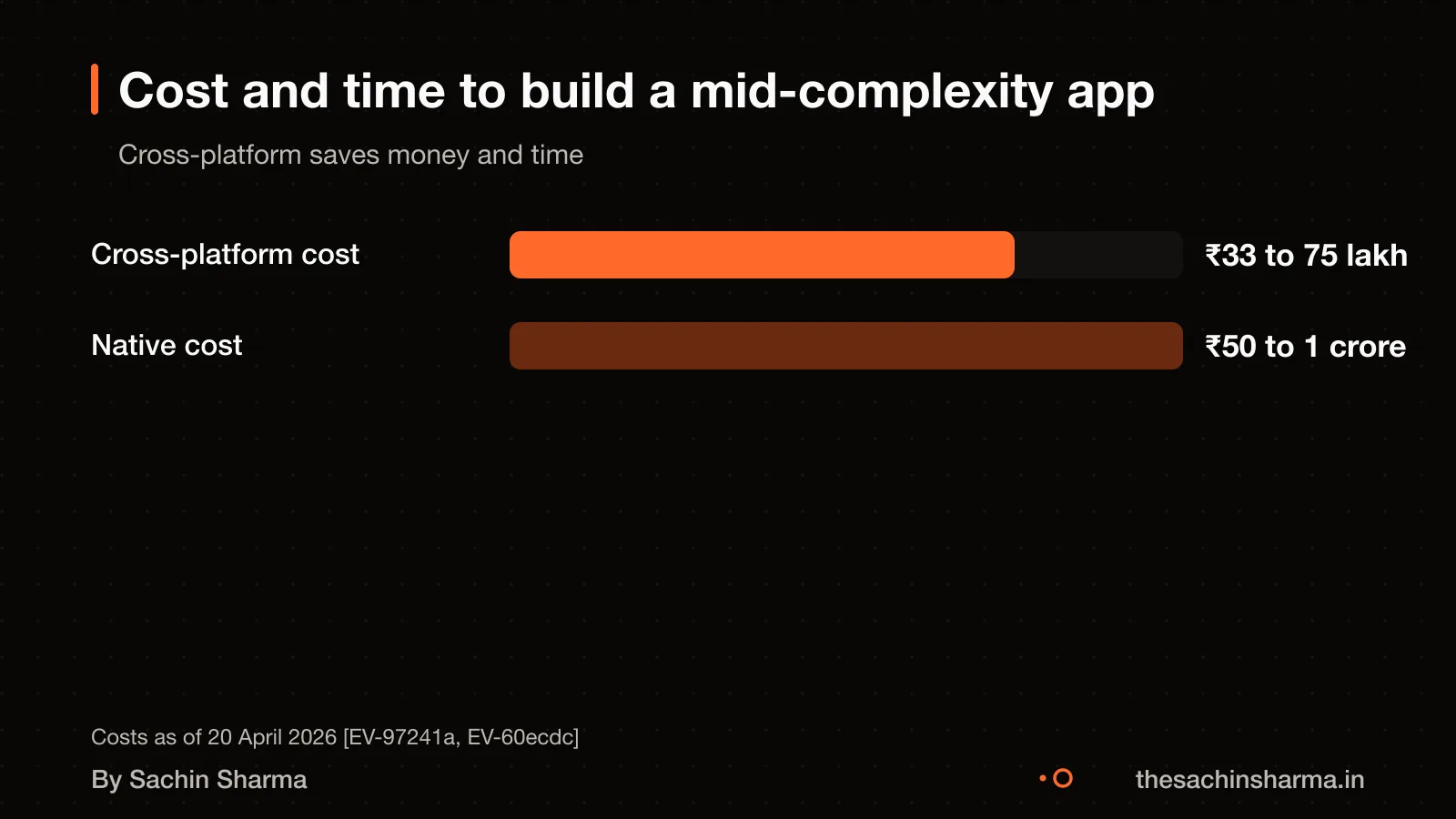
How long does each take to build?
A cross-platform MVP takes 8 to 12 weeks from start to launch. Assumption: includes 3 to 5 weeks for design and 5 to 7 weeks for development. As an estimate, this includes 3 to 5 weeks for design. 5 to 7 weeks for development using one team and a shared codebase. Cross-platform is faster because you write code once for both Android and iOS, cutting launch time by up to 50 percent. This also means fewer delays from team coordination. In contrast, native apps need separate teams for each platform, which doubles the effort and extends timelines. Both types face the same delays in app store approvals, third-party API integrations, and last-minute bug fixes. Design clarity and stakeholder feedback speed affect both equally.
Do you need two teams for a native app?
Yes, native apps often need two separate teams. Each team writes and maintains code for one platform, such as Android or iOS, because the code does not share between them. This increases the need for developers, testers and project leads for each platform. Cross-platform tools like Flutter let one team write code that works on both platforms, cutting the team size nearly in half. With native, you also face delays when one team finishes a feature but the other is still working. Misalignment in design, updates or bug fixes can create user confusion. Using a single codebase avoids these coordination problems.
When should you choose each approach?
Cross-platform suits startups needing quick iteration. If you must launch on both iOS and Android within six months but cannot afford two separate teams. Cross-platform is a constraint if the budget requires launching on both iOS and Android within six months without parallel native teams. Small businesses with tight budgets should pick cross-platform to avoid double development costs and speed up time to market.
E-commerce and marketplaces work well with Flutter or React Native for standard UX patterns and payment integrations. These apps do not need deep hardware access, so they gain the full benefit of shared code. For example, a local grocery delivery app can use one codebase for both platforms and still offer smooth checkout and order tracking.
If your goal is to test an idea quickly or grow with limited funds, cross-platform gives you more control with less spend. But if your app depends on the latest AR features or real-time audio processing, native may be worth the extra cost.
App or website first?
What are the risks of cross-platform apps?
The main risks of cross-platform apps are hidden costs from framework dependency and missing access to some native features. Framework dependency is a risk in cross-platform projects, as reliance on tools like Flutter or React Native can affect long-term maintenance. Choosing the wrong approach in mobile development can lead to hidden costs, such as the need to rebuild. For example, Aashwasan, a Flutter app I built for gig workers, used Firebase for real-time updates. Some platform-specific features, like advanced camera controls or Bluetooth sensors, may not be fully supported in cross-platform frameworks. To check if your app will be limited, list the device features you need, such as GPS tracking. Camera filters or offline sync, and confirm if your framework’s plugins support them on both Android and iOS. Test these on real devices early.
Not sure if your project has this risk? Tell me the plan in two lines and I will say yes or no.
Message me on WhatsAppWhat are the risks of native apps?
Native apps are more expensive because you must build and maintain two separate codebases. One for Android and one for iOS, doubling the development effort. They take longer to launch because each version must be developed, tested, and approved independently.
With two teams, coordination costs increase. Miscommunication can delay bug fixes and feature rollouts. For small businesses, this overhead slows iteration when speed matters most.
Compare that with a cross-platform alternative before deciding.
Who owns the code and app store accounts?
You legally own the code only if your contract says so. By default, the developer owns the code unless a written agreement transfers the rights to you. To make this transfer valid, Indian law requires the assignment to be in writing and signed under Section 19 of the Copyright Act. Without this, even if you paid for development, you may not have full rights to reuse, modify or sell the software.
For app store accounts, the Account Holder has full control. On Apple’s App Store Connect, only the Account Holder can sign legal agreements, renew membership, or submit apps. Admins have broad access but cannot perform all actions. You should be the Account Holder or have a trusted partner in that role. If the developer controls the account, they can block updates or remove the app.
Always sign a contract that assigns code ownership to you and set up app store accounts under your organisation from day one. Can I get the source code of my app?
When this advice is wrong
- You must choose native if your app relies on real-time video, audio or media processing pipelines. Where direct access to hardware and low-level APIs is needed for stable performance.
- Hardware features like advanced AR, 3D rendering at high frame rates or deep integration with secure enclaves in fintech require native development. For example, a banking app needing platform-specific biometric security or a medical imaging app using real-time GPU processing should be built natively.
Next step: message me on WhatsApp with what you want to build. No forms, no sales team.
Message me on WhatsApp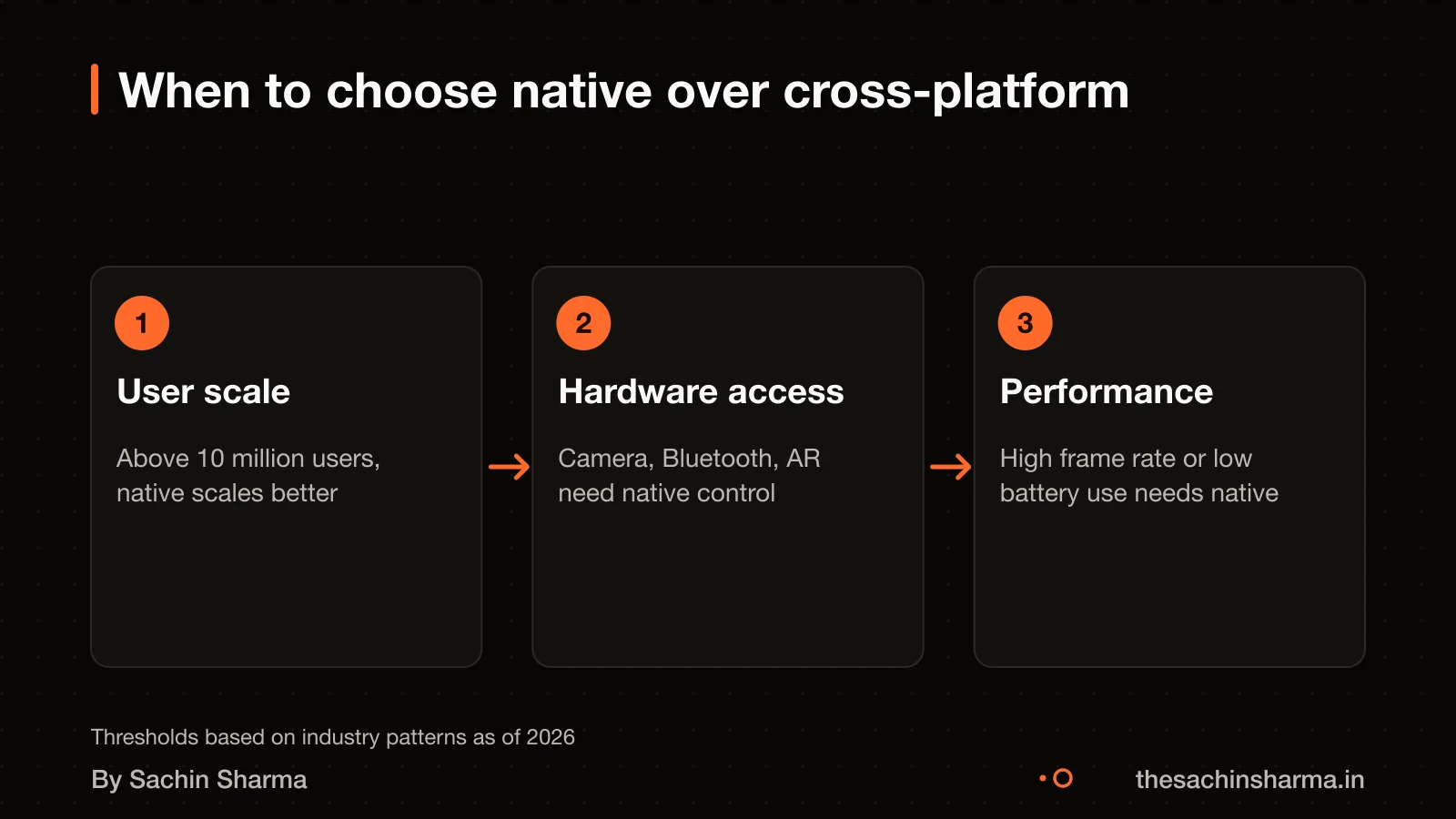
Assumptions behind the numbers
- Mid-complexity app used for cost and time estimates
- Cost saving of 30-40% applies to Indian teams
- Time saving of 50% applies to clean, non-hardware-dependent scope
- ₹33L to ₹75L is the native baseline for mid-complexity apps
Pick your situation
I build mostly in Flutter, so I benefit from recommending cross-platform. But the numbers below are based on published data and apply even if you hire someone else.
Pick your situation
Cross-Platform wins. One team builds for all platforms. Less code means fewer bugs and lower cost.
The whole comparison
| Cross-Platform | Native | |
|---|---|---|
| Development cost | ₹23L to ₹45L (as estimate) | ₹33L to ₹75L |
| Launch time | As estimate, 50% faster | 12 to 16 weeks |
| Team size | One cross-skilled team | Two platform-specific teams |
| Code sharing | 95 to 99% | None, two codebases |
| Performance | Good for most apps | Best for media or games |
| Risk | Framework dependency | Higher cost and delay |
Whichever you choose, ask these
- Can I see past apps you've built?
- Who owns the code after launch?
- What happens if we pause the project?
- Do you test on real devices?
Questions people ask
01How do native and cross-platform apps behave under heavy load?
Native apps handle real-time media and high frame rates better under heavy load because they use platform-specific tools. Cross-platform apps work well for most business logic under load but may struggle with intensive tasks like real-time video or 3D rendering.
02Can I switch from cross-platform to native later?
Yes, you can switch from cross-platform to native, but it means rebuilding both Android and iOS apps from scratch. There is no documented cost or timeline for this migration, so treat it as a major project.
03What happens if a new OS update breaks my app?
Cross-platform apps may lag in supporting new OS features because they depend on framework updates. Native apps get access to new features faster. Always check the release notes of your framework after an OS update.
04Does GST apply to app development services in India?
Yes, software development services in India attract GST. The rate depends on how the service is delivered and whether you are a registered business. Check this for your case with a chartered accountant.
05Who controls the app after launch?
You must control the Apple Developer and Google Play accounts as the account holder, not just as an admin. Admins have broad access but cannot sign legal agreements or renew memberships.
06What if my app needs Bluetooth or camera effects?
Cross-platform apps may need custom native plugins to use Bluetooth or advanced camera effects. Test early on real devices because relying on platform-specific APIs can increase complexity.
07Is Flutter better than React Native for Indian startups?
Both Flutter and React Native work for Indian startups. Flutter allows 95% to 99% code sharing across platforms. Flutter allows building apps for multiple platforms with a single, shared source codebase. See our Flutter vs React Native page when live.
08How do I check if my idea needs native performance?
Ask if your app needs real-time video, AR, 3D rendering, or deep compliance features. If not, cross-platform is likely enough. Most business apps do not need native-level speed.
09What maintenance will my app need?
All apps need updates for new OS versions, bug fixes, and security patches. Cross-platform apps use a shared codebase which may reduce development effort. Three-year maintenance costs are not currently documented.
10Can one developer build a cross-platform app?
Yes, one developer can build a cross-platform app for an MVP or mid-complexity product. Native apps usually need two specialists, one for each platform. Cross-platform saves time and cost for small teams.