Freelancer, agency or in-house: what each really means
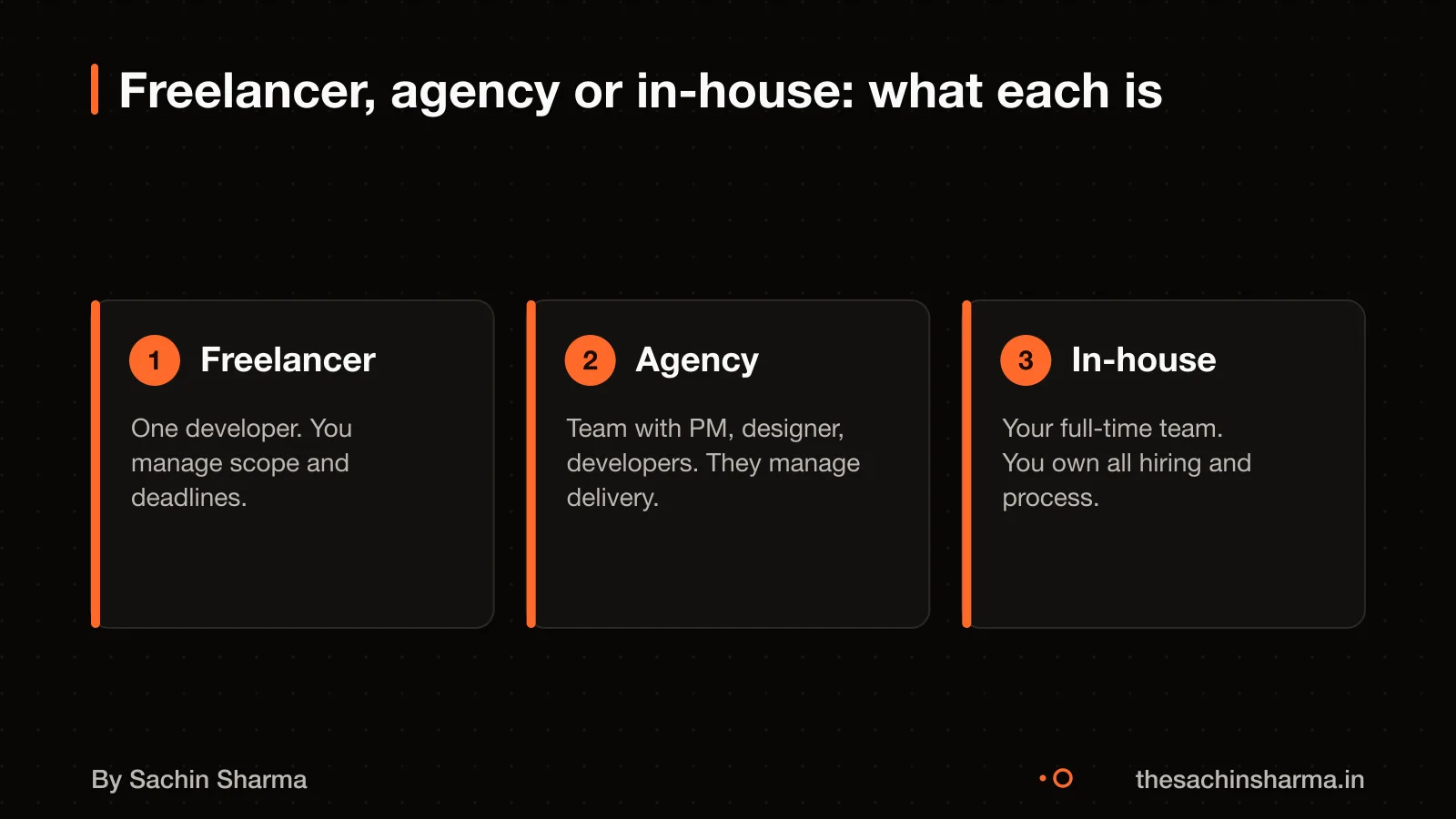
A freelancer is a single developer who works on your project part-time or full-time, often remotely. They are best for simple apps with clear requirements, like a basic MVP with one core feature. They fail when you need multiple skills or if they leave mid-project without notice.
An agency is a team of developers, designers and testers who work under one company. They suit complex apps needing different experts, such as a marketplace with payments, chat and admin panels. They fail when your budget is tight or your idea is still unclear.
An in-house team is your own full-time staff, working only for you. This works when you have funding and need full control, fast changes and long-term ownership. It fails for early startups because hiring takes time and costs more in salary, tools and management.
Founding developers work best when you want a partner who understands your problem and builds with conviction. They suit pre-seed to Series A founders who need deep involvement.
If you are still exploring options, consider whether a no-code or AI tool might test your idea faster. See When a developer beats an AI app builder.
When and how to start: test before you build
Do not build an app if you can test demand without code. Building is too early if you have not found people who will pay for your solution. Instead, use no-code tools, mockups or landing pages to validate demand. For example, create a simple form or a video demo and share it with your target users to see if they sign up or pay. This costs less and gives proof before any coding starts.
An MVP should solve one core problem with the fewest features. Start by defining that problem clearly. Then list only the features that directly solve it. Avoid adding extras like social sharing or analytics at this stage. A fixed-scope project for an MVP works well with freelancers.
Your first message to a developer must include a clear project brief. It should state the problem, the users, and the key features you want. Without this, quotes will vary widely and be inaccurate. Use an App brief template to include all needed details.
With clear specs, you can get a quote in 2 to 3 business days. For complex systems, it may take 1 to 2 weeks. To avoid scope creep, agree on a fixed scope and timeline before work starts. Add a clause to pause and re-quote if new features are requested. This keeps cost and time under control.
Real cost: hourly, monthly and hidden fees
A freelancer in India charges $14 to $18 for junior, $22 to $30 for mid-level, and $35 to $48 for senior roles per hour. An agency charges $150 to $300 per hour. An in-house team member in the US costs $210,000 to $285,000 per year. Freelancers charge less per hour but you manage coordination yourself. Agencies include project management but at a premium rate. In-house teams have high fixed costs including benefits, equipment and recruitment. As an estimate, a full-time junior freelancer works 160 hours a month at $14 to $18/hr. A mid-level freelancer charges $22 to $30/hr. Senior freelancers charge $35 to $48/hr. Agencies often quote fixed project fees, but their hourly rate runs $150 to $300. US in-house roles include hidden costs like payroll tax and ramp-up time.
Custom software development is a service under SAC 998311 and attracts 18% GST. This applies to freelancers and agencies unless the service is exported. You pay GST on each invoice unless the developer is outside India and the contract is export-rated. Always check the developer’s GSTIN and whether the invoice includes tax. For example, a ₹5 lakh project from an Indian freelancer could incur 18% GST.
| Role | Hourly Rate | Monthly (est.) | Based on |
|---|---|---|---|
| Junior Freelancer (India) | $14 to $18 | ₹1.1 to 1.4 lakh | 160 hrs, |
| Mid Freelancer (India) | $22 to $30 | ₹1.8 to 2.4 lakh | 160 hrs, |
| Senior Freelancer (India) | $35 to $48 | ₹2.8 to 3.8 lakh | 160 hrs, |
| Agency (US) | $150 to $300 | $24,000 to $48,000 | 160 hrs, |
| In-House (US) | ~$100 to $137 | $210,000 to $285,000/yr | Fully loaded, |
Hidden costs include delays from misalignment, rework due to unclear scope, and onboarding time. Agencies reduce coordination work but charge for it. Freelancers may not include testing or devops. In-house teams need office space and tools. You must plan for all these.
Want a number for your idea? Send one line on WhatsApp. I reply with what drives the cost and what to cut.
Message me on WhatsApp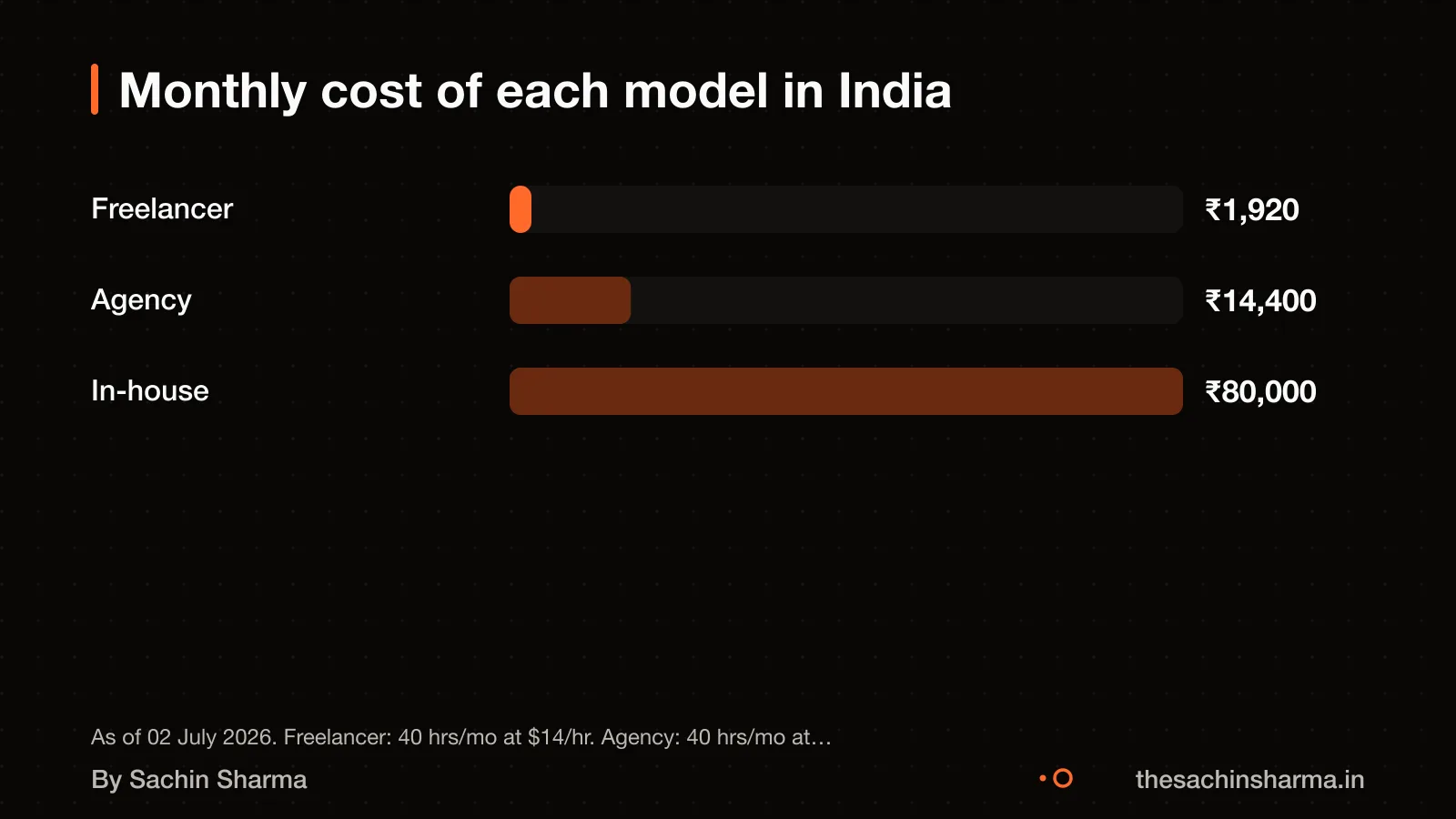
How long to build an MVP with each option
A freelancer on a vetted platform can be in your Slack within 48 to 72 hours after kickoff. This speed comes from skipping long hiring rounds and onboarding. If your idea is clear and scoped, you could have a small API or LiveView feature in one to two weeks. Loopin is a Flutter offline-first habit tracker using Hive and Google Drive sync.
Hiring in-house takes longer. You need 35 to 41 days just to make an offer. Then add 30 to 90 days for onboarding before the developer ships independently. So, from job post to first feature, expect 65 to 131 days. This model suits startups past validation, not those testing ideas.
Agencies move faster than in-house hires but slower than freelancers. They must align teams, scope the project, and set up processes. Delays often come from internal handoffs or unclear client briefs. A full MVP with an agency may take several months, depending on complexity.
When a freelancer is the right choice
Most pre-Series A startups benefit more from managed freelancers until they hit product-market fit. For most defined projects, an experienced freelance Phoenix developer delivers faster and more cost-effectively than an agency. This works best when your idea is simple and you can describe the inputs and outputs clearly.
A freelancer may fail if your project is complex, changes often, or needs multiple skills at once. Since they work alone, you must manage timelines, feature gaps, and hand-offs yourself. You also need to plan for what happens if they stop responding or leave mid-project.
You must manage project continuity, code access, and long-term updates on your own. Make sure you get all source files and login details from day one. For mobile apps, this includes app store accounts and API keys.
If your startup is pre-Series A and testing product-market fit, a freelancer can deliver fast at low cost. For a mobile-first MVP, Hire a Flutter developer for your first app to match your tech stack with the right expert.
When you need an agency
An agency is best when your project needs designers, project managers and developers working together, and you cannot manage coordination yourself. This is true if your scope is unclear and the deadline is tight. The overhead cost is worth it when you lack internal project leadership and need multiple skills under one contract.
You lose direct control and pay more for management layers. Agencies often work on several projects at once, so your work may not be their top priority. Their process can feel slow if your needs change fast.
For example, if you are building a health app that needs a clean UI, HIPAA-like data practices. Fast delivery for a funding round, an agency can bring all those skills together. A freelancer might handle one part well but not the whole.
If you go this route, vet agencies by their past work in your domain and how they handle scope changes. Ask how many team members will touch your project and who manages timelines.
When to build an in-house team
Build an in-house team only when your app is your main competitive advantage. This model suits startups that have validated demand and raised funding.
Hiring full-time takes 3 to 6 months and adds costs beyond salary, such as benefits and training.
In-house teams fail when the product-market fit is unproven or when the startup cannot afford long-term salaries. They also struggle if the founder lacks technical skill to guide the team. Without clear direction, hiring early can drain funds before revenue starts.
Risks: attrition, hand-offs and failure points
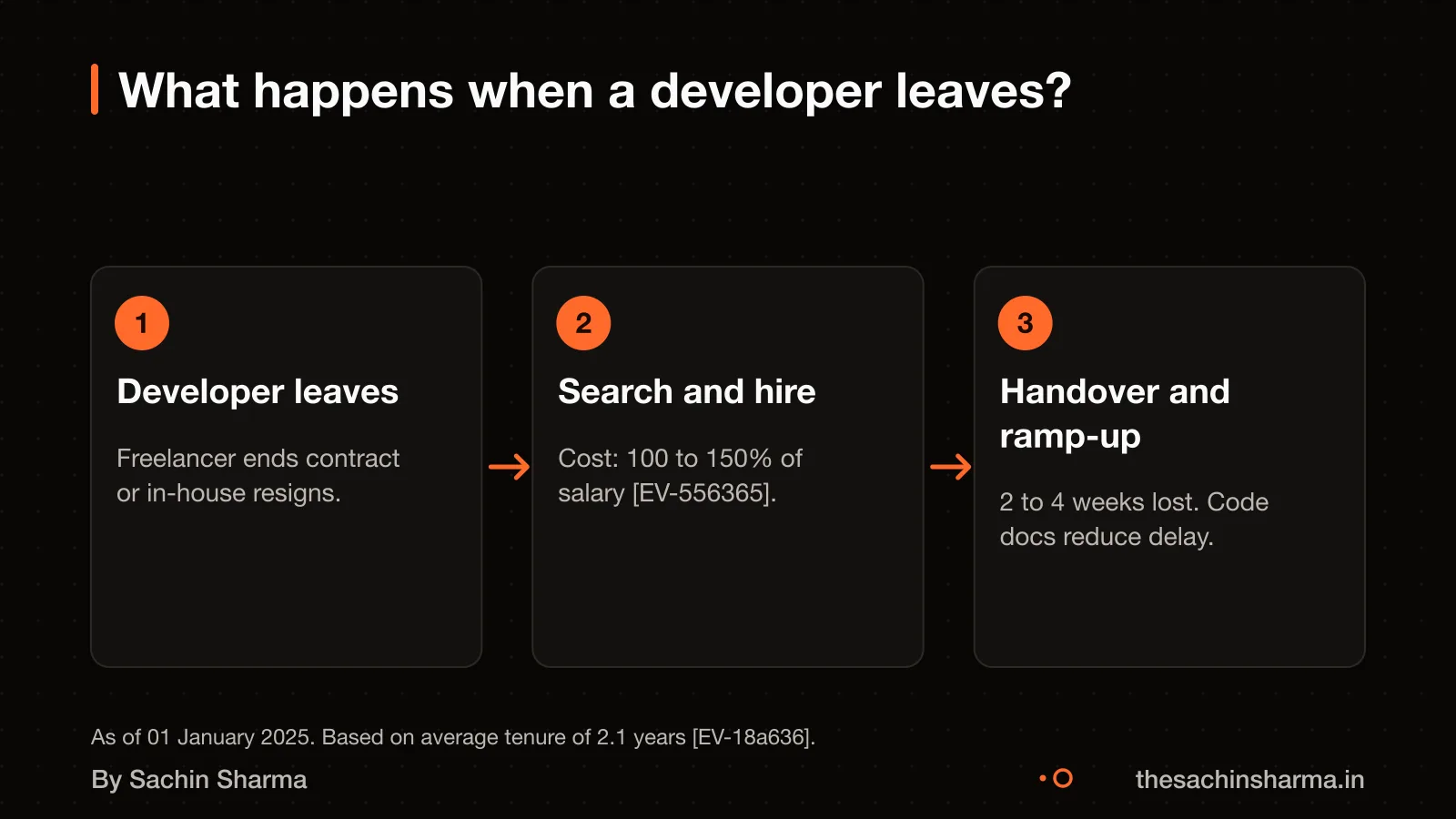
A freelancer may leave mid-project, and replacing them is costly. As an estimate, assuming average developer tenure of 2.1 years, attrition risk is moderate. If a senior developer leaves, the cost to replace them can be 100% to 150% of their annual salary. This includes hiring time, onboarding, and lost productivity during the handover.
Hand-offs create failure points, especially if documentation is poor or knowledge is not shared. When a freelancer exits, you may face delays while a new developer gets up to speed. Agencies reduce this risk by having backup resources, but they still rely on key individuals.
The first thing that fails when an app scales is often the architecture. A prototype built quickly may work at first but not support growth. If the initial developer does not plan for scale, you may need a full rebuild later. This is true for both freelancers and in-house builds. The risk is not who built it, but how it was built.
Yearly maintenance: what it costs and why
For most apps, this costs 15 to 25% of the original development cost every year it is in use.
As an estimate, assuming a ₹30 lakh app, yearly maintenance would be ₹4.5 to ₹7.5 lakh. This matches the US dollar example of a $30,000 app needing $4,500 to $7,500 per year. In India, monthly costs can range from ₹1,500 to ₹15,000+ depending on what is included.
You can reduce this cost by handling basic updates yourself, using stable and well-supported tools, or limiting feature complexity. However, skipping maintenance risks security flaws and app failure.
Legal: contracts, GST and zero-rated exports
Your contract with a freelancer or agency must include three key clauses: compensation, confidentiality and jurisdiction. Compensation sets the agreed amount to be paid after work completion. Confidentiality stops the developer from sharing your app’s details with others. Jurisdiction and dispute resolution depend on your nationalities and decide which country’s laws apply if a conflict arises.
Yes, GST applies to custom software development in India. However, if you are building for a foreign client and the service is exported, you can charge 0% GST. This is called zero-rated supply. To claim this, payment must be received in convertible foreign exchange, such as USD or EUR. You must also file proper export documentation with your GST return.
For example, if you hire a freelancer in India to build an app for your US-based startup. Pay them in dollars, the service qualifies as an export. You pay no GST on the invoice, but the freelancer must still register for GST and file returns correctly.
If you are unsure whether your contract covers ownership, see Can I get the source code of my app? to check your rights.
Have a quote in hand? Send it to me and I will mark what is missing.
Message me on WhatsAppWhen this advice does not apply
- You should ignore this guide if your app is in a regulated field like edtech or healthtech and needs compliance expertise from day one. In such cases, a specialist agency with domain experience may be safer, even for an MVP.
- If you are in quick commerce or another high-velocity, operations-heavy sector, speed alone is not enough. You will need a team that can handle real-time logistics, integrations and scale from day one, freelancers may lack the bandwidth.
- If you have no technical skills and cannot evaluate code or manage timelines, going solo with a freelancer is risky. You may need an agency’s project management layer, or a trusted technical advisor, before choosing any path.
Next step: message me on WhatsApp with what you want to build. No forms, no sales team.
Message me on WhatsAppAssumptions behind the numbers
- Agency staffing time is 1-2 weeks
- Freelancer may leave mid-project
- Agency offers built-in post-launch support
- Support terms for freelancers are negotiable
Pick your situation
I am a solo developer, so I benefit from the first answer. That is why the table below also tells you when an agency or in-house team is the better pick.
Pick your situation
Freelancer wins. A freelancer can start within 48-72 hours and owns the work end to end. Agencies add overhead; in-house adds delay.
The whole comparison
| Freelancer | Agency | |
|---|---|---|
| Who writes the code | The person you speak to | Often someone you never meet |
| Cost shape | $14-$48/hr with no overhead | $150-$300/hr with team and process |
| Time to start | 48-72 hours | 1-2 weeks to staff [assumption] |
| Main risk | Attrition mid-project [assumption] | Hand-offs and unclear accountability |
| Ownership of code | Depends on contract | Depends on contract |
| Support after launch | Negotiable, often limited [assumption] | Built-in, billed monthly [assumption] |
Whichever you choose, ask these
- Who exactly will write my code?
- What happens to my code if we stop midway?
- What is not included in the quote?
- What does post-launch support cost?
Questions people ask
01Who owns the code when a freelancer or agency builds my app?
You own the code only if your contract says so.
02What support is included after the app launches?
Support terms depend on your agreement with the developer. Ask directly about bug fixes, updates, and response times.
03Can a freelancer provide long-term support?
A freelancer may support your app long-term, but the average software engineer stays just 2.1 years. Plan for continuity with a retainer or a documented handover process.
04Does this advice change if I'm a non-technical founder?
Non-technical founders should add a technical advisor or pick an agency with project management. This helps you understand progress, risks, and code quality when you cannot review it yourself.
05Is this model suitable for a startup in edtech or quick commerce?
The hiring model trade-offs apply to all sectors. But edtech and quick commerce need specific features like real-time sync or payment reliability. Check that your developer has experience in your domain.
06What happens if my freelancer leaves mid-project?
If a freelancer leaves, replacing them can cost 100% to 150% of their annual salary. Reduce risk by insisting on clear documentation and milestone-based payments.
07How much does it cost to switch from a freelancer or agency to in-house?
The cost to switch depends on how well the code is documented and tested. Budget for knowledge transfer, possible rework, and time to bring the in-house team up to speed.
08How do they behave under real-world load and scale?
Performance depends on the app's design, not whether you hire a freelancer or agency. Test under real-world load before launch using tools like k6 or Locust to catch bottlenecks early.
09What fails first when the app grows?
Databases and third-party APIs often fail first as traffic grows. Design for scale from the start with connection pooling, caching, and fallback logic. Monitor these closely after launch.