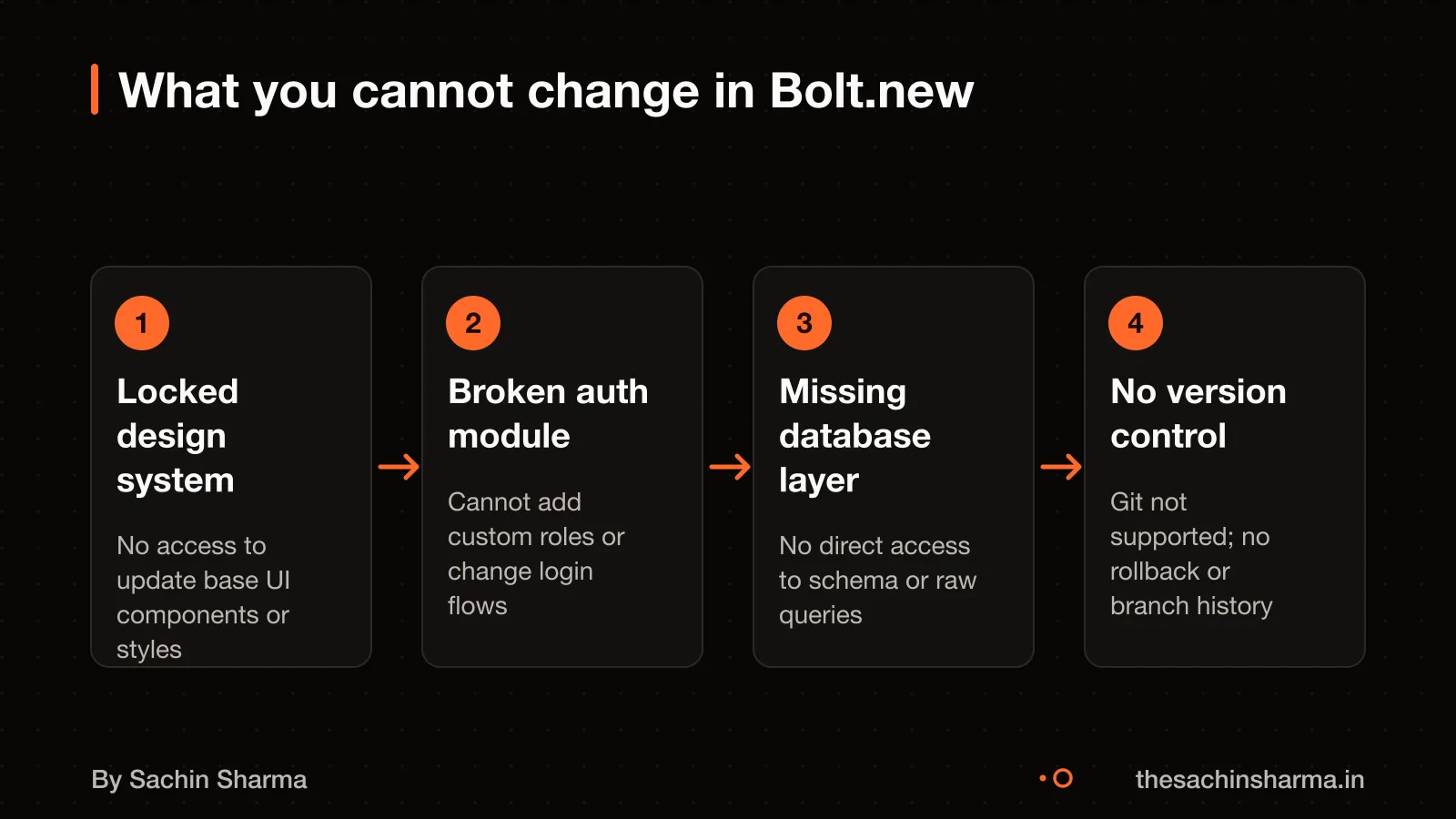
What you cannot change in Bolt.new
You cannot update pre-loaded design systems in Bolt.new, even if they do not match your brand. To use a custom design system, you must upgrade to a paid Teams plan. This limits design control for early-stage apps that are not yet revenue-generating.
Bolt.new does not let you add custom authentication beyond its built-in options. Its auth system breaks with three or more OAuth providers, single sign-on (SSO), or role-based access control. If your team needs custom roles or secure session storage, you will face roadblocks.
You cannot connect custom databases or set up webhooks in Bolt.new. The platform is frontend-focused and does not support backend code, background jobs, or direct database links. This means no custom logic for delivery alerts, payment callbacks, or sync with accounting software.
There is no full version control in Bolt.new. You cannot roll back to a working version if a change breaks your app. This increases risk during updates, especially when multiple people are working on the same project.
If you need full design, auth, backend or version control, Bolt.new will not support you. For a shipping business that plans to grow, these limits can block key features. Consider a FlutterFlow alternative for mobile apps if you need more code access.
When Bolt.new becomes more expensive than custom
At that point, the same features built with custom code on a standard stack cost less and give you full control. Debugging on Bolt.new roughly doubles your token use, so active development pushes you past the limit faster. For example, a single refactor can burn 1 to 2 million tokens, draining half your monthly Pro plan in one step. Third-party tools for payments, maps or notifications add more cost, and their pricing can change without notice. As an estimate, at $50/month, custom code with open-source tools becomes cheaper over 12 months, especially if you reuse components across projects. You can compare long-term hosting and development costs for small businesses What a small business website really costs.
Want a number for your shipping app idea? Send one line on WhatsApp. I reply with what drives the cost and what to cut.
Message me on WhatsAppCost to migrate from Bolt.new to custom
Migration costs $50 to $100 per hour. A basic migration takes 1 to 2 hours. It includes setting up a Next.js frontend with Vercel. It also includes a Supabase backend with data schema replication. You can reuse forms, field names, and UI logic from your Bolt.new setup if exported.
Costs go beyond basic when you add custom workflows. They also go up with payment integrations or real-time tracking. Complex logic like multi-warehouse dispatch adds development time. Delivery agent apps also add time. Data cleanup or transformation increases hours. This is if your Bolt.new records are inconsistent or incomplete.
As an estimate, a full migration with payments and notifications may take 8 to 12 hours. This costs ₹36,000 to ₹1.08 lakh. This assumes clean data and no legacy system integration.
Have a migration quote in hand? Send it to me and I will mark what is missing.
Message me on WhatsAppHow long migration takes
A simple migration from Bolt.new to your own Next.js project takes 1 to 2 hours. This covers moving basic forms and data to your own server. For most live businesses, professional hardening is needed. That takes 2 to 4 weeks. It includes secure user roles, audit logs, backups and monitoring. Complex apps with real-time tracking, payments or multiple user types take 4 to 8 weeks. This includes testing edge cases and ensuring uptime during peak loads. The time depends on how much custom logic and third-party tools you add.
What you can reuse from Bolt.new
Yes, you can download your Bolt.new project as a zip file at any time. The code is standard full-stack JavaScript, not locked into a proprietary format. This means you can open it in your own editor and make changes without Bolt.new. You can also deploy the exported code on any platform that supports Node.js, such as Vercel or Netlify. You can even sync it to a GitHub repository for version control and team collaboration. So if you decide to leave Bolt.new, you do not have to start from scratch. You keep the core logic and UI you built. For those who’ve used Bubble, this reuse path is similar, Moving off Bubble without starting over covers how to carry forward what you own.
Where Bolt.new fails under load
Bolt.new fails under load when security flaws, performance lags or hidden vulnerabilities emerge. AI-generated code from tools like Bolt.new fails standard security tests in 45% of cases. This means nearly half of the code may expose your app to attacks. One key flaw is the lack of CSRF (Cross-Site Request Forgery) protection, found in 100% of apps built with vibe-coded methods. CSRF flaws let attackers perform actions as your user, like changing delivery addresses or cancelling orders without consent.
A study of 15 real apps built with similar AI coding tools found 69 security vulnerabilities in total. These are not theoretical risks, they are live bugs that could let hackers access customer data or disrupt operations. Performance is another breaking point. If your app’s Largest Contentful Paint (LCP) exceeds 3 seconds in PageSpeed Insights. It is a signal to consider moving from Bolt.new to a custom system. Slow load times hurt user trust and hurt delivery coordination.
For example, a delivery dashboard that takes more than 3 seconds to show today’s orders can delay field teams and upset customers. You may not see these flaws until you scale, but by then, the cost of fixing them is high.
Not sure if your project has this risk? Tell me the plan in two lines and I will say yes or no.
Message me on WhatsApp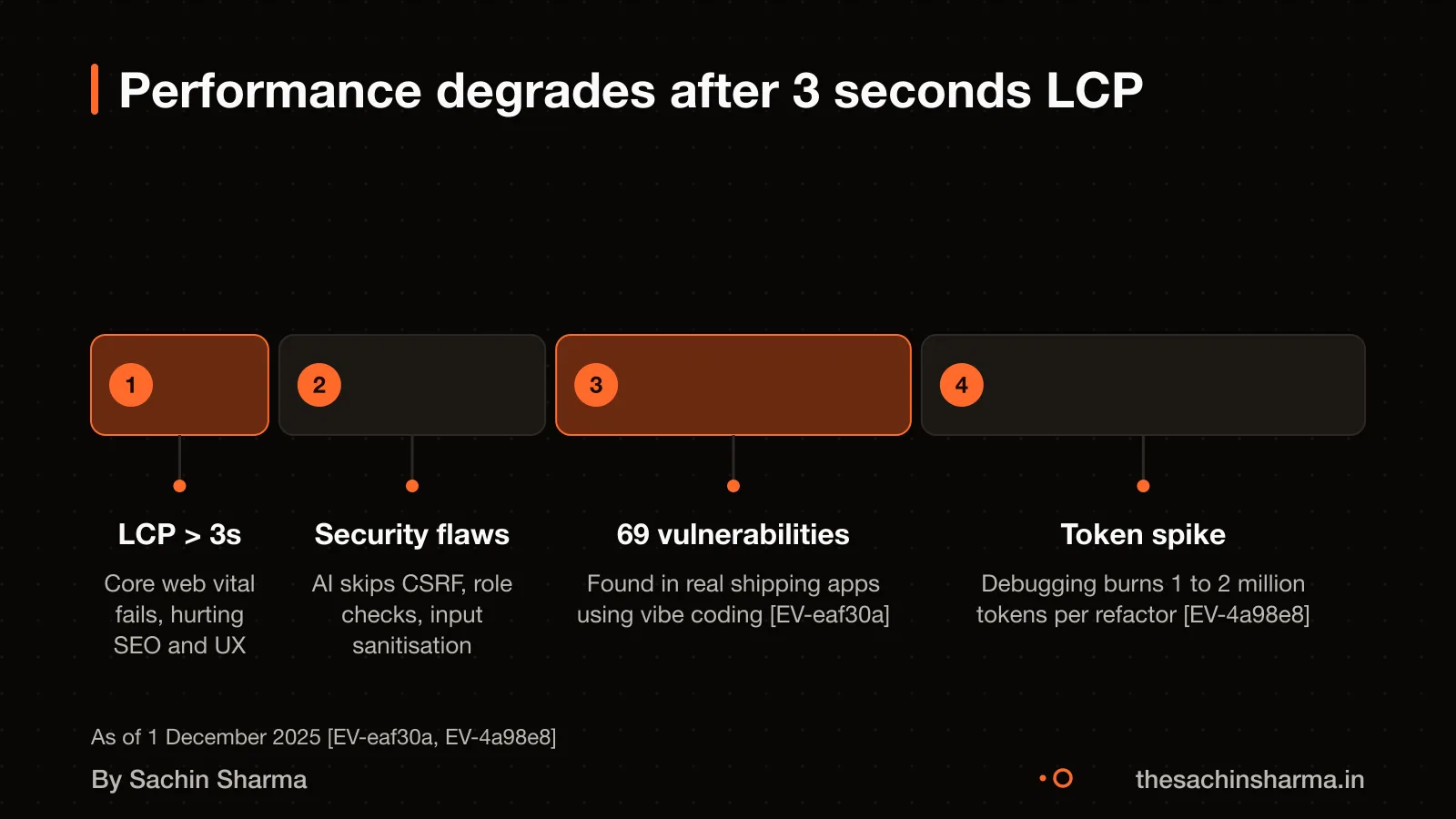
Vendor risks: pricing, shutdown, data ownership
Bolt.new now limits its liability to just three months of your fees. This means if Bolt suffers a breach or outage that harms your business. Your legal recovery is capped at what you paid in the last quarter. That cap used to be 12 months, so this change increases your financial risk.
Bolt can audit your usage without 30 days’ notice if they suspect a breach. An immediate audit may disrupt your operations, and since you must comply, it reduces your control over daily workflows. This power imbalance is common in SaaS platforms but still raises operational risk.
You do not own your customer data when using Bolt.new. Bolt claims full, independent, and sole ownership of all end-user data, relationships, and personal information. Even if you bring your own customers, Bolt treats their data as its asset. You grant Bolt a perpetual, irrevocable license to use your data, which makes leaving harder and raises privacy concerns.
For regulated businesses, this data claim could clash with Indian laws like the Digital Personal Data Protection Act, 2023. You should consult a legal expert on compliance risks before storing customer data through Bolt. See SEBI rules that touch an investing app for how data ownership affects regulated domains.
Best tech stack for a custom shipping system
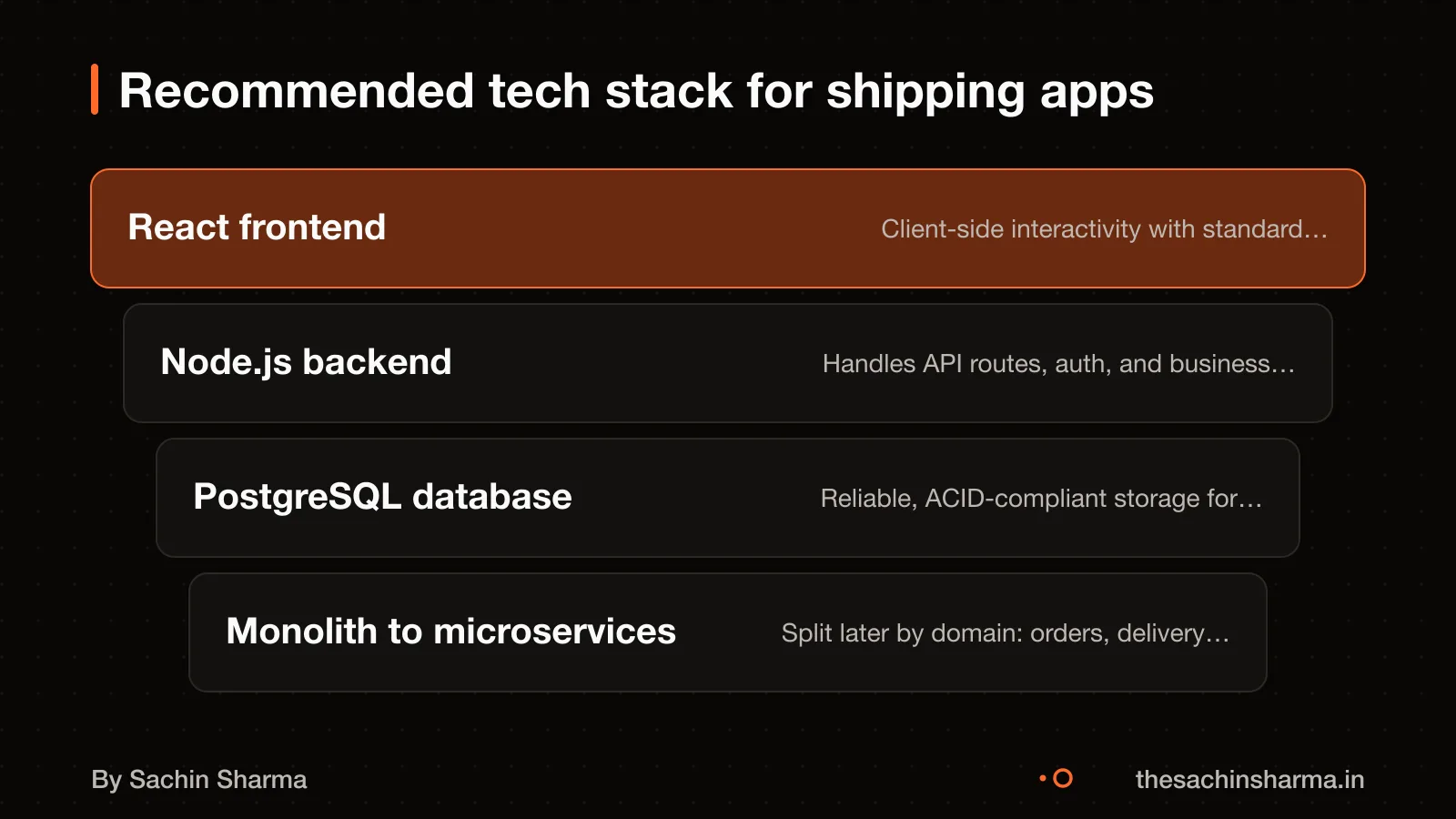
SupplyChainX, a full-stack analytics platform, is built with React, Node.js, and PostgreSQL. This stack supports real-time tracking, multi-warehouse dispatch, and high-volume transactions.
The MERN stack (MongoDB, Express, React, Node.js) is a popular choice due to its flexibility, scalability, and fast development cycle. However, for shipping systems that need strong data consistency, like order locking during high traffic, PostgreSQL is safer than MongoDB. You can still use React and Node.js with PostgreSQL, so keep the frontend and backend but swap the database.
Start with a monolith to simplify early development. A single codebase lets you launch faster and fix issues in one place. As your team grows and features multiply, split parts like billing, tracking, or notifications into microservices. This avoids early complexity while allowing future scale.
If you are building in India for Indian businesses, host on Vercel (frontend) and a local cloud provider (backend) to meet data residency needs.
Next.js or WordPress for a business site? compares trade-offs for content-heavy sites. But for shipping apps, full control over data and workflow makes custom stacks better.
Bolt.new API and integration options
The Bolt Driver API SDK provides complete access to Bolt's driver platform, enabling developers to build applications that interact with Bolt's ride-hailing services. However, there is no evidence that Bolt.new integrates with Delhivery or Shipway, two common Indian logistics APIs. If your business relies on these carriers, you may need custom middleware or a different platform. For deeper communication needs, you can later add WhatsApp Business API integration.
How to integrate WhatsApp Business API
Best Bolt.new alternatives for shipping
For the cheapest prototyping, Banani AI starts at $12 per month and offers a free tier with around 170 generations monthly. This may make it more affordable than some AI builders for early-stage testing. As an example, a one-person delivery startup could run initial workflows at almost no cost.
If you want full code ownership and use Supabase, Lovable's team plan costs $50 per month for 100 monthly credits. 5 daily credits in a shared workspace, and supports PostgreSQL-based backends like Supabase. This is ideal if you plan to hand over development to a team later. For instance, a growing logistics firm could switch from Bolt.new to Lovable and retain full control of its codebase.
For Indian courier integrations, Shipway connects with 20+ partners including Delhivery. It supports API-based shipping label generation and tracking sync, which helps if your business relies on local logistics networks. A small e-commerce seller in Tier 2 cities could automate dispatch across multiple carriers using Shipway.
Lovable alternative: when a developer beats an AI app builder Replit Agent alternative: from prototype to production
When this advice does not apply
Stay on Bolt.new if you are using the base plan and do not need a custom domain. The base plan is meant for prototypes, not production deployment. It works well for sharing early ideas.
Custom code is overkill for internal tools with five or fewer users. Small in-house tools can stay in Bolt.new if they are not customer-facing. This keeps costs low and speeds up delivery.
Do not migrate if your project is still unvalidated and has fewer than five users. Use Bolt.new to test your idea first. Building custom systems too early adds cost and risk.
Next step: message me on WhatsApp with what you want to build. No forms, no sales team.
Message me on WhatsAppAssumptions behind the numbers
- Assumes 15+ components trigger Bolt AI context loss
- Assumes $50/month token spend signals cost inefficiency
- Assumes weekly order count correlates with backend load
Pick your situation
I am a solo developer and build custom apps. My bias is towards custom code, but I've listed when Bolt.new still works.
Pick your situation
Stick with Bolt.new wins. Bolt.new handles light transaction volumes without stress. No need to over-engineer.
The whole comparison
| Stick with Bolt.new | Build custom | |
|---|---|---|
| Monthly token cost | Under $50 | Over $50 |
| Order volume | Under 50/week | Over 50/week |
| Code control | Limited by Bolt | Full access |
| Data ownership | Shared with Bolt | Yours entirely |
| Auth support | Basic only | Any setup |
| Backend hooks | None | Webhooks, DB, jobs |
| Migration path | No need yet | 1–8 weeks effort |
Whichever you choose, ask these
- Can I export my Bolt code anytime?
- Will Bolt scale with my traffic?
- Do I own my customer data?
- What’s the cost to move later?
Questions people ask
01Is it better to migrate all at once or piece by piece?
There is no evidence to confirm whether a full or phased migration works better for Bolt.new. A phased approach may reduce risk, but you must test each stage. Check with your developer what downtime each method causes.
02What kind of developer should I hire to replace Bolt.new?
A full-stack developer with experience in React, Node.js, and PostgreSQL may be able to rebuild your system. Knowledge of Vercel and Supabase could be helpful during migration. See Next.js or WordPress for a business site? for stack trade-offs.
03What legal or GST issues come up when moving systems?
You must keep invoice continuity and e-way bill generation during migration to stay GST-compliant. Data privacy rules also apply when moving customer records. Check this for your case with a chartered accountant or lawyer.
04How much does ongoing maintenance cost after migration?
As an estimate, ongoing costs are ₹10,000 to ₹20,000 per month for hosting, updates, and support. This assumes a small business system on Next.js, Node.js, and PostgreSQL. Actual cost depends on traffic and feature changes.
05Can I integrate WhatsApp or UPI more deeply after leaving Bolt.new?
Yes. With custom code, you can use WhatsApp Business API and UPI SDKs directly for deeper integration than Bolt.new allows. This gives you full control over messaging and payments. See how to integrate WhatsApp Business API for steps.
06Can I reuse any parts of my Bolt.new app in a custom build?
Bolt.new does not provide full access to its backend or data. Check your export options and what data you own.
07How do I know if my Bolt.new app is hitting token limits?
There is no public way to check token usage in Bolt.new. Monitor app performance and contact support if you suspect limits are being hit.
08What happens if I run out of tokens on Bolt.new?
It is not known what happens when token limits are exceeded. Plan for this by checking your usage and upgrading your plan if needed.