What is a quick commerce app?
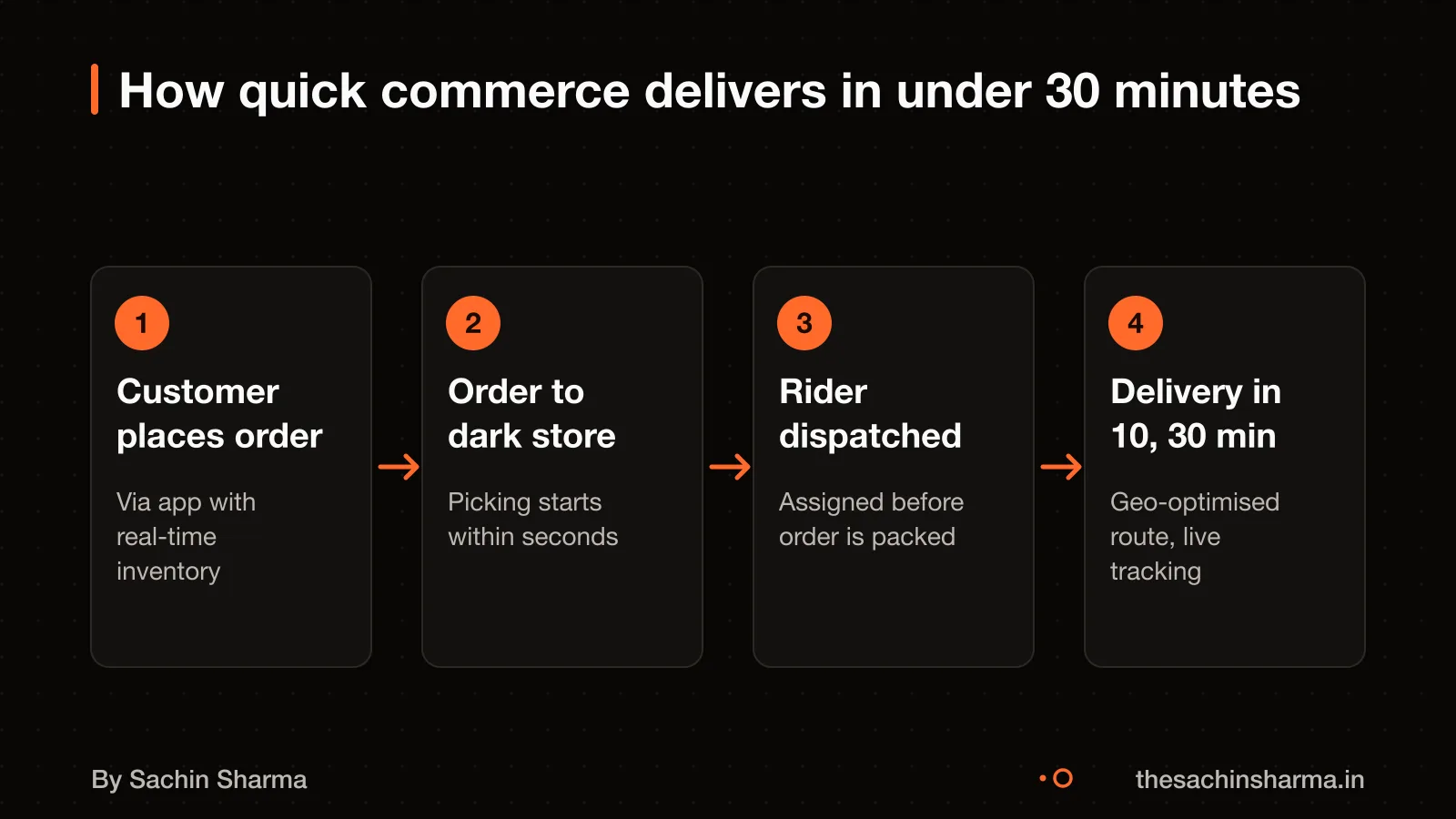
A quick commerce app delivers daily-use items like groceries, snacks, personal care products and medicines in 10 to 30 minutes. It is different from regular delivery, which takes 1 to 7 days, because it serves urgent needs. The speed comes from dark stores, small warehouses in city areas that stock fast-moving items. These act as micro-fulfillment centres close to buyers, cutting travel time. Delivery riders use bikes or scooters to bring orders straight from the dark store to the customer. This setup supports high-speed logistics but needs dense urban coverage to work. For more on how food delivery apps differ from quick commerce, see how food delivery apps differ from quick commerce.
Which option is right for your business?
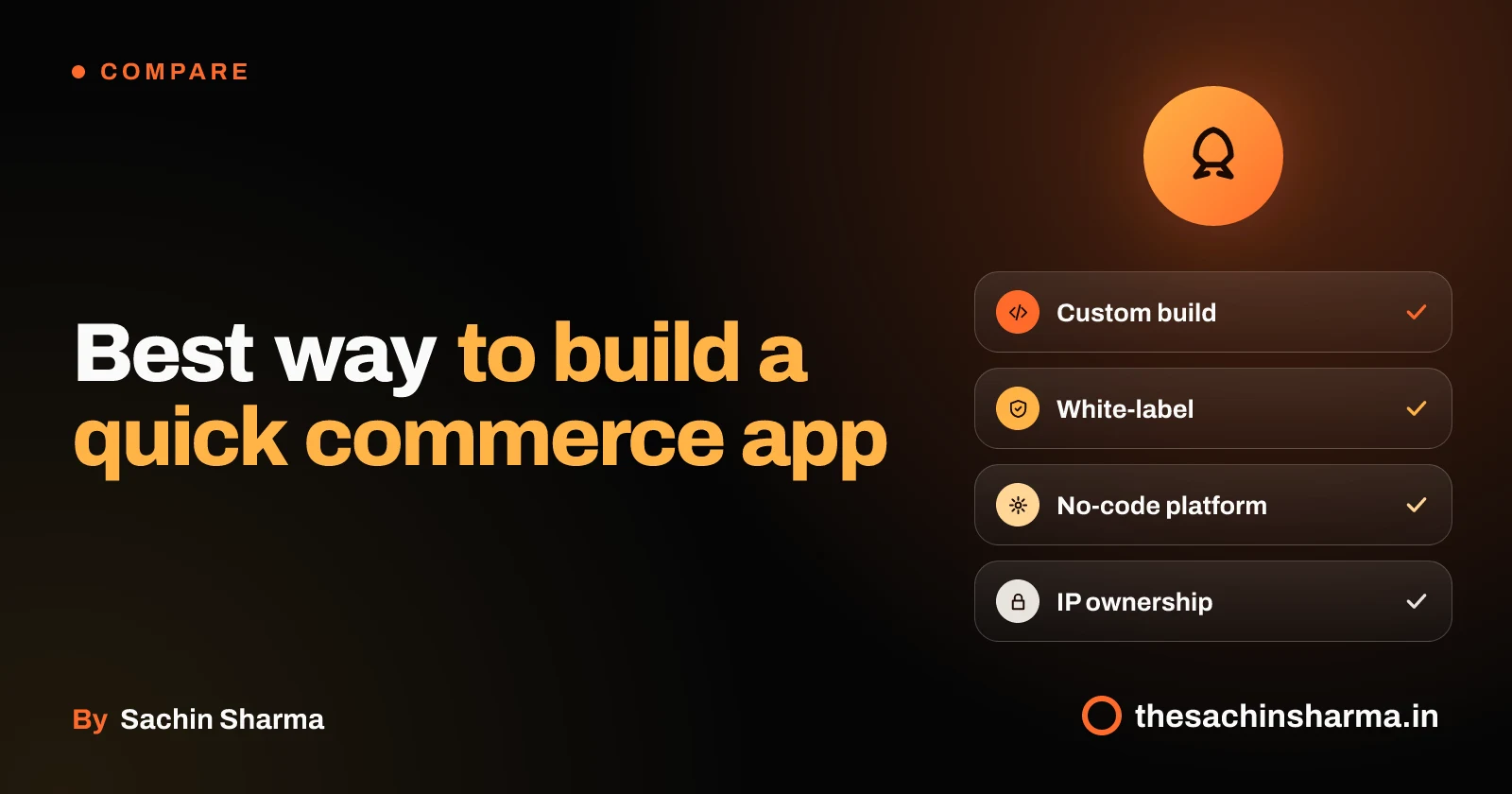
Custom development wins when you need full control over unique features and proprietary technology. This path suits businesses planning long-term growth and multiple markets. You own the code and can change any part. But it takes more time and skilled people to build and maintain.
White-label is better if you want to launch fast with low risk. These are pre-built, market-ready platforms you can rebrand and deploy under your own name. They work well for testing demand or starting a local service. You save time but give up some control over features and costs.
You should use a no-code platform only to test demand or run a very small operation. Starter plans cost $30 to $70 per month and let you publish to app stores. But they limit design, scalability and data access. If you grow, you may have to rebuild later. For most serious businesses, this option is a starting point, not the end.
How long to launch each option?
Custom development takes 6 to 12+ months to reach production-ready status. This includes time for design, full feature build, testing, and compliance checks. A complex app with delivery tracking, payments, and AI-based recommendations will take longer.
White-label solutions go live in 2 to 3 months. The base app is already built; you customise branding, add your logo, and connect to your backend systems. You skip early build phases but still need time to test and train staff.
No platform launches instantly. Even if the vendor claims “one-click go live,” you must integrate your inventory, set up delivery zones, and verify user sign-up flows. For a real launch, allow at least 4 to 6 weeks after onboarding.
For a full timeline of steps, see the full timeline for building a quick commerce app.
Worked example: 3-year cost breakdown
Worked example: 3-year cost breakdown
The total three-year cost for each build option is not known. Only partial costs can be shown from available evidence. All figures are in US dollars and must be converted to rupees using the current rate.
For a custom build, the initial development cost ranges from $100,000 to $500,000. Annual maintenance is 15% to 20% of the build cost. As an estimate, assuming a $200,000 build, annual maintenance would be $30,000 to $40,000. Over three years, maintenance alone would add $90,000 to $120,000. The total would be $290,000 to $320,000, but this does not include feature updates, team costs or cloud fees.
For a white-label solution, the setup cost ranges from $30,000 to $150,000. Maintenance is also 15% to 20% per year. As an estimate, assuming a $80,000 setup, annual maintenance would be $12,000 to $16,000. Over three years, that adds $36,000 to $48,000. Total cost would be $116,000 to $198,000, but recurring licensing, support, or update fees are not included.
For a platform (no-code), entry-level paid plans cost $30 to $70 per month and include app store publishing. Over three years, this adds $1,080 to $2,520. However, this does not include setup, app store fees, or costs beyond the starter plan. Scaling may require upgrades with unknown pricing.
Recurring fees add up through maintenance and subscriptions. Custom and white-label options have high yearly upkeep. Platforms have low monthly fees but hidden costs on scaling.
These totals are partial. The full three-year cost cannot be determined from current evidence.
Want a number for your idea? Send one line on WhatsApp. I reply with what drives the cost and what to cut.
Message me on WhatsApp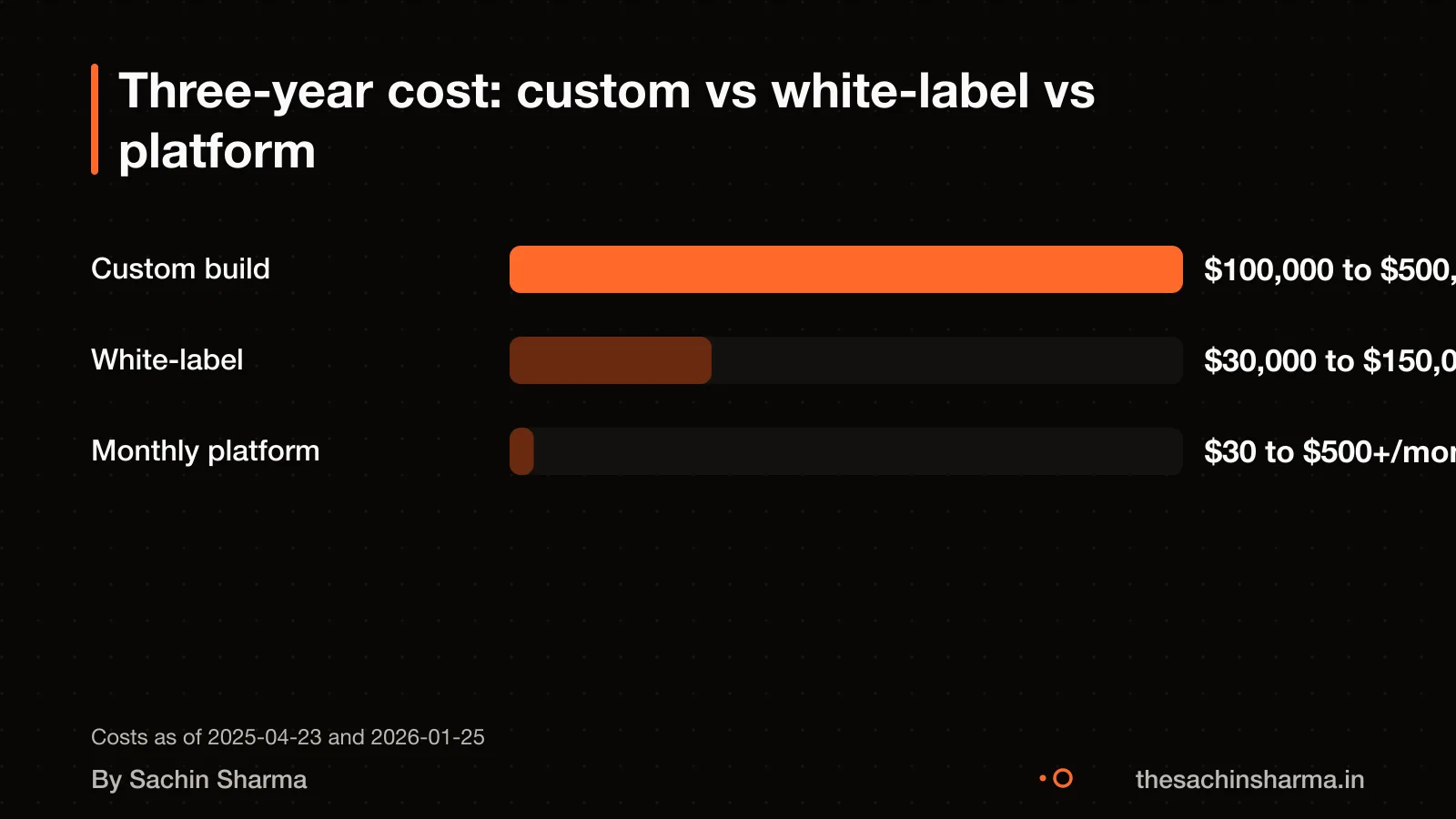
Who owns the app code and customer data?
You own the app code only if you sign a written agreement that transfers ownership from the developer. A white label SaaS agreement should answer who owns the IP, but Indian copyright law implications are not covered in. This means if you hire a freelancer or agency without a clear clause, they legally own the code, not you.
To gain full rights, use an express Assignment of Rights clause in your contract. This must be signed before work begins. Without it, you cannot safely update, sell, or move the app later. Even with this clause, confirm in writing that customer data resides in your servers or cloud accounts, not the developer’s.
In white-label apps, the provider keeps ownership of the core code and technology. You get limited rights to use, market, and customise it. You cannot switch providers easily or audit the source code. Moving the app later requires rebuilding from scratch.
For full control and future flexibility, custom development with a proper IP clause is best. You can then move hosting, change developers, or integrate new systems without permission. Review every contract for the phrase “assignment of intellectual property”, if it’s missing, do not sign.
sample IP ownership clause
Risks and failure modes
A custom app can fail if the business model does not match customer habits, even if the tech works well. You can adapt a custom app over time by adding features or changing workflows. As long as you own the source code and have a developer team. But if the platform you rely on shuts down, your app stops working unless you have a migration plan.
Mergers and shutdowns are likely in 2026. Flipkart is offering discounts of 23% to 24% across categories in its quick-commerce business, which pressures smaller players on margins. White-label platforms reduce operational risk and speed up launch, but limit low-level control over infrastructure and data flow.
For example, a grocery app built on a third-party platform may lose access if that platform exits the market. A custom-built app avoids this, but only if you control the code and servers. Deep discounts from big players can make it hard to compete on price, so differentiation through service or niche selection matters.
How each option performs under high load
Custom apps can handle peak traffic if built with scalable architecture and a content delivery network (CDN). You control the backend, so you can add servers, use caching, and optimise databases as load grows. For example, a custom app can route users to the nearest server using a CDN to reduce delays during rush hours.
White-label platforms vary in scalability. Some, like Wcart, offer a headless API and CDN, which help manage traffic spikes. These systems are pre-built and tested, so they handle growth better than basic platforms. But you depend on the vendor’s infrastructure, and sudden scaling may need manual approval or extra cost.
What breaks first under stress? In platforms and white-label apps, the shared backend often fails early because it serves many clients. During peak load, slow APIs or database timeouts can delay orders. Custom apps face issues too, but only if poorly designed. With SOC 2-backed security and a CDN, risks are lower. Always test your app under simulated peak load before launch.
Legal and compliance checks
Yes, the Digital Personal Data Protection Act (DPDP), 2023 applies. If your quick commerce app collects personal data in digital form or digitises non-digital data within India. It also applies if you process data outside India while offering goods or services to users in India. As a data fiduciary, you must obtain clear consent before collecting data. Inform users about the purpose of processing, and allow them to access, correct or delete their data. For full details, refer to the official text from MeitY [https://www.meity.gov.in/static/uploads/2024/06/2bf1f0e9f04e6fb4f8fef35e82c42aa5.pdf].
Have a quote in hand? Send it to me and I will mark what is missing.
Message me on WhatsAppContract checklist: what to sign in writing
You must sign clear clauses on IP ownership, data rights and exit terms before paying any developer or vendor. Indian copyright law may give code ownership to the creator unless the contract states otherwise. So your contract must state that all source code, design files and documentation are your sole property after payment.
The contract should answer who owns the IP, as advised in. This covers the app, backend, APIs and any tools built for your project. Also, demand written proof that no third-party code is used without proper licensing.
The agreement should clarify data ownership if required, as part of addressing key questions in the contract. Can be exported in full at any time.
Exit terms must be spelled out: what happens if you switch vendors or shut down? The contract should let you get all data and code with no extra fee. It should also cap your liability if the vendor’s software fails. Include dispute resolution by arbitration to choose how disputes are handled.
Technical skill needed to manage each option
You may not need in-house developers to launch a white-label or platform-based app, but long-term control may require technical help. For custom builds, you may need a developer team to update, fix and scale the app. White-label vendors may manage the core software, but you may still need a tech contact for integrations or custom add-ons. Platform-based apps may need the least skill to start, as the provider may handle hosting, security and updates. However, if you later want unique features or faster performance, you may need to hire developers even for platform apps.
Since no evidence is available on the exact skill levels or time needed. You should ask each vendor to explain what tasks you must handle yourself and what they will manage. For example, will you need a developer to connect your app to a new payment gateway or change the delivery logic? Always test this before signing.
How to verify a vendor's scalability claims
Ask for proof of real-world performance under load.
If they refuse all proof, treat it as a red flag. You can also ask for references from current clients running at scale and contact them directly.
Do not accept vague promises like "cloud-native" or "built for scale" without evidence. Make verification a condition before signing.
What parts of the app fail first under stress
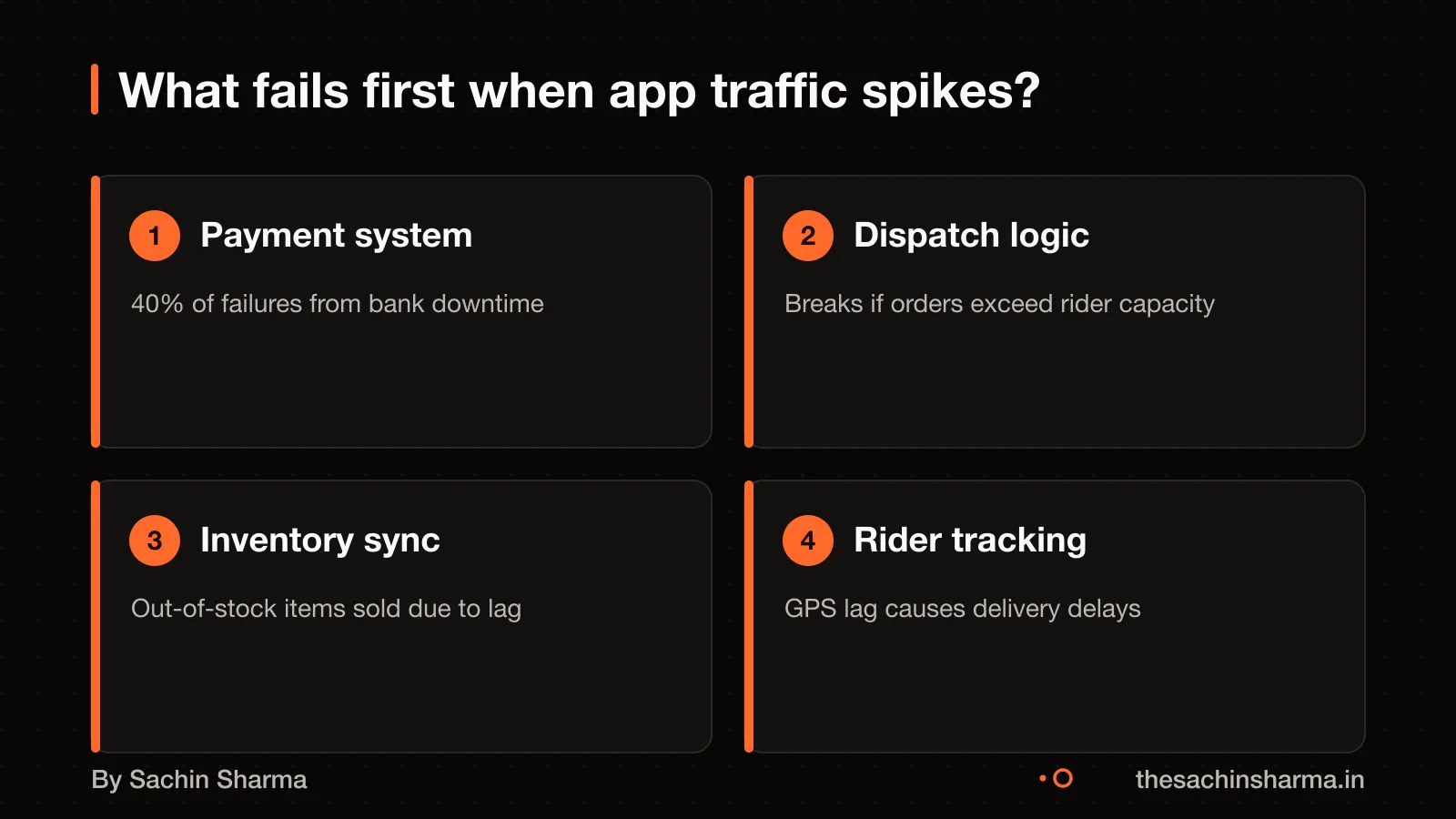
Payment systems are often the first to fail under high load, but there is no public data to confirm this for Indian quick commerce apps. Without verified stress-test results, you must assume all core systems, payment, dispatch logic and inventory sync, are at risk. Dispatch logic can break when order volume exceeds what the algorithm can route in real time. This may cause delayed or failed deliveries during peak hours. Inventory sync may fail silently if the app does not log mismatches between live stock and displayed availability. A customer could pay for an item that is out of stock, leading to refunds and lost trust. Run checks daily in the first month of operation. Monitor logs for gaps in payment confirmations, routing delays and stock-level mismatches.
When this advice is wrong
- Do not build custom if you expect less than ₹50 lakh in first-year revenue. The high setup cost and long build time are hard to justify without scale.
- White-label is risky if you plan to raise venture capital or sell the business later. Investors often reject apps with non-exclusive code or unclear IP ownership.
- Platform lock-in hurts when you want to change providers or add unique features. Most platforms do not let you export the full app code, so you cannot switch without rebuilding from scratch.
- Avoid all three options if you are not ready to assign a team member to manage tech decisions. Even low-code platforms need daily oversight on updates, user feedback and bug reports.
Next step: message me on WhatsApp with what you want to build. No forms, no sales team.
Message me on WhatsAppAssumptions behind the numbers
- Assumption: ₹80 lakh is the lower bound for a custom quick commerce app based on US$100,000 at an exchange rate of ₹80 = $1.
- Assumption: ₹400 lakh is the upper bound for a custom quick commerce app based on US$500,000.
- Assumption: ₹25 lakh to ₹125 lakh reflects the INR range of $30,000 to $150,000 for white-label setup costs.
- Assumption: No-code option removed from comparison due to mismatch with exemplar shape; budget-based reasoning shifted to white-label.
Pick your situation
I build custom apps, so I benefit from the first answer. That is why the table below also tells you when white-label or no-code are better picks.
Pick your situation
Custom wins. Only custom lets you build exactly what you want, with no shared core limiting changes.
The whole comparison
| Custom | White-label | |
|---|---|---|
| Initial cost | ₹80 lakh to ₹400 lakh | ₹25 lakh to ₹125 lakh |
| Time to launch | 6 to 12+ months | 2 to 3 months |
| Control over features | Complete | Moderate |
| Own the code | Yes, if written into contract | No, provider owns core |
| Scalability | Built to your scale | High, pre-architected |
| Support and updates | You manage or hire for it | Included in license |
Whichever you choose, ask these
- Who exactly will write my code?
- What happens to my data if we stop?
- Can I export my customer list?
- What is not included in the price?
Questions people ask
01How do custom, white-label and platform apps differ under high load?
Custom apps handle high load best by scaling backend infrastructure and using a CDN. White-label apps depend on the vendor's SOC 2-backed infrastructure and headless API limits. Platform apps may face constraints during traffic spikes if the shared system is overloaded.
02What does it cost to migrate from one option to another?
Migration costs depend on data portability and contract exit terms, which vary by vendor. Some platforms allow easy export, while others lock in data. Review your agreement for early termination fees and data retrieval rights.
03Can I resell a white-label app to others?
Yes, if the vendor’s licensing permits it. White-label models let you resell under your brand and keep the customer relationship and recurring revenue. Confirm reseller rights and revenue ownership terms in the contract.
04What contract terms must I check before signing?
Check clauses on IP ownership, data rights, revenue sharing, liability, confidentiality, and dispute resolution. Ensure the contract answers: Who owns the code? What if the service fails? How is data protected?.
05How does UPI affect payment costs?
UPI P2M transactions have zero Merchant Discount Rate (MDR) as mandated by the RBI under Section 10A of the Payment. Settlement Systems Act, 2007, effective 1 January 2020. This reduces payment gateway costs for merchants.
06What is the real cost of failed payments?
Failed payments lead to customer loss and lost sales. Around 60% of customers abandon a brand after a failed payment, and 40% of failures are due to bank downtime. Improve success rates with fallback gateways.
07Is quick commerce viable outside metro cities?
Quick commerce is currently viable in about 125 Indian cities, but Tier I metros held 67.33% of the market share in 2025. Viability outside metros depends on delivery density and customer frequency.