What counts as business automation?
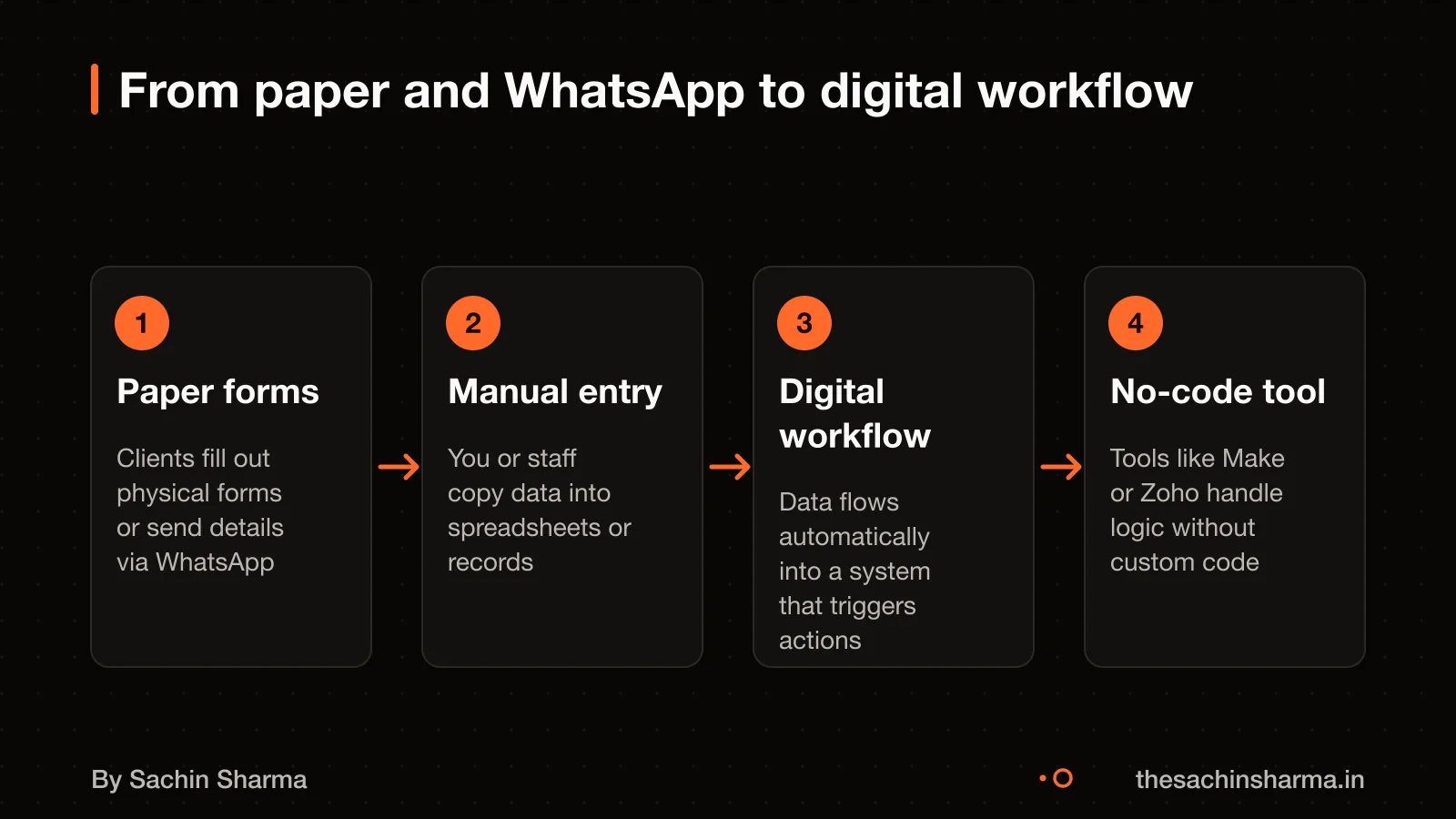
Business automation means using software to handle repetitive tasks so you do not have to. It starts with spotting where your team repeats work, makes errors, or loses time in handoffs. Tasks like sending invoices, logging leads, and WhatsApp replies can be automated.
You can use tools like AI bots, workflow software, or custom apps to run these tasks without manual input. For example, a lead from Instagram can trigger an automatic WhatsApp message and add the person to your CRM.
This is not just using WhatsApp more. Simply saving numbers or sending bulk messages still needs human effort. True automation removes the person from the loop. A system that reads incoming messages, sorts them by intent using AI, and replies with the correct template is automation. It reduces manual effort and makes your process visible and reliable.
If your team spends hours each day on the same steps, automation can free that time. You do not need a big team or budget to start, just a clear idea of what repeats.
how to integrate WhatsApp Business API if you want to connect WhatsApp to other tools securely.
When should you automate your business?
Automate tasks that are rule-based, repetitive, and high in volume. These are the ones where humans waste time on predictable steps. For example, sending invoice reminders every Friday or moving order details from WhatsApp to a spreadsheet. If a task follows clear rules and happens often, it is a strong candidate.
Do not automate if your current process is broken or unclear. Automation makes inefficiencies faster and harder to fix. For instance, if your delivery team keeps missing steps because roles are not defined, coding a system will only lock in those gaps.
As an estimate, if you spend 20 hours building an automation that saves only 5 minutes per year, it is not worth it. This means low-frequency tasks, even if annoying, often cost more to automate than to keep manual. Focus on tasks that take hours each week, not minutes per month.
There is no published error rate or handoff delay that makes automation worth it. You must judge when delays or mistakes start hurting trust or growth. If order details are missed twice a week, or approvals take more than two days, it may be time.
WhatsApp bot or your own app?
Common first automations for Indian small businesses
Most small businesses start by automating invoicing, appointment scheduling, or data entry. These tasks are often the most painful because they are repetitive, error-prone and slow down daily operations. Fixing them first gives quick wins in time saved and accuracy improved.
ERP systems also show that accounting, inventory management and CRM are common starting points for automation in India. These areas touch multiple teams and records, so simplify them reduces delays and miscommunication. For example, linking inventory updates to sales invoices helps avoid overselling.
You can expect fewer manual errors, faster task completion and better record-keeping. In one case, a multi-outlet dealership cut its lead-to-delivery time from 2 weeks to 4 days after centralising workflows. Results depend on how broken the original process was and how well the tool matches the team’s habits.
If your team spends hours copying data between WhatsApp, spreadsheets and registers, starting with one of these core tasks makes sense.
From paper to one platform: a 5-brand, 8-outlet dealership build
Cost structure of business automation
The setup cost for done-for-you business automation is ₹15,000 to ₹60,000 as a one-time fee. This covers building the workflow, connecting tools and testing it with your team. The range depends on how many steps are involved. It also depends on how many apps need to talk to each other. Whether custom logic or approvals are needed also affects the cost.
Your monthly cost will be ₹2,000 to ₹15,000. For simpler systems, you pay less. For example, a starter stack using n8n, Zoho CRM and a WhatsApp tool costs ₹2,000 to ₹4,000 per month. If you need ongoing support, updates or monitoring, monthly maintenance is ₹5,000 to ₹15,000.
Hidden costs to watch for include tool subscriptions not included in the quote. Extra charges for adding new users or workflows later. Also, fees for data migration from old spreadsheets or messages. Some providers lock you into their hosting. This can raise costs over time. Always ask what happens if you want to move the system elsewhere.
The factors that decide your exact cost are not documented in public data. As an estimate, assuming a mid-complexity process with three apps and one approval step, setup is likely around ₹35,000. Monthly cost is likely around ₹6,000. But your needs may differ.
Want a number for your idea? Send one line on WhatsApp. I reply with what drives the cost and what to cut.
Message me on WhatsAppHow I deliver automation: the process
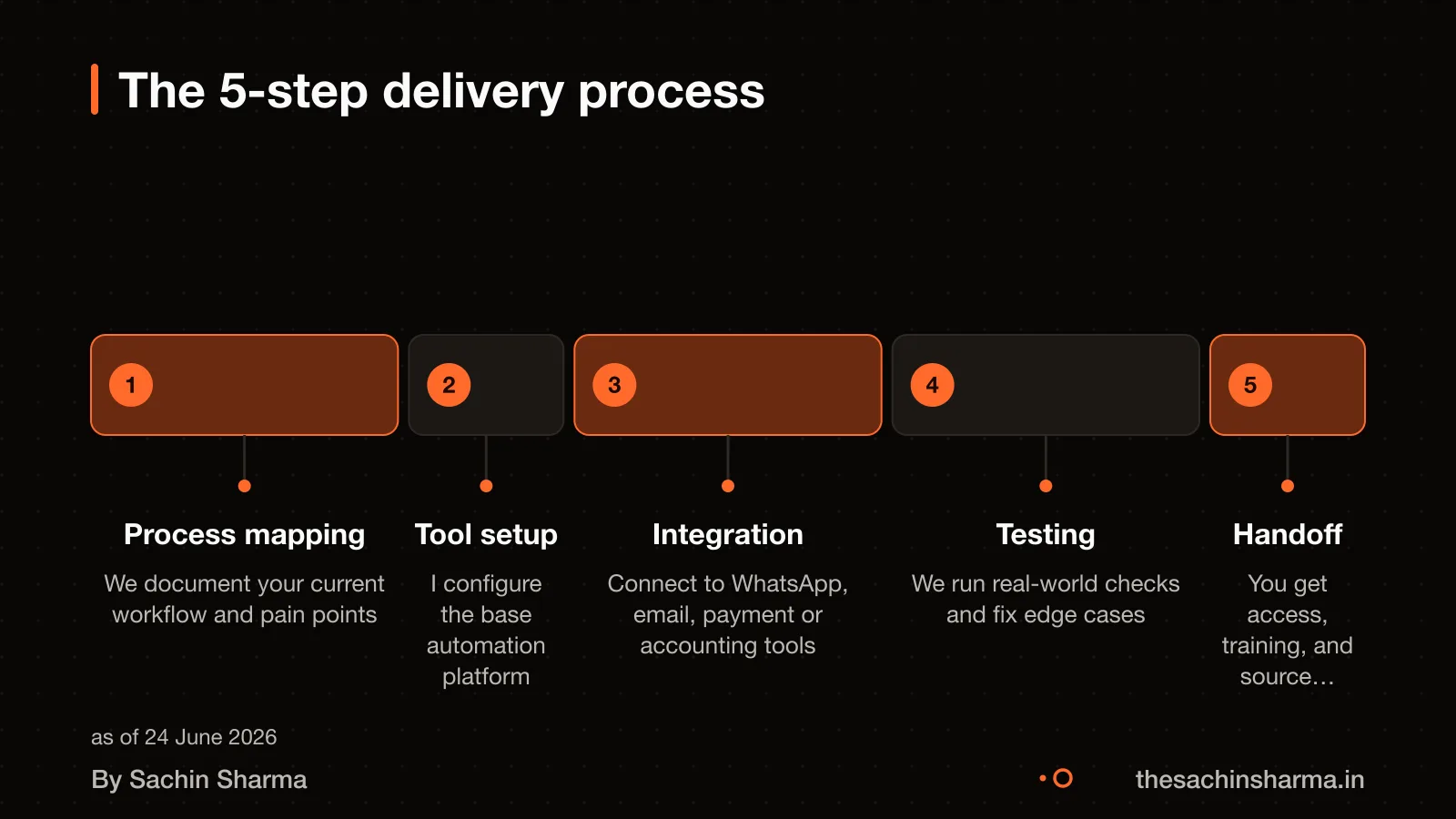
I start by mapping your current process step by step, not by picking tools. This means writing down who does what, when, and where errors or delays happen. Only then do we build software that fixes those gaps. You must share how work moves today, over WhatsApp, paper, or spreadsheets, so we do not automate inefficiency. As the rule goes, automating an inefficient process only makes it worse.
The steps are: first, we document your workflow as it is; second, we spot failure points like missed messages or duplicate entries. Third, we design a solution that only handles what is broken. You review each step so nothing is built on assumptions. For example, if order details are lost between your salesperson and delivery team, we map every handoff before coding.
I avoid inefficiency by not skipping observation. Many jump to bots or triggers too soon. But without seeing where delays live, automation just speeds up a broken system. The goal is not speed, it is accuracy and fewer manual fixes.
anchor text [[cta]] Have a workflow you want to automate? Send a one-line summary and I will map the first three steps for free.
Tool choice: WhatsApp, bot or custom system?
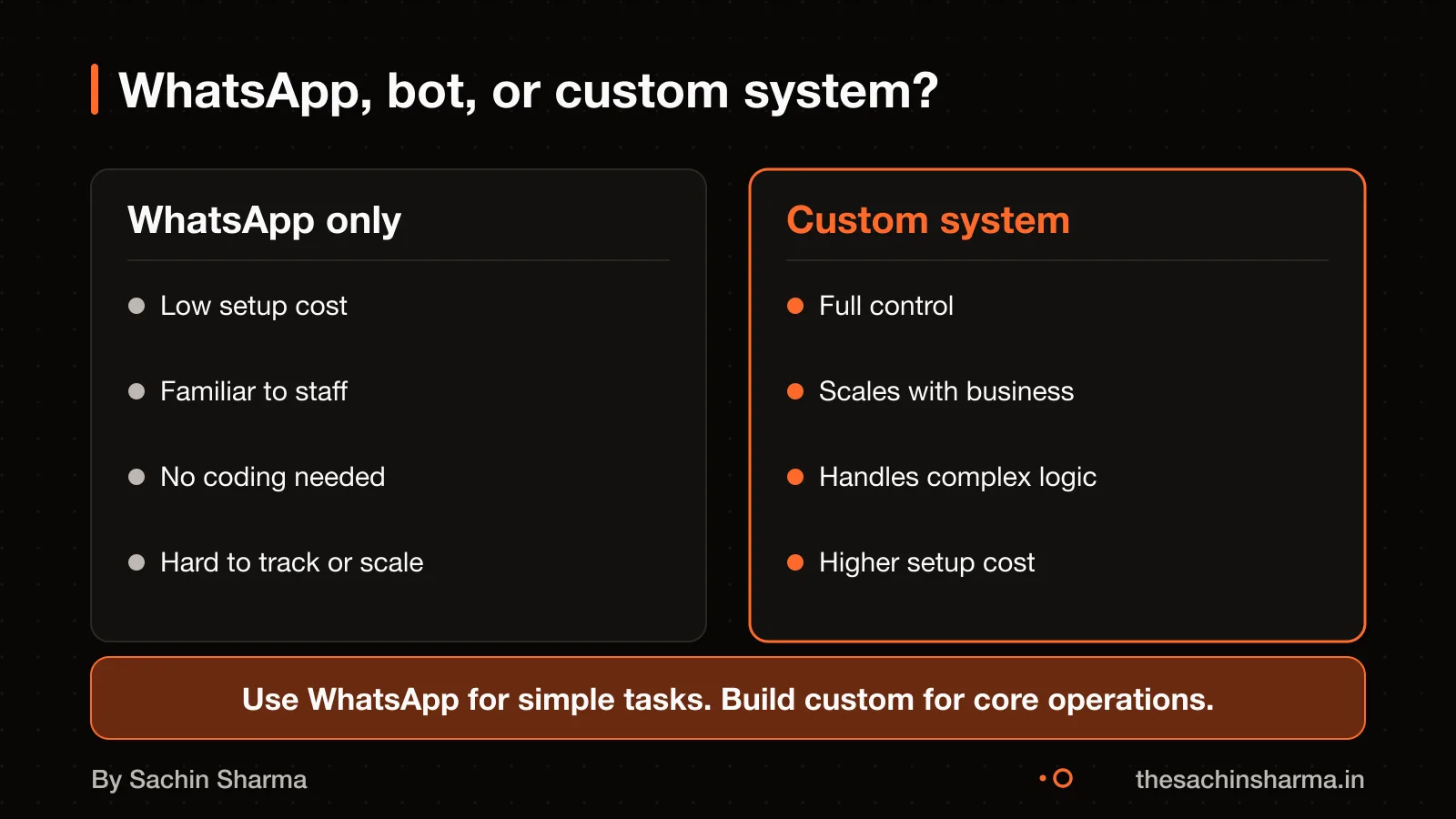
Use WhatsApp Business AI only for simple, high-volume customer queries like order status, pricing. Or availability, as it works best for rule-based replies to common questions. A custom workflow tool is better when your process spans multiple teams, needs data validation. Or must work offline, for example, field staff submitting inspection reports that trigger internal approvals.
The trade-off comes down to speed versus control. WhatsApp tools like Wati or AiSensy start at ₹1,999 per month. Can go live in 2 to 4 hours, making them fast but limited. A full custom system built with tools like n8n and Zoho CRM costs ₹2,000 to ₹4,000 per month. Offers more flexibility, but needs clearer rules and data flows from you. If your process changes often, start with WhatsApp. If accuracy and audit trails matter more, build custom.
For deeper control, I use self-hosted automation stacks that do not rely on third-party APIs, reducing long-term risk. This matters when uptime, data privacy or cost stability are key.
WhatsApp catalogue or your own store?
Risks, ownership and quality checks
Automation can fail if it does not plan for edge cases or system mismatches. Fully autonomous processes can cause major security or operational headaches when they encounter edge cases. Integration issues between different systems often create digital bottlenecks in office automation. Employee resistance remains significant when automation threatens familiar routines. For example, staff may avoid using a new tool that skips steps they trust, even if it is faster.
You own your data and business logic. I deliver source code under a custom agreement that gives you full rights to the software built for you. This means you can modify, host or hand it off to another developer. The code is not reused for other clients. Third-party tools like CRMs or payment systems have their own terms, so check those separately.
A well-built system does what it should without errors, handles failures safely and is easy to update. It integrates with your existing tools like CRM, financial software and databases. Check that each step logs actions, allows manual override and recovers from crashes. Test it with real data and watch for delays or incorrect outputs. For long-term trust, review how it handles data access, correction and erasure, see Data principal rights: access, correction, erasure in your app.
When this advice is wrong
- You should not automate if the task takes only seconds or minutes a year to do by hand. Spending 20 hours to automate a 5-minute task gives a poor return. Focus on high-volume, repetitive work instead.
- If your current process is chaotic or keeps changing, do not automate yet. Automation makes inefficiencies worse, not better. First, document and stabilise the steps with your team.
- If your team does not agree on the process or resists new tools, automation will fail. No software can fix a lack of buy-in. Talk to your staff, explain the why, and test changes in one department first.
- This advice is for owners with stable, rule-based workflows ready to scale. If your business is still experimenting with operations, manual tracking with shared spreadsheets may be the right stage.
Next step: message me on WhatsApp with what you want to build. No forms, no sales team.
Message me on WhatsAppAssumptions behind the numbers
- Automation workflows are priced per distinct process, not per tool used.
- Clients pay third-party hosting and subscription fees directly.
- WhatsApp Business AI is sufficient for basic reply automation in Indian contexts.
- n8n is a suitable default choice for workflow orchestration due to flexibility and cost.
What is in it, and what is not
Business automation mapped to your actual work, not generic templates. Built with no-code tools like n8n and WhatsApp Business AI, by the person who speaks to you.
- 01Process mapping
We draw your current workflow as-is, naming the gaps and delays before writing any automation rule.
- 02Gap-filling automation
Only automate what solves a real delay, error or handoff issue — not everything just because we can.
- 03WhatsApp Business AI setup
Live in India since May 2026, used for smart replies, lead capture and task triggers.
- 04n8n or similar no-code tool
Used to connect your apps and run workflows without writing code, hosted where you choose.
- 05Testing with real data
Each workflow runs on sample data from your actual process before going live.
- 06Documentation and handover
A readable document of what was built, how it connects, and where to manage it.
How it runs: milestones you can test
- 1Workflow audit
You can test: Current process mapped, gaps named, automation candidates selected.
- 2First workflow built
You can test: One core workflow running on test data and responding correctly.
- 3Integration test
You can test: Connected to your tools like CRM or sheets, tested with real inputs.
- 4Live and documented
You can test: Running in your environment, with logs, docs and handover completed.
Right for you if
- You have a clear, repeated manual process causing delays or errors.
- You use tools like WhatsApp, Google Sheets, Zoho or QuickBooks daily.
- You want to understand what is automated and why, not just a black box.
Look elsewhere if
- You want a chatbot-only solution without workflow changes.
- Your process changes weekly or lacks clear steps.
- You expect automation to fix a disorganised team or unclear goals.
How it is priced
Price depends on how complex your workflow is and how many tools it connects. I charge per workflow built, not per hour. A one-page scope comes first, then a fixed quote. No upfront automation without a written plan.
Questions to ask before you sign, with anyone
- Can you show me a past workflow you automated?
- Will this connect to my existing tools?
- What exactly will I test at each stage?
- Where will the system run and who pays the bills?
- What happens if we pause mid-way?
Quick answers
Why not just use Zapier or Make?
They work for simple triggers. But for multi-step logic or conditional paths, n8n gives better control and lower long-term cost.
Is WhatsApp automation legal in India?
Yes, under the Digital Personal Data Protection Rules, 2025, if users consent and data is stored securely. I follow those rules.
Can automation replace my staff?
Its goal is to reduce repetitive work, not fire people. Most teams redeploy time, not cut roles.
Questions people ask
01What does the engineer actually decide on business automation?
The engineer decides what tasks to automate, which tools to use, how deeply systems should connect, and how errors are handled. They must first check that the process is efficient, as automation magnifies inefficiencies. Setting up the first workflow takes less than a day with modern no-code tools.
02Which skills matter most for business automation?
Key skills are process mapping, using no-code tools, connecting APIs, and validating data. The automation must work with your CRM, financial software, and marketing tools. A common starter stack for Indian SMBs has a monthly cost of ₹2,000 to ₹4,000.
03How do I test if an automation developer is a good fit?
Ask them to share a process map, a workflow diagram, or a sample case study. A strong portfolio includes detailed write-ups for each project. You can also review their technical approach by checking their portfolio's code structure and tools used.
04Can I see a sample of the code or architecture used?
Yes, the portfolio's code is free to reference for learning purposes. The portfolio site is a static site built from scratch with HTML5, CSS3, and Vanilla JavaScript. Case studies are shared as PDFs but are not licensed for reuse.
05What laws apply to business automation in India?
The Digital Personal Data Protection Rules, 2025 are to be implemented from the date of publication of the notification. A data fiduciary must retain data for at least seven years or for a longer period. If agreed upon by the data processor and the certified intermediary. and use security measures like encryption, authentication, masking, or virtual tokens. Check this for your case with a chartered accountant or lawyer.
06Can I use WhatsApp Business for free if I'm a small business in India?
Yes, the WhatsApp Business app is free for small businesses in India. However, the WhatsApp Business Platform charges for messages beyond the first 1,000 replies per month.
07What advanced features does WhatsApp Business offer for automation?
WhatsApp Business allows automation like chatbots, workflows, and integrations. These help reduce manual work and improve customer communication.
08How can I use WhatsApp Business on my computer?
You can link WhatsApp Business to a computer via WhatsApp Web in your browser or the desktop app for Windows and Mac.