What a small business website actually does
A website is your 24/7 sales representative and central hub for brand identity. Unlike WhatsApp or Instagram, which are messaging and social tools, a website gives you full control over how your business looks. What information you share, and how customers interact with you. It contains all the necessary details, your brand, what you sell, how to buy, and who you serve, in one trusted place. While social profiles come and go, a website stays yours. For small businesses, it answers the basic question: “Who are you, what do you do, and why should I care?”. This clarity builds trust and helps customers find you any time, day or night.
What parts of a website actually cost money?
The biggest cost in a website comes from features that need logic, not design or domain names. Simple pages like 'About Us' cost little, but interactive tools, user logins or payment handling raise the price fast. This is because each feature adds rules, checks and steps that must work without errors.
Content structure matters because how you organise pages affects the backend setup. A blog with ten posts needs less planning than a product catalog with filters, categories and stock levels. Poor structure leads to rework, which adds time and cost. For example, changing a menu layout late can force changes in code and content.
Hidden backend work includes setting up databases, user roles, forms that save data, and links to email or payment systems. These are not visible but take time to build and test. A contact form might look simple, but it needs secure storage, spam checks and email alerts, all coded carefully.
Three core parts make up every site: a domain name, hosting and a platform. The domain is your web address, hosting is where files live, and the platform is how you build it. These are fixed costs, but small compared to custom features.
Custom websites can cost $15,000 to 50,000+ upfront in 2025, depending on complexity. In rupees, that is roughly ₹12 lakh to ₹40 lakh or more, based on current exchange rates. This range reflects real projects with tailored logic, not templates.
Want a number for your idea? Send one line on WhatsApp. I reply with what drives the cost and what to cut.
Message me on WhatsApp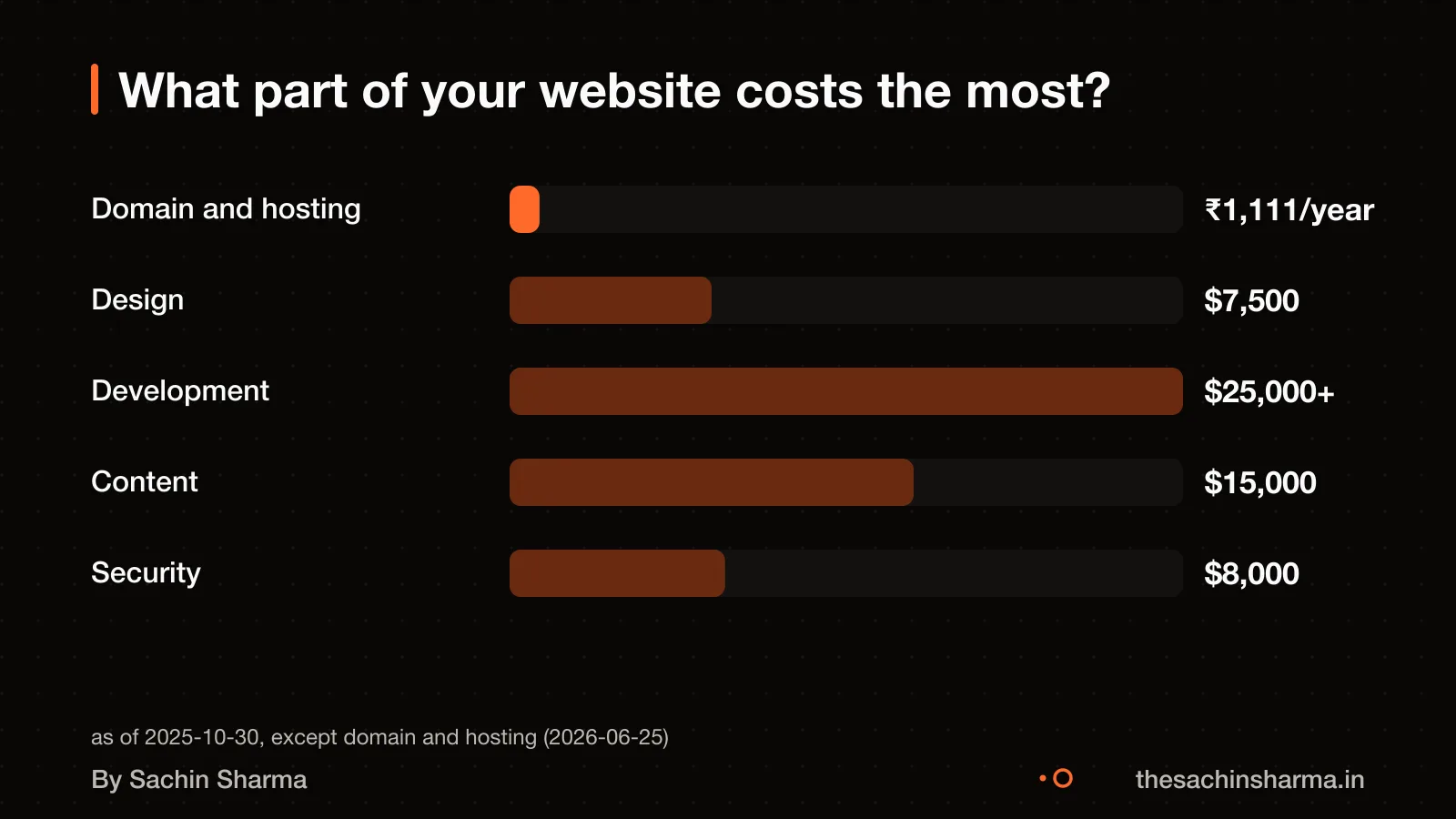
How long does it take to build a website?
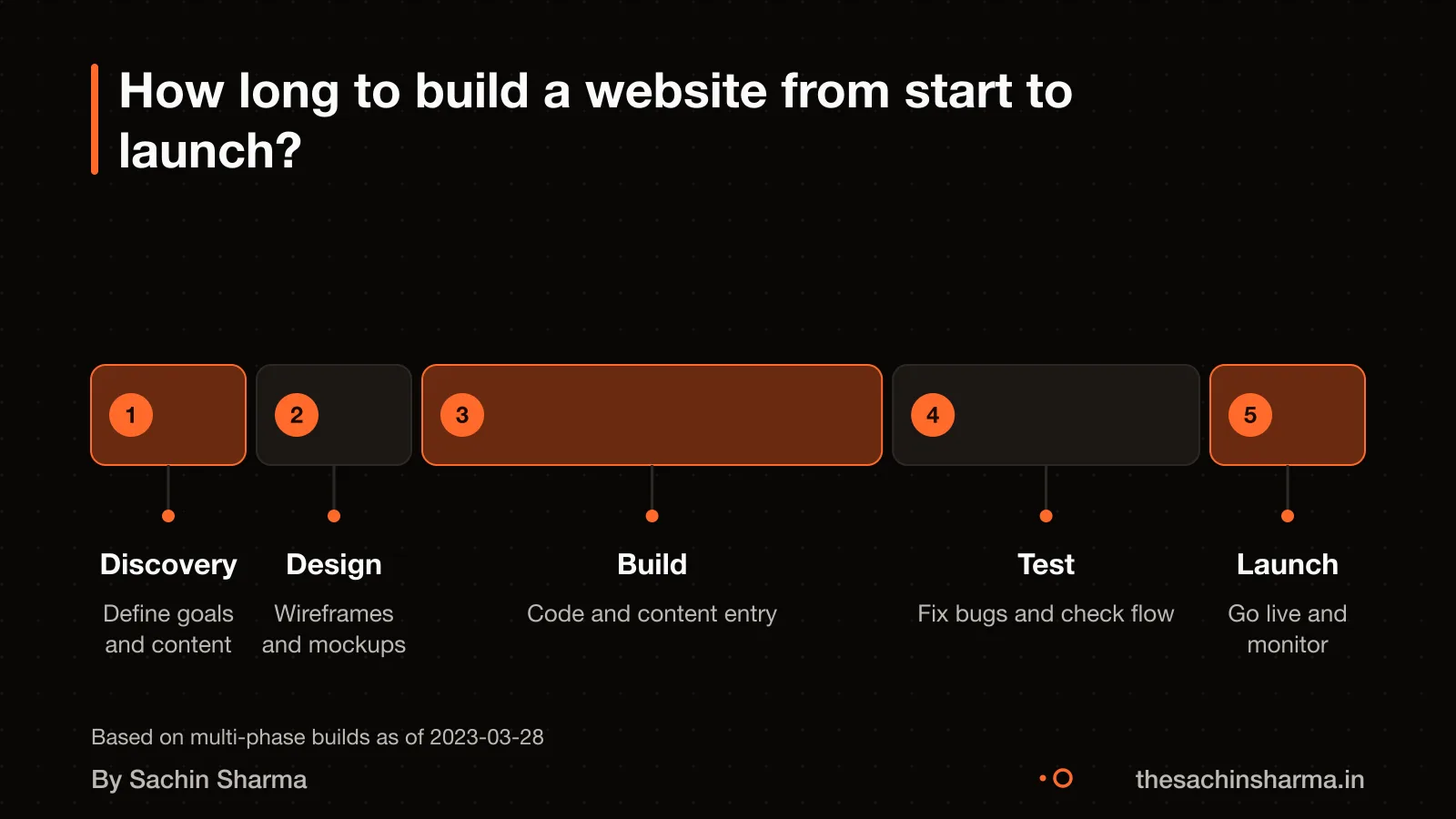
A basic single-page website can be ready in one day using a webpage builder. This works if you only need a simple layout with text, images and contact details. Most small businesses, however, need multiple pages and custom features, which can take weeks to months to build from scratch.
The main delay comes from unclear goals or missing content. If you do not have your text, images or product list ready, the build will pause. Complex functions like user logins, forms or payment systems also add time. Coding everything from scratch allows full control but may take months.
Yes, it can be done faster, if you use a template and provide all content upfront. Some builders let you launch a basic site in hours. But if you need custom workflows or integration with other tools, speed depends on how well you prepare. Breaking the work into clear steps helps avoid delays.
WordPress, static site, or custom code: which costs less?
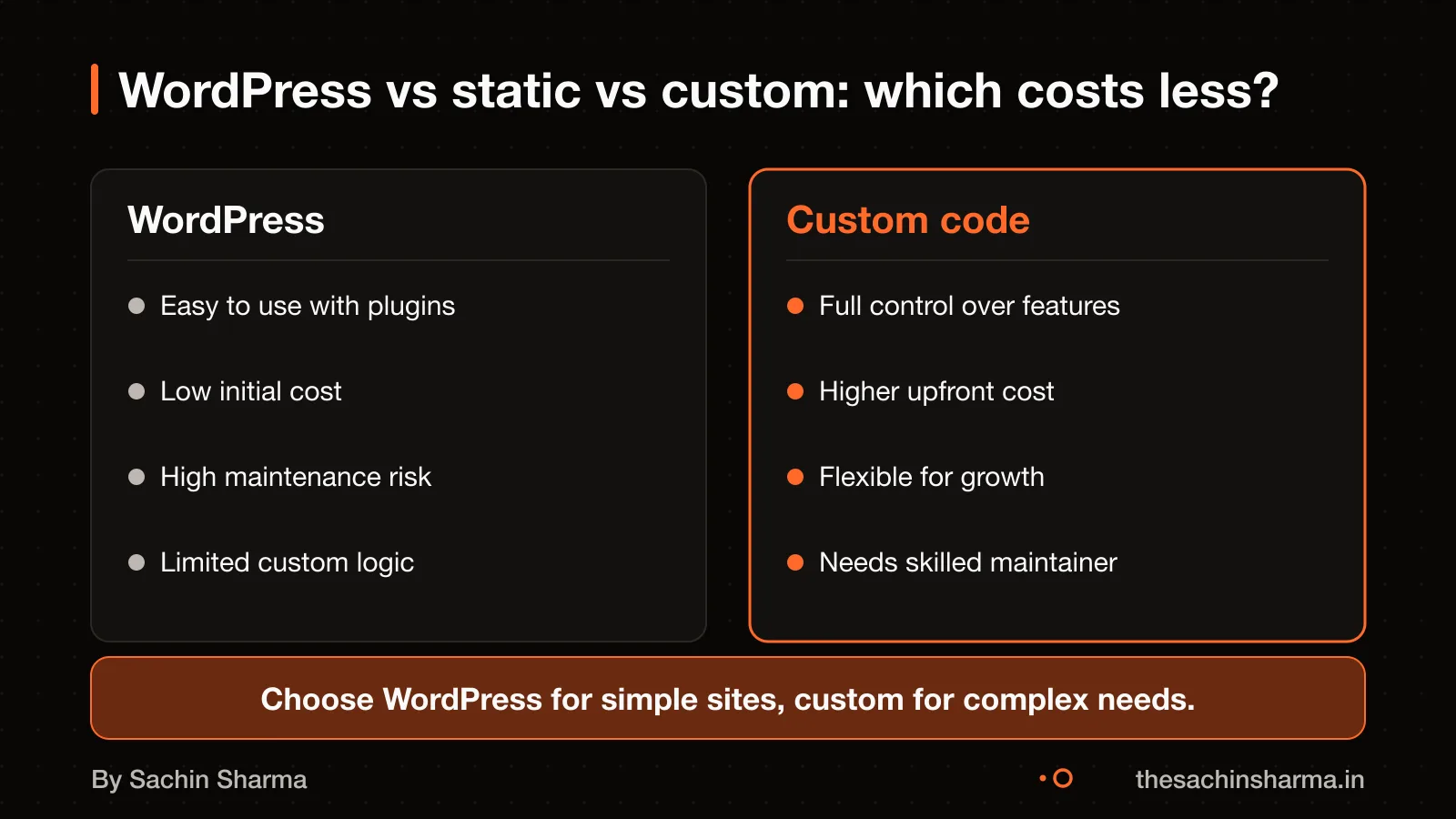
WordPress sites are often cheaper to build at first because they use pre-built themes and plugins. As an estimate, a basic WordPress site costs ₹50,000 to ₹1.5 lakh, while a custom-coded site starts at ₹1.5 lakh. This is because custom code means building every feature from scratch. However, long-term costs depend on who maintains it.
You can update content on WordPress yourself after training, even without coding skills. The dashboard lets you add pages, images and blog posts. But for new features, like a booking form or stock tracker, you still need a developer. Custom sites always need a developer for changes.
Static sites (like those built with Next.js) are fast and secure. But you need a developer to update content unless paired with a content management system. They suit sites with fixed content, like a portfolio or brochure site.
Custom code gives full control over design and function, which helps if your business logic is unique. But it costs more to build and maintain. WordPress suits those who want to manage content themselves and have standard needs. Static sites work well when content updates are rare.
What corners can I cut to save money?
You can save money by using a ready-made template and preparing your content in advance. DIY with a template cuts cost because you skip custom design work. Most website builders let you pick a layout and swap in your text and images. This works well if your business needs are simple and you do not need unique features.
Providing ready content also reduces cost. When you supply final text, images and structure, the developer spends less time asking questions or making edits. This avoids delays and extra billing for back-and-forth changes.
But cutting corners has risks. Choosing the cheapest developer often leads to poor code quality or missed features. Bad code creates technical debt, which makes future updates slower and more expensive. As an estimate, technical debt can add 20 to 40% more time to new feature work on older websites. You may save now but pay more later.
A template limits how much you can customise. If your brand or workflow is unique, a template may not fit. You might end up paying more to modify it than to build from scratch.
What legal and tax rules apply to my website?
Yes, you may need to show GST on your website if your business turnover meets the threshold. Some businesses must register under GST if their turnover meets certain thresholds. For current rules, consult a tax professional. If you sell goods or services online, your website must display your GSTIN once registered. For precise thresholds and exemptions, consult a tax professional.
Privacy laws apply if your website collects user data. While India does not yet have a single data protection law in force, the Digital Personal Data (Protection) Act, 2023 is expected to apply soon. Until then, best practice is to have a clear privacy policy that says what data you collect and why.
The Information Technology (IT) Act, 2000 governs electronic records and cybercrimes. It requires businesses to protect sensitive information and report certain breaches. If your website allows user accounts, payments or data storage, you should follow due diligence under this Act. For current compliance, refer to MeitY guidelines.
The Online Gaming Rules, 2026 will come into force on 1 May 2026. Similarly, tax rules for digital transactions are updated regularly, such as the Income-tax (Second Amendment) Rules, 2026 effective 31 March 2026. Laws change fast, always confirm current requirements with a legal advisor for your specific business.
Can I build the website in phases?
Yes, you can start with the basics and add features later. This approach works well if you want to launch quickly and improve over time. The first phase should include your core business information, what you offer, prices, contact details, and a way for customers to reach you. These pages help customers decide whether to work with you and are the most important part of your site.
Adding features in phases can lower your initial cost. You pay only for what you need at the start. Later, you can add booking systems, user accounts or payment handling as your business grows. Each new phase will have its own cost, based on the complexity of the feature.
As an estimate, assuming you begin with five key pages and no complex tools, the first phase could cost under ₹1 lakh. Future phases depend on what you add. For example, a booking system or member login will cost more than a blog or gallery.
Phasing gives you control over both timeline and budget. It lets you test what works before spending more. Many small businesses use this method to manage risk.
How to phase your build covers how to plan each stage and what to build first.
When this advice does not apply to you
When this advice does not apply to you
You should not build a website if your business runs entirely on personal referrals and you serve clients only by appointment. In such cases, a WhatsApp number or Instagram profile may be enough to confirm your presence and share contact details.
Stick with social media if your main goal is to post daily updates, run short-term offers or show behind-the-scenes content. Platforms like Facebook and Instagram already have built-in audiences and discovery tools that a new website cannot match.
If your budget is under ₹50,000 and you need something live now, a website with custom features is not feasible. Instead, use a free website builder like Wix or Google Sites with a template, or focus on claiming and upgrading your Google Business profile.
Related reading: What does a Flutter app cost?, What does a clinic booking app cost?.
Next step: message me on WhatsApp with what you want to build. No forms, no sales team.
Message me on WhatsAppAssumptions behind the numbers
- Hosting and domain cost is ₹1,111/year as a conservative baseline.
- Security review cost is estimated at ₹1.5–6 lakh for OWASP Top 10 compliance.
- Hourly rate assumed between ₹1,500–2,500 for skilled developers and designers.
- Project phases are split into discovery, build, test and launch with default weeks.
Work out your own number
I won't hand you a number that pretends to be the market. Instead, here is the working: set the weeks, the people and the rate, and see where the money goes.
Your working total
₹4,40,00011 weeks × 2 people × 5 days × ₹4,000- Scope and design18%
- Build55%
- Testing and fixes18%
- Launch and stores9%
The weeks shown are an example of a small app, there to be changed. Fees you pay others (store accounts, cloud, SMS) are not in this total.
What moves the price
- More screens or roles
Each extra user type (customer, admin, rider) is close to another app.
- Real-time features
Live tracking and chat need more design and more testing.
- Many integrations
Every payment, SMS, maps or ERP link is its own piece of work.
- Cutting to one platform first
Starting with one clear flow can be half the work.
- Using managed services
A managed backend for login and data removes weeks.
- A clear scope up front
Changes mid-build are the most expensive weeks.
Fees that go to someone else
Domain and hosting
As an estimate, ₹1,111/year based on shared plans. Check current rates.
Security review
As an estimate, ₹1.5–6 lakh for a pre-launch OWASP Top 10 audit.
Cloud, SMS, maps, payments
Usage-based, billed by the provider to you.
Ask for these before you sign
- How many weeks per phase, and with how many people?
- What is not included?
- Which fees do I pay to others directly?
- What happens to the price when I change my mind?
- What does the first month after launch cost?
Questions people ask
01Which components drive the cost of website development?
Backend logic like user accounts or payments costs more than design. A custom site can cost $15,000 to 50,000+ upfront in 2025.
02Where do estimates for website development usually go wrong?
Estimates fail when content structure is ignored, integrations are underestimated, or timelines are too urgent. Urgent work adds cost due to workflow disruption. Add 20 to 40% for older sites with technical debt.
03What can be cut without hurting the product?
DIY with a template keeps cost low. Avoid the cheapest developer to reduce hidden risks.
04How much does hosting and a domain cost per year?
A domain and basic hosting cost ₹1,111 for one year.
05Does having content ready reduce cost?
Yes, having content ready saves developer time during setup. While the exact savings are not known, preparing text and images in advance helps lower overall effort.
06What happens after the website launches?
As an estimate, 70 to 80% of the total cost occurs after launch. Plan for ongoing work to keep the site secure and functional.
07Who owns the website code and content?
Ownership is not specified in the evidence. You must clarify in your contract who owns the code and content. Always get this in writing to avoid disputes later.
08How do I check if a developer’s estimate is fair?
Look for a pricing model that combines fixed-price quotes with fair hourly rates. A clear, itemised breakdown helps you see what you are paying for. Compare it to standard ranges for your scope.
09What if my business needs change later?
Business growth can make your website outdated even with regular updates. Plan for change by using modular design and avoiding vendor lock-in.