What a quick commerce app is made of
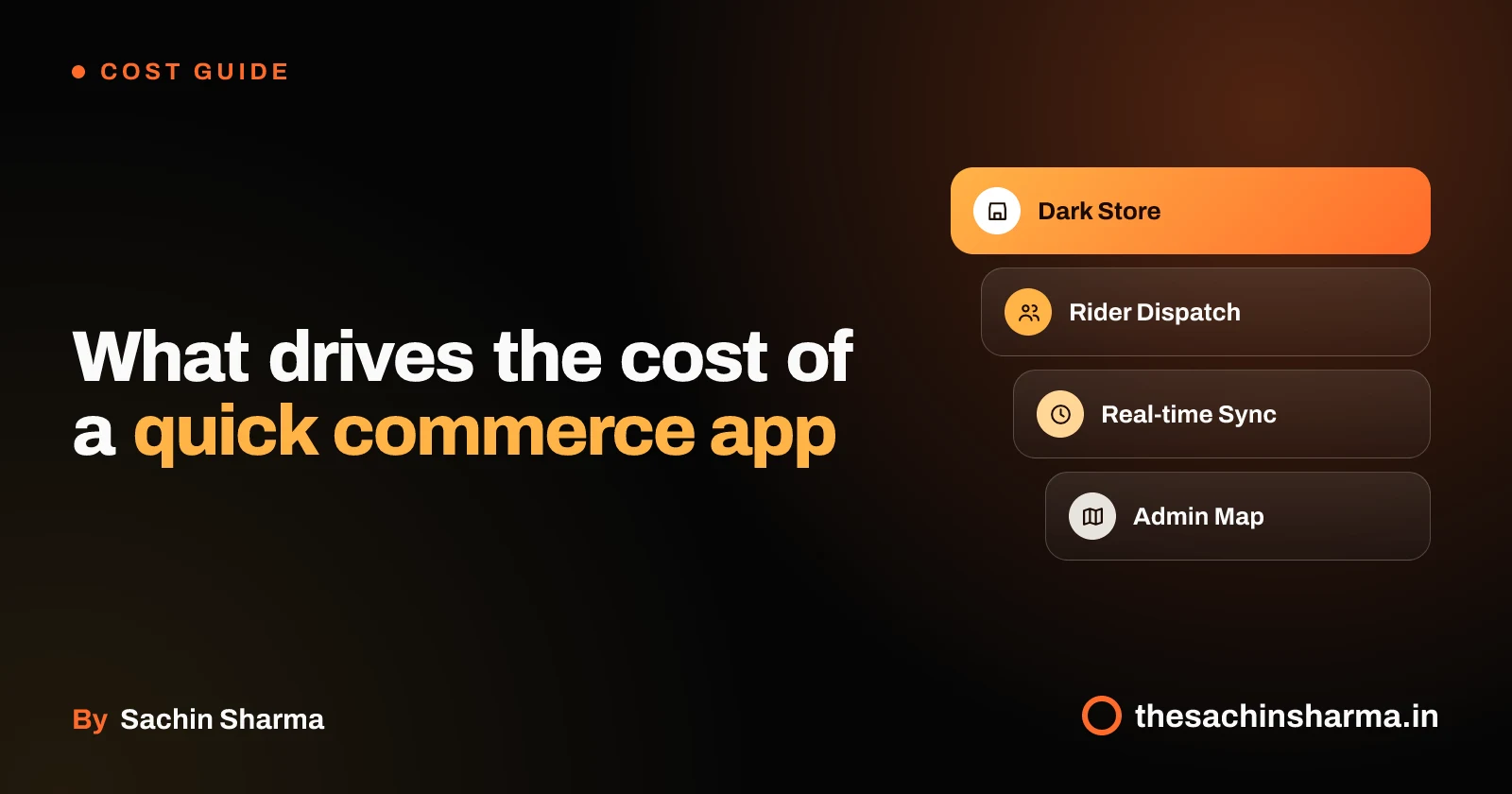
A quick commerce app is made of four systems: the customer app, the rider app, the picker app, and the admin dashboard. Each has a different job and team using it.
The customer app lets shoppers browse, order, pay, track, and reorder. This is what most people see, but it is only one part of the system.
The rider app helps delivery staff see assigned orders, navigate to a pin on the map. Collect cash if needed, and mark delivery as done. It works best when built for offline use and quick actions.
The picker app is used inside the dark store. Staff receive orders, follow the fastest pick path, scan items, and mark them as packed. This reduces errors and speeds up order prep.
The admin dashboard lets your team manage the product catalog, set prices. View the live order map, handle multi-store operations, and check payouts and analytics. This is where daily operations run.
Because all four systems must stay in sync, the real cost comes from the unseen parts, not just the customer app. The backend that connects them is where most time and money go.
How to build a quick commerce app if you want to see the full process.

Cost to build a single-store MVP
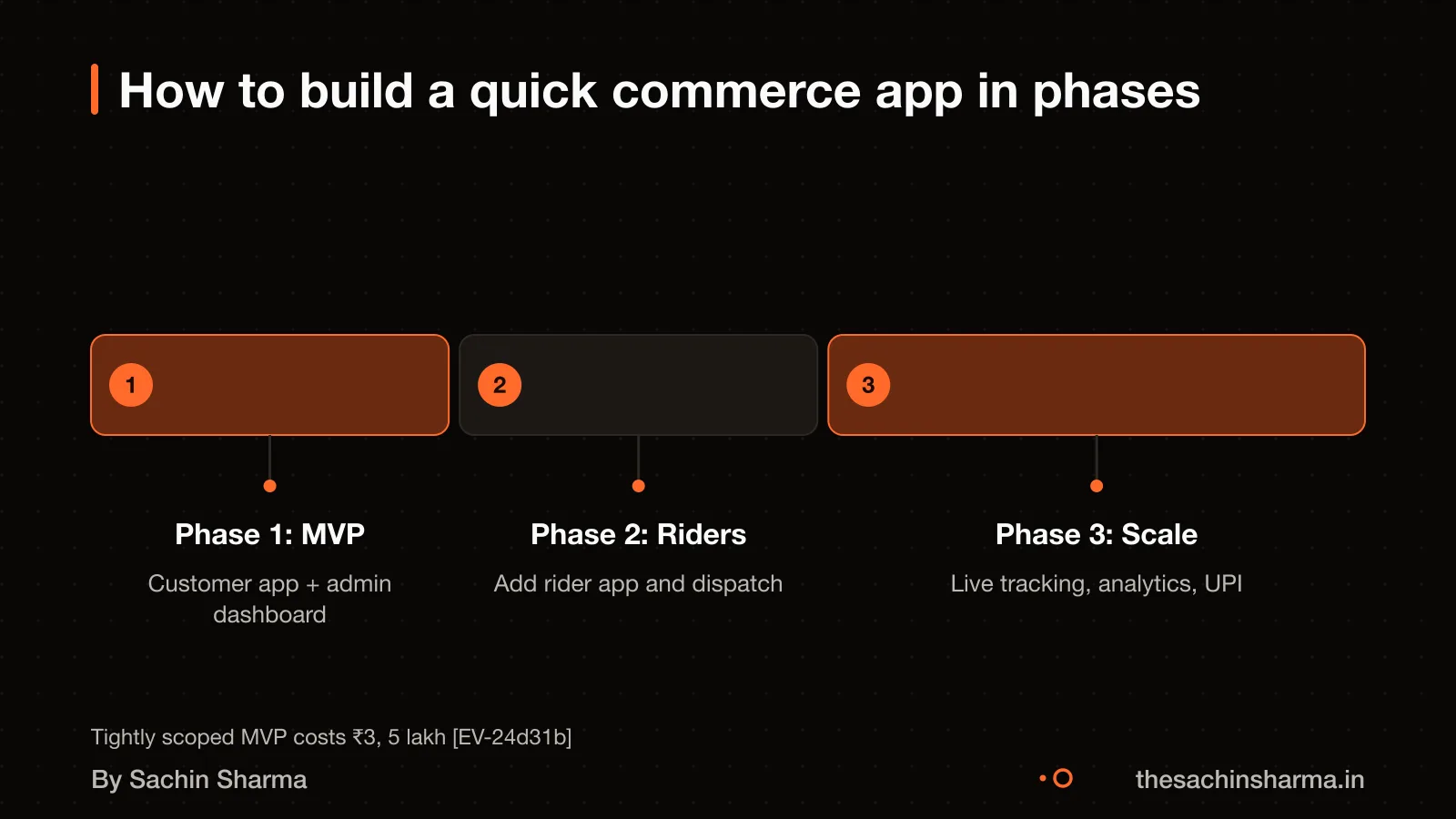
A minimal quick commerce app for one dark store costs ₹3 to 5 lakh as of 2026-10-16. Covering only the core features needed to launch. This base cost assumes a tightly scoped MVP with a customer app, basic order flow, and a single platform (iOS or Android). It includes no complex backend systems like real-time rider dispatch or dynamic pricing. What this range does not cover includes multi-store support, a dedicated rider app, advanced inventory sync, or surge pricing logic. For comparison, a broader estimate from 2025 puts a single-dark-store MVP at $30,000 to $55,000. This highlights that ₹3 to 5 lakh is only possible with strict feature limits and no scalability built in. If you need area mapping, rider tracking, or automated substitutions, costs will rise.
You may want to compare this with the Cost to build a grocery delivery app if your needs are simpler.
Want a number for your idea? Send one line on WhatsApp. I reply with what drives the cost and what to cut.
Message me on WhatsAppRider app vs using an existing network
Building a rider app adds major cost because it needs real-time location tracking, order dispatch logic, and rider availability checks. The rider app costs almost as much as the backend itself.
Using an existing delivery network avoids this build cost. You do not need to develop or maintain a rider app. But for every order, you pay a commission of 10 to 25% of the order value. These fees cut into your margin and rise as sales grow.
For example, on a ₹200 order, a 15% fee means ₹30 goes to the delivery partner. If you handle 1,000 such orders a day, that is ₹30,000 in daily fees. Over a month, it adds up to ₹9 lakh.
Building your own rider team gives you control over delivery speed and customer experience. But it brings higher upfront cost and ongoing maintenance. Relying on a partner saves time and initial spend but ties your profit to order volume.
Build or buy a quick commerce app to see which model fits your scale and budget.
Still unsure between building a rider app or using a delivery network? Tell me your budget and order volume and I will say which fits.
Message me on WhatsAppDark store inventory sync: cost and complexity
Real-time inventory sync is hard because stock data must update instantly across all sales channels to avoid overselling. If your app shows an item in stock but the dark store has already sold it, the order fails. This creates customer frustration and refund costs. Batch updates every 15 minutes create an average of 3-7 overselling events per week.
Delayed stock data means your app promises what it cannot deliver. Even small delays add up. For example, if two orders come in at the same time for the last unit of a product, the system may accept both. By the time the update runs, one customer gets a cancellation. This hurts trust and increases support work. Real-time sync avoids this by updating stock the moment an order is placed.
Dark stores rely on tight inventory control within a local area to support fast delivery. Systems like Shiprocket offer real-time sync and AI routing to reduce failed deliveries. Without it, you risk higher return-to-origin (RTO) rates and lower checkout conversions.
Keeping stock accurate is not just about software. It requires barcode scanners, staff discipline and integration with your warehouse management system (WMS). These add to setup time and cost. The complexity grows if you plan to scale to multiple dark stores.
Must-have features for a quick commerce app

UPI and payment gateway costs
Setting up UPI through a payment gateway like Razorpay costs nothing upfront and runs at 2% per domestic transaction. This rate has no setup fee, no annual charge, and no lock-in period. New merchants can even get 0% platform fees for the first 90 days or until they process ₹5 lakh in total sales, whichever comes first.
However, the 2% fee is not the full cost. An 18% GST applies to the payment gateway’s fee, adding roughly 0.35 percentage points to your effective rate. For example, on a ₹100 order, the gateway charges ₹2, and GST adds ₹0.36 more, making the total cost ₹2.36.
There are no hidden fees beyond this if you use Razorpay under these terms. But always check whether other gateways bundle services or charge extra for failed transactions, refunds, or settlements. The real cost depends on your monthly order volume and average order value. Since GST is a legal requirement, factor it into your pricing or margins from day one.
Ongoing and hidden costs
After launch, ongoing costs will be 15% to 20% of the initial build cost annually. These include cloud hosting, SMS, mapping APIs, and app store fees. As an estimate, this range assumes moderate usage and may rise with scale. Third-party services add up over time, especially maps and SMS, which charge per request. Mapping APIs can become a major cost if not managed, since each rider location update or route calculation counts as a call. To control this, apps must cache map data and limit requests. Cloud hosting costs grow with user numbers and order volume. App store fees are small but recurring, at $99 per year for Apple. You should budget for these from day one. For a broader view, see App development cost in India.
How to phase your build to save cost
Start with the customer app and a basic admin dashboard to take orders. Use phone calls or messaging apps to coordinate riders at first. This keeps your launch fast and low-cost. You do not need a dedicated rider app right away.
The cheapest way to start is by adding a picking app and delivery slot capacity to a storefront you already run. This project takes 200 to 460 hours plus dispatch. Once orders grow, you can build a rider app to replace manual coordination.
You can delay dark store development by starting as an aggregator. Work with existing local stores instead. This lets you test demand in different areas before investing in your own inventory and warehouse systems. Add dark stores only when you see consistent orders in a zone.
Features like automated rider dispatch, dynamic pricing, and AI-based demand forecasting can wait. These add cost and complexity. Use them only after you have real data from live operations. Focus first on fulfilling orders reliably at small scale.
Biggest risks and how to check for them
Most quick commerce apps fail because of high operating costs and low margins, often driven by aggressive discounting to win customers. For example, Blinkit has a 5.3% contribution margin, while Swiggy Instamart has a -0.2% contribution margin, meaning it loses money per order. These thin margins make it hard to sustain operations without deep funding. A key hidden cost is inventory spoilage, dark stores can lose close to 2% of sales to expired or damaged stock.
You can test if your vendor underestimates the work by checking the quote amount. If it is under $15,000 (about ₹12 lakh), it likely leaves out critical parts like the rider app or real-time inventory sync. These omissions can break the app’s core promise of 10-minute delivery. To verify, ask the vendor to list all four components: customer app, rider app. Picker interface, and admin dashboard, and confirm if real-time sync is included.
Not sure if your project has hidden risks? Tell me your plan in two lines and I will say yes or no.
Message me on WhatsAppWhen this advice is wrong
When this advice is wrong
- You are in a small town or low-density area. Quick commerce only works where orders are frequent and close together. It is currently viable in about 125 cities. In smaller markets, a 30- to 60-minute grocery delivery model is cheaper to build and more sustainable. Consider starting with that instead.
- Your customer base is too small to support constant rider availability.. If you cannot guarantee at least 10 to 15 orders per hour in a 3 km radius, the cost per delivery will be too high. A simpler, on-demand dispatch system using phone calls or WhatsApp may work better at this scale.
- You want fast delivery but do not have a dedicated dark store. Without a compact. High-turnover inventory hub in a dense area, 10-minute delivery is not possible. If you are using a regular retail store for fulfilment, a standard delivery app is a better fit.
- You are not ready to handle real-time inventory sync and rider coordination. These systems are complex and costly. If your team lacks technical support or your budget is under ₹3 lakh, this model will stretch you too thin. Start with a manual process and scale only when demand justifies automation.
Read about the cost to build a simpler grocery delivery app if your market or budget is not suited for quick commerce.
Assumptions behind the numbers
- Base cost split assumes no rider app, no real-time sync, one store
- Adding rider app increases cost by ~40%
- Enabling real-time sync adds 25-50% to backend
- Second dark store doubles dark store tool cost
Work out your own number
I won't hand you a number that pretends to be the market. Instead, here is the working: toggle features and see where the money goes.
Your working total
₹4,40,00011 weeks × 2 people × 5 days × ₹4,000- Scope and design18%
- Build55%
- Testing and fixes18%
- Launch and stores9%
The weeks shown are an example of a small app, there to be changed. Fees you pay others (store accounts, cloud, SMS) are not in this total.
What moves the price
- Add rider app
Required for owned delivery. Costs almost as much as the backend.
- Enable real-time sync
Prevents overselling. Adds 25–50% to backend cost.
- Second dark store
Doubles the dark store tool cost. Multiplies logistics.
- Skip rider app
Use an aggregator. Pay 10–25% commission instead.
- Delay real-time sync
Run batch sync. Risk 3–7 overselling events weekly.
- One platform first
Android or iOS only. Cut frontend work in half.
Fees that go to someone else
App store fees
₹7,500/year for Apple, ₹2,000 one-time for Google.
Cloud, SMS, maps
Usage-based. Starts at ₹2,000/month.
Payment gateway
2% per transaction. No setup fee.
Ask for these before you sign
- Is the rider app really needed?
- What happens if I skip real-time sync?
- Can I start with one store and expand?
- Who pays the app store and cloud fees?
- What does the first month after launch cost?
Questions people ask
01Which components drive the cost of a quick commerce app?
Four systems drive the cost: the customer app, rider app, picker app, and admin dashboard. The rider app and backend are the costliest, as they handle real-time tracking and order sync.
02Where do estimates for a quick commerce app usually go wrong?
Estimates often miss the rider app, real-time inventory sync, and ongoing third-party costs. A quote under $15,000 likely omits key systems. Batch delays can cause 3 to 7 overselling events weekly.
03What can be cut without hurting the product?
You can start without a rider app, live tracking, or multi-store mapping. Use messaging apps to coordinate deliveries at first. A picking app with slot capacity takes 200 to 460 hours.
04How much does live order tracking add to cost?
Live order tracking adds 25 to 50% to server-side costs.
05Do I need a dark store to start?
No. Start with partner stores using the aggregator model. Add dark stores only after demand is proven in specific areas.
06How do I verify a vendor's claim about delivery time?
There is no public data to verify delivery time claims. Ask your vendor for load test results and logs of inventory sync performance to check reliability.
07Who owns the app code after it is built?
You must assign copyright in the contract. By default in India, the developer owns the code, not the buyer. Owning 'the app' includes seven parts like source code and API keys.
08What team size is needed to build this?
As an estimate, a team of 2 to 4 developers can deliver in 3 months. This assumes 1,330 to 3,210 hours of work at typical Indian hourly rates.
09How long does it take to build a minimal version?
As an estimate, it takes 8 to 12 weeks to build a minimal version. This is based on single-city MVP timelines from industry data.
10What legal rules apply to quick commerce apps in India?
There is no public data on specific legal rules for quick commerce apps. See the build guide and consult a lawyer for GST, data, and delivery compliance. Check this for your case with a chartered accountant or lawyer.