Food delivery app vs restaurant ordering: what you really need
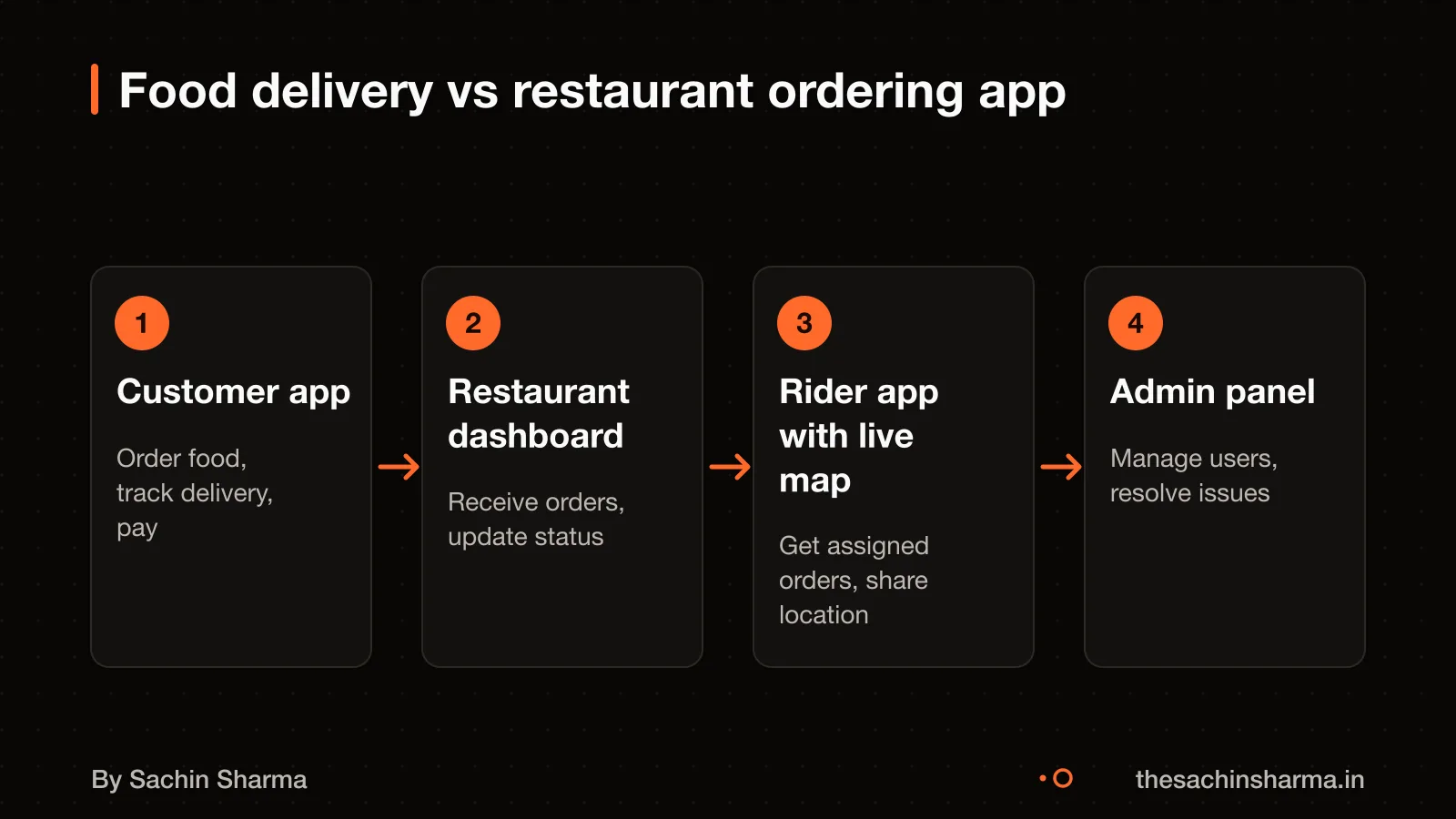
A food delivery app connects users to multiple restaurants and includes rider dispatch and live tracking. While a restaurant ordering app only handles orders for one brand. You do not need rider dispatch if you are a single restaurant using your own staff or an existing service like Swiggy Access. A simple ordering system is enough when you want customers to place orders online but manage delivery yourself, which cuts cost and complexity.
Some food delivery apps are built for individual brands, while others connect users to multiple restaurants. For example, a local biryani shop can use a Flutter app to take orders and payments, then deliver using family or hired help. This avoids the backend cost of managing riders, live GPS tracking, and dynamic routing. Aggregator apps like Zomato or Swiggy already handle discovery and delivery for many. Building a dedicated delivery app only makes sense if you plan to scale across cities or offer unique logistics.
If you run one outlet and deliver locally, a basic ordering app with a payment gateway and order dashboard is sufficient. You can later expand if demand grows. Building a full delivery app too soon adds months of development and high maintenance with little return.
Must-have features for a food delivery app
Where the money goes: the real cost components
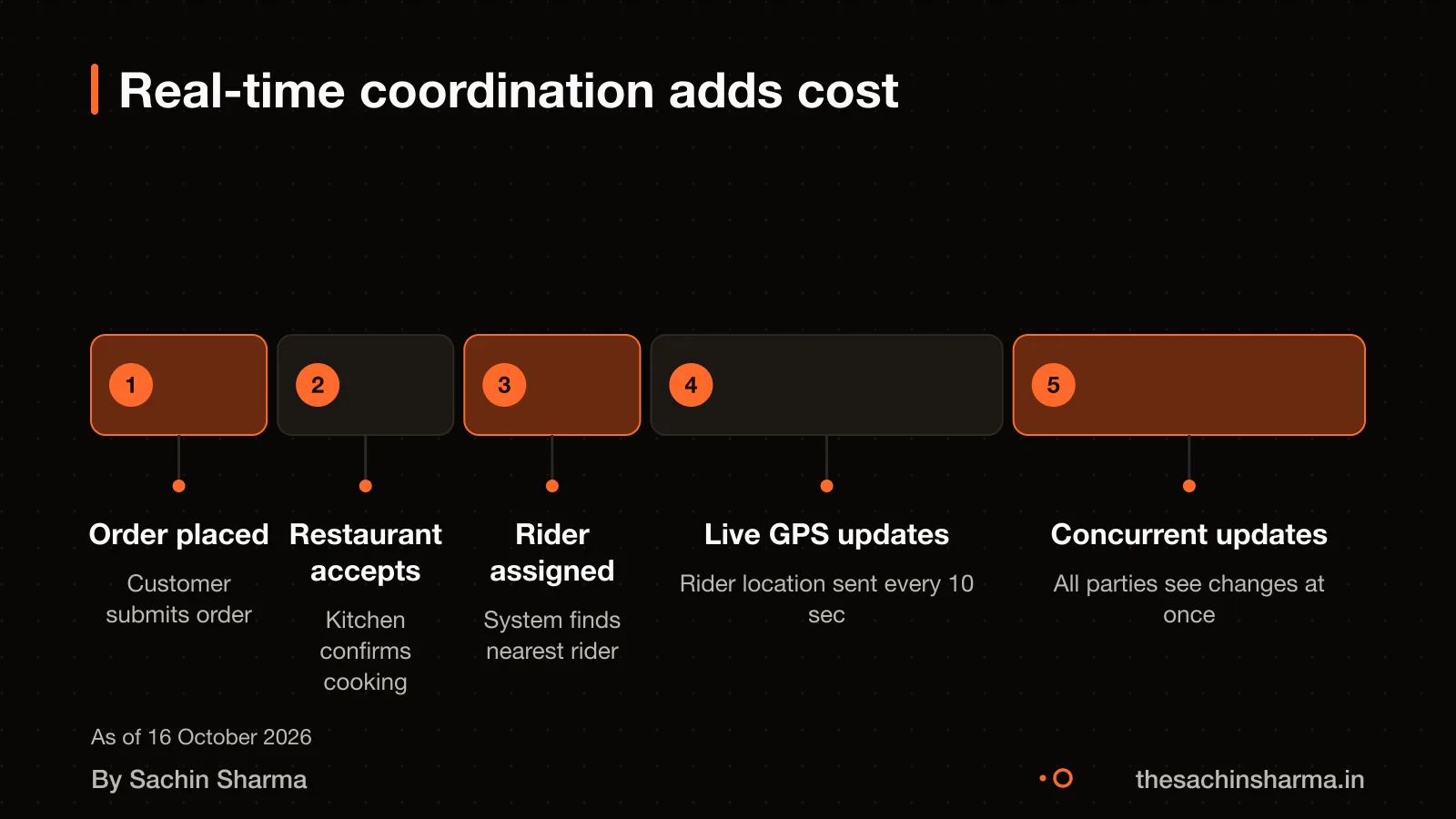
The main parts that make up the cost are UI/UX design, front-end and back-end development, API integrations, testing, and cloud infrastructure. Payment integration costs between $3,000 and $8,000, as it needs secure gateways like Stripe or Braintree and compliance with financial rules. Backend development costs more than front-end because it handles real-time coordination between users, restaurants, and riders, which adds complex logic and error handling. For example, when you place an order, the backend must confirm kitchen capacity, assign a rider, update delivery time, and process payments, all in seconds. Real-time tracking and maps through APIs like Google Maps add another $5,000 to $10,000 to the budget. This includes GPS sync, route optimisation, and live status updates. UI/UX design and front-end work focus on screens and interactions but rely on a strong backend to function. Testing ensures all roles, customer, restaurant, rider, see correct data at the right time. Infrastructure includes servers, databases, and cloud costs to keep the app running 24/7.
You can cut costs by using standard design systems and limiting custom animations. But do not skip backend testing, bugs here break the whole flow. The best tech stack balances speed and long-term maintenance Best tech stack for a food delivery app.
Want a number for your idea? Send one line on WhatsApp. I reply with what drives the cost and what to cut.
Message me on WhatsAppWhy real-time systems cost more
Live tracking raises costs because it needs constant GPS updates, real-time map rendering and server coordination between users, riders and restaurants. This means more data, higher server load and greater battery drain on phones. As an estimate, assuming Google Maps Platform integration, real-time tracking adds $5,000 to $10,000 to setup costs. The ongoing cost comes from API usage: Google Maps API can run $300 to $1,500 per month once you scale up. These fees depend on how many trips you run and how often positions update. For example, updating a rider’s location every 15 seconds for 1,000 active trips a day will use more calls than hourly updates. You also need extra server capacity to handle live connections. The system must stay reliable even when many users move at once, like during lunch rushes. This complexity makes development and testing harder. There is no public data on the exact cost to maintain this system monthly or to update it for new OS versions. To control costs, some apps limit update frequency or use lighter location methods when the app runs in the background.
How long it takes to build
An MVP for a food delivery app takes about 12 weeks to build. This timeline assumes a focused scope, a dedicated team, and no major delays in feedback or testing. The longest stages are backend setup and real-time system integration, as these handle order routing, rider assignment and live tracking. These parts need careful design because a delay of even 30 seconds can break the user experience.
Testing takes longer than in other apps because all roles, customer, restaurant and rider, must work together at once. You cannot test the customer’s order flow without a mock restaurant accepting it and a rider picking it up. Bugs often appear only when all three systems interact. For example, an order might show as confirmed but not reach the kitchen if the restaurant’s internet drops for 10 seconds.
As an estimate, a 12-week timeline assumes one mobile app (customer), a basic restaurant dashboard. A rider app, and a backend with order and payment logic. Delays happen if you add features like dynamic pricing, multi-vendor settlements or offline mode. Teams working part-time or with unclear goals often take 20 weeks or more.
Step-by-step process to build a food delivery app
Custom app vs white-label: which costs less?
A white-label solution is a ready-made app that you rebrand as your own. It costs less and launches faster than a custom build. As of 2026, white-label food delivery apps cost $5,000 to $20,000 and go live in 2 to 4 weeks. This is much cheaper than a custom app, which can cost several times more and take over 12 weeks to build.
The main trade-off is control. With a white-label app, you cannot change core features or workflows. You are limited to what the provider offers. Custom apps let you shape every part of the user experience, integrate with your systems, and scale on your terms. But they need more time, money and technical input.
White-label works if you want to start fast with a proven design. Custom development fits when you need unique features or plan to scale across cities. The choice depends on your budget, timeline and long-term goals.
You can compare all three paths, custom, white-label or using an existing platform. In the full guide: Build or buy a food delivery app: custom, white-label or platform?
Hidden and ongoing costs
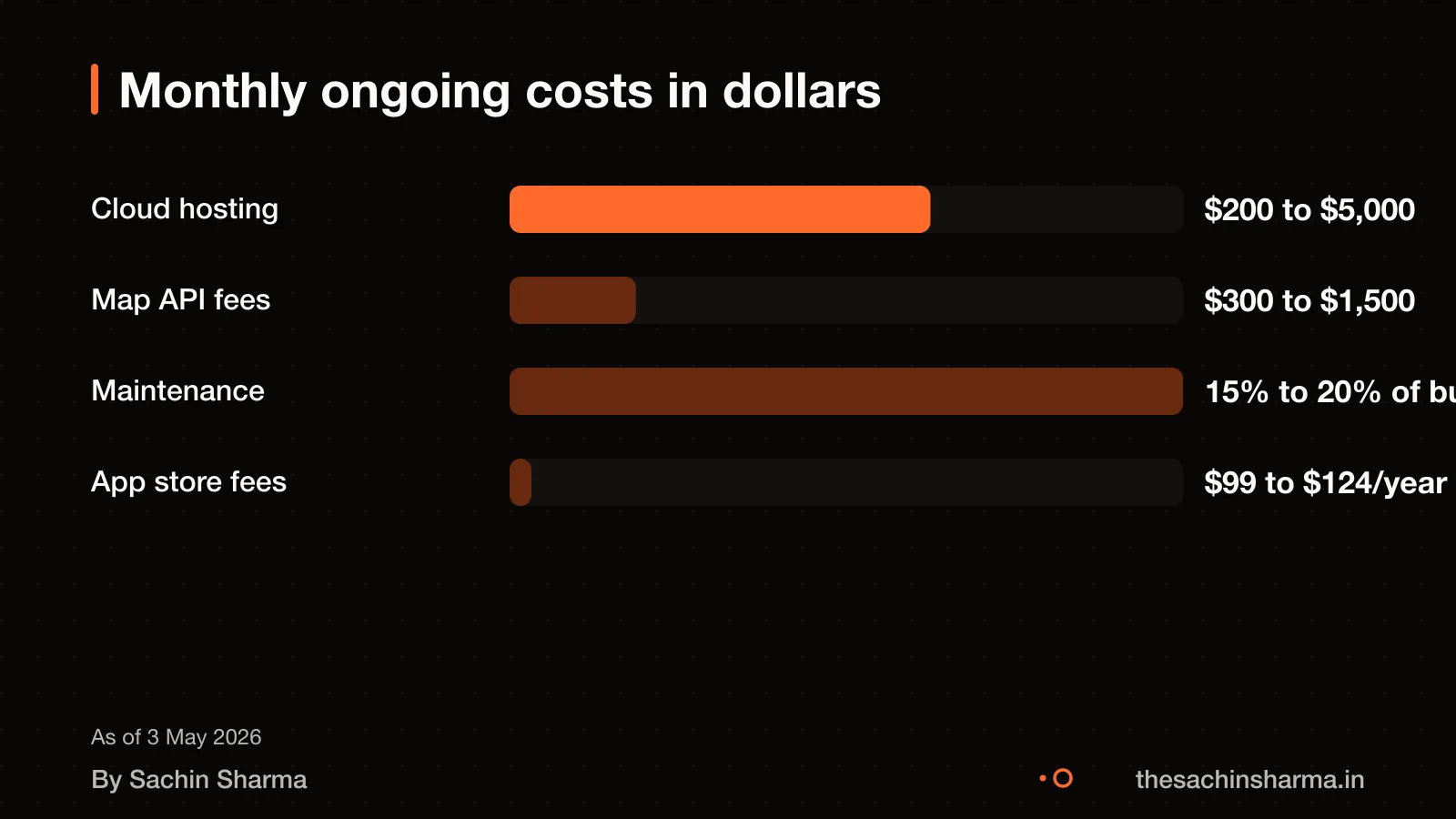
Your food delivery app will have monthly and yearly costs after launch. These include cloud hosting, API fees, maintenance, and app store fees. You must plan for them to avoid surprises.
Cloud hosting costs $200 to $5,000 per month. This cost goes up as more users join. You pay for server space, data transfer, and real-time coordination between users, riders and restaurants.
This fee applies when you use live tracking, route optimisation, or distance-based pricing. It scales with usage.
Maintenance costs 15% to 20% of the initial development cost every year. This covers bug fixes, security updates, OS compatibility, and minor feature tweaks.
App stores charge annual fees: $99 to $124 per year for Apple and Google. These are fixed and must be paid to keep your apps live.
While exact figures for restaurant dashboards, rider apps or commission engines are not known, these standard costs apply to all food delivery apps. Always ask your developer for a breakdown of ongoing expenses.
How to check if a quote is fair
A fair quote should list each major part: user app, restaurant dashboard, rider app. Backend APIs, real-time tracking, payment and commission logic, testing, and ongoing maintenance. It should not group costs under vague labels like "UI/UX" or "tech stack" without explaining what that covers. An under-quoted project often skips real-time coordination, multi-role workflows, or automated payouts, which are expensive but critical. If the quote seems too low, it may miss hidden costs like server load during peak hours or long-term updates. Ask your developer: "Does this include live order tracking, rider dispatch logic, and a working commission engine?" and "Have you tested the system under real load?" Also ask for a breakdown of time spent per module, not just total cost. A detailed estimate shows they understand the complexity.
Have a quote in hand? Send it to me and I will mark what is missing.
Message me on WhatsAppLegal rules for food delivery apps in India
You need an FSSAI license to operate a food delivery app in India if you take orders, handle food data, or collect commissions. The FSSAI Licensing and Registration of Food Businesses Regulation, 2011, requires every food business operator to register, with rules scaled by turnover and activity type. Since your app may act as a food business operator, you must apply for State or Central license based on your annual sales.
The Advertising and Claims Regulation, 2018, requires that food claims, including those related to ingredients. Allergens, and nutrition, are not misleading when shown on your platform. The Food Safety and Standards (Advertising and Claims) Regulation, 2018, bans false or misleading claims about food, such as “healthy” or “organic” without certification. Any filter or tag you use in the app must follow these rules.
Claims like “lowest prices” or “top-rated food” must be substantiated. Since laws depend on your business model and scale, consult a food safety lawyer to confirm your obligations. The legal requirement for GSTIN when taking commission is not known [unknown].
Who owns the app and can I switch developers?
You own the app’s code once it is built, and you can switch developers at any time. As I work directly with clients with no agency layers. The source code, design files and backend scripts are yours to keep and transfer. To move the app, you must back up all code, assets, certificates and configuration files. For iOS, Apple allows app ownership transfer between App Store Connect accounts when the app is sold or moved. On Android, the Developer ID Status API helps verify if a package name is registered to another developer. You will need the new developer’s verified account details and access to your current developer console. Without these, the transfer may fail. Always keep a full backup before starting.
When this advice is wrong
When this advice is wrong This advice is for people building a multi-restaurant food delivery platform. It does not apply if you run one restaurant or serve a small town.
If you are a single restaurant, you do not need rider dispatch, live tracking or a commission engine. You can use a simple online ordering system instead. The cost and effort are much lower.
If your town has low internet speed or few smartphone users, a custom app may not work well. A WhatsApp or phone-order based system could be more reliable and cheaper.
If you only want online orders and in-house delivery, you do not need a full delivery app. A basic website or third-party service like Swiggy Access or Zomato Gold may be enough.
Next step: message me on WhatsApp with what you want to build. No forms, no sales team.
Message me on WhatsAppAssumptions behind the numbers
- Team size starts at 3 people: 1 designer, 1 backend dev, 1 frontend dev
- Hourly rate assumed at ₹1,500 as a working baseline
- Real-time dispatch and multi-vendor features are assumed by default
- Phases and weeks based on evidence of typical MVP timelines
Work out your own number
I won't hand you a number that pretends to be the market. Instead, here is the working: set the weeks, the people and the rate, and see where the money goes.
Your working total
₹8,00,00020 weeks × 2 people × 5 days × ₹4,000- Scope and design15%
- Build60%
- Testing and fixes15%
- Launch and stores10%
The weeks shown are an example of a small app, there to be changed. Fees you pay others (store accounts, cloud, SMS) are not in this total.
What moves the price
- More user roles
Each extra role (admin, rider, vendor) adds complexity.
- Real-time dispatch
Live order allocation and tracking require robust backend systems.
- Multi-vendor support
Handling menus, inventory, and payouts from multiple vendors.
- Cutting to one platform
Building for Android alone halves the frontend work.
- Using managed auth and push
Firebase Auth and FCM reduce custom backend logic.
- Fixed scope and design
Fewer revisions mean fewer rounds of costly changes.
Fees that go to someone else
Google Play developer account
A one-time registration fee, paid to Google. Check the current amount.
Apple Developer Program
A yearly fee paid to Apple. Check the current amount.
Cloud, SMS, maps, payments
Usage-based, billed by the provider to you.
Ask for these before you sign
- How many weeks per phase, and with how many people?
- What is not included?
- Which fees do I pay to others directly?
- What happens to the price when I change my mind?
- What does the first month after launch cost?
Questions people ask
01Which components drive the cost of a food delivery app?
The main cost drivers are backend systems, real-time tracking, payment integration, and multi-role coordination between users, restaurants and riders. UI design is less costly than the logic that connects roles. Custom workflows and API integrations add more than visual features.
02Where do estimates for a food delivery app usually go wrong?
Estimates fail when they ignore real-time systems, concurrency handling, idempotency in payments, and ongoing API costs like Google Maps. They often only count visible features, not hidden coordination logic. As an estimate, assuming 40 screens and one payment gateway, real-time costs can add ₹5 lakh to ₹10 lakh.
03What can be cut without hurting the product?
Start with a white-label solution or an MVP to test demand. Skip AI features, advanced analytics, and multi-city support at first. A white-label app costs $5,000 to $20,000 and launches in 2 to 4 weeks.
04How much does it cost to update the app for new OS versions?
The cost to update for new OS versions is not known [unknown]. Work with your developer to plan for OS changes each year.
05Do I need a GSTIN if I take commission from restaurants?
If you earn commission from restaurants, that income is taxable and you may need a GSTIN. The legal requirement depends on your turnover and business structure. Check this for your case with a chartered accountant.
06Can I see proof of a developer's past food delivery app work?
Ask for live app store links and check if the apps are under their developer account. Use the Android Developer ID Status API to verify ownership of an app package. Look for custom backend logic, not just white-label apps.
07What happens if rider tracking fails during delivery?
Failed tracking leads to lost orders, customer complaints, and lower trust. The system should have fallbacks like manual status updates and alerts to riders. Design for partial failures, not perfect conditions.
08How do I verify a developer actually built the apps they claim?
Ask for access to source code or GitHub history. Use the Android Developer ID Status API to confirm the app is registered to their verified account. Public repositories or live dashboards add proof.
09What legal rules apply to food delivery apps in India?
The FSSAI Licensing and Registration of Food Businesses Regulation, 2011, requires registration for all food business operators. Additional rules cover labelling, advertising and imports. The Food Safety and Standards (Advertising and Claims) Regulation, 2018, also applies. Check this for your case with a food law expert.
10How much does it cost to maintain a food delivery app monthly?
Annual maintenance is 15 to 20% of the initial development cost. Monthly cloud hosting costs $200 to $5,000, based on usage. Google Maps API costs $300 to $1,500 per month. As an estimate, a ₹50 lakh app costs ₹7.5 lakh to ₹10 lakh per year to maintain.