What is fixed price development?
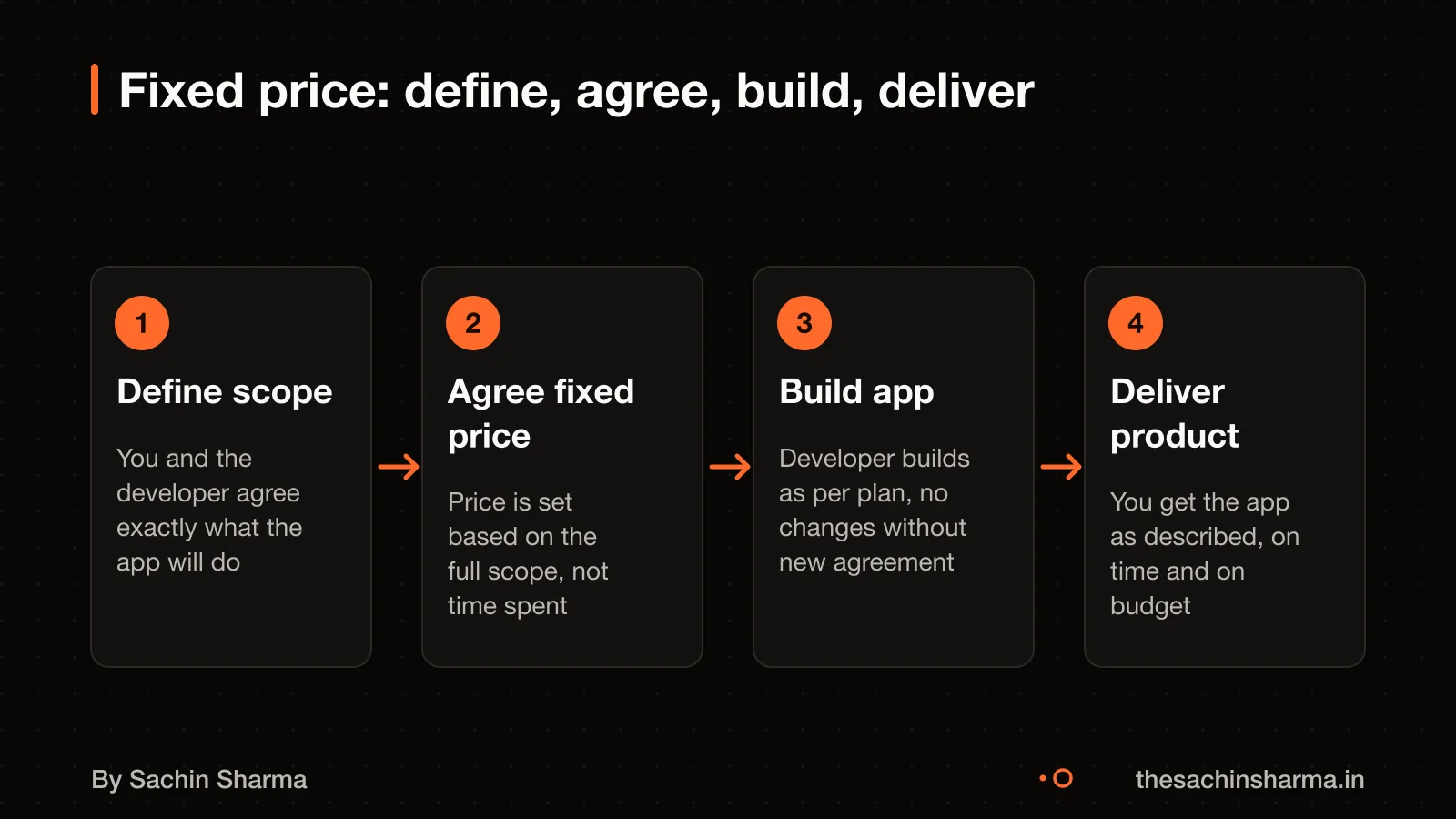
Fixed price means you and the developer agree on a total cost for the whole project before work starts. This works best when your app or website has clear features and screens that do not change often. The final cost is locked, so you are protected from surprise overruns if the developer takes longer.
But fixed price does not cover all changes. If you ask for new features or major edits later, those cost extra. Both sides must agree on what is in and out of scope up front. This leads to detailed talks early on, which helps avoid misunderstandings.
It is not always a one-time payment. The total may be split into milestone payments, such as 30% at start, 40% at mid-point, and 30% on delivery. The payment schedule is part of the contract, not the pricing model itself. Whether it is one payment or many, the sum does not rise unless the scope changes.
What is hourly (time and materials) development?
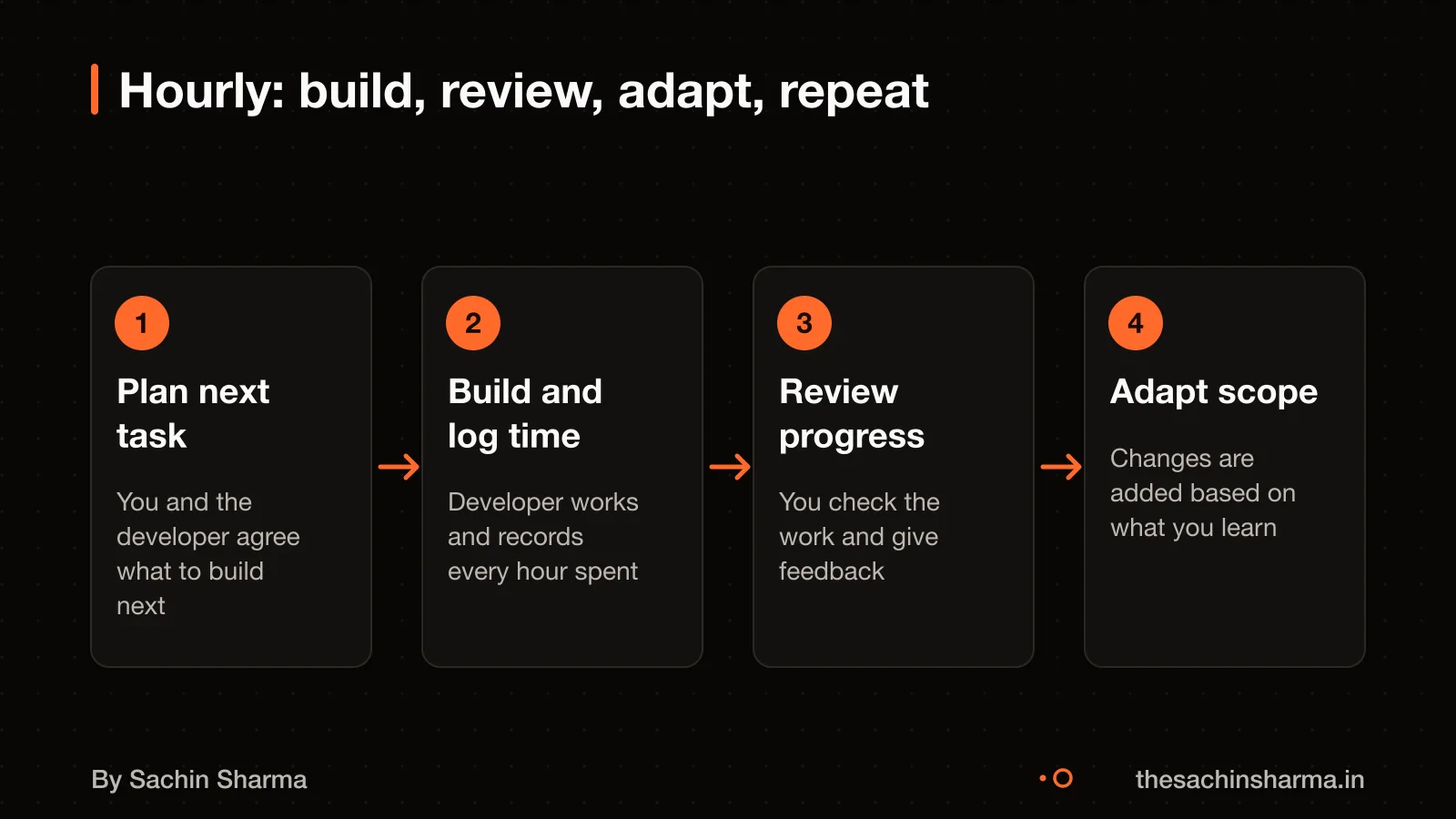
Hourly development means you pay for the actual time a developer spends on your project. This model offers fair payment based on real effort and allows changes as your needs evolve. You do not pay for every minute if you set a weekly cap or budget limit. The developer can charge more than expected only if work goes beyond agreed limits, which you can control with regular check-ins. For example, if a feature takes longer than planned, you can pause or adjust it. This method works well when your project scope is uncertain or likely to change.
When to choose fixed price
Choose fixed price only if your project has clear, unchanging needs and you can describe every screen and feature now. Projects like a simple brochure website or a basic data-entry tool fit this model because the work ends when the list is done. You must agree on a full spec before coding starts, and any later change. Like adding a login or a new report, may cost extra or break the timeline.
If your idea is still forming, fixed price can hurt you. I once scoped a legal app too early and missed key user needs, which led to rework. Small changes later are not free, so only pick this model if you are sure. For less clear ideas, hourly is safer.
Want a number for your idea? Send one line on WhatsApp. I reply with what drives the cost and what to cut.
Message me on WhatsAppWhen hourly is the better choice
Choose hourly pricing when your project has changing needs or a scope you cannot fully define now. This model fits early-stage products, AI feature development, or any work where feedback will shape the next step. You pay for actual time spent, so it adapts well as you learn what the app must do.
Hourly billing works best when you expect the work to take at least 8 hours. It is not only for big or long projects, but for any project where goals may shift. For example, if you start building a client portal but later add team roles or audit logs, hourly pricing covers those changes without new contracts.
This model supports ongoing work like adding features over months. If you are unsure how the app should behave in real use, hourly lets you adjust without delays. It is common in AI feature development where scope evolves. AI feature development often begins with unclear outcomes and needs this flexibility.
Hourly rates for developers in India
Junior developers in India charge ₹750 to ₹1,875 per hour as of January 2026, based on $10 to $25 at ₹75 per dollar. Mid-level developers charge ₹1,500 to ₹3,750 per hour as of January 2026, based on $20 to $50 at ₹75 per dollar. Senior developers charge ₹3,000 to ₹5,250 per hour as of January 2026, based on $40 to $70 at ₹75 per dollar. If your quoted rate falls outside this range, check whether the developer is including tools, testing, or project management.
The actual cost to you depends on how much time the work takes and how closely you track it. A senior developer charging ₹5,000/hour for 20 hours will cost ₹1.0 lakh. But the same work could cost more if requirements change and time is not controlled.
Flutter developer hourly rate in India for role-specific details.
Want a number for your idea? Send one line on WhatsApp. I reply with what drives the cost and what to cut.
Message me on WhatsAppRisks in fixed price projects
Fixed price projects can go over budget when the original estimate misses key tasks or risks. This often happens because the developer underestimates the effort or the client adds new needs during the build. As a result, the agreed price no longer covers the real cost. For example, I once lost ₹1.2 lakh on a project due to scope creep, where small unagreed changes piled up.
Scope creep is when you ask for extra features or changes after the project has started, but the price stays fixed. These additions take time and effort that were not planned. The developer may cut corners to stay within budget, leading to lower quality. For instance, they might skip testing, use simpler designs, or delay performance fixes.
Poor estimates hurt the project because they set unrealistic budgets from the start. If the developer does not account for hidden complexities, like third-party integrations or edge cases, the work will cost more than planned. Without a buffer, the developer has to absorb the extra cost or deliver less than expected.
To avoid this, define every screen and feature clearly before signing. Use a detailed spec or mockup. If changes are needed later, agree on a revised price before work begins.
best pricing model for app development
Have a quote in hand? Send it to me and I will mark what is missing.
Message me on WhatsAppHow to track hourly work and avoid waste
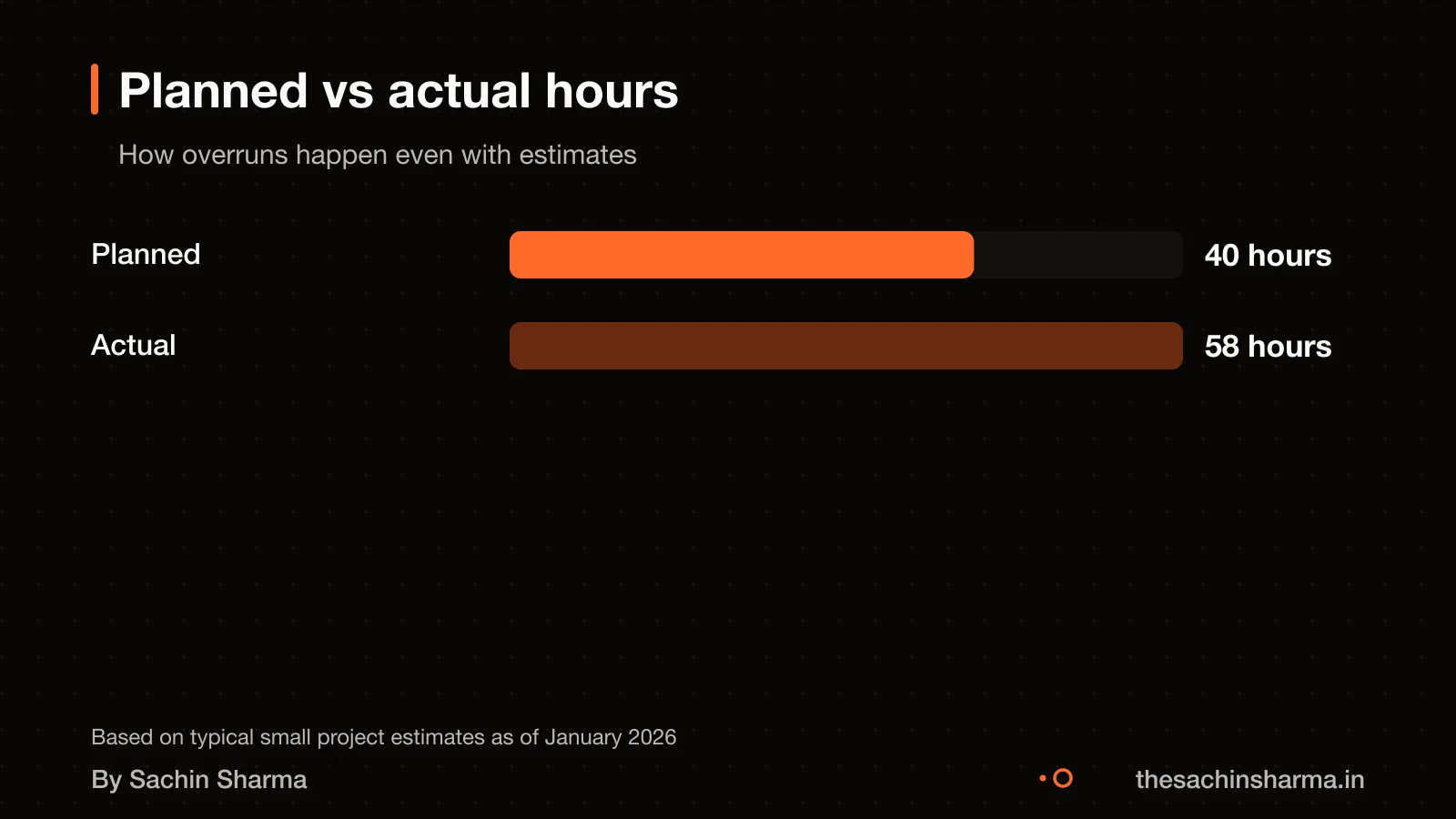
You can verify hourly work by checking time logs, code commits, and weekly reports that show planned versus actual hours. This keeps the work honest and shows if the project is on track.
Use tools like Tempo or Clockify to log time. These let you see when work happened and how long each task took. Code commits on GitHub or GitLab show real progress, as each upload marks completed work. Daily or weekly standups help you stay updated without long meetings.
A planned vs actual report compares what was expected with what was logged. Planned Time is the total hours set for a phase. Actual Time is what was recorded in timesheets. Time Variance shows the difference as a percent. A negative variance means more time was used than planned, which is a yellow flag.
Yellow flags for inefficiency include low commit frequency, long gaps between updates, and negative time variance. If commits happen less than twice a week or logs show long hours with little output, ask for a breakdown. As a rule, check that each day of work adds visible progress in code or design.
You should get weekly updates that include time logs, commit summaries, and variance data. This lets you catch drift early. If the developer resists sharing these, it is a red flag. Open tracking builds trust and cuts waste.
Who owns the code?
You own the code only if your contract says so. This applies whether you choose fixed price or hourly work. By default, the developer keeps ownership of the software they write. This is true unless a contract clearly transfers it to you. This rule is the same for both pricing models.
To secure your ownership, your agreement must include a clause that says the developer "hereby assigns" all rights to you. This phrase is standard in Indian contracts. Courts use it to prevent disputes. Without it, you may pay fully but still not have legal rights. You may not be able to reuse, modify or sell the code.
For example, a fintech startup once reused code from a past project. They faced a legal notice. The original contract did not include 'hereby assign'. A clear assignment clause would have avoided this.
Ownership depends on clear contractual assignment. It does not depend on payment type. So even if you pay a lump sum, do not assume you own the code. Do so only if the contract says so.
If you are outsourcing, this matters more than when building in-house. When you hire a freelancer or a small team, always confirm the contract includes the 'hereby assign' clause. [link to /compare/in-house-or-outsourced-development/ for why ownership matters more when outsourcing]
Legal documents and key clauses
For fixed price projects, use a milestone-based contract that lists deliverables, deadlines, and payment amounts for each stage. This keeps both sides aligned and ensures you only pay when work is done. Upwork requires milestones of at least $5 USD each. For hourly projects, use a time and materials contract that defines the hourly rate. Expected weekly hours, and how you will receive time logs or reports.
In both models, include clauses that clearly state what you will receive, when payments are due, and how changes to the scope are handled. A clause on intellectual property must confirm that you own the final code and design. Add a termination clause so you can end the project if progress stalls or quality drops. A witness clause can help catch errors or missed terms before they cause loss.
Always read the full contract and have a local lawyer review it. Do not sign if any term is unclear or missing. Since GST applicability and hidden costs are not documented, ask your lawyer to confirm tax treatment and whether payments cover hosting, tools, or third-party services.
When this advice is wrong
When this advice is wrong
Fixed price is not ideal for projects with potential future expansion or high client input. Fixed price contracts might present more problems than they solve when building something new where the scope may expand. You may end up with a product that meets the contract but not your users.
The hourly model is suitable for projects with evolving or hard-to-define scopes. This model needs trust and active oversight to avoid waste.
If the developer insists on one model and will not discuss trade-offs, be cautious. A rigid approach can mean they are not acting in your best interest. Instead, look for someone who explains risks and adapts to your project’s needs.
Related reading: custom app or readymade app, in-house or outsourced development.
Next step: message me on WhatsApp with what you want to build. No forms, no sales team.
Message me on WhatsAppAssumptions behind the numbers
- Developers may charge up to ₹3,000/hour (based on seniority and demand)
- ₹1 = approx. $0.012 (for illustrative conversion only)
- A typical small project takes 200 hours (illustration only, not a standard)
Pick your situation
I am a solo developer and work on both fixed price and hourly models depending on the project. My preference is to match the payment model to the nature of the work, not push one over the other.
Pick your situation
Fixed Price wins. Fixed price locks in the cost and protects your budget when nothing is expected to shift.
The whole comparison
| Fixed Price | Hourly | |
|---|---|---|
| Best for | Clear, stable projects | Evolving or unclear needs |
| Risk of overpaying | Low, if scope is unchanged | Possible, without oversight |
| Flexibility to change | Requires a new quote | Built into the model |
| Payment visibility | Total known before start | Adds up as you go |
| Developer preference | Good for quick sign-off | Preferred for complex work |
Whichever you choose, ask these
- Can you show past projects done on each model?
- What’s your process to prevent scope creep?
- How do you track and report time spent?
- Do I own the code once paid?
Questions people ask
01Is fixed price the same as a one-time payment?
No, fixed price means the total cost is agreed upfront, but payments can be split into milestones. A one-time payment is just one way to pay a fixed price. The contract should state when each payment is due.
02How much does fixed price development cost in India?
Fixed price depends on your project's scope, not a set hourly rate. Costs vary by features, screens, and complexity. For example, a simple app might start around ₹5 lakh. See the app cost in India page for full ranges.
03What hidden costs come with hourly billing?
Hourly billing may not include GST, payment gateway fees, or third-party tool subscriptions. These are often billed extra. Always check the quote for inclusions. Check this for your case with a chartered accountant or lawyer.
04How long does a fixed price project take?
As an estimate, large projects take 1 to 2 weeks just for planning and finalising the scope before work starts. Build time depends on the agreed features and can take several weeks or months.
05What slows down hourly projects?
Hourly projects slow down when goals are unclear, feedback is delayed, or changes are frequent. Your direction and availability affect progress. Set clear weekly goals to keep things moving.
06What maintenance costs come after the project?
Both fixed price and hourly projects need ongoing costs for hosting, updates, and bug fixes. These are not part of the build cost. See the maintenance cost guide for average yearly amounts.
07Can I switch from fixed price to hourly later?
Yes, you can switch if both you and the developer agree. The contract must allow for termination or change. Discuss terms early to avoid delays if plans change.