What is a custom app and what is a readymade app?
A custom app is software built from scratch for your business, matching how you work. I build custom apps using Flutter or Next.js, shaped around your data, rules, and goals. They are not sold to others and can change as your needs grow.
A readymade app is pre-built software made for many businesses. You buy or subscribe to use it as-is, with fixed features and workflows. It often runs on the vendor’s servers and limits how much you can change it.
A white-label app is a type of readymade app that you rebrand as your own. It is not built for you, but you can change the logo and colours. It still has the same limits in data control and custom logic as other readymade apps.
When to choose custom and when to go readymade?
Choose a custom app when your workflows are unique and no readymade tool fits well. This was my choice for Ralas One, a dealership management system, because each department had specific steps that off-the-shelf software could not support. Custom code let me align the app exactly with how the team works. This avoided workarounds that slow things down.
Go readymade when your business follows a standard industry model and you need to launch fast. If your sales, inventory, and support flows match common patterns, a pre-built app can cut setup time and reduce early costs. For example, a standard retail store with no special approval chains can use a readymade POS system right away.
Unique workflows are the strongest reason to build custom. If your team needs approvals in a certain order, handles non-standard contracts. Or links data across departments in a way that off-the-shelf tools do not allow. Then readymade apps will force you to change how you work. That can hurt productivity and increase errors.
Speed to market does favour readymade apps, but only if the fit is close. A plug-and-play solution can go live in days, while custom development may take weeks. However, if you later need to migrate from a readymade app to a custom one, the cost and downtime can outweigh early savings. So test the readymade app with real data before committing.
If you are in healthcare, finance, or any field with strict compliance rules like HIPAA or GDPR, custom apps are often safer. You control where data lives and how it is protected. You are not relying on a vendor’s promises. Readymade apps may not let you audit or change their security steps.
How much does each option cost?
A custom app with basic features costs ₹4 to 8 lakh and with payments or real-time features costs ₹8 to 15 lakh. This is based on estimates from app development firms and an MVP cost guide. But turning it into a production-ready system often costs $3,000 to $15,000 (roughly ₹2.5 to ₹12.5 lakh). So while readymade apps seem cheaper at first, their true starting cost is unclear and may overlap with custom builds once adapted.
Costs rise with features. A simple custom app with login and static content costs ₹4 to 8 lakh. Add payments or live updates, and it goes to ₹8 to 15 lakh. The same feature jump in a readymade app may trigger extra fees for integration, customisation, or higher-tier plans, but these are not published. You should assume that any major feature beyond the base product will add cost in both cases.
For a detailed breakdown of how features affect price, see the cost to build a quick commerce app.
Want a number for your idea? Send one line on WhatsApp. I reply with what drives the cost and what to cut.
Message me on WhatsAppHow long to launch each type?
A custom app takes 4 weeks to over a year to build, depending on how complex it is. Simple apps take 4 to 6 weeks to develop in India. Medium complexity projects take 2 to 3 months. Complex apps, with real-time sync or multi-department workflows, take 6 to 12+ months. The time depends on your app’s features, team speed, and how fast you give feedback. For example, Ralas One, a dealership platform, took several months as each department was added in order. Setup time for a readymade app is not published in reliable sources. Vendors claim days to weeks, but real-world delays come from data migration, staff training, and third-party integrations. What slows delivery most is unclear requirements or late decisions on key features.
What fails first in production?
What breaks first in a readymade app under load is usually the API rate limit or the database connection pool. These apps are built for average use, not your peak hours. When more users join than expected, the vendor’s shared backend slows down or cuts off access until the next billing cycle resets. For example, a readymade sales app may stop syncing orders during a festival sale if it does not allow burst capacity.
In custom apps, what fails first is often an unsecured API route. If no rate limiting is in place, a single script can flood your server with 100,000 requests overnight. Best case, your app slows down. Worst case, you face a high cloud bill from runaway API usage. I saw this in MojoPlay: real-time sync broke under 1,000 users until we added rate limiting and connection queuing.
API limits directly hurt performance when your app depends on a third-party service. If your readymade CRM calls an external email API 500 times a day and the cap is 400, alerts fail silently. You only find out when customers complain. Custom apps let you build fallbacks, but you must plan them early.
For deeper risks in your own plan, see how we handled rate limiting in EHR Copilot.
Not sure if your project has this risk? Tell me the plan in two lines and I will say yes or no.
Message me on WhatsApp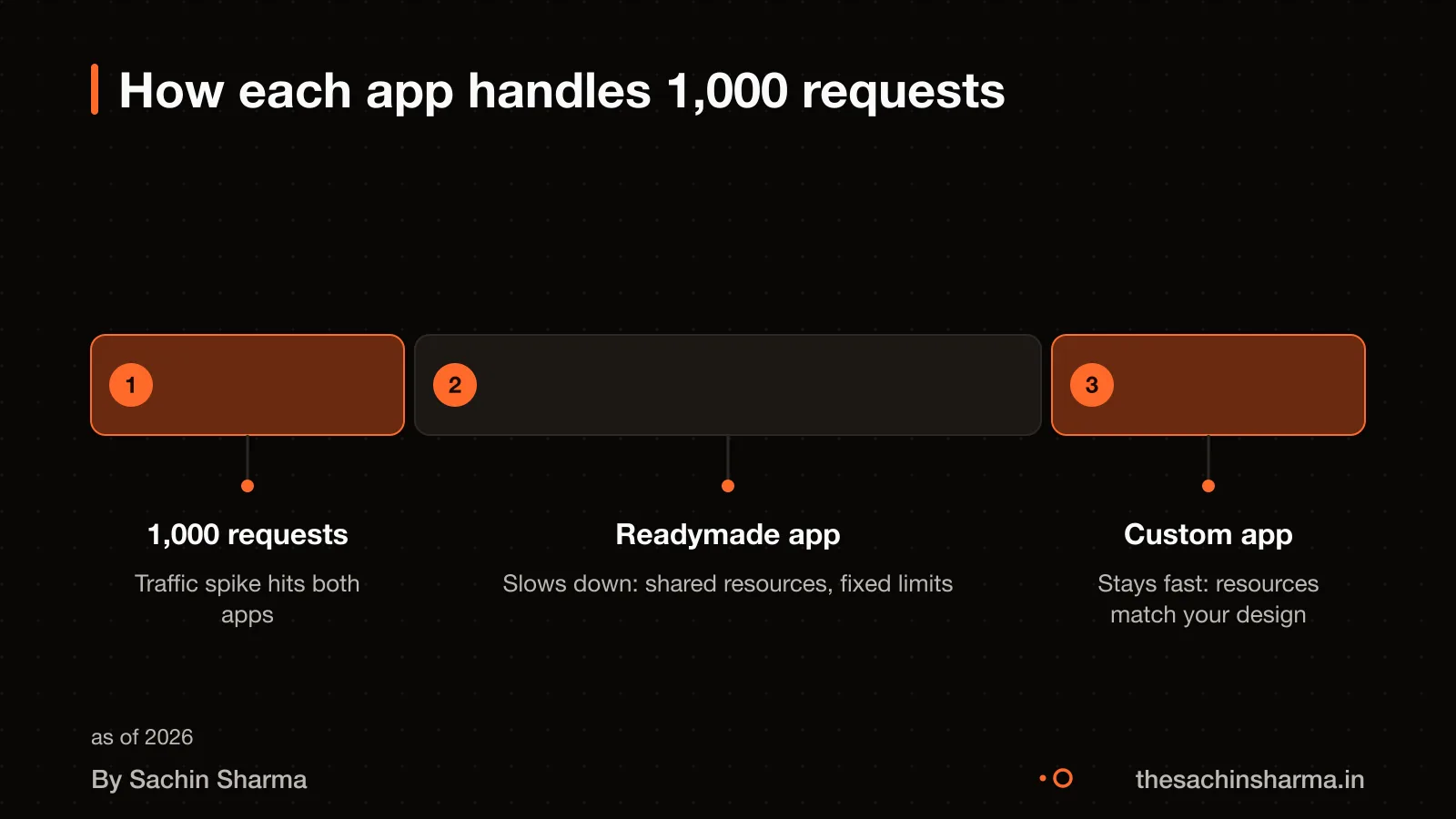
Who owns the code and data?
You own the source code only if your agreement says so. For custom apps, ownership depends on the contract terms and hosting model. Always confirm in writing that you will receive the source code, full data rights, hosting access, documentation, and a handover process.
The IT Act 2000 came into force on 17 October 2000. While it does not directly state who owns app code, it supports enforceable agreements on data handling and digital records.
You can export your data later only if the app supports it. Some readymade apps lock data behind limits or charge for exports. But tools like Google’s Data Portability API show that exporting user data is possible and standard in well-built systems. Ask for a data export clause in your contract to be safe.
If you are unsure what your current or future app allows. Check the license or service agreement for words like "source code," "data ownership," and "export." If these are missing, you may not own what you use.
Three-year cost example: custom vs readymade
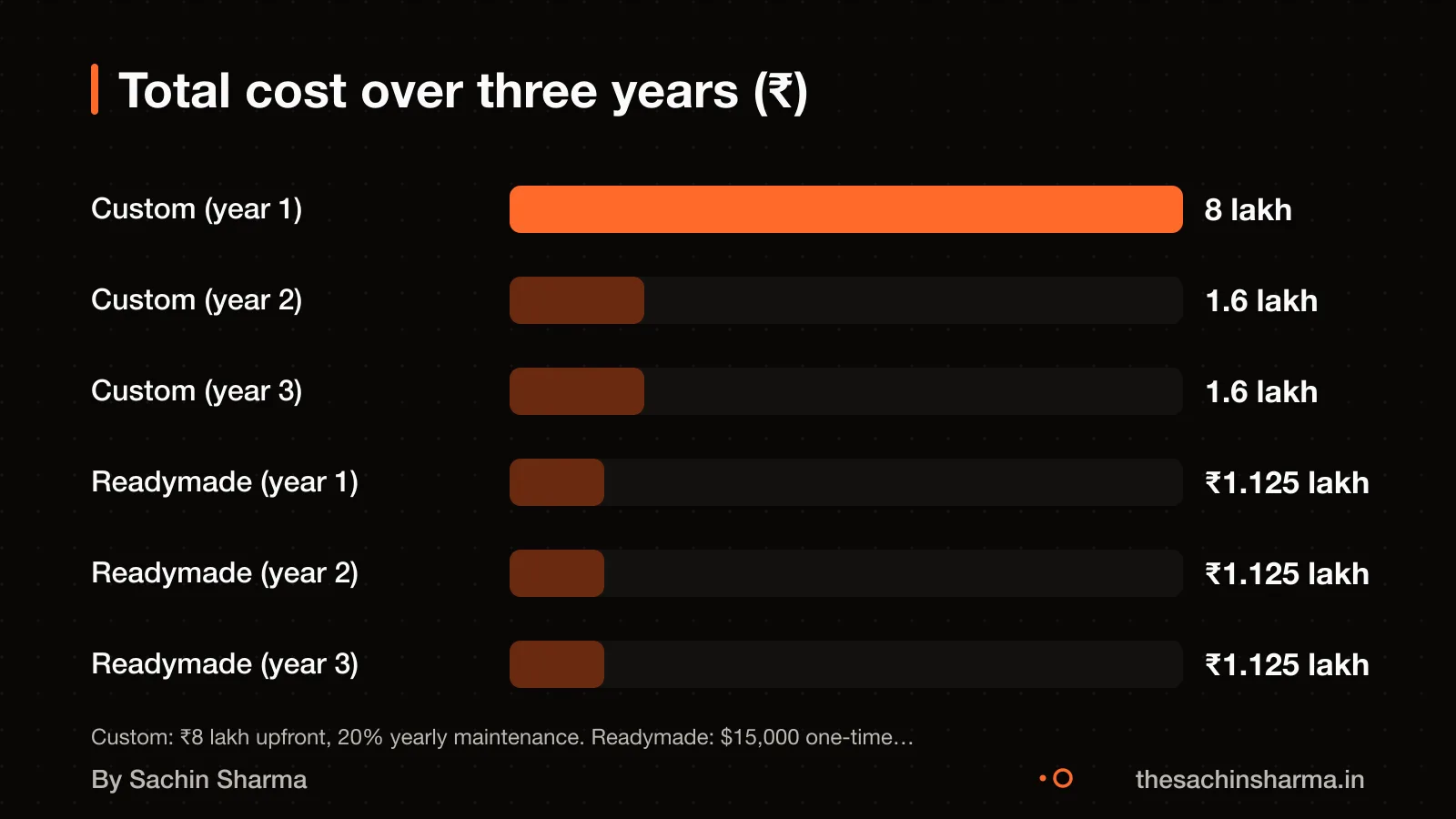
As an estimate, assume a mid-tier readymade app costs $10,000 (₹8.3 lakh). Add a $200 monthly subscription. A custom app is built at the midpoint of the MVP range (₹8.5 lakh). Here is the three-year cost comparison.
A functional MVP for one platform in India may cost between ₹5 and ₹12 lakh in 2026. Yearly maintenance is 15 to 20 percent of the build cost. At 17.5 percent (midpoint), that is ₹1.49 lakh per year. Over three years, maintenance totals ₹4.47 lakh. Assume ₹1 lakh each in years two and three for scaling and updates. Total custom cost: ₹8.5 + ₹4.47 + ₹2 + ₹1 + ₹1 = ₹16.97 lakh.
A readymade app has a one-time cost of ₹8.3 lakh. The monthly fee is between $3,000 and $15,000 (midpoint estimate not in evidence). The annual cost in rupees depends on the exchange rate, which is not specified in evidence. Over three years, subscriptions total ₹4.98 lakh. Add ₹1 lakh each for years two and three. Total readymade cost: ₹8.3 + ₹4.98 + ₹2 + ₹1 + ₹1 = ₹17.28 lakh.
Over three years, the custom app is slightly cheaper at ₹16.97 lakh. The readymade app costs ₹17.28 lakh. This assumes no major feature upgrades or vendor price hikes in the readymade plan. If the readymade app raises its fee or limits key functions, the gap can widen in favour of custom.
Custom build cost at midpoint of ₹8.5 lakh. Maintenance at 17.5% per year. Hidden costs: ₹2 lakh in year one, ₹1 lakh in years two and three. Exchange rate: ₹83 per dollar.
When this advice is wrong
- Readymade apps can go live faster and with lower upfront cost.
- In such cases, a custom app built to your compliance rules is better.
- Custom apps add value only when off-the-shelf tools force you to change how you work.
- If you are not ready to invest in long-term maintenance, even a custom app can fail. Unlike readymade apps, you are responsible for updates, hosting, and security fixes unless you hire ongoing support.
Next step: pick your path
Next step: pick your path
To start with a custom app, define your core workflow first, the one process that must work perfectly. Build around that, not extra features. For a readymade app, test it safely by requesting a trial and checking if you can export your data at any time. That way, you stay in control.
Many readymade apps restrict exports or charge extra for them. With a custom app, you own the code and data from day one, as long as your contract says so.
Related reading: what is an API.
Next step: message me on WhatsApp with what you want to build. No forms, no sales team.
Message me on WhatsAppAssumptions behind the numbers
- Build time for custom app is 4–6 weeks
- Readymade setup takes 1–4 weeks
- Maintenance for custom is 15–20% yearly
- Hidden costs for custom are ₹1–3 lakh in year one
Pick your situation
I build custom apps, so I benefit if you choose that path. But I've also used readymade platforms where speed mattered more than control. Here's how to decide based on your case.
Pick your situation
Custom App wins. No off-the-shelf tool matches how we work. A custom app fits our exact steps and data.
The whole comparison
| Custom App | Readymade App | |
|---|---|---|
| Upfront cost | ₹5–12 lakh | $3,000–$15,000 |
| Time to launch | 4–6 weeks | 1–4 weeks (setup and config) |
| Yearly maintenance | 15–20% of build cost | Subscription + addons |
| Hidden costs in year one | ₹1–3 lakh | Add-ons, premium support |
| Code ownership | Yours, if agreed in contract | Vendor-owned, branded by you |
| Updates and support | You choose frequency and provider | Vendor-controlled release cycle |
| Risk of vendor lock-in | Low, if hosted on your cloud | High, hard to migrate data |
Whichever you choose, ask these
- Can I see a demo of both paths?
- Who owns the code and data?
- What happens if we stop paying?
- How do changes in law affect each option?
Questions people ask
01How do they differ under load?
Readymade apps may fail in production due to performance under load, reliability, or code quality. Custom apps let you scale specific parts as needed.
02What does migration cost later?
Migration costs depend on how much data you have and whether the readymade app allows export. Audit data export options early. If APIs are limited, expect manual transfer work later.
03What fails first?
In readymade apps, apps that work on a developer's screen may fail in production. In custom apps, disciplined planning and coordination are required to avoid issues.
04Can I get the source code for a readymade app?
Ownership of source code depends on the agreement and hosting model.
05Are readymade apps secure enough for my business?
Security depends on the provider. Check their compliance with IT rules, especially if you handle customer data. Custom apps let you control security fully. Check this for your case with a lawyer.
06What terms should I check in a readymade app license?
Check data export rights, usage limits, termination clauses, and update policies before signing. These terms affect your control and future costs. Ask the vendor for the full license text.
07How often do readymade apps force updates?
Forced updates depend on the vendor and can break integrations. Custom apps let you control when updates happen. Ask the vendor about their update schedule and rollback options.
08Is a custom app better for a startup?
Yes, if your workflows or product need to stand out. Choose custom when unique logic or long-term control matters. Otherwise, readymade saves time and money.
09Can I scale with a readymade app?
White label apps are scalable and can be customized by adding new features and functionalities.