What is React Native, and how is it different?
React Native is a framework that lets you build mobile apps using JavaScript and React. It makes apps that look and feel like real Android and iOS apps. This is because your app’s interface uses actual Android and iOS components, not a web browser window.
Unlike native Android apps, which are built in Java or Kotlin, React Native lets you write one codebase for both Android and iOS. This can save time and reduce cost if you need both apps. But it still runs directly on the device, not in a browser.
Flutter is different. It uses its own widgets and draws the UI itself, rather than using the platform’s built-in components. Both React Native and Flutter allow cross-platform development, but React Native relies more on native platform features. Each has trade-offs in performance, look and maintenance.
What are Raipur’s internet and device conditions?
You should expect most users in Raipur to be on mobile networks with varying speeds, and many will use mid-range or older phones. India had 1,092.79 million internet subscribers as of 31 March 2026, of which 1,046.26 million were wireless users. This means nearly all your users will access your app over mobile data, not Wi-Fi.
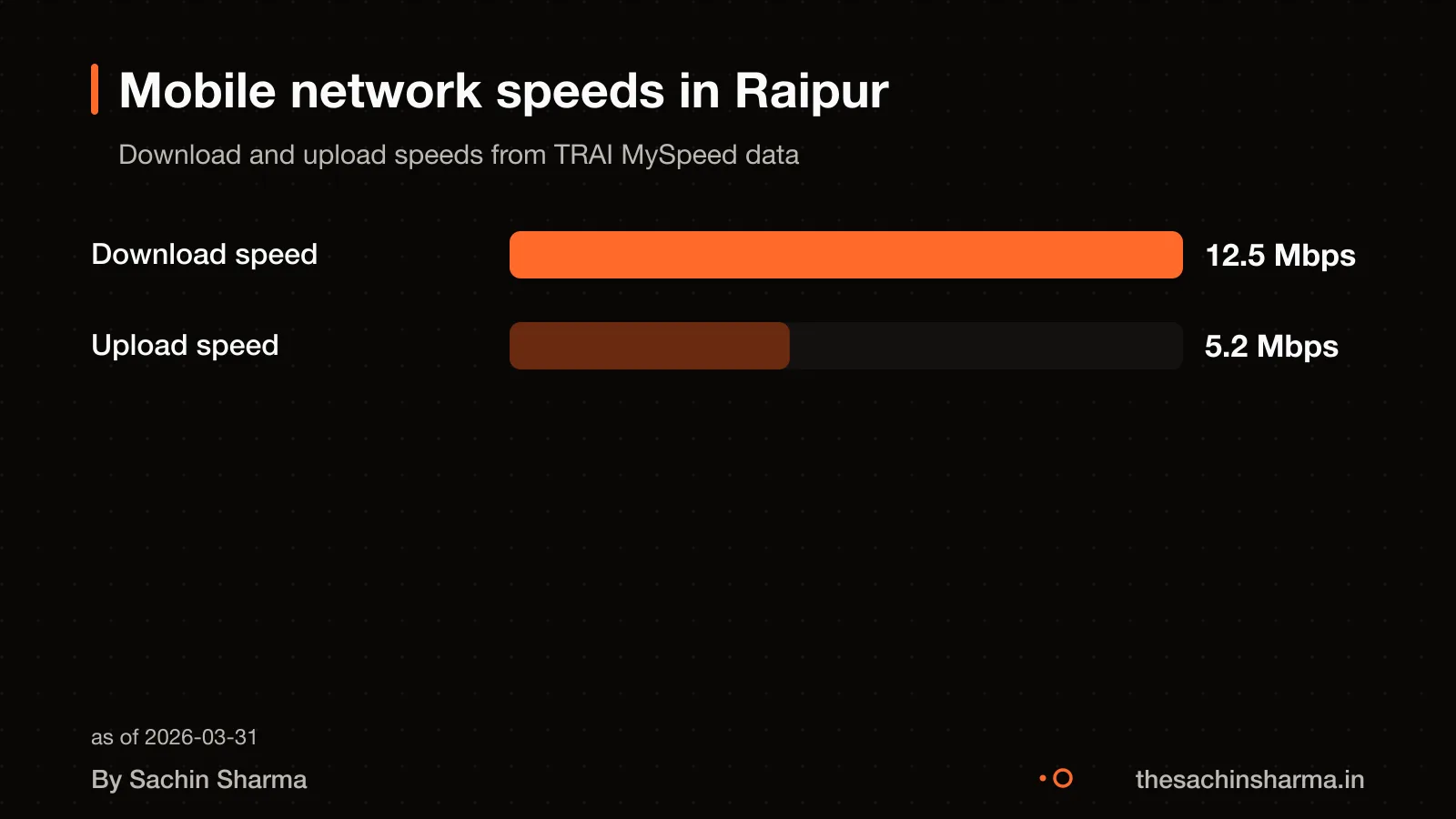
Network reliability can vary, especially in crowded or remote parts of the city. There is no Raipur-specific speed data, so assume conditions are typical for tier-2 Indian cities. You can test real speeds using the TRAI MySpeed app, available for download at myspeed.trai.gov.in.
Most users will not have flagship phones. While exact device models in Raipur are not known, mid-range Android phones with 4GB to 6GB RAM are common across India. Your app must run smoothly on these. A well-built React Native app can perform well on such devices, but only if the developer optimises for memory use and offline function.
If your users are likely to face poor connectivity, consider a web app instead. For more, see web app vs mobile app in low-connectivity areas.
How much does a React Native developer in Raipur cost?
A React Native developer in Raipur likely charges between $35 and $50 per hour for senior-level work, based on South Asia regional rates. This means a simple app MVP could cost $15,000 to $40,000. These figures are not specific to Raipur, as local pricing data is not published. You should treat them as a starting point. Rates may vary based on the developer’s portfolio, app complexity, and how much native module work is needed. For example, adding offline sync or background location tracking will increase hours. There is no evidence that React Native developers in Raipur charge more or less than React.js developers, that comparison is not documented. As an estimate, assuming a 12-week build at 30 hours per week, your cost could be around $12,600 to $18,000. This does not include design, testing, or post-launch updates. For a clearer number, see the cost to build a quick commerce app, which includes real-world budget items.
Want a number for your idea? Send one line on WhatsApp. I reply with what drives the cost and what to cut.
Message me on WhatsAppHow long does it take to build a React Native app?
A simple React Native app takes 6 to 8 weeks to build. A mid-size app takes 10 to 12 weeks, and a complex one takes 14 to 16+ weeks. Enterprise apps can take 24 to 31+ weeks to build.
The main factors that cause delays are unclear requirements, last-minute feature changes, backend system slowdowns. Problems with third-party APIs, and poor communication between you and the developer. For example, if your app needs to pull data from an older billing system. That system is slow or poorly documented, your timeline may stretch by several weeks.
If your developer says the app will be ready in less than six weeks, ask what corners are being cut. Fast delivery often means less testing, lower quality, or missing features. On the other hand, a timeline longer than 16 weeks for a standard app may mean over-engineering or weak project management.
Delays are common when the app must work smoothly on low-end phones or in areas with patchy internet. To stay on track, set clear goals up front, review progress every week, and freeze the feature list before coding starts.
Who owns the app and the code?
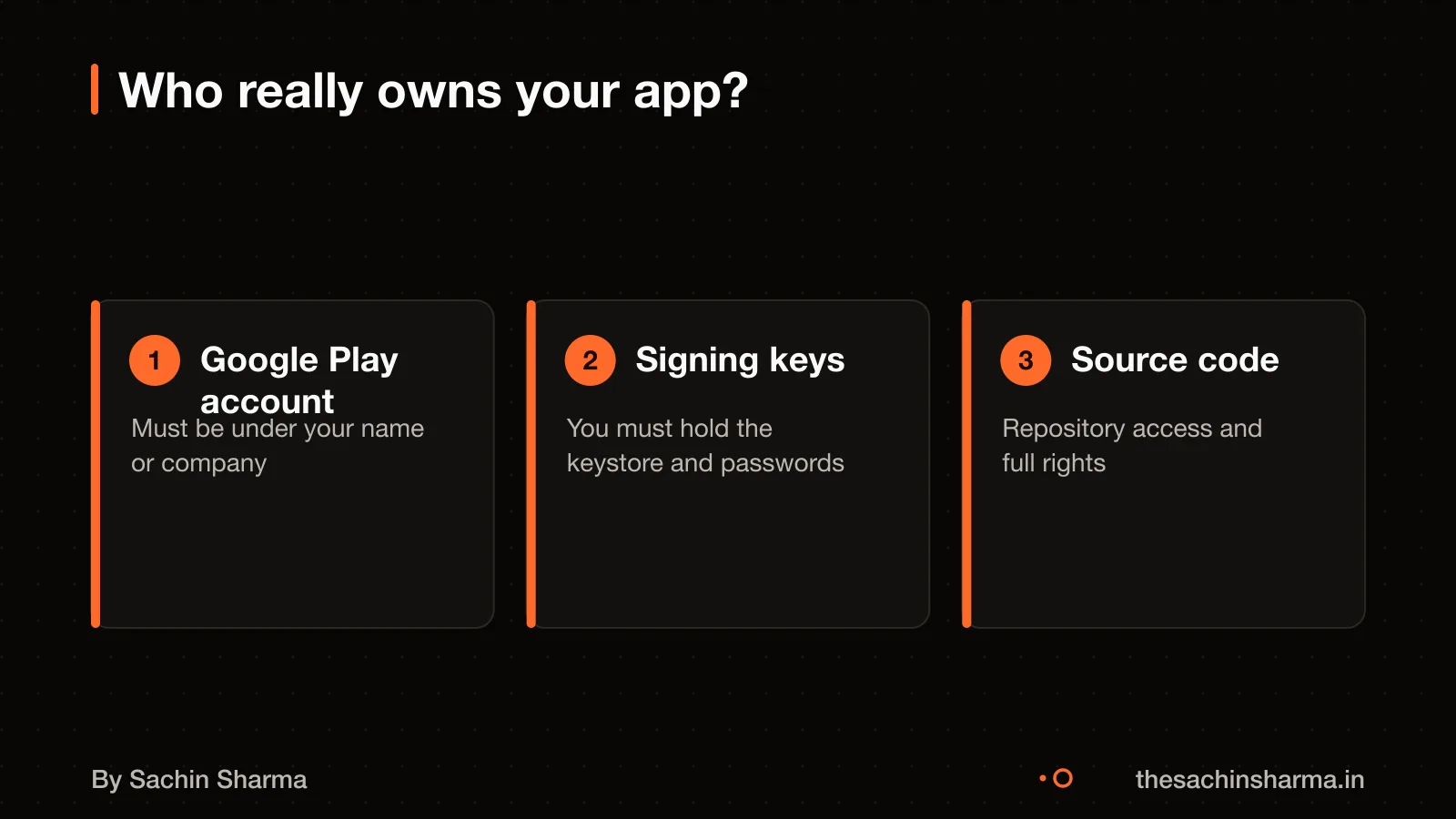
You own the app only if the developer signs over the source code, copyright and IP, and gives you the signing keys. Paying for development does not automatically transfer ownership under Indian law. Without full ownership, you cannot update, rebrand or sell the app later.
To stay in control, you should own your Google Play and Apple Developer accounts from day one. If the developer sets them up, they may retain access. Instead, create the accounts yourself and add them as a team member with limited permissions.
For example, in *work that runs on promises* Aashwasan, the client owns the full stack, including source code and deployment credentials. This allows long-term updates without depending on the original developer.
Handover of signing keys is part of a complete ownership transfer. After launch, test this by publishing a small update yourself. If you cannot, you do not fully own the app.
What are the risks in React Native development?
Project delays are common when requirements are unclear, features change during development, or backend systems and third-party APIs do not work as expected. Unexpected technical hurdles, testing failures, or slow app store reviews can also add time. You may face longer timelines if your developer is not in your time zone or lacks strong technical leadership.
Poor communication is a major risk. If your developer does not update you regularly or avoids clear commitments, small issues can grow. Scope changes without agreement can inflate costs and delay launch. To reduce this, agree on a clear scope and process for handling new requests before work begins.
Lack of written ownership is a serious warning sign. If a developer hesitates to sign over full rights to the app and code. It may mean they plan to retain control or charge extra later. Always get ownership terms in writing before paying any money. This protects you if the relationship ends or you need to switch developers.
How can I verify a developer’s real experience?
Check their apps in the store, not just the demo videos. Look at the five-star and one-star reviews to see if users report crashes, slow performance or features that do not work. A stable app has steady ratings and updates that fix real issues. You can test the app on a low-end phone to see if it stays responsive during use.
Ask the developer to show their CI/CD pipeline, such as GitHub Actions or Bitrise, that runs tests and builds the app automatically. A good setup includes unit tests, UI tests and crash reporting with tools like Sentry or Firebase Crashlytics. These show they care about long-term stability, not just launch.
To validate past projects, ask for a live link or the app store listing. Then check if the app matches their claims. You can also ask how they handled updates or bugs after launch.
As an estimate, vetting a developer properly may cost $2,000 to $5,000 in time and tools. But it can save you $50,000 or more by avoiding a bad hire. This includes paying for a technical audit or a trial task.
For more on how to judge quality, see "how do you know it is good?" in the EHR Copilot project. There, real user feedback and technical checks were used to improve the tool.
Have a quote in hand? Send it to me and I will mark what is missing.
Message me on WhatsApp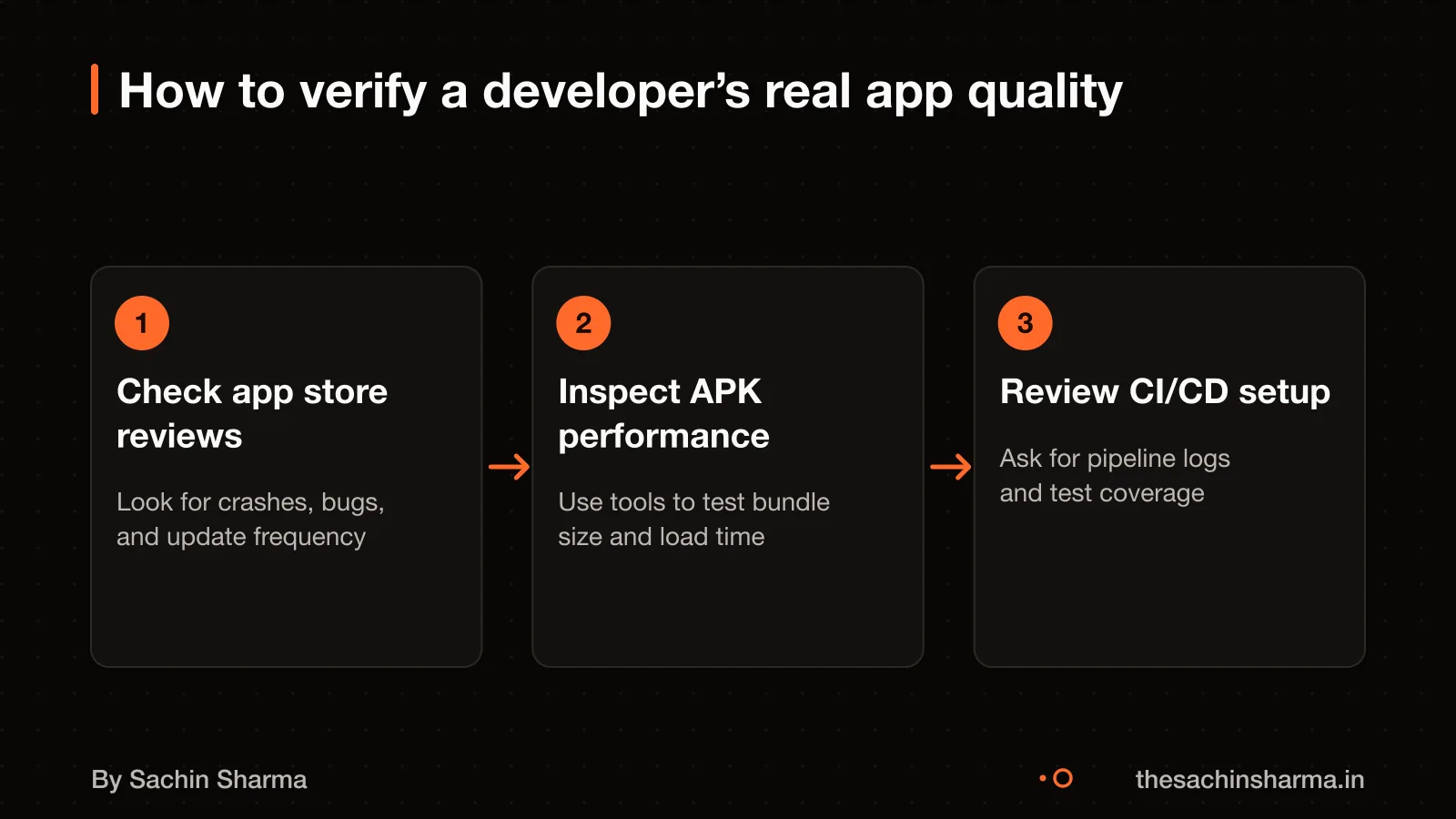
When you should not hire a React Native developer
- If your business can run on a website or WhatsApp bot, do not hire a React Native developer. Many services in Raipur, like local shops or service providers, work better with a simple website or automated WhatsApp messages. These are cheaper, faster to build, and easier to update. See when a website is better than an app.
- If your budget is too tight for long-term maintenance, avoid a React Native app. Even a stable app needs updates for new phone OS versions, bug fixes, and security patches. These costs come every few months and add up. If you cannot set aside funds for this, the app may break over time and lose users. Build something simpler first.
Related reading: how do you know it is good?.
Still unsure between an app, website or WhatsApp bot? Tell me your business and I will say which fits.
Message me on WhatsAppQuestions people ask
01What support and updates should I expect after app launch?
Support after launch depends on your developer's maintenance plan. Some offer fixed-hour packages, while others charge per incident. Ask for their update frequency, response time, and cost for bug fixes. Check this for your case with a chartered accountant or lawyer.
02What extra costs come after launching a React Native app?
After launch, you may pay for hosting, app store fees, and maintenance hours. Google Play has a one-time $25 fee, and Apple charges $99 per year. Ongoing costs include server bills and updates for OS changes.
03What are the steps in building a React Native app?
Common steps include planning core features, UI/UX design, frontend and backend development, testing, and launch. Design takes 2 to 4 weeks, and core development takes 4 to 8 weeks. Ask your developer for their full workflow.
04What legal agreements should I have when hiring a developer?
Use a work-for-hire agreement, IP assignment clause, and NDA to protect your idea. These ensure you own the code and sensitive data. Check this for your case with a lawyer.
05Should my app support regional languages in Raipur?
If your users speak Chhattisgarhi or Hindi, consider adding regional language support. Many users in Raipur may prefer content in their native language. Check with your target audience before deciding.
06Are there tech hubs or IT parks in Raipur?
There are no verified tech hubs or IT parks in Raipur. The city is growing in digital services, but infrastructure details are not public. Confirm local options through business networks or the chamber of commerce.
07What industries in Raipur need React Native apps?
Retail, logistics, and local services may benefit from mobile apps. Ralas AutoCorp, an authorized Ather dealership in Raipur, has a website. Explore needs in your sector before building.
08How do I start hiring a React Native developer in Raipur?
Send a one-line message with your app idea. I will reply with a technical checklist and next steps. You can also review the Ralas Group website to assess fit.