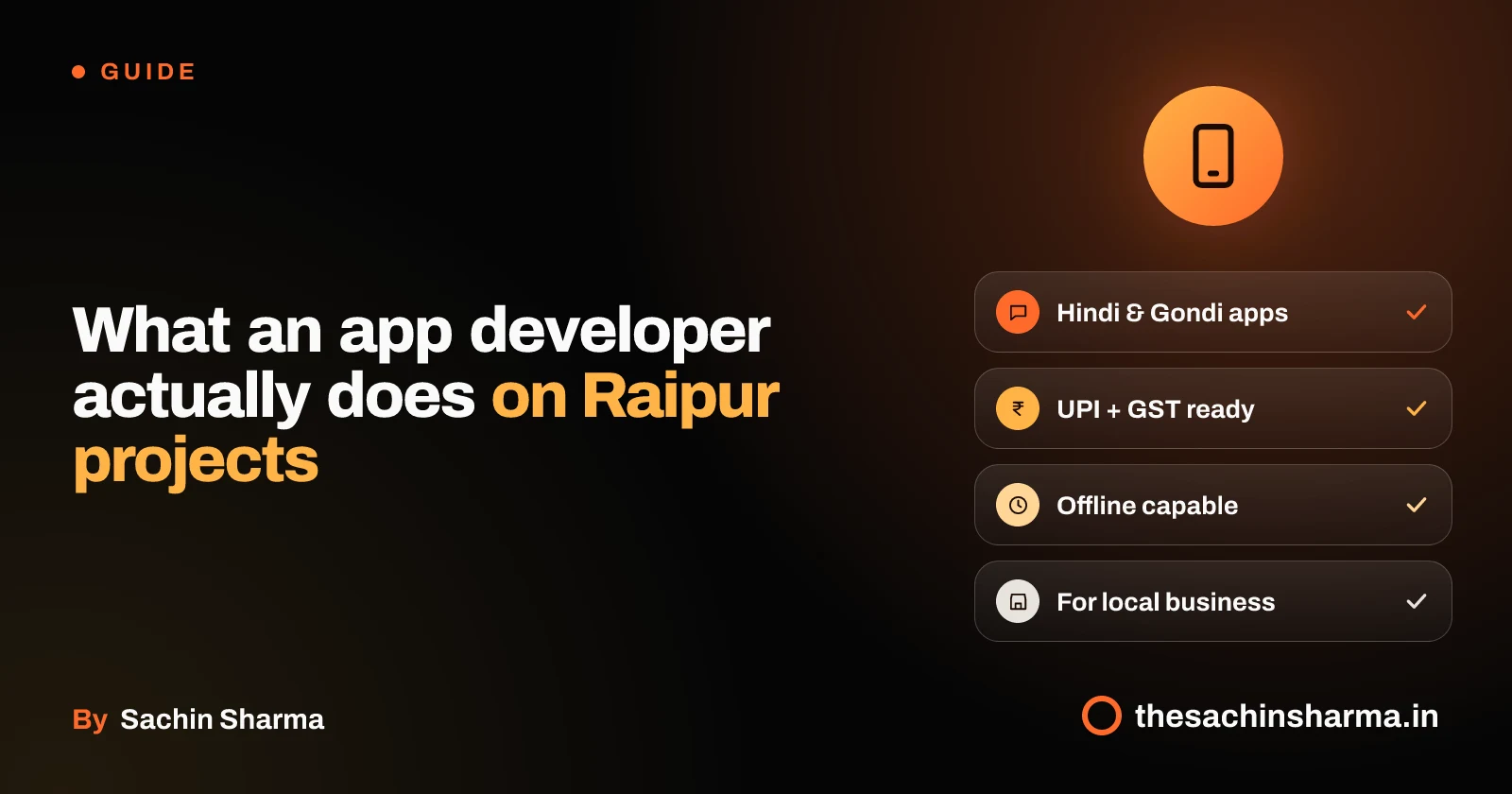
What does an app developer actually do on a Raipur project?
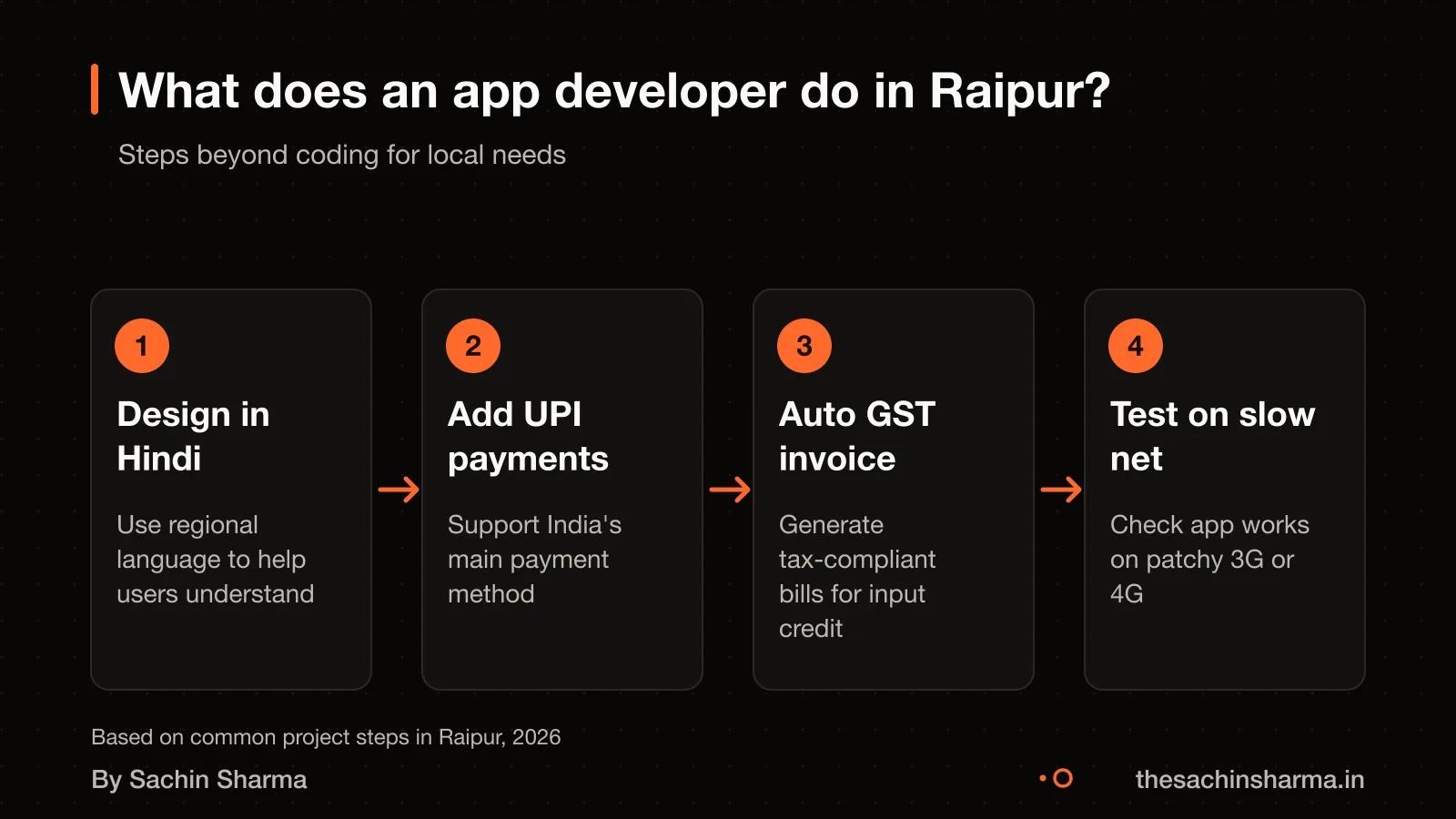
An app developer in Raipur handles more than just coding. They choose tools that speed up delivery and may adapt workflows to local business habits. For example, they may use a low-code platform like Zoho Creator to build mobile apps and automate workflows. This is useful when your team has spotty internet or needs quick updates without heavy coding.
Beyond writing code, developers decide how data is stored and synced. They set up offline-first systems so your staff can keep working even when the network drops. They also pick whether to use local servers, cloud tools, or hybrid models based on your needs. These choices affect speed, cost, and reliability.
They also integrate local systems like UPI for payments and GST-compliant invoicing. Since many users in Raipur may prefer Hindi or regional languages, developers plan for multilingual support early. The Adi Vaani app, developed by a consortium including IIT Delhi and IIIT Naya Raipur, shows how local language apps can be built.
They test the app in real conditions, not just on fast Wi-Fi but also on 2G or shared connections. This helps avoid crashes during peak hours. Developers also train your team and document steps so you can manage small changes later.
Local, remote or hybrid: what works in Chhattisgarh explains how work models affect delivery and support.
What are the most common types of apps built in Raipur?
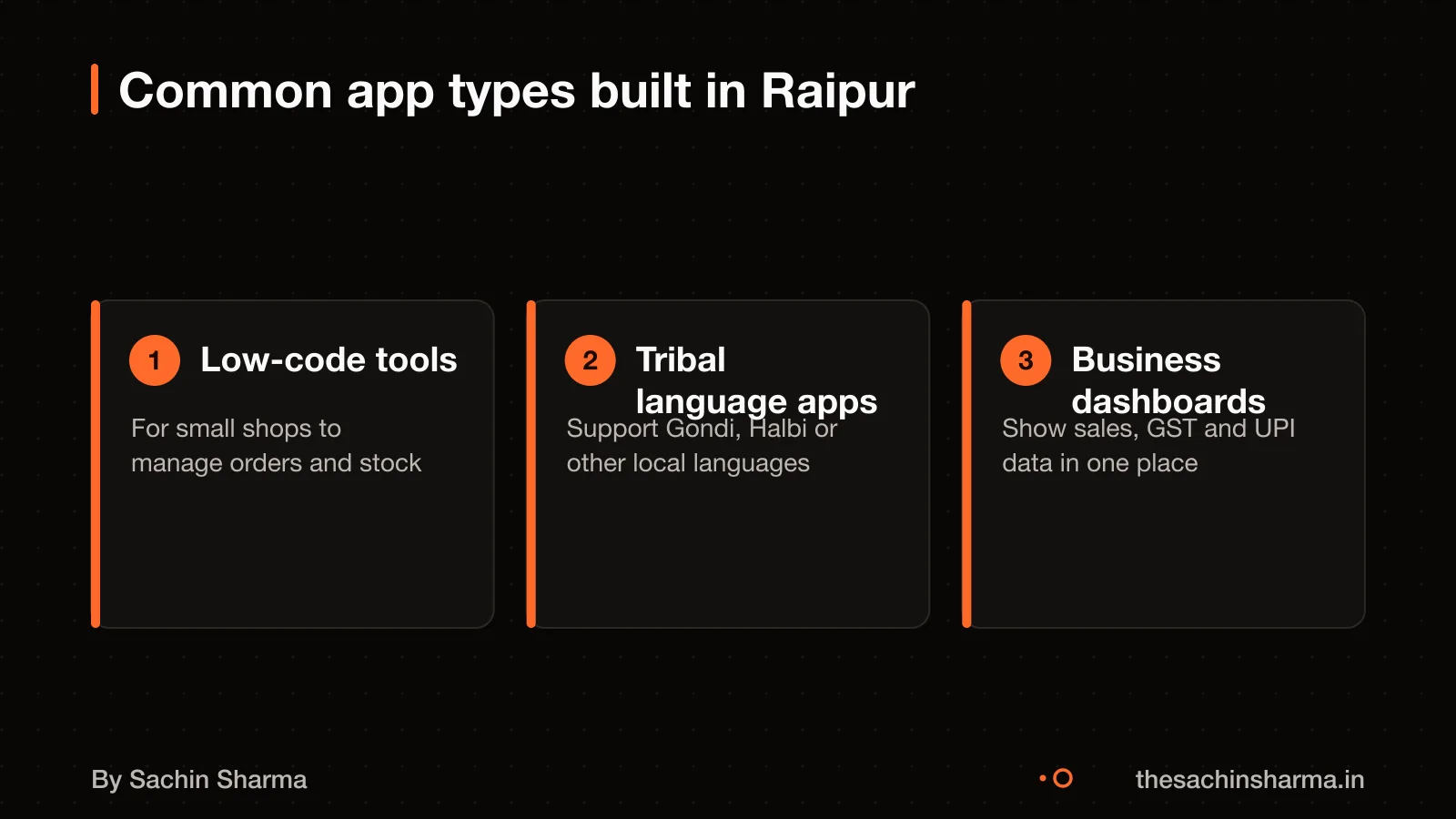
Most apps built for businesses in Raipur are mobile apps, online portals, and business intelligence dashboards. These help local companies manage orders, track sales, and view performance in real time. For example, a retail shop might use a mobile app to update inventory across branches.
In education and government services, apps like *Adi Vaani* support real-time translation between Hindi, English, and tribal languages such as Gondi. This helps bridge communication gaps in public health and literacy programmes. Such tools are especially useful in rural Chhattisgarh where Gondi is spoken.
Low-code platforms like Zoho Creator are used to build these apps quickly. They allow non-developers to create forms and workflows with drag-and-drop tools. However, they may not support complex features like offline sync or deep customisation.
One real example is *Adi Vaani*, which enables speech and text translation for tribal communities. It shows how apps in Raipur often solve local language and access challenges. For commerce apps, you can compare tech options to fit your needs Best tech stack for a quick commerce app in India.
Which industries in Raipur use custom apps?
Government, education, and tribal welfare services in Chhattisgarh use apps like Adi Vaani for real-time translation and access to tribal language content. These apps help bridge language gaps and improve access to public services. For example, a Gondi language translator app supports tribal communities by enabling translation of English. Hindi into Gondi, which can be effectively used in health, education, and other sectors. This app also allows users to view Ministry guidelines and schemes in tribal languages.
Education initiatives benefit from digital tools that support local language use and offline access. Government digitisation efforts are growing, especially in delivering welfare schemes to remote areas. Tribal communities are increasingly using digital tools, though adoption depends on connectivity and local support.
While private sector use exists, public service apps are more visible and documented. Manufacturing, retail, and services may use apps, but specific examples from Raipur are not available. Digital transformation in small businesses is possible but not yet widely reported.
You should check if your industry has similar needs in language support or government integration, as these are proven use cases in the region.
What does it cost to build an app in Raipur?
The starting price for a basic app can be as low as ₹9,999, based on a fixed-price offer from Roy Digital App Studio. This may cover simple apps with minimal features and no custom backend. However, the average cost for most functional apps is not known. More complex apps, such as those with user accounts, payments, or admin panels. Can range from ₹10,000 to ₹15 lakh, as seen in nearby markets like Noida. This wide range depends on features, design, and integration needs.
Cross-platform development using tools like Flutter or React Native may reduce cost by 20 to 40% compared to building separate Android and iOS apps. This is because one codebase works on both platforms, cutting development time. As an estimate, a mid-level app with 10 screens, login, and a payment gateway might cost ₹3 to 5 lakh when built cross-platform. The assumption is that backend, testing, and deployment are included, and no major third-party API costs apply.
Some developers offer fixed-price packages for standard app types. These often come with predefined features and timelines. But for custom needs, most developers charge by the project or hour. Fixed quotes may not include post-launch updates or server costs.
App development cost in India varies widely by city and scope. For a clearer picture, see the national breakdown: App development cost in India: the working.
Want a number for your idea? Send one line on WhatsApp. I reply with what drives the cost and what to cut.
Message me on WhatsAppHow long does it take to build an app in Raipur?
The time to build an app in Raipur is not known [unknowns]. This is because no public data tracks average project timelines for app development in the city. However, the duration depends on several factors you should plan for.
Scope is the biggest factor. A simple app with five to six screens and no live data might take 6 to 8 weeks.
Team size affects speed. A solo developer may take longer than a small team working in parallel. But coordination also takes time, so adding more people does not always shorten the timeline.
Delays often come from late feedback or changing requirements. If you delay in reviewing drafts or ask for new features mid-project, the timeline may extend. Regular check-ins help avoid this.
Other factors include the review and testing phase, which can take 2 to 3 weeks, and app store approval, which takes 1 to 7 days. Integration with local systems like GST e-invoicing or UPI payments may need extra time if the documentation is unclear.
As an estimate, assuming a mid-sized team and clear scope, a typical business app takes 10 to 14 weeks from start to launch. But this is not a guarantee. Your project may take less or more time based on your decisions and needs.
What tech stacks do developers in Raipur commonly use?
The most common tech stacks used by developers in Raipur are not known. However, based on national trends, some developers may use Flutter for mobile apps and Next.js for web apps.
Flutter allows one codebase to run on both Android and iOS, which can reduce development time and cost. React is often chosen for web dashboards and portals that need real-time updates. Low-code tools can speed up delivery for simple workflows but may limit flexibility later.
How a developer chooses a stack affects how easy it is to fix bugs, add features, or switch teams later. A widely used, open-source stack like Flutter or React may have more developers who can maintain it. Closed or custom platforms may lock you into one team.
For example, I have used Flutter for offline-first apps like Loopin and Aashwasan, where data sync and local storage were key. CONFIRM the client may be named and what is public. For web tools, I have used Next.js with SQLite or Postgres, as in Daily and Ralas One, to support structured data and admin panels. CONFIRM the client may be named and what is public.
What are the risks of hiring a developer in Raipur?
Hiring a developer in Raipur carries the same risks as hiring anywhere in India: unclear scope, missed deadlines, and poor communication. These can delay your project or inflate costs.
Scope creep often starts when requirements are not written down. A developer may assume features you did not request, or leave out ones you expected. Without a clear contract, both sides end up unhappy.
Delays happen when milestones are not set or tracked. A developer might promise a quick delivery but fail to account for testing, approvals, or changes. Progress can stall if there is no weekly check-in or shared tool to track tasks.
Communication breaks down when language, time zones, or response habits differ. Some developers do not update clients regularly. You may need to chase for updates, especially if payments are not tied to visible progress.
To reduce risk, sign a simple contract that lists features, timelines, and payment terms. Break the project into milestones with deliverables. Use free tools like WhatsApp or Google Meet for weekly calls. Ask for screenshots or live demos every few days.
Specific risks of hiring a developer in Raipur are not documented. But clear agreements and regular contact help any project succeed.
What kind of post-launch support do developers offer?
Post-launch support practices in Raipur are not known. However, app developers across India commonly offer bug fixing, updates, and maintenance, but the terms vary by project and provider.
Bug fixing after launch may be included for a limited period, such as 30 to 90 days. If the app was built under a fixed-price contract. After that, fixes are often billed separately. You should confirm whether bugs are covered and for how long before signing any agreement.
Updates and maintenance are usually offered as an ongoing service. These include compatibility fixes for new Android or iOS versions, security patches, and feature upgrades. Some developers offer a monthly retainer, others charge per hour, and a few provide fixed-price maintenance plans. The choice depends on your app’s complexity and how often you expect changes.
Support pricing is not standardised. Retainers can start from ₹5,000 per month for light maintenance, while per-hour rates may range from ₹1,000 to ₹2,500. As an estimate, assuming minor monthly updates and two hours of support, costs could be around ₹7,000 to ₹10,000 per month. This is based on general market patterns, not Raipur-specific data.
Always discuss support terms before development begins. Ask for a written clause on bug coverage, response times, and pricing for future work. Without this, you may face delays or unexpected charges when issues arise.
What internet connectivity issues affect app design in Raipur?
Internet connectivity issues affecting app design in Raipur are not documented. However, as a best practice for uncertain networks, apps should be built to work offline or on slow connections. This means storing data locally on the device and syncing when the network is available. For example, a salesperson visiting shops in remote areas can record orders without signal and upload them later. This approach uses tools like local databases (Hive or SQLite) and background sync tasks. It reduces failed transactions and improves user trust. Slow or unstable networks are common in many parts of India, even if specific data for Raipur is not published. So, assuming poor connectivity is safer than relying on constant signal. Technical choices like offline-first design, lightweight APIs, and cached media improve real-world performance. These choices also reduce data costs for users. You should ask your developer how the app behaves with no network for at least 24 hours.
Are there IT parks or STPI units in Raipur for software firms?
There is no evidence of official IT parks or Software Technology Parks of India (STPI) units hosting software firms in Raipur. As of now, the city does not have formal infrastructure like dedicated tech zones or government-backed incubation centres for software companies. STPI units support software exports across India by offering tax benefits and high-speed connectivity. But there is no public record of such a unit operating in Raipur.
If a developer claims to be part of an STPI unit or based in an IT park. You should verify their registration directly on the official STPI portal (https://www.stpi.in). This will show whether the unit is active and what benefits it holds. Similarly, check the Chhattisgarh Industrial Policy portal or the Department of Information Technology, Government of Chhattisgarh, for updates on new tech infrastructure.
As of now, most software work in Raipur is done by independent developers or small studios working from shared offices or remote setups. The lack of formal tech parks does not mean quality work is unavailable, but it does mean you must check credentials more carefully.
You can also ask the developer for their GST registration details, which will list their official business address. That address can help confirm where they operate from and whether they are part of any organised tech cluster.
Freelancer or agency: which should you hire in Raipur?
A freelancer is enough when your project needs one skilled person to deliver a clear task. Such as building a simple app or updating a website. This works well for small businesses with a straightforward goal and a fixed budget. For example, if you need a basic UPI-enabled sales tracker for your retail shop. A single developer can build it using tools like Flutter or a low-code platform.
You need a full team when your project requires multiple roles, like a designer, backend developer, and QA tester, to work together. This is common for complex apps, such as a multi-branch inventory system with real-time sync and GST billing. Agencies can coordinate these roles, but they cost more and may add overhead.
Project complexity directly affects your choice. Simple apps with few screens and no integration can be handled by a freelancer. But if you need offline access, multi-user workflows, or integration with GST and banking APIs, a team effort reduces risk and speeds up delivery.
For a situational guide, see Freelancer or agency for a first app? Pick by situation.
How can you verify a developer's past work in Raipur?
Ask for live apps on the Google Play Store or Apple App Store, and check if the developer is verified on Android. A verified developer profile links a real-world identity to their apps, making it harder for bad actors to operate anonymously. You can also download and test the app yourself to see how it works in daily use.
For example, if a developer claims to have built a business app, install it and check if it loads quickly, works offline, and feels stable. Avoid developers who only show videos or screenshots, you need to interact with the real product.
Android verification helps by deterring bad actors who prefer to operate anonymously. While not all honest developers are verified, it is a useful signal when present.
Have a quote in hand? Send it to me and I will mark what is missing.
Message me on WhatsAppWho owns the source code after the app is built?
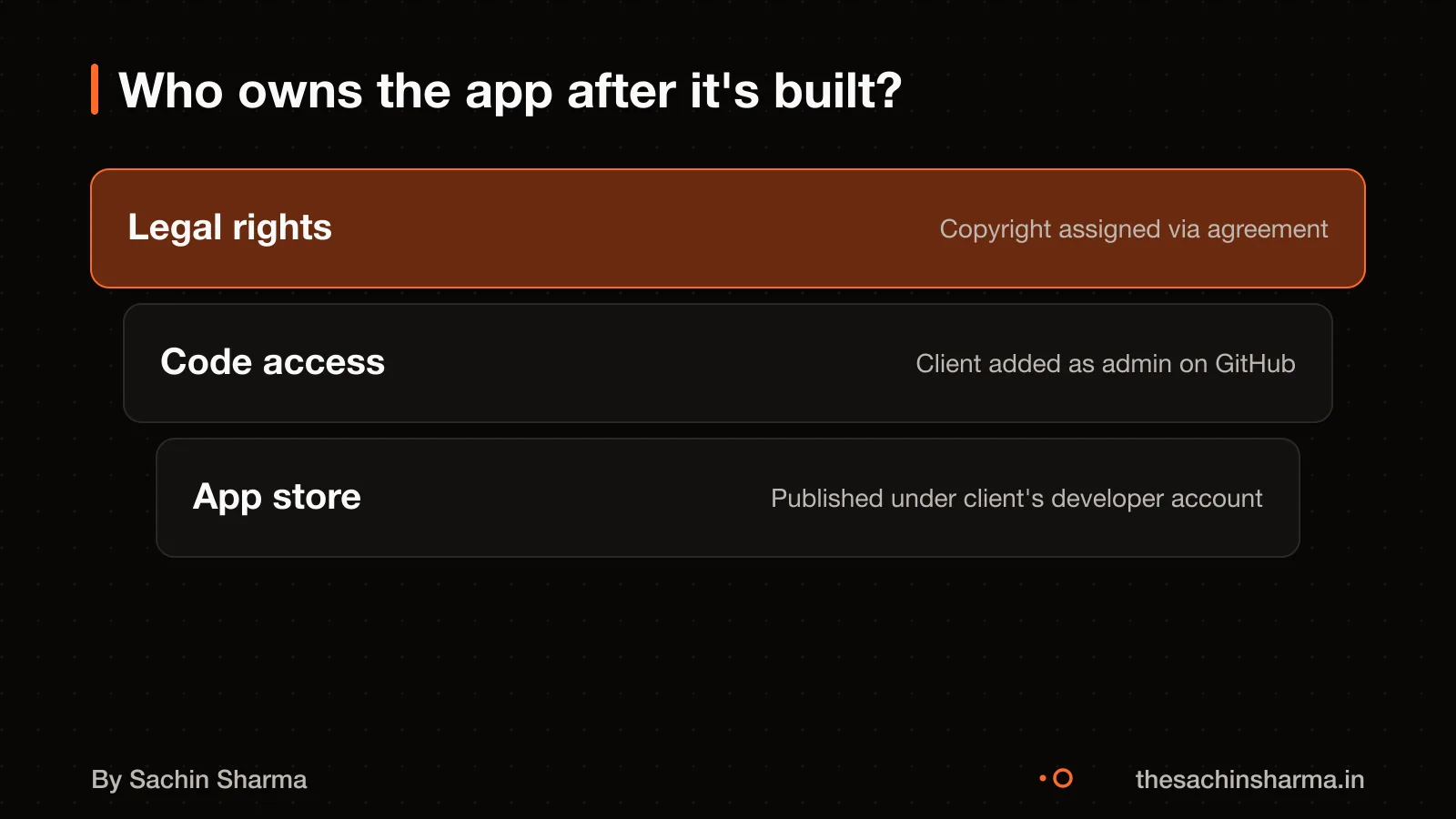
Paying for an app does not transfer ownership of the source code. In India, the developer who writes the code is the first owner of the copyright, even if you funded the project. This means that unless there is a written agreement, the code legally belongs to the developer, not you.
Ownership only changes hands through a formal, written assignment of copyright. Verbal promises or invoices with payment notes do not count. The only thing that transfers ownership is a signed document that explicitly assigns the source code rights to you.
For example, in my work on Legease, a Flutter AI legal-document platform, I retained ownership because it is my product. But in Project Rho, a client-funded agentic investing environment, the source code was transferred via a written agreement after delivery.
If the app is published under the developer's account, such as on Google Play or Apple App Store, they control updates and removal. You cannot make changes or move the app without their cooperation. Always insist on a written copyright assignment before the final payment.
When this advice does not apply
This advice is for small businesses in Raipur that need practical, low-cost apps for local use. It does not apply if your project needs specialist skills like AI model training, blockchain integration, or hardware-linked software.
If your budget is under ₹50,000 and you expect a fully custom app with backend, real-time sync, and multiple user roles. This advice may not help, such apps usually cost more and take longer than buyers expect. Consider starting with a simpler tool or a no-code platform instead.
This guidance also assumes your users have smartphones and some data access. If you are building for feature phones or areas with no internet, you need different design choices, like SMS-based systems or USSD.
Next step: message me on WhatsApp with what you want to build. No forms, no sales team.
Message me on WhatsAppSix clauses, in plain words
In Raipur, app developers solve for network gaps, language diversity, and local compliance. Here's what a solid developer agreement includes.
Raipur developers often serve tribal communities and small businesses. Meeting in person is easy, so use it to agree on scope and language needs.
The developer must state whether they are registered for GST and whether GST is included in the quoted price.
Why it matters: It avoids surprises at payment time and confirms legal compliance.
The clauses above explain intent in plain words. They are not legal text, so have a lawyer read the real agreement.
Read the quote with these
- Does the quote assume internet access?
- Is Hindi or Gondi interface included?
- Who exactly writes the code and for how long?
- Is GST charged separately?
Questions people ask
01What does the engineer actually decide on Raipur projects?
The engineer chooses offline-first design for poor connectivity, supports local languages like Gondi through tools like Adi Vaani, and integrates UPI for payments. They may use low-code platforms like Zoho Creator. As this applies to apps serving tribal regions in Chhattisgarh, check your use case with a local developer.
02Which skills matter most for developers in Raipur?
Key skills include building apps using platforms like Zoho Creator, real-time translation of text and speech between Hindi. Tribal languages, and GST registration requirements for businesses with turnover exceeding ₹40 lakhs. These help deliver functional, accessible apps for government and tribal services in the region.
03How do I test a developer's claims before hiring?
Ask to see live apps on Google Play or the App Store, and verify the developer's profile on Android. Check their GSTIN if their turnover exceeds ₹40 lakhs. A verified profile links a real identity to the apps, reducing risk from bad actors. For your project, review their past work and confirm legal compliance.
04Can I build an app without knowing coding?
Yes, you can use low-code platforms like Zoho Creator to build mobile apps without coding. These let you create forms, workflows, and dashboards using visual tools. This works well for simple business apps, but complex features may still need a developer. See how to pick the right tool for your needs.
05Is GST registration mandatory for app developers?
GST registration is mandatory only if your annual turnover exceeds ₹40 lakhs (₹20 lakhs for special category states). It depends on turnover, not location or profession. UPI payments do not attract GST themselves. Check this for your case with a chartered accountant.
06How do I handle payments in my Raipur-based app?
You can use UPI via WhatsApp or send payment links to collect payments without leaving the chat. Users can pay via UPI, cards, or net banking without leaving WhatsApp. This suits small businesses in Raipur who rely on personal customer contact. Set up a payment gateway that supports these options.
07Should my app support Gondi or other tribal languages?
Yes, if your app serves tribal communities in Chhattisgarh, support for Gondi is important. About three million people speak Gondi across central India. Tools like Adi Vaani offer real-time translation between Hindi, English, and Gondi. This improves access for non-Hindi speakers. Link to local language resources if needed.
08What if my users have poor internet?
Design your app to work offline or on slow networks using offline-first methods. While specific connectivity data for Raipur is not known, this is a best practice in areas with unreliable internet. Use local storage and sync when online. Check real-world performance with users in low-connectivity areas.