What decisions does a developer make for you?
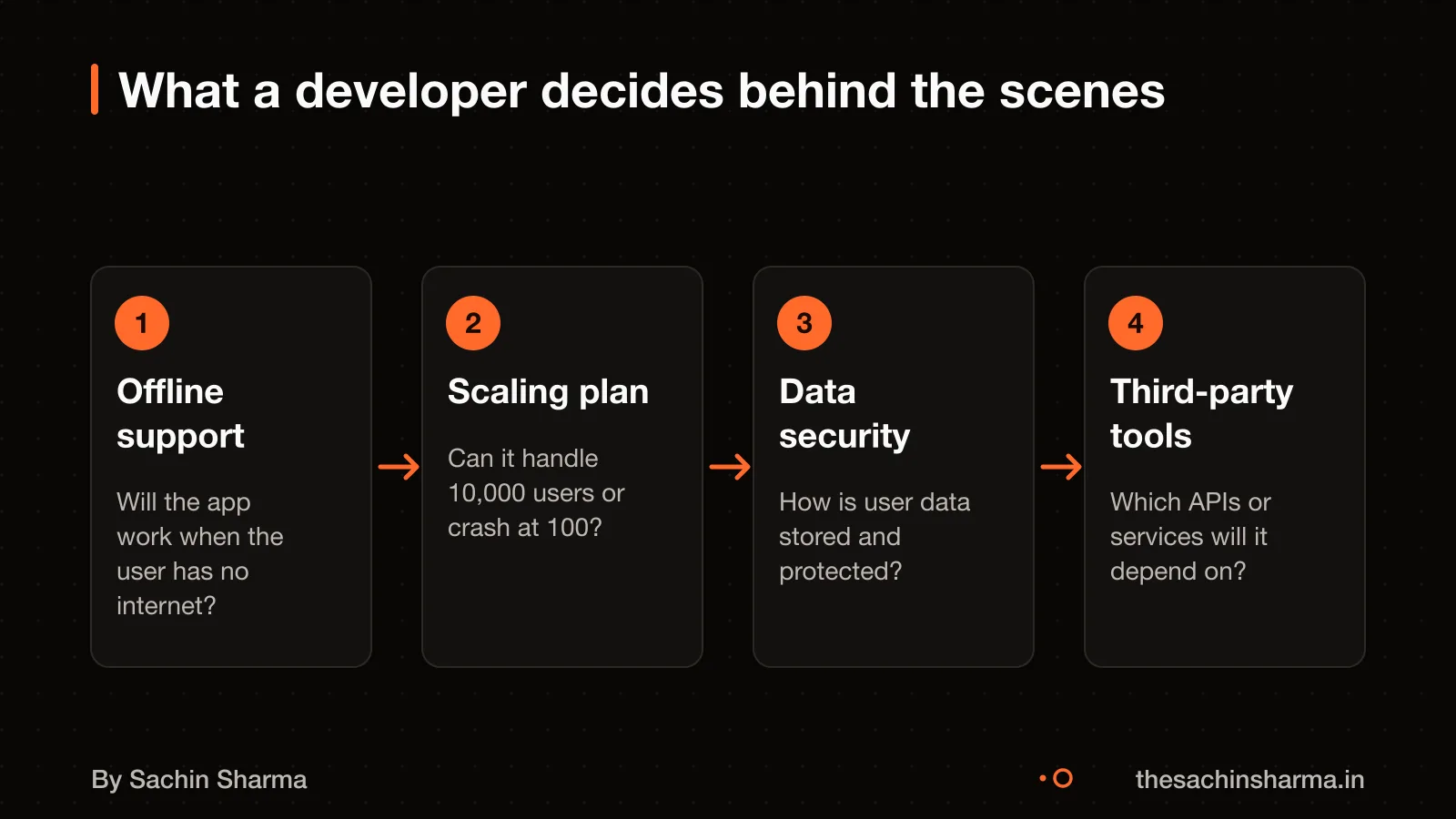
A developer chooses the tech stack, data flow and system rules that decide if your app works offline, handles growth or keeps data safe. These choices are hidden but critical. For example, in Loopin, my offline-first habit tracker, I picked Hive for local storage. You can log habits without internet, then sync later to Google Drive. That choice supports users in low-connectivity areas. If the app stored data only online, it would fail when the network drops.
Scaling choices matter too. A system built for 100 users may crash at 10,000 without changes to the database or server setup. The developer must plan for growth early, even if your launch starts small. Security is another hidden call. They decide where data lives, who can access it and how it is encrypted. AI builds exactly what you describe, including your mistakes. Good scoping includes these fundamentals, not just features.
For AI features, the developer picks an AI-native stack that supports LLMs and ML pipelines. At Microsoft Build 2026, they stressed that modern apps are end-to-end systems, not just frontends with AI pasted on. So the developer must balance model power with platform stability and governance. These answers reveal their system thinking. For more on this, see how to handle app security as a non-technical owner.
When can you skip a developer and use no-code?
You may consider skipping a developer if your app has one core workflow, authentication. Two user roles, and does not need native mobile features. No-code tools like WeWeb let you build web apps and Progressive Web Apps (PWAs) with a visual editor. These tools support custom JavaScript, Vue components, and REST or GraphQL APIs for integration. B2B SaaS typically needs more complex role hierarchies and admin controls, which are well-supported visually. B2C apps tend to need more polished UIs and simpler auth, which are also well-supported.
But you still need a developer when you require native mobile apps, offline-first sync, or complex background logic not supported in no-code. If your app must run without internet or use device hardware deeply, no-code will not suffice. Also, while WeWeb allows code export and full ownership, many no-code platforms lock your app inside their ecosystem. You may lose control over performance, data, or scaling. For long-term ownership and deep integrations, a developer adds value beyond what no-code can do.
For simpler apps that fit within web and PWA limits, no-code speeds up launch and cuts cost. But when your idea grows beyond forms and workflows, a developer helps you keep full ownership and build what no-code cannot. See when a developer beats an AI app builder for more trade-offs when a developer beats an AI app builder.
How much does it cost to hire a developer in India?
A developer in India typically charges $15 to $30 per hour. This rate applies to mid-level to senior freelance or contract developers. For a full project, costs can range from nothing (for AI-built prototypes) to $50,000 or more for complex systems like enterprise platforms. As an estimate, a custom app with user accounts, a dashboard, and offline sync might take 600 hours. At $20 per hour, that totals $12,000. This does not include extra hiring costs.
Extra costs depend on how you hire. If you use an agency, expect a fee of 15% to 25% of the first-year cost. For contract hiring through a firm, markups add 35% to 50% on top of the developer’s pay rate. These fees cover payroll, compliance, and profit. Direct hiring avoids markups but means you handle contracts, taxes, and tools. You also pay for project management, design, and testing if not included.
Freelancer, agency, and co-founder models have different cost shapes. Freelancers charge hourly or per project, giving you control over spending. Agencies cost more due to overhead and fees, but may offer full-service support. Co-founders may take equity instead of cash, reducing upfront cost but sharing long-term value. However, the tradeoffs between these models are not covered in the evidence.
You may also face post-launch costs like updates, hosting, and support, but these are not detailed in the sources. For a real example with full numbers, see the cost to build a quick commerce app.
Want a number for your idea? Send one line on WhatsApp. I reply with what drives the cost and what to cut.
Message me on WhatsApp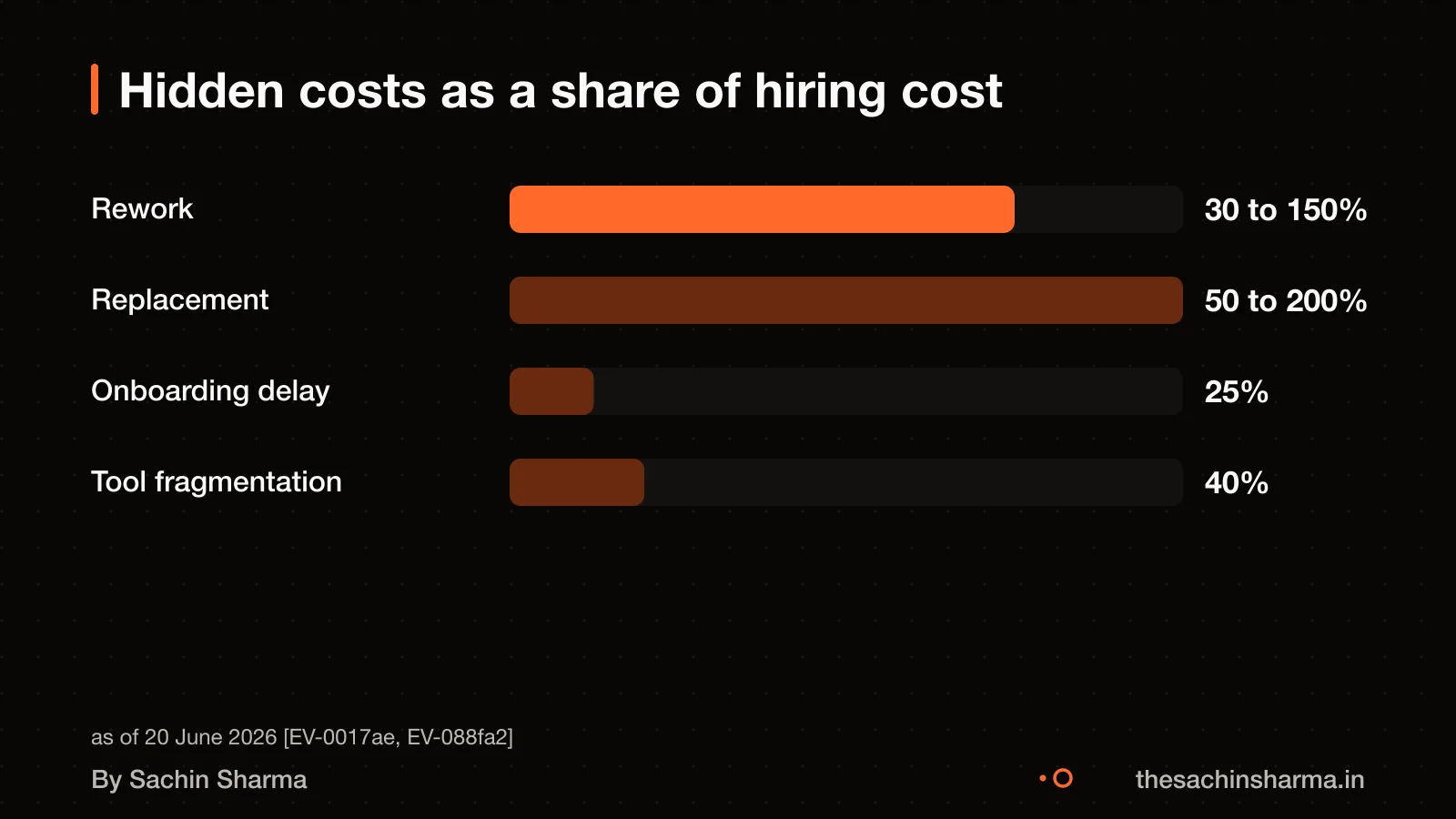
What skills matter most for your project?
A developer should have a decent idea of operating systems, networking, concurrency, databases. Basic web architecture to build apps that work reliably at scale. These skills let them decide how data moves, how users are served and how the app behaves under load. For example, choosing between real-time sync or batch updates affects offline use and battery life.
Networking knowledge ensures your app handles poor or changing connections, common in India’s mobile networks. Database skills let them model your business data correctly so reports and features stay accurate. Concurrency control stops data conflicts when multiple users act at once.
UI/UX skills ensure the app is easy to use and looks professional. A well-designed interface reduces user errors and training time. This includes layout, navigation and feedback on actions.
Developers use AI assistants like GitHub Copilot with models such as MAI-Code-1-Flash to write code faster. They must know when to trust the output and when to review it.
System design skill helps understand how large systems are planned and scaled. It ties all other skills together. You can test this even if you don’t code, by asking how they would structure your app.
How to test their system design skill without code
Ask how they would handle real-world limits like spotty internet or sudden growth. A skilled developer starts by clarifying your app’s use-cases and scale. This step shows they focus on your needs before jumping to tools. Then, they map out how parts of the system connect, using simple terms you can follow.
To test their thinking on real-time data, ask how they would collect votes from lakhs of election booths at once. For logging, ask how they would detect critical errors like "Disk Full" in server logs. Their answer should include what data is captured, where it is stored, and how alerts are triggered. You are checking if they plan for failure and monitoring, not just features.
For trade-offs, give a mock task: “Design an app that works when internet is slow or offline.” A strong response explores caching, local storage, and sync strategies. They will also consider minor optimizations based on your use-case.
Use a flow diagram template for non-technical founders to sketch their ideas together. This makes their thinking visible and testable.
Have a developer in mind? Send me their proposal and I will mark what to ask about system design.
Message me on WhatsApp
Who owns the code after it is built?
For example, WeWeb allows full ownership by exporting your complete Vue.js SPA, so you can deploy it anywhere. To ensure full ownership, your contract must say you own the source code, with no retained licenses or claims by the developer. Standard terms that protect your ownership include a written assignment of copyright, a clear deliverables list, and a statement that no third-party claims exist. Without these, you risk disputes or blocked updates. Since Indian law does not specify default ownership in developer contracts, you must define it in writing. Ask for a signed agreement that includes “work for hire” and code assignment before the project starts.
When this advice does not apply
- You should validate your idea before hiring if you are not sure whether customers will pay for it. Build a simple version with pen and paper, a landing page, or a no-code tool to test demand first. This saves you from paying for code you may not need.
- A freelancer can handle it when your project is small, well-defined, and does not require multiple teams. Some agencies overcomplicate such work with process and overhead, while a skilled freelancer delivers faster at lower cost.
- This advice does not apply if you are hiring a co-founder. That decision involves equity, long-term vision, and shared risk, not just technical delivery. The evidence does not cover how to choose between hiring and co-founding.
- It also does not apply if your app needs regulated data handling, like health or financial records. In those cases, legal compliance and audits matter more than the general system design choices described here.
Next step: message me on WhatsApp with what you want to build. No forms, no sales team.
Message me on WhatsAppAssumptions behind the numbers
- Developer explains past design decisions
- Developer matches tech stack to business goals
- Developer warns about hidden costs like onboarding and rework
Your checklist
Before you hire, here is what to check in the order it hurts to skip. Tick what you have verified; the page tells you where you stand.
System Design
Tech Fit
Ownership
Hidden Costs
Walk away if
- Won’t explain how they’d handle scale or failure
- Pushes their favorite stack regardless of fit
- Keeps the repository or store accounts
- Doesn’t price changes or support
- Quotes only a total with no scope
- Asks for the whole payment up front
- Won’t say who writes the code
Questions people ask
01What does the engineer actually decide on a build for a non-technical founder?
The engineer decides the tech stack, system design, data workflows, and how AI features integrate. These choices affect offline use, scaling, and security. They balance business goals with technical limits, such as choosing simplicity over advanced AI if it speeds launch.
02Which skills matter most for a developer working with a non-technical founder?
Key skills include system design, operating systems, networking, databases, concurrency, UI/UX, and AI tooling. A developer should understand how components interact at scale and use tools like GitHub Copilot with MAI-Code-1-Flash.
03How do I test a developer's skill without knowing code?
Ask them to explain how they would design a system for a use case, including constraints like user load or real-time needs. Have them walk through a logging system or vote collation example. Suggest a mock interview or whiteboarding session to see their thought process.
04Can I use no-code tools instead of hiring a developer?
Yes, for simple apps with one workflow, auth, and two roles. No-code tools like WeWeb can build a working prototype in 1 to 2 weeks part-time. They support custom code and APIs but only build web apps, not native mobile apps. For complex logic or security, a developer is still needed.
05What are the hidden costs of hiring a developer?
Hidden costs include slow onboarding, rework, poor handoffs, tool fragmentation, security risks, attrition, and vendor lock-in. Paying full salary during partial productivity raises effective cost, and missed market windows can cost more than months of salary.
06How much do developers charge in India?
As of 2026, developers in India charge roughly $15 to $30 per hour. This is lower than Latin America ($30 to 60) and far below the U.S. ($90 to 135). Rates apply to mid-level to senior freelance or contract roles.
07Who owns the app code after it is built?
Ownership depends on the tool and contract. With WeWeb, you own the exported Vue.js code and can deploy it anywhere. But this is not automatic with all platforms. Always confirm ownership terms in writing.
08What tech stack should I choose for my first app?
Choose a stack that matches your business goals and team skills. React (43% use), JavaScript (66%), Python (58%), and TypeScript (44%) are widely used. Avoid Kubernetes early on. AI integration is now a key factor in selection.