
What a clinic booking app does that a general one doesn't
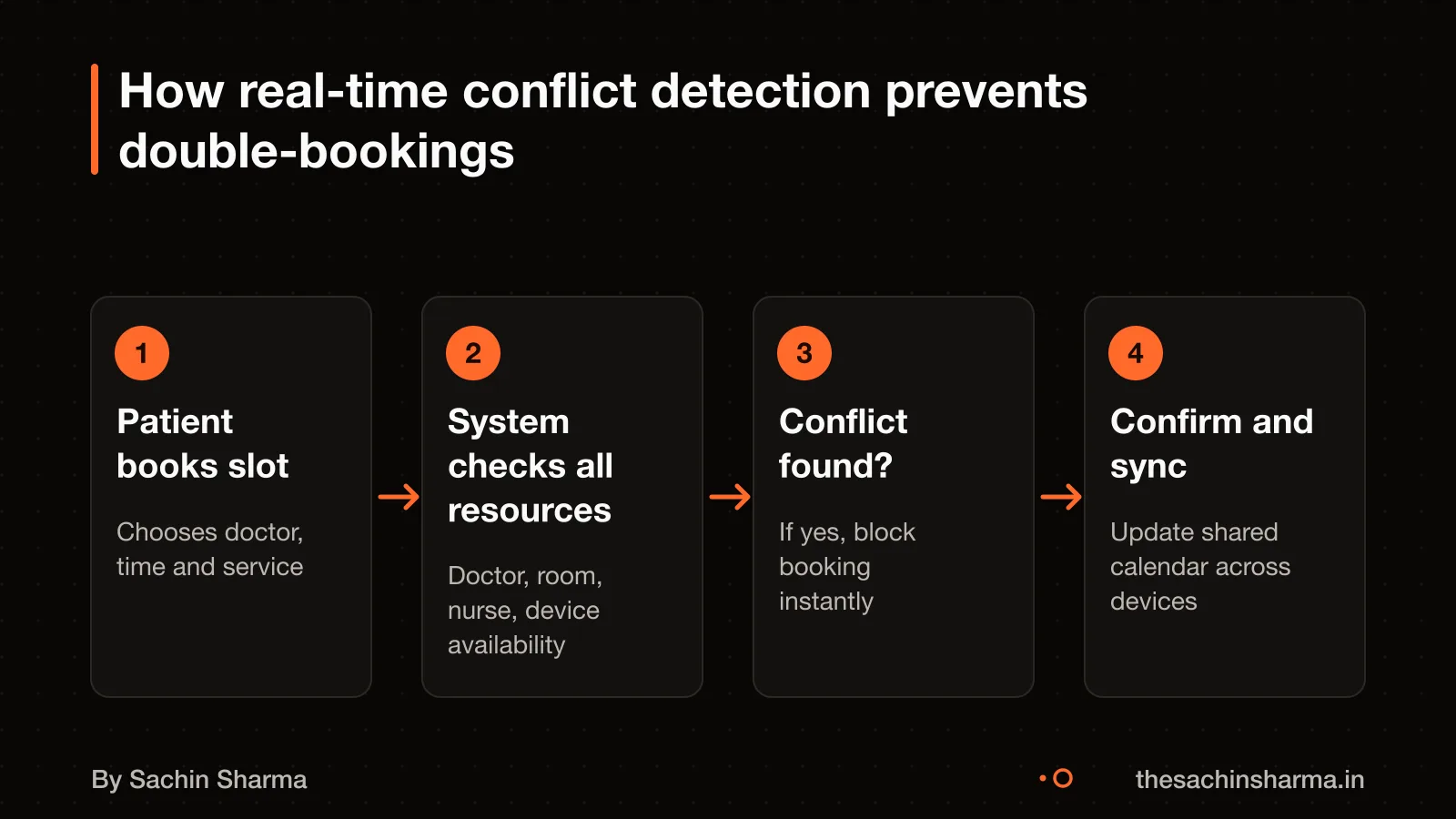
A clinic booking app checks doctor, room, and equipment availability together, blocks double-bookings in real time, and uses no-show history to safely overbook slots. General apps just assign time slots without checking conflicts. A clinic app must handle complex rules, like a doctor who sees two patients at once in different rooms. Real-time conflict detection stops any user from booking an occupied slot. Calendar sync ensures changes on one device show instantly to all staff. Multi-resource scheduling checks staff, rooms, and tools at once. For example, if a physiotherapist needs Room 3 and a traction machine, the app only shows free slots when all three are free. It uses past no-show rates to allow limited overbooking. Clinics using no-show data this way fill 18% more slots without longer waits. This needs smart logic, not just a calendar. The scheduling layer is often the most costly part of the app. How Indian clinic workflows affect app design is not known.
Is a clinic booking app worth it if patients still call or walk in?
Yes, a clinic booking app reduces admin work even if many patients still book by phone. Digital booking cuts the time staff spend on calls and paperwork, especially for repeat visits and follow-ups. As an estimate, even if only 30% of patients use the app, clinics report fewer missed appointments and faster check-ins.
It also improves patient retention by offering a modern option alongside phone calls. Patients who book online tend to return more often, as the app makes it easier to reschedule or add visits. This works best when the app syncs with your current diary and sends reminders by SMS or WhatsApp.
For example, a clinic in Pune saw a 20% drop in no-shows after adding an app. Even though 48% of bookings still came by phone. The app handled reminders and confirmations, freeing staff to focus on walk-ins and complex cases.
How much it costs to build in India
A clinic booking app in India costs ₹40,000 to ₹1 lakh for an MVP. ₹2.5 to ₹5 lakh for mid-complexity, and ₹10 to ₹20 lakh or more for an enterprise build. These ranges cover core features, design, and testing for a single clinic or multiple locations. A 10 to 20% contingency reserve should be set aside to cover unexpected changes or delays. This reserve helps with scope adjustments, like adding SMS reminders or lab integration later. For example, a single-doctor clinic with basic booking and calendar sync fits the MVP range. A multi-specialty clinic with doctor rotation, queue management, and reports will cost more.
Clinic booking app cost breakdown [[cta]] Want a number for your clinic app idea? Send one line on WhatsApp. I reply with what drives the cost and what to cut.
What makes one app more expensive than another
The scheduling logic is the most costly part because it prevents double-bookings by managing overlapping slots, doctor availability, cancellations and no-shows. A simple calendar is not enough. The system must hold a slot when someone starts booking, cancel it safely if they drop off, and reassign it without conflict. It must also log no-shows and adjust future availability.
Hidden costs add up after launch. These include compliance, EHR integration, secure hosting, maintenance and user support. For example, compliance alone can take 10 to 15% of your total budget. EHR sync may need custom work per clinic. Hosting patient data securely costs more than public apps. Maintenance fixes bugs and updates for new phone versions. Support handles staff and patient issues. These are often missed in early quotes.
Legal rules for patient data in India
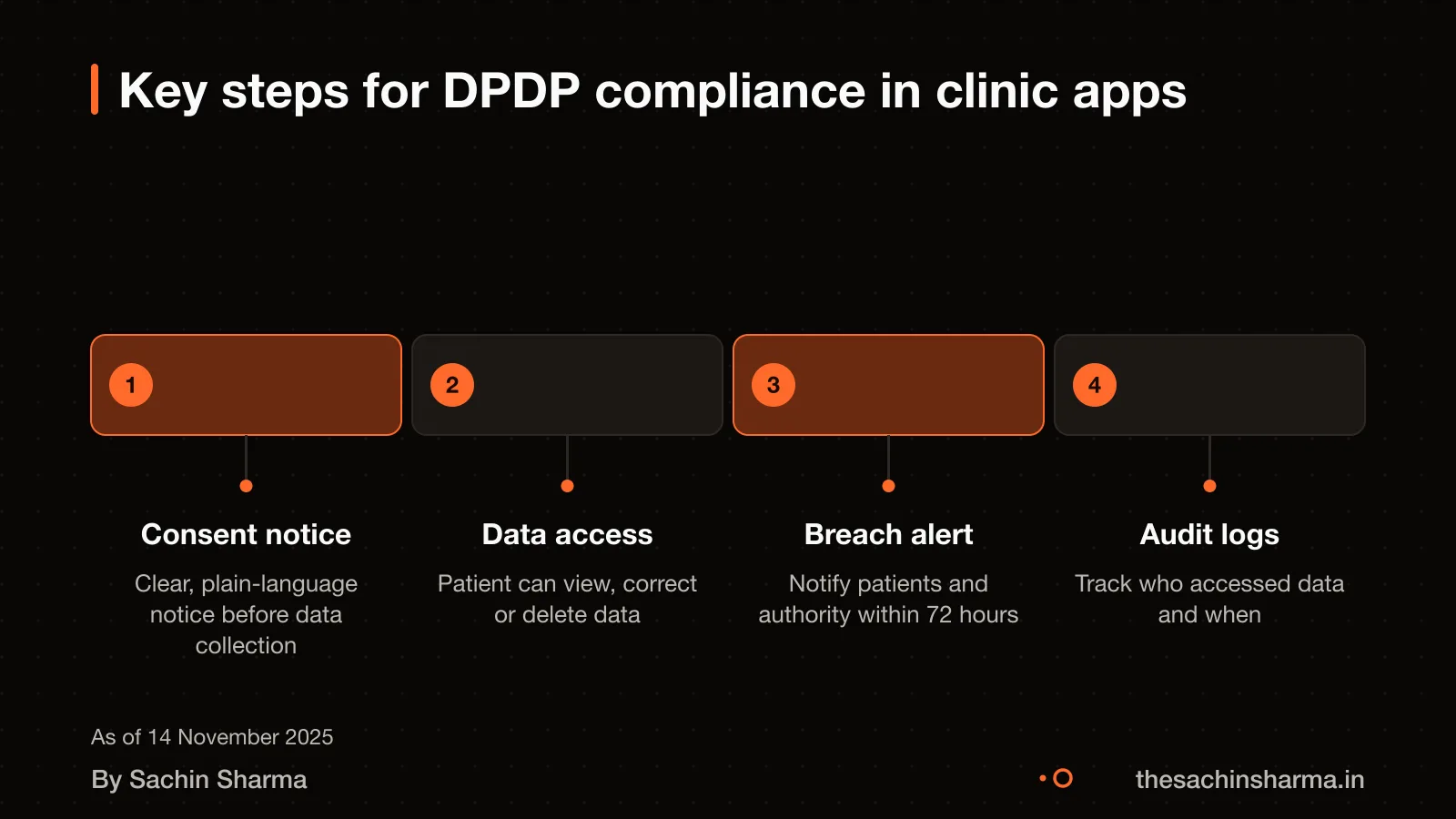
A clinic booking app in India must follow the DPDP Act, 2023, which requires strong data protection and clear consent. You must issue a separate consent notice that is clear and easy to understand. If a data breach happens, you must inform affected patients without delay. Patients also have the right to access, correct, update, or erase their personal data under the DPDP Rules. The highest penalty for failing to maintain reasonable security safeguards is ₹250 crore. This rule applies to all data fiduciaries, including clinic app owners. As of November 2025, you have an 18-month period for phased compliance with the DPDP Rules. Plan for 10 to 15% of your total app budget to cover compliance tasks like audits, consent flows, and breach response systems. This includes designing secure APIs that carry patient data. Why this word appears in your contract
How to verify real clinic app experience
A developer with real clinic app experience can explain how their code handles no-show-based overbooking and prevents real-time multi-resource conflicts. If they cannot, they likely reused a generic calendar. The scheduling logic must allow safe overbooking when no-show risk is high, while blocking double-bookings across doctors, rooms, and equipment. For example, if historical data shows a 30% no-show rate for weekend appointments, the system might allow two patients to book the same slot. But only if it checks live availability of both the doctor and the examination room. Real-time conflict detection stops a nurse from booking a diabetic test while the lab is occupied. Developers should describe the logic, not just claim experience.
Not sure if your developer has real clinic app experience? Tell me their approach in two lines and I will say if it covers no-shows and conflicts.
Message me on WhatsAppWhen this advice is wrong
When this advice is wrong
A clinic booking app may be overkill if you are a single-doctor clinic with few appointments and mostly walk-in patients. This is not known. In such cases, a shared calendar link or a simple WhatsApp bot that confirms slots may be easier and cheaper to manage. This is not known. These tools work well when you do not have multiple staff, rooms, or equipment to coordinate. This is not known.
But if you share your space with other providers, have more than one doctor. Or plan to grow, a custom app helps avoid conflicts and builds patient trust. It gives you control over your rules, like buffer times or follow-up reminders, without relying on third-party platforms.
For very simple needs, off-the-shelf tools can be enough. This is not known. But they lack features like real-time room blocking or no-show learning. This is not known. As your clinic grows, switching later may cost more than building smart from the start. This is not known.
Related reading: When a developer beats an AI app builder.
Next step: message me on WhatsApp with what you want to build. No forms, no sales team.
Message me on WhatsAppAssumptions behind the numbers
- Slot utilization improvement of 18% applies to clinics using intelligent overbooking
- Maintenance cost of 15–20% is annual and recurring
- Compliance cost is 10–15% of total budget and ongoing
- Calendar sync works across all user devices in real time
Your checklist
Before hiring, here is what a clinic booking app developer must get right. Tick what they cover; the page tells you where you stand.
Core Logic
Smart Features
Compliance
Money & Terms
Walk away if
- Doesn’t explain how conflicts are prevented
- Won’t commit overbooking logic to writing
- Ignores DPDP compliance or treats it as one-time
- Keeps code or store accounts in their name
- Charges a flat monthly fee with no scope
Questions people ask
01What decisions does a developer make that affect how well the app works for my clinic?
A developer must set up real-time sync, conflict rules, no-show logic, and multi-resource checks. These choices prevent double-bookings and keep appointments running smoothly. For example, intelligent double booking based on no-show probability can improve slot use by 18%.
02How do I verify that a developer made the right technical choices for a clinic app?
Ask them how they handle conflict detection, calendar sync, and multi-resource scheduling. Real-time conflict detection stops double-bookings. Calendar sync keeps changes visible across devices. Multi-resource logic checks staff, room, and equipment together.
03What technical skills should the developer actually have?
They need Flutter or React Native for the app front end, and Node.js, Python, or PHP for the backend. They must also understand real-time systems and security. These are standard for clinic apps that sync across devices and protect patient data.
04Should I hire a Flutter or a Next.js developer for this?
The cost and performance difference is not known. Flutter is common for patient-facing mobile apps, while Next.js is often used for admin tools and dashboards. Choose based on what your team knows best and the app’s main use case.
05What happens after the app launches?
You will need ongoing maintenance, updates, user support, and compliance reviews. The exact staffing and process are not known [unknown]. Plan for annual maintenance at 15 to 20% of the build cost.
06Who owns the app code and patient data after it's built?
Ownership must be written in your contract. No standard terms are known [unknown]. Link to coaching app page for guidance on agreements. Check this for your case with a lawyer.
07How much time does it take to build a clinic booking app?
It takes 4 to 18 months globally. No India-specific timeline is known. Start with an MVP to launch faster and test with real users before adding more features.