
What is a clinic booking app?
A clinic booking app is a full-stack web application that lets patients book appointments directly through a branded mobile app or website. Unlike WhatsApp or Google Calendar, it gives your clinic a professional look and full control over scheduling. With WhatsApp, you risk missing bookings and mixing personal and clinic chats. Google Calendar lacks patient-facing features like reminders and online payments.
This app solves real clinic problems: double bookings, no-shows, and time wasted on phone calls. It automates appointment confirmations and sends SMS or app alerts to reduce missed visits. Since the app carries your clinic’s name and logo, patients see it as part of your brand. Unlike Practo, where the patient app is not fully yours, a custom app means you own the experience.
You can add features like lab integration or telemedicine later. For now, focus on core booking needs. See what features matter most in the early stages and which can wait.
Must-have vs later features for lab booking apps

Base cost: ₹1.5 lakh and up
A clinic booking app starts at ₹1.5 lakh. This is an estimate, assuming a basic version with patient registration, appointment scheduling, doctor profiles, and SMS confirmations. The minimum price is driven by the core development effort needed to build a working, testable app even in its simplest form.
You may need to pay more if your clinic has special needs like multi-location support or integration with existing systems. The base cost does not include legal setup, third-party tools, or ongoing maintenance. For example, registering a clinic in India costs between ₹15,000 and ₹2,00,000 as of 2026.
What you get at this level is a functional app for one clinic with a single admin. It will not include features like online payments, lab integrations, or a custom admin dashboard unless specified. The real cost of development depends on how many such features you add.
The ₹1.5 lakh figure is not from published data but is a reasonable starting point based on typical software effort in India. The actual time to build such an app is not known, and no public build log maps features to cost [unknowns]. For how app costs are built from weeks and rates, see How app costs are built from weeks and rates.
Cost of adding online payments
Adding online payments to your clinic booking app increases development cost. This is an estimate and assumes integration with one major gateway such as Razorpay and standard security setup. This depends on the number of gateways and features like recurring billing. The range is an estimate. You will also pay a transaction fee on each booking. For domestic payments like UPI, debit or credit cards, Razorpay charges a 2% platform fee. An 18% GST applies to this fee, not the full transaction amount. So for a ₹1,000 consultation, you pay ₹20 as the platform fee and ₹3.60 as GST on that fee. This totals ₹23.60. International card payments cost more: 3% of the transaction plus GST on the fee. If you offer subscription plans, an extra approximately 1% fee applies per transaction.
New Razorpay merchants activating on or after 1 July 2026 get zero platform fees for domestic payments. This is until they reach ₹5 lakh in total sales or 90 days pass, whichever comes first. This can lower your early costs. GST does not apply to the development cost of the app itself. It applies only to ongoing service fees like those from payment gateways. For most clinics, domestic payments will cover nearly all transactions. So the 2% + GST model is the one to plan for.
To set this up, you need to complete KYC with Razorpay and follow their API integration steps. The technical work includes handling secure checkout, webhooks for payment confirmation, and error states.
Technical guide to integrate Razorpay in Flutter or Next.js explains the steps for developers.
Want a number for your idea? Send one line on WhatsApp. I reply with what drives the cost and what to cut.
Message me on WhatsApp
Does GST apply to development cost?
Yes, GST applies to the software development fee you pay. As of 2026, the standard rate is 18%. This tax is charged on the developer’s fee, not the full project cost if other items like hosting or third-party tools are listed separately. For example, if your developer charges ₹1.5 lakh, GST will add ₹27,000 (18% of ₹1.5 lakh). Always check if the quote you receive is inclusive or exclusive of GST. Since tax rules can vary by state and service type, consult a local tax advisor to confirm what applies to your clinic.
Android vs iOS: which costs more?
Native development for iOS and Android now costs almost the same by 2026. However, Android apps still tend to cost 10 to 15% more than iOS due to a wider range of devices and longer testing cycles. This extra cost comes from checking your app on many screen sizes, Android versions, and manufacturer-specific settings.
Cross-platform tools like Flutter and React Native can cut total costs by 30 to 40%. They let one codebase run on both platforms, reducing development and maintenance time. For example, an MVP that takes 6 to 10 weeks to build cross-platform would take 3 to 6 months. If built separately for each platform.
So, if you want both Android and iOS apps, cross-platform development is usually cheaper and faster. It also means fewer bugs and easier updates. But if your clinic mainly serves Android users, a native Android app may still be worth the extra cost for peak performance.
For most small clinics, starting with a cross-platform app using Flutter is a cost-effective choice. I use Flutter in my own projects like Loopin and Aashwasan, and it helps deliver stable apps faster.
Freelancer, agency or in-house team?
A freelancer is usually the cheapest option for a clinic booking app. They charge less than agencies and can move fast if the scope is clear and limited. You pay only for the project, not a monthly salary.
An in-house team gives you the most control over long-term changes and updates. With deep knowledge of your code, they can fix issues quickly and add features without re-onboarding. But this comes at a high fixed cost. A team of three to four developers in India costs a lot each month, even when no work is ongoing.
For long-term support, an in-house team is best if you plan constant updates. But for a one-time build, ongoing agency maintenance or a retained freelancer may be more practical and affordable.
If you want full control without full-time hires, consider a hybrid model: a core app built by a freelancer. With a local developer on retainer for updates.
Risks of hiring a freelancer
If your freelancer stops working, your project can stall with no one to fix it. This is the biggest risk of hiring a single developer. Unlike agencies or teams, there is no backup person to take over. You face delays or total stoppage if they leave, fall sick, or lose interest.
You may also lose access to your code and data. If there is no clear handover process, you might get an incomplete or poorly documented codebase. This makes it hard for another developer to continue. You could end up paying more to restart or debug.
To protect your code and data, sign a contract that assigns full ownership to you. Demand regular updates on a platform like GitHub, where you have access. At the end, get all source code, designs, and login details in writing.
Make sure the freelancer uses standard tools and clear code. This makes it easier to switch developers if needed. Avoid custom or secret methods that only they understand.
Want a number for your idea? Send one line on WhatsApp. I reply with what drives the cost and what to cut.
Message me on WhatsAppLegal and compliance costs
Yes, the DPDP Act applies if your app collects personal data from patients, such as names, phone numbers or medical history. Any digital platform that processes Indian users’ personal data must follow the Digital Personal Data Protection (DPDP) Act, 2023. This means building consent flows, data access logs and the ability for users to request deletion. As an estimate, adding DPDP compliance increases development time by 2 to 3 weeks. Assuming forms, logs and settings pages need to be built and tested.
Your clinic must have Clinical Establishment Registration and a Municipal Trade Licence to operate legally. Without these, you risk penalties or closure. If your clinic uses ultrasound equipment, PCPNDT registration is mandatory. Failure to comply can lead to criminal charges, including up to 3 years in prison. You also need biomedical waste authorisation under the 2016 rules if your clinic produces any such waste, even from minor procedures like injectables.
Compliance affects development time because each legal requirement adds features. For example, GST registration may not be needed if your turnover is below ₹20 lakh (or ₹10 lakh in some special category states). But if you do charge GST, your app must generate compliant invoices. ABDM compliance, while not yet mandatory for all, is becoming standard. Some platforms like Doccure offer full ABDM compliance.
You should consult a legal professional to confirm which registrations apply to your clinic and location. Do not rely only on software advice for compliance.
Not sure if your project has this risk? Tell me the plan in two lines and I will say yes or no.
Message me on WhatsApp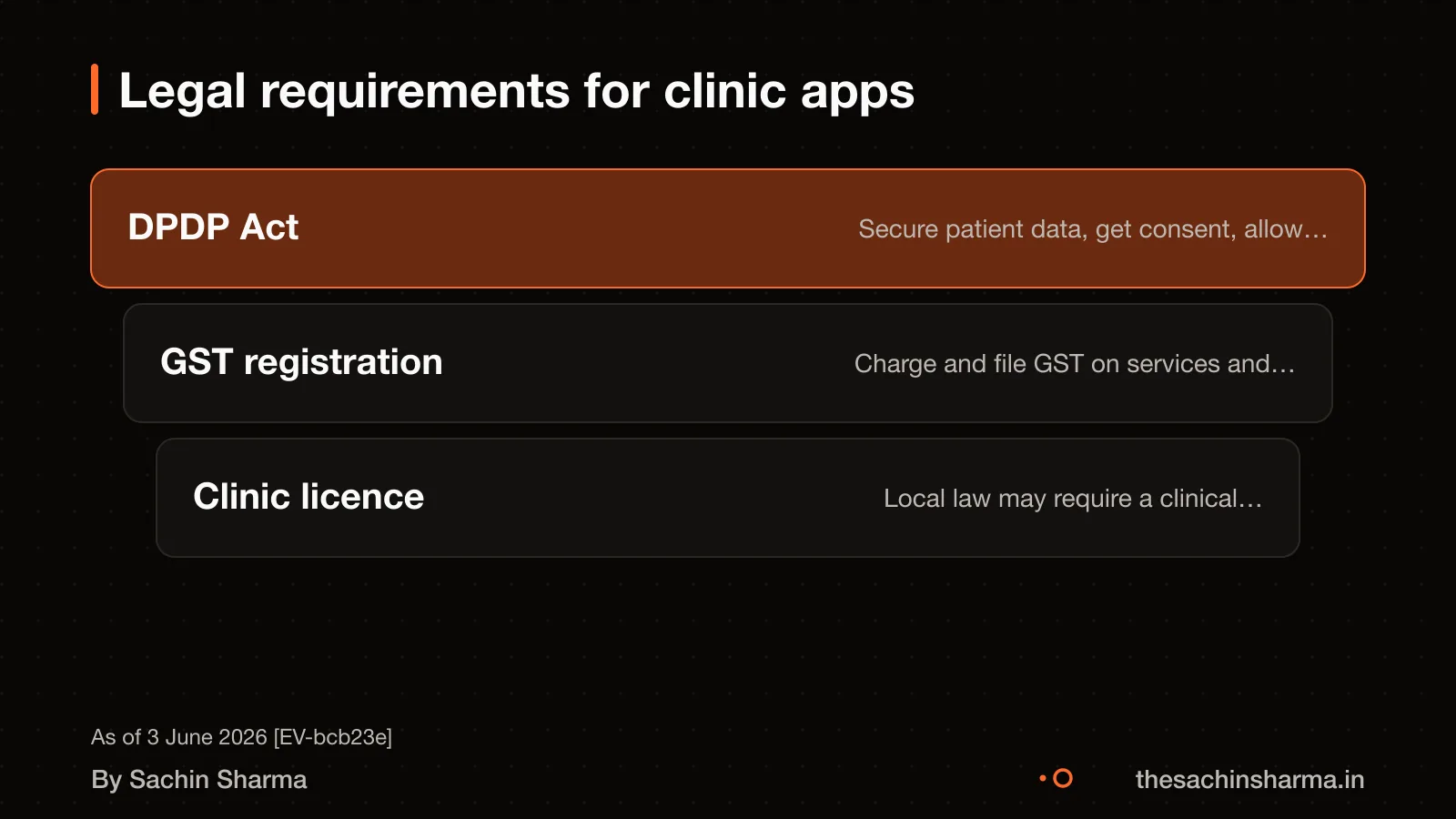
Ongoing and hidden costs
The annual maintenance cost for a clinic booking app is not known. However, hidden costs such as API subscriptions, backend scaling, and app store compliance do impact the total budget and must be planned for early. These costs often appear after launch and can add up over time. For example, using a cloud service like Google Cloud may have final bills that differ from initial estimates.
Maintenance tasks include server updates, security patches, and compatibility fixes for new OS versions. While some providers claim no annual maintenance charges, real-world apps usually need ongoing support. You should budget for at least 15 to 20% of the initial build cost per year as an estimate. Assuming regular updates and minor feature tweaks.
Failed payments also add to cost. Each failed payment can cost your clinic the full value of the appointment, not just a processing fee. This loss adds up if your payment flow is not optimised. To reduce this, test your payment gateway under real conditions and monitor success rates weekly.
Common hidden costs include third-party API fees for SMS, email, or lab integrations, which may charge per message or transaction. Backend infrastructure can scale up quickly with user growth, leading to higher cloud bills. App store compliance requires regular updates to meet changing rules, especially under India’s DPDP Act.
For small clinics, these hidden costs can be more damaging than high upfront fees. Track every transaction and review your tech bills monthly. Compare this with the experience of small business websites, where ongoing costs often surprise first-time owners Ongoing costs for small business websites.
Worked example: cost for a 3-doctor clinic
A custom clinic booking app for a 3-doctor clinic costs an estimated ₹2.8 lakh to build. This assumes 40 screens and one payment gateway. This includes ₹2 lakh for core features like patient registration, appointment scheduling, doctor profiles and SMS reminders. Adding online payments increases cost. This is an estimate. Using a cross-platform framework like Flutter reduces total development cost by 30 to 40%.
GST is not charged on the development fee in this estimate, as the full rate and applicability depend on the developer’s registration and service structure. You should confirm 18% GST on the final quote if it applies.
For online payments, Razorpay charges a 2% platform fee on each transaction. For example, on a ₹500 consultation, the platform fee is ₹10, and GST on that fee is ₹1.80, making the total deduction ₹11.80.
First-year maintenance cost is not known, as no published figure exists for clinic apps in India in 2026 [unknowns]. However, 6 months of support are included in the build cost as an assumption. Ongoing updates, bug fixes and server costs after that are extra.
This estimate does not include an admin dashboard or EHR integration, as their costs are not known [unknowns].
Next step: message me on WhatsApp with what you want to build. No forms, no sales team.
Message me on WhatsAppWhen not to build a custom app
- If your budget is under ₹2 lakh, a custom app may not be feasible, as even a basic version starts at ₹1.5 lakh. Off-the-shelf tools may be better. For example, Doccure offers pricing that starts affordably for solo doctors and scales predictably with branches. Budget-friendly tools like eClinic / eHospital are also available.
- You are overbuilding if you need only appointment reminders and basic scheduling. A custom app makes sense when you need unique features like multi-location sync, custom reporting or integration with lab systems. If your clinic has fewer than three doctors and no plans to expand, a ready-made tool will save time and cost.
- Another sign of overbuilding is choosing native development when a web or cross-platform app would do. Most business apps, including clinic tools, work well as cross-platform apps, which are cheaper and faster to build. If you do not need advanced device features like offline-first access or background audio, stick to a simpler stack.
- Lastly, avoid custom development if you expect instant results. Even a basic app takes weeks to build and test. Off-the-shelf tools can go live in days. If your main goal is to start accepting bookings fast, a pre-built solution is the better choice.
Assumptions behind the numbers
- Adding online payments increases cost by ₹50,000 to ₹2 lakh
- Cross-platform saves 30–40% over two native apps
- GST on fees is 18%
- Base app cost starts at ₹1.5 lakh
- Maintenance is 15–20% yearly
Work out your own number
I won't hand you a number that pretends to be the market. Instead, here is the working: set the weeks, the people and the rate, and see where the money goes.
Your working total
₹4,40,00011 weeks × 2 people × 5 days × ₹4,000- Scope and design18%
- Build55%
- Testing and fixes18%
- Launch and stores9%
The weeks shown are an example of a small app, there to be changed. Fees you pay others (store accounts, cloud, SMS) are not in this total.
What moves the price
- Online payments
Adds ₹50,000 to ₹2 lakh for secure gateway setup and testing.
- More screens or roles
Each extra user type (patient, doctor, admin) is close to another app.
- Real-time features
Live tracking and chat need more design and more testing.
- Cross-platform build
Saves 30–40% over two native apps.
- Cutting to one platform first
Starting with one clear flow can be half the work.
- A clear scope up front
Changes mid-build are the most expensive weeks.
Fees that go to someone else
Razorpay setup (first ₹5L free)
Zero fees for first ₹5 lakh GMV or 90 days.
Payment gateway fees
2% domestic, 3% international + 18% GST on fee.
App store fees
$99/year to Apple, free to Google.
Ask for these before you sign
- How many weeks per phase, and with how many people?
- What is not included?
- Which fees do I pay to others directly?
- What happens to the price when I change my mind?
- What does the first month after launch cost?
Questions people ask
01Which components drive the cost of a clinic booking app?
The main cost drivers are user roles, online payments, compliance, and platform choice. Cross-platform apps using Flutter or React Native cut costs by 30 to 40% compared to native builds. Adding payments and complex dashboards increases the price. Start with core features and expand later.
02Where do estimates for clinic booking app usually go wrong?
Estimates fail when they miss hidden costs like maintenance, API fees, backend scaling, and app store rules. Unclear scope and not owning the source code or developer accounts also cause problems. Always check for itemised deliverables and ownership terms.
03What can be cut without hurting the product?
Start with one platform using cross-platform tools like Flutter. Delay automated reminders and skip complex dashboards until later. Focus on booking, profiles, and SMS confirmations first. Tools like Doccure and eClinic show budget-friendly entry points.
04Do I need to pay Google or Apple to publish the app?
Yes, Apple charges $99 per year for a developer account, which is mandatory to publish on the App Store. Google charges a one-time $25 fee for the Play Store. These are separate from development costs.
05How do changes during development affect the price?
Scope changes usually add cost. Fair quotes include capped change orders and clear milestones. Avoid open-ended agreements. Price increases for subscriptions in some regions require customer consent as of August 2025.
06Can I start simple and add features later?
Yes, build an MVP first with core booking features. A cross-platform MVP takes 6 to 10 weeks, much faster than two native apps. You can add payments, ABDM compliance, or dashboards later as your clinic grows.
07What should my first message to a developer include?
Share your clinic size, number of doctors, current tools, and must-have features. Ask for itemised phases, milestones, and clear ownership of code and accounts. This helps get a fair and accurate quote.
08Is ABDM compliance required for my clinic?
ABDM compliance is not mandatory, but it allows your clinic to join the national health network and share records securely. Doccure offers full ABDM support. Check if it fits your long-term goals.
09How do I check if a developer's quote is fair?
A fair quote lists itemised phases, named deliverables, a milestone schedule, and ownership terms for code and developer accounts. Avoid lump-sum quotes with no line items or silence on ownership.