What can a fitness app actually do for your gym?
A fitness app can manage memberships, track attendance, schedule classes, handle billing, and store member profiles and waivers. This reduces manual work and helps you run your gym smoothly. For example, staff can check in members with a tap instead of paper sheets. Many apps also let members book classes or view schedules on their phones. You can improve daily operations by cutting sign-in time and reducing billing errors. Some apps support AI features like workout recommendations or track progress from wearable devices like smartwatches. These features help members stay engaged and make your service feel more personal. However, AI and wearables need extra setup and may raise costs.
As a contrast, how a restaurant app handles real-time orders shows how different industries use apps for different workflows. Your gym’s needs are unique, so the app must fit your routines, not force new ones.
Custom app vs ready-made: which is right for your gym?
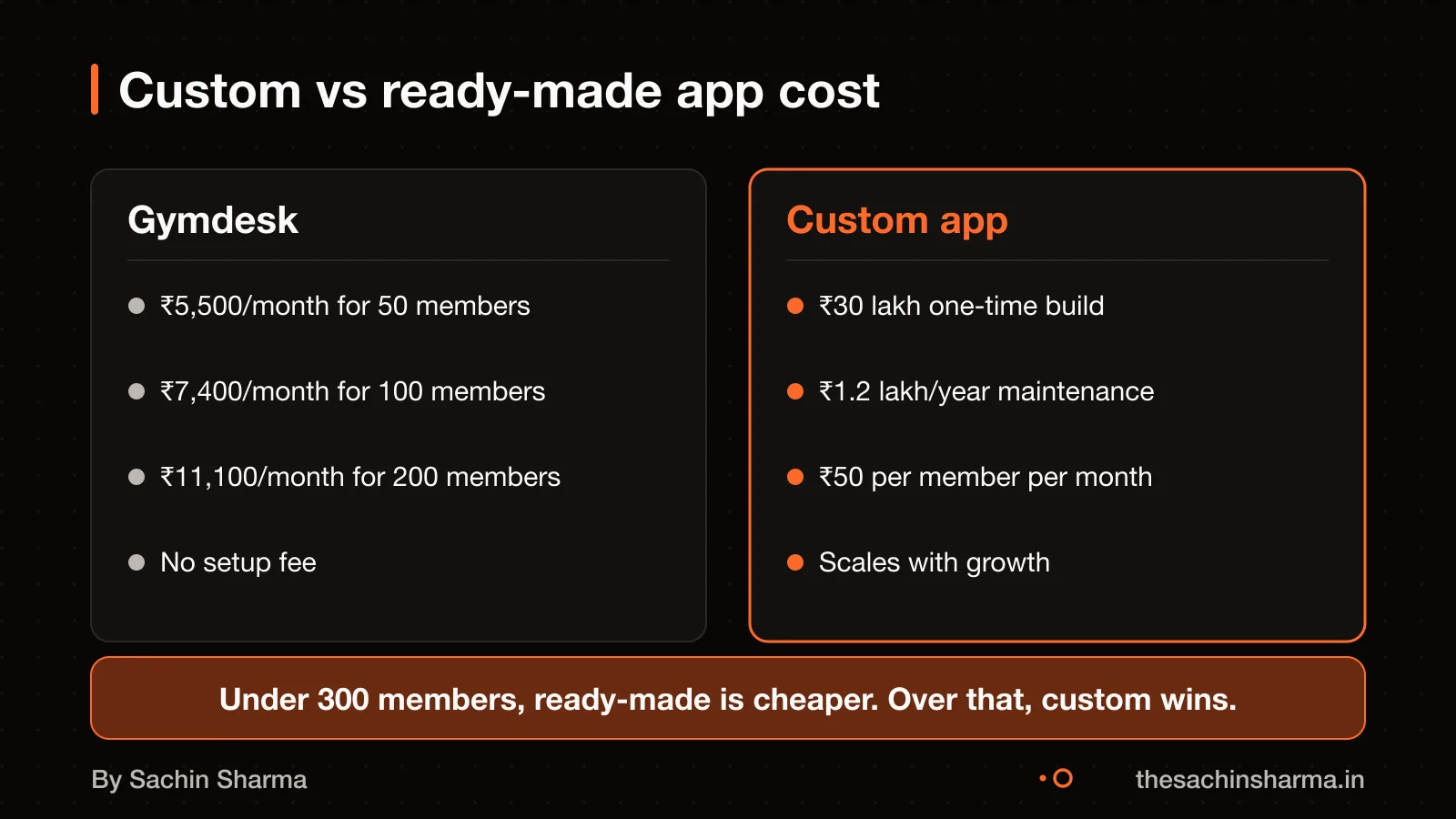
A ready-made app like Gymdesk, Mindbody or ABC Glofox may suit your gym if you need core features fast and can work within their limits. These tools offer membership tracking, class scheduling and payment handling out of the box. Gymdesk costs $75 per month for up to 50 members. Mindbody starts at $79 per month per location. ABC Glofox starts at $99 per month per eligible location. As of 2026, such software can cost from $0 to over $200 per month for one location.
A custom app makes sense only if your gym has unique workflows that no off-the-shelf product supports. For example, if you run a chain with region-specific pricing, hybrid in-person and remote coaching. Or need deep integration with local payment systems like UPI, then off-the-shelf tools may fall short. Custom apps also let you own the data and control updates.
Pricing models differ sharply. Ready-made apps charge monthly subscriptions per location or member. Custom apps have high upfront build costs, often ₹5 lakh and above, but lower long-term fees if you manage updates yourself. You pay more later if you need new features, even with a custom app.
For most small gyms in India under 200 members, a ready-made tool cuts setup time and cost. If you outgrow it later, you can migrate. Ask yourself: are your needs common or unique? If common, start with a proven tool. If unique, explore custom, but only after mapping your full workflow.
See when a school needs custom software for a similar decision path [when a school needs custom software].
How much does a fitness app cost to build?
A fitness app can cost from $40,000 to $400,000, based on features and scale. This range is for custom apps built from scratch. The final cost depends on what you want the app to do, who builds it, and how you plan to earn from it.
A basic app costs $40,000 to $80,000. It includes user login, activity tracking, and a simple interface. This version suits gyms that want core features without extras.
A mid-level app costs $80,000 to $150,000. It adds video content, online payments, and links to third-party tools like Google Calendar or WhatsApp. These features help automate class bookings and member billing.
An advanced app costs $150,000 to $400,000 or more. It includes AI-driven workout plans, real-time tracking, wearable device sync, and deep analytics. These features raise cost due to complex coding and testing.
More features mean higher cost. AI personalisation, live coaching, and syncing with wearables like Fitbit or Apple Watch add time and skill needs. Each integration must work reliably and stay secure.
Team location affects cost because hourly rates vary by region. Developers in India often charge less than those in the US or Western Europe. But rates alone should not decide your choice, focus on proven work.
Your monetisation model also shapes cost. A subscription app needs secure billing and member management. A marketplace model, where trainers offer paid sessions, needs user profiles, reviews, and payout systems. Both add complexity.
For a clear cost based on your goals, see how feature complexity changes cost for a cross-industry view.
Want a number for your idea? Send one line on WhatsApp. I reply with what drives the cost and what to cut.
Message me on WhatsAppWhat technical skills should your developer have?
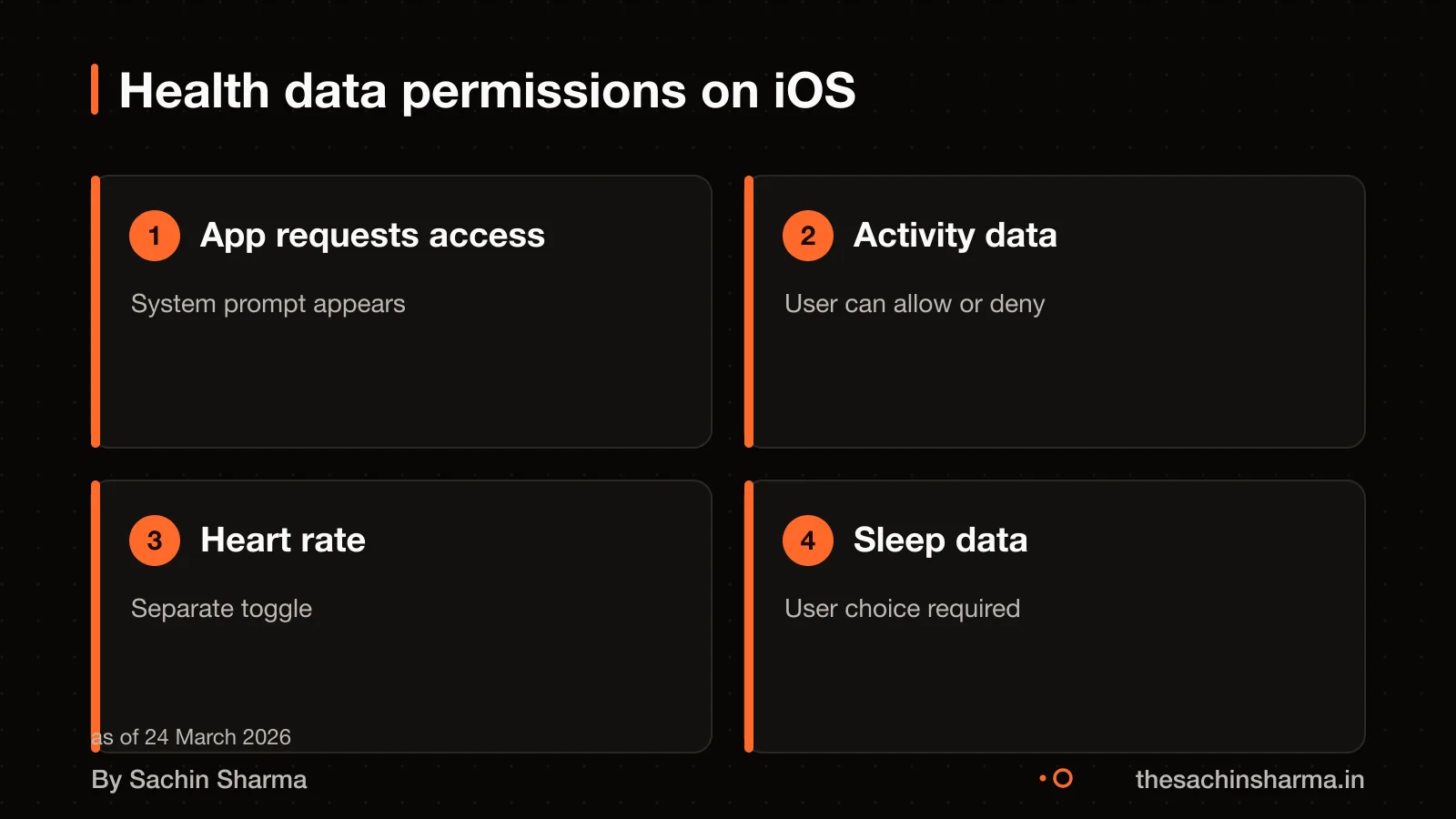
Your developer must know iOS and Android frameworks that handle health data, location tracking and workout plans. For iPhone apps, they should use HealthKit to store and read health data like steps, heart rate and weight in a secure, standard way. This keeps member data private and lets other fitness apps read it only with permission.
For outdoor activity tracking, your developer should use Core Location to record runs, cycles or hikes using GPS. This works even when the app is in the background, but it must be coded carefully to save battery and respect privacy.
They should also use WorkoutKit to build interval workouts with goals based on time, distance or pace. This lets members follow structured plans like HIIT or triathlon training inside your app.
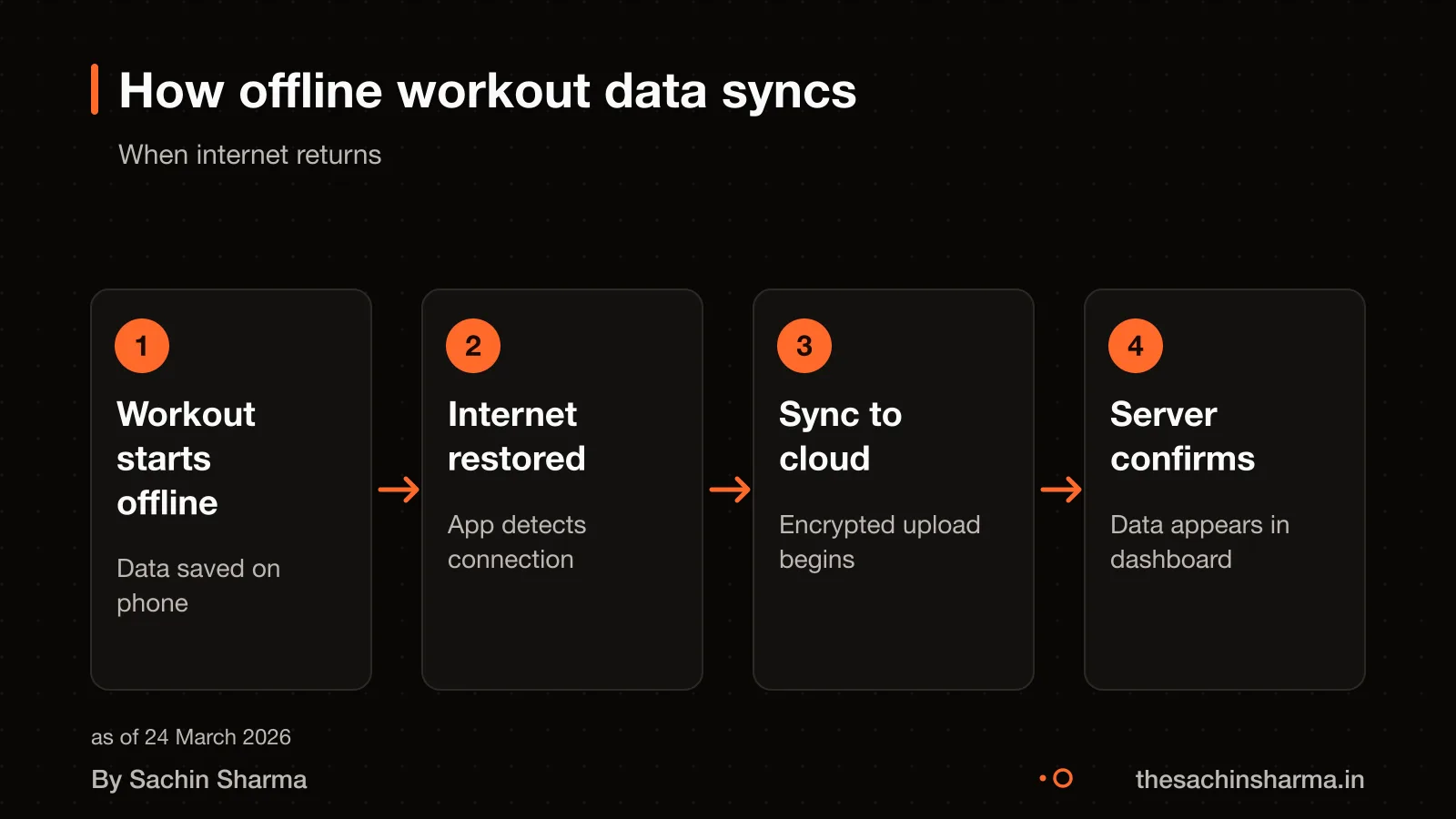
Fitness apps are different from regular apps because they collect sensitive health data, run for hours during workouts, and often work offline. Your developer must design for battery life, data safety and smooth sync when the phone reconnects.
Flutter is often a good fit for fitness apps because it lets one codebase run on both iOS and Android, cutting development time and cost. It also supports plugins for HealthKit and location services.
why Flutter works for fitness apps
Have a quote in hand? Send it to me and I will mark what is missing.
Message me on WhatsAppWhat architecture decisions matter most?
How your fitness app handles offline workouts, health data and growth matters more than the code itself. A developer must design the system so it works when the internet drops. Keeps personal data safe, and does not break when you add more members or classes.
For offline workout data, pull-based sync means the app fetches updates just before showing them to the user. This works well if your gym has brief or medium-length network outages. In contrast, push sync sends changes instantly but needs more battery and data. For gyms with unreliable Wi-Fi, a local-first design stores data on the member’s phone and syncs only when online, reducing delays and failed uploads.
Health data, like body measurements, medical waivers or workout injuries, must stay private. The developer should store this data encrypted, either on the device or in a secure cloud, with access limited to staff who need it. Since India’s Digital Personal Data Protection Act (DPDPA) 2023 requires data principals to know what is collected. Why, your app must log access and allow members to request their data or deletion.
Scalability means the app keeps working as your gym grows. A multi-tenant backend, like the one I built for a family-run conglomerate with five brands. Eight outlets, lets you manage multiple locations under one system without rebuilding. Lead-to-delivery time for that project fell from two weeks to four days. For a fitness app, scalability comes from clean separation between the user app. The admin panel, and the database, so each can be updated or scaled independently.
For a real example of how sync was designed in a client project, see how real-time sync was designed.
What legal and data privacy rules apply in India?
A fitness app in India should protect health and biometric data as sensitive personal information. You must get clear consent before collecting such data and only collect what is necessary for the app to work. This includes location, health, and motion data. Apple and Google both require that you do not use this data for ads, marketing or selling to third parties. On Apple’s platform, users expect health and fitness apps to preserve privacy and protect sensitive data.
As a developer, you must follow India’s data protection rules. Minimize data collection and request permission to collect data such as location, health, and motion data to protect user privacy.
If you are a developer based in India, you must assess your own GST liability and pay tax as applicable. If your annual turnover crosses ₹20 lakh, you must register for GST and collect it on your services. You may also need to share your GSTIN with app stores like Google Play. For your specific case, talk to a tax professional before launching.
When a fitness app is not the right choice
When a fitness app is not the right choice
For small teams, the time spent managing app updates, user access and feature requests can outweigh the benefits. A simpler tool like a shared spreadsheet or WhatsApp group may be enough to track attendance and class sign-ups.
An app won’t help if your main issue is low member engagement or poor trainer quality. No amount of tech can fix weak service or a bad experience. If you are still using paper forms and have not digitised your billing, start with a basic digital register or invoicing tool first.
Yes, WhatsApp or spreadsheets can work instead, especially in the early stages. These tools are free, familiar and need no training. They are not secure for sensitive data, but for basic coordination, they are often good enough.
Next step: message me on WhatsApp with what you want to build. No forms, no sales team.
Message me on WhatsAppAssumptions behind the numbers
- Developer will explain sync method clearly
- Developer follows standard health data protection rules
- Wearable integration is possible and affordable
Your checklist
Before hiring, here is what to check. Tick what the developer agrees to in writing. The page tells you where you stand.
App Ownership
Offline Sync
Health Data Privacy
Wearable Integration
Walk away if
- Developer refuses to put app ownership in writing
- No mention of how health data is protected
- Offline mode is promised but not explained
- Wearable integration is assumed, not confirmed
- Payment asked upfront with no milestones
Questions people ask
01What does the engineer actually decide on a fitness app?
The engineer chooses how data sync works, where data is stored, and how user privacy is handled. For short offline periods, pull-based sync fetches data just before presenting it to the user. On Apple devices, HealthKit provides a central repository for health and fitness data.
02Which skills matter most for a fitness app developer?
On Apple, this means HealthKit for fitness data, Core Location for outdoor activity tracking, and WorkoutKit for interval workouts. On Apple, this means HealthKit for fitness data, Core Location for outdoor activity tracking, and WorkoutKit for interval workouts. These are key for accurate, reliable features.
03How do I test a developer’s fitness app experience?
Check if their app is registered under a verified developer on Android. Use the Android Developer Status API to check whether an Android app package name is registered to a verified developer.
04Who owns the app code after it is built?
The developer who creates the app in the Developer Portal is the initial owner. They can add other owners or transfer control. A Global Administrator can take over the ownership of an app and add other developers as owners. You should confirm ownership terms in your contract.
05Do I need to collect GST on app sales?
App developers based in India must decide their own tax duties and pay GST if applicable. If you are required to have a GSTIN, you must give it to Google. Check this for your case with a chartered accountant.
06What are the risks of poor offline sync?
Poor offline sync can cause data loss or duplicate entries when the app reconnects. Pull-based sync works best for brief to medium outages. For longer offline use, more solid methods are needed to avoid errors during data fetch.
07What if the app fails during peak hours?
If the app fails at peak times, it may not handle user demand well. Load testing and scalable design help prevent this. Professional fitness app development services may help businesses create solutions that meet user expectations while supporting long-term growth.