Custom build vs white-label: what each really gives you
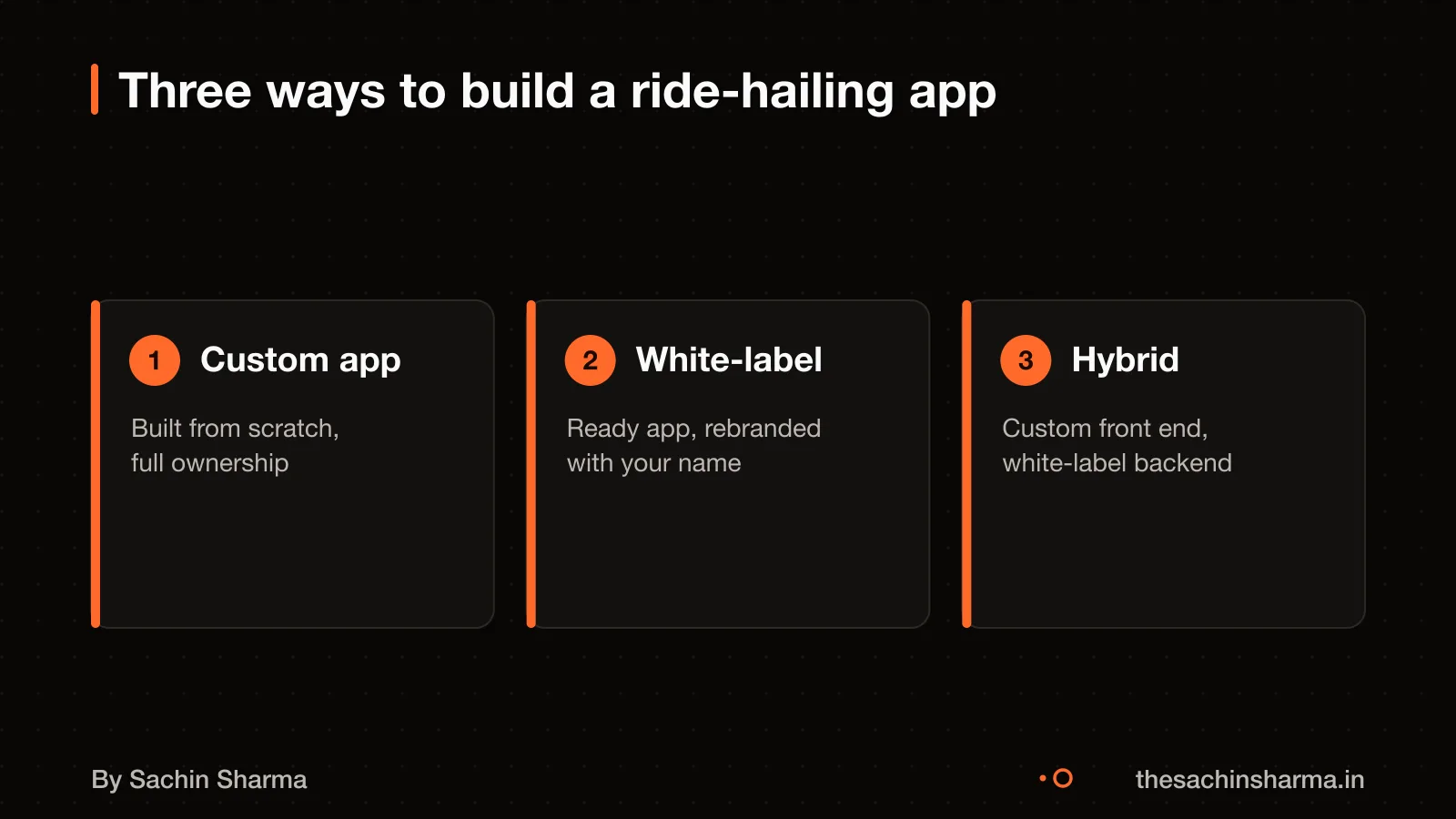
A custom-built ride-hailing app is made from scratch to match your business needs. It includes a passenger app, a driver app and an admin panel, all built to work together smoothly. You control every feature, design choice and backend rule. This means you can change pricing, add new vehicle types, or adjust dispatch logic at any time.
A white-label platform is a pre-built app that you rebrand and launch quickly. But the code is shared across many brands, and your ability to change core features is limited. You are locked into the platform’s update schedule and pricing model.
Both approaches give you the three core apps needed for a ride-hailing service. The difference lies in control and flexibility. A custom build gives full ownership. A white-label solution trades control for speed.
How much each option costs to build
A custom ride-hailing app costs $40,000 to $300,000 or more, depending on feature complexity. This is just the upfront build cost. The main factor that drives cost up is feature complexity, more screens, real-time logic, admin panels and third-party integrations all add time and testing. For example, adding live driver tracking, dynamic pricing, or multi-language support increases development effort significantly.
White-label platforms do not list upfront build costs in the evidence, only faster launch times. As an estimate, assuming mid-range features and Indian developer rates, a white-label solution may start from ₹5 to 15 lakh for setup and licensing.
You also need to budget for maps, SMS, cloud hosting and customer support, these are not included in base figures. Costs rise further if you need custom branding, advanced analytics or compliance tools.
For a clearer picture, see the full cost to build a ride-hailing app, which breaks down each component.
Want a number for your idea? Send one line on WhatsApp. I reply with what drives the cost and what to cut.
Message me on WhatsAppHow long each approach takes to launch
A white-label ride-hailing app can go live in 3 to 5 weeks. This is because the core app, driver and rider interfaces, and admin panel are already built. You only customise the branding and onboarding flow. For example, a city taxi service can start operations within a month using a pre-built platform with its own logo and fare rules.
A custom Minimum Viable Product (MVP) takes 4 to 6 months to build. This includes 4 to 6 weeks of planning and discovery. The timeline covers building core features like user registration, ride booking, real-time tracking, and payment processing. For instance, a startup in Pune building a Flutter-based app with a Next.js backend would spend the first month finalising the scope and design.
A full enterprise-grade ride-hailing app takes 8 to 12 months or longer. This includes native apps for riders and drivers, a detailed admin dashboard, dynamic pricing, AI-based dispatch, and integration with third-party services. An example is a multi-city fleet operator needing role-based access, audit logs, and custom reporting.
The actual time depends on team size, feature complexity, and how fast you make decisions. Delays often come from unclear requirements or late feedback, not coding speed. For a more detailed timeline for a ride-hailing app, see the full guide on the timeline for a ride-hailing app.
When a white-label platform will not work for your taxi business
You cannot change core features or design in a white-label app because you do not own the source code. This means even small fixes or branding updates need approval from the provider, and major changes are often blocked. As your business grows, this lack of control can slow you down.
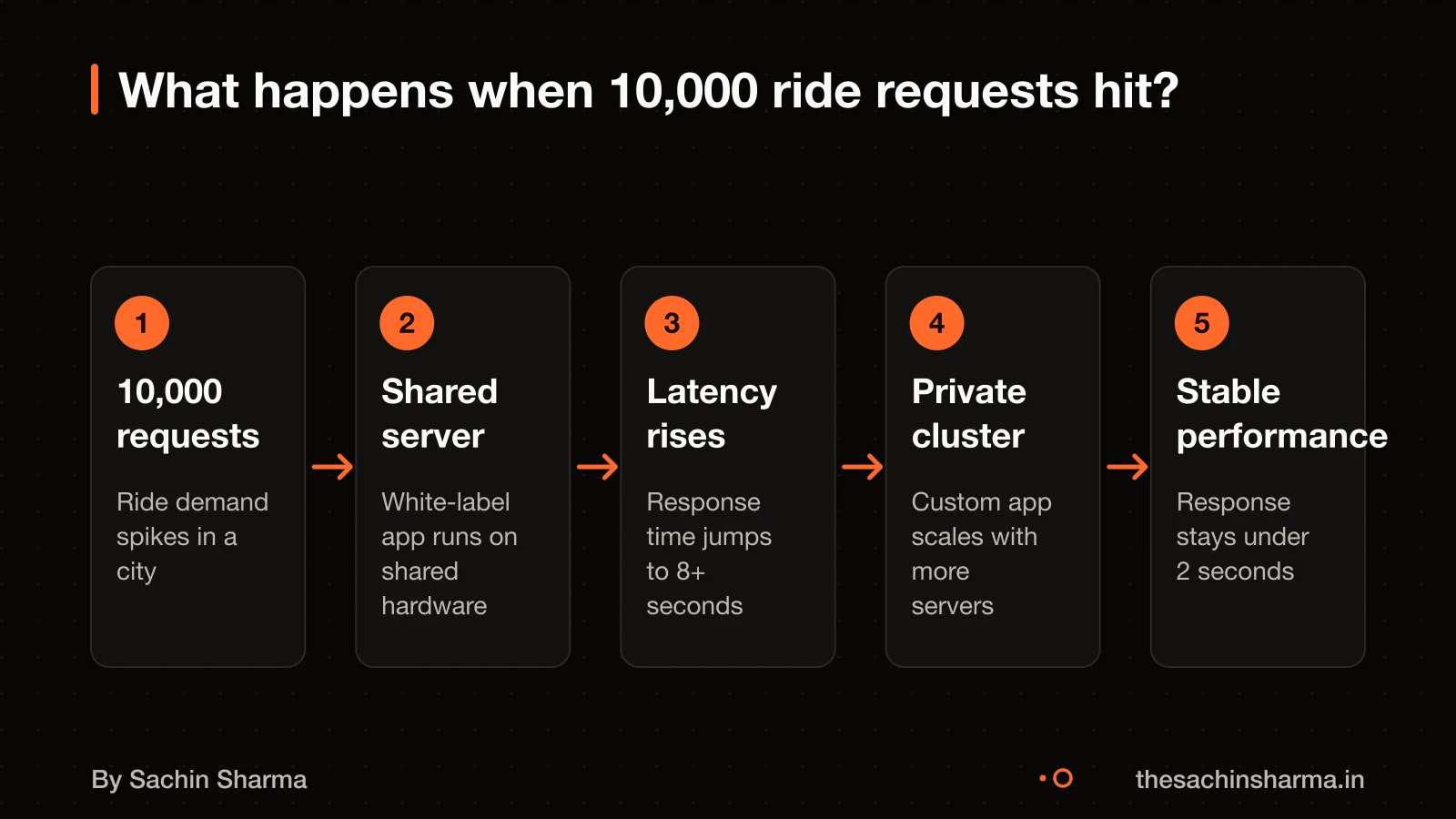
White-label platforms may experience performance issues under high load because they often run on shared cloud infrastructure. When too many users book rides at once, performance drops for everyone on the system.
You cannot stand out from competitors using the same white-label platform. All apps look and work similarly, so riders have no reason to pick yours over another. Marketing and pricing become your only tools, but those are not enough in crowded markets.
If your city has peak-hour surges or you plan to expand fast, a white-label platform may not scale with you. Shared systems limit your growth, and switching later means rebuilding from scratch.
build or buy a ride-hailing app compares these trade-offs in depth.
Not sure if your project has this risk? Tell me the plan in two lines and I will say yes or no.
Message me on WhatsAppHow each app behaves when 10,000 rides are requested at once
A white-label ride-hailing app is likely to slow down or fail under 10,000 simultaneous ride requests because it runs on shared cloud infrastructure. The first thing that breaks is usually the ride-matching engine or the API gateway. As these components face the highest load and are not built for sudden spikes in one tenant’s usage. Since multiple businesses share the same system, a surge in one app can affect others. The provider may rate-limit or throttle traffic to keep the platform stable.
Custom-built apps can handle such traffic spikes, but only if designed for scale from the start. You must use auto-scaling backend services, a solid database setup (like read replicas or sharding), and a message queue to manage ride requests in bursts. For example, using Kubernetes to scale the ride-matching service and Redis to manage real-time driver locations helps maintain speed under load.
What architecture choices matter most is not fully documented in the evidence. However, based on standard high-load systems, using event-driven design, separating read and write databases, and hosting critical services independently are key. These choices let you upgrade one part without affecting the whole system.
The technical choices with the biggest performance impact are not known. You should ask your developer how their design handles peak loads and request a load-testing report.
Who owns the code and can you switch developers?
With a custom build, you get full ownership of the source code and can hire any developer later. This means your team can fix bugs, add features, or switch agencies without asking anyone. The code is yours by default, as long as the contract says so. For example, if your current developer stops responding, you can hand the code to another team and keep building.
White-label platforms do not give you the source code. You only get access to use the app, not to change its core. If the vendor shuts down or changes pricing, your app could stop working with little warning. Since you cannot migrate the app itself, you would have to rebuild from scratch on a new platform.
This lack of control is a real risk if your business depends on the app. You cannot audit the code for security, nor adapt it to new laws or user needs. Even small fixes may need vendor approval, which can be slow or costly.
If you are hiring a developer, ask up front: "Will I own the source code?" and get it in writing. A clear contract protects you more than any platform promise.
what to ask a developer
What it costs to move from a white-label platform to custom
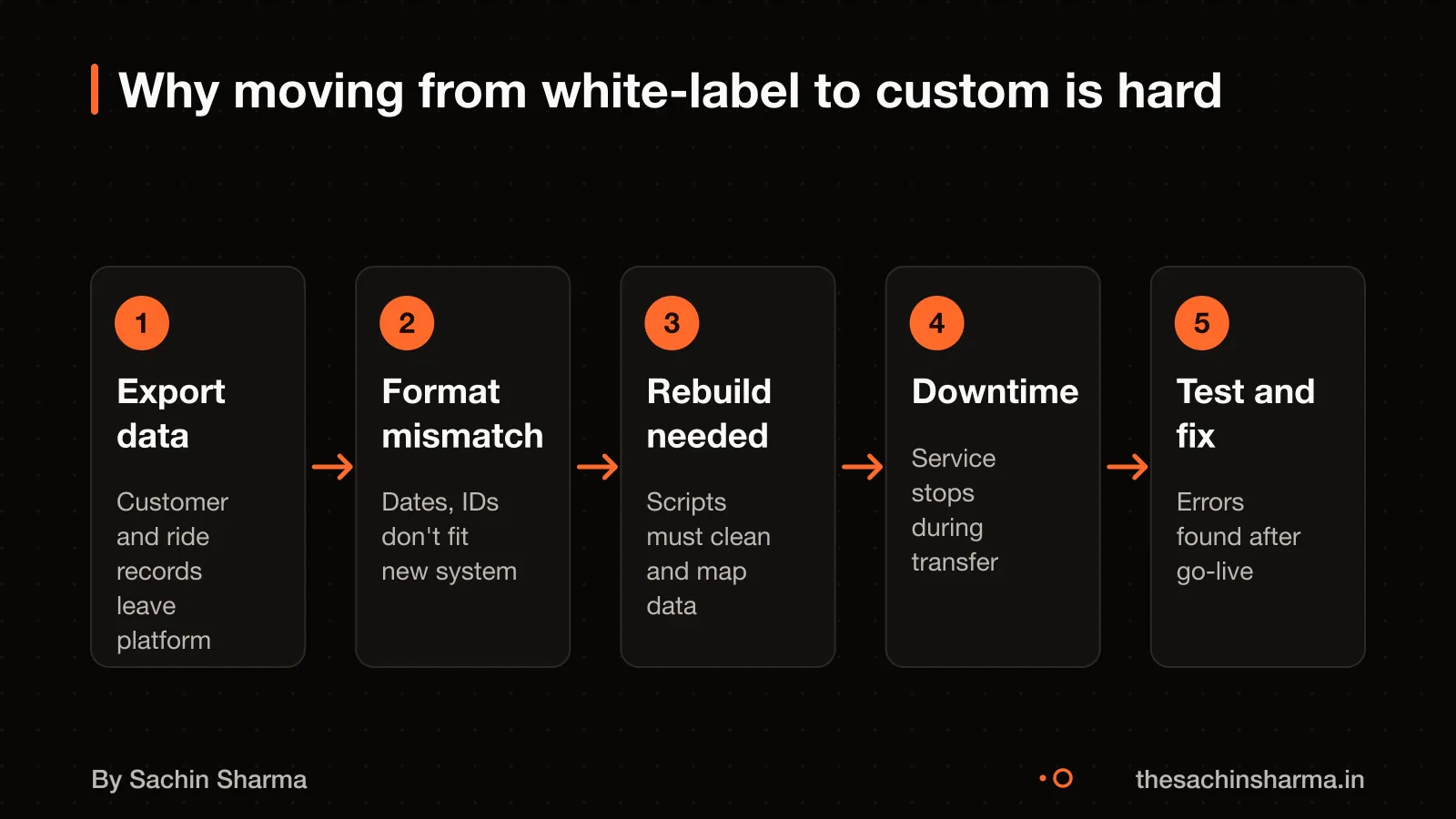
You cannot move a white-label ride-hailing app to your own server unless the provider allows it. Trawex does let you install their solution on a shared, hosted or cloud server. Most other white-label platforms do not give this option, locking you into their infrastructure.
If you later switch from a white-label or custom platform to a new system like Shopify, the migration can cost $10,000 to $500,000+. As an estimate, this range depends on data size, integrations, and design complexity. A simple migration starts at $10,000, while enterprise-level moves can exceed $500,000.
The main risk is a full data structure rebuild. Your ride history, user accounts, pricing logs and driver records may not transfer directly. You might lose historical data or have to recreate it manually. This rebuild effort often takes weeks and requires deep testing.
The backend running cost at scale is not known, long-term expenses after migration are hard to predict. You should ask your developer for a data portability plan before starting on any white-label platform.
Laws and rules for ride-hailing apps in India
The Motor Vehicle Aggregator Guidelines, 2020 set the legal baseline for ride-hailing apps in India. These rules were issued under the Motor Vehicles Act, 1988 and the 2019 Amendment Act. They apply to any digital platform that connects passengers with drivers for hire.
You do not need a central licence to operate a ride-hailing app. The guidelines require state-level registration and compliance. Each state transport authority handles permits for vehicles and drivers. Your app must verify driver documents and share data with authorities when required.
The Income-tax Rules, 2026 are available for download as a PDF. You must collect GST on service fees. The GST rate for ride-hailing services is not known. Ask a chartered accountant for your business structure.
The legal requirements for driver verification in India are not fully known. Check with your state transport department and a legal advisor before launch.
When you should not build a ride-hailing app at all
When you should not build a ride-hailing app at all
Nearly 90% of taxi app startups fail within the first two years. If your city already has strong players like Ola, Uber or local fleets, entering the market may not be worth the risk. Competition drives down fares and increases customer acquisition costs. You would need deep pockets to survive the early losses.
If you do not have sufficient capital for the initial build, do not start. Ride-hailing apps require custom backend systems, real-time tracking and secure payment flows. These are expensive to build and test. Without enough capital, you cannot handle delays or unexpected costs.
You should also avoid building if you are unsure about local transport laws. In India, ride-hailing services must follow state-level permits, driver background checks and vehicle registration rules. Talk to a transport lawyer before committing.
Related reading: ride-hailing app features, timeline for a ride-hailing app.
Next step: message me on WhatsApp with what you want to build. No forms, no sales team.
Message me on WhatsAppAssumptions behind the numbers
- White-label cost in rupees is estimated at ₹50,000 to ₹5 lakh based on typical conversions and entry-level packages.
- Scalability and long-term cost assessments are based on architectural principles, not direct evidence.
Pick your situation
I am a solo developer who builds custom apps. I benefit from the verdict that favours custom development. That is why the table below also tells you when white-label is the better pick.
Pick your situation
Custom wins. Custom apps give you the complete source code and intellectual property rights.
The whole comparison
| Custom | White-label | |
|---|---|---|
| Upfront cost | $40,000 to $300,000+ | ₹50,000 to ₹5 lakh (estimate) |
| Time to launch | 4 to 12 months | 3 to 5 weeks |
| Ownership | Full code and IP | Limited or none |
| Scalability | High (architected for growth) | Medium (shared infrastructure) |
| Long-term cost | Lower (no recurring fees) | Higher (subscriptions, fees) |
Whichever you choose, ask these
- Can I see the source code?
- What happens if I stop paying?
- How do updates work?
- Can I switch platforms later?
Questions people ask
01How do custom and white-label apps differ under high load?
Custom apps may handle high load better due to dedicated infrastructure, but this is not directly supported by the evidence. White-label platforms run on shared cloud resources, which can create bottlenecks during peak demand. This often affects ride-matching or API response times.
02What does it cost to migrate from a white-label platform to a custom app?
Migration can cost between $10,000 and $500,000 or more, depending on complexity. The main risk is a full data structure rebuild.
03Can a small team maintain a custom ride-hailing app?
It depends on the app's complexity and the team's devops skills. There is no evidence on the minimum team size needed. For reliable performance, you need strong backend and monitoring expertise.
04Do I need a license to run a taxi app in India?
Yes, you need to follow the Motor Vehicle Aggregator Guidelines, 2020 issued by the Ministry of Road Transport & Highways on 27 November 2020. Check the official notification for full requirements.
05How much GST applies when hiring a developer?
The GST rate for hiring a software developer is not in the evidence. Rates depend on the service type and whether the developer is registered. Check this for your case with a chartered accountant.
06Is a white-label app worth it for a pilot project?
Yes, if you need a fast launch and can accept design and feature limits. White-label solutions trade flexibility for speed. But be aware of vendor lock-in risks.
07Can I add AI features to a white-label app?
It is hard to add custom AI features to a white-label app. These platforms may face challenges in API integration and system interoperability. You may need a custom build for full AI control.