What is a flower and gifting app?
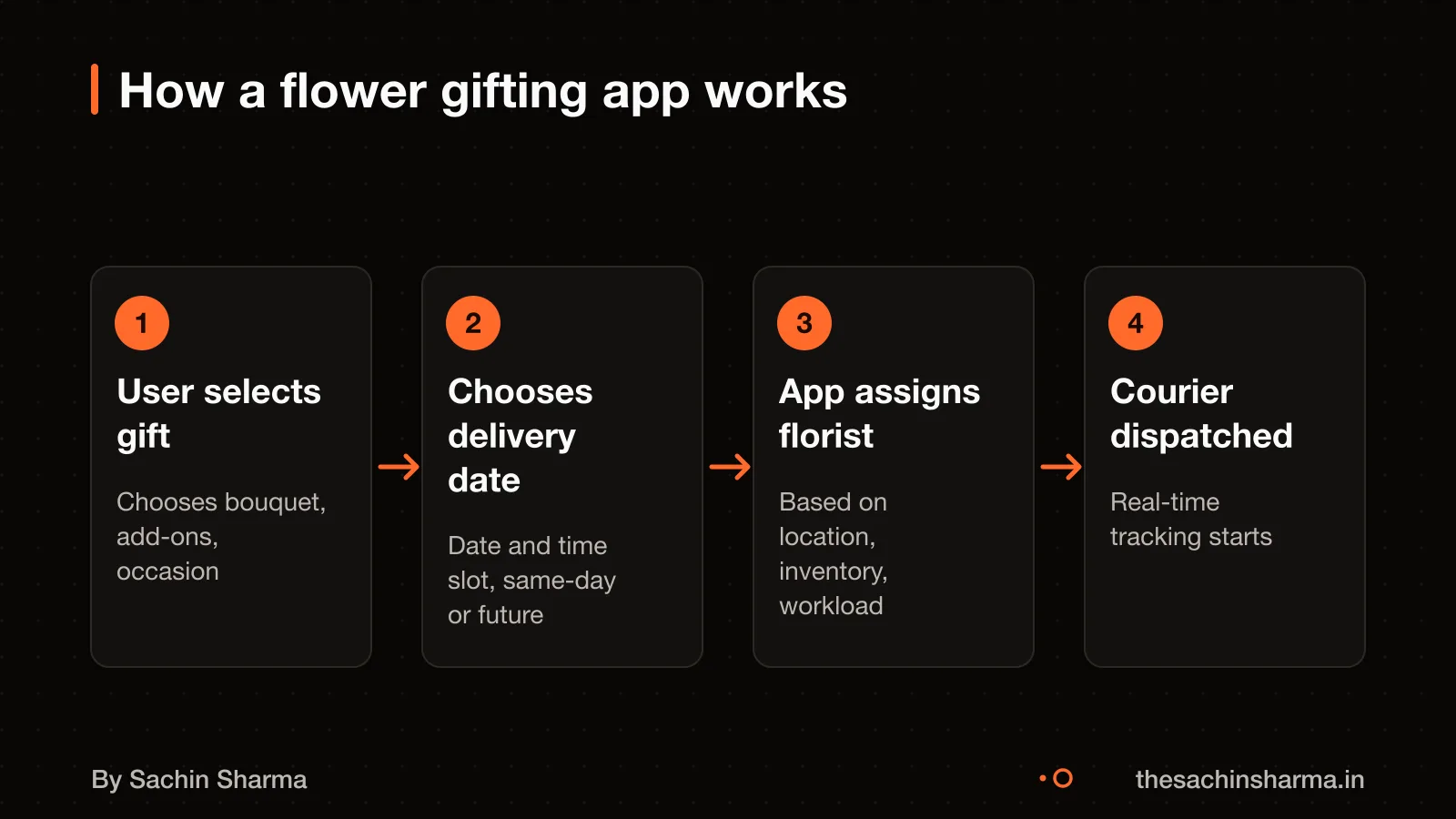
A flower and gifting app lets you order and schedule deliveries of fresh flowers. Curated gift hampers, often with personal messages and same-day or future-date delivery. Unlike general e-commerce apps, it handles perishable items, so freshness, timing and delivery coordination are built into every step.
It differs from standard online stores by focusing on time-sensitive gifting, birthdays, anniversaries, Diwali, where delivery windows matter more than price alone. Core functions include browsing arrangements, selecting delivery dates, adding custom notes, and tracking real-time delivery status. Some apps also offer subscription plans for weekly or monthly deliveries.
Users are mostly gift buyers, individuals or businesses, who want a reliable, personal way to send joy without visiting a physical shop. The app works with local florists or in-house teams to prepare and deliver orders, often within a single city or region. This hyperlocal model ensures speed and freshness but adds coordination complexity.
For deeper detail on what features to include, see Must-have features in a flower and gifting app.
Custom app vs platform: which do you really need?
A custom app is worth it only if you need automation at scale, such as recurring deliveries, dynamic pricing, or multi-vendor coordination. For most small businesses, starting with WhatsApp Business and spreadsheets cuts cost and risk. You can manage orders, collect payments, and send updates using WhatsApp, while tracking inventory and delivery schedules in a shared sheet.
Shopify or similar platforms let you list bouquets, accept orders, and process payments with built-in tools. They work well for one-off gifts and seasonal spikes like Diwali or Valentine’s Day. Weekly subscriptions are common because flowers do not last long in warm climates. These platforms handle hosting, security, and basic reporting, so you pay a monthly fee instead of a large upfront build cost.
The trade-off is control. With a platform, you cannot customise delivery reminders, integrate local courier APIs, or personalise unboxing notes at scale. A custom app adds cost but supports complex logic, white-labelling, and vendor dashboards. It takes several months, while a Shopify store goes live in under a week.
If you are testing demand or serving fewer than 200 customers a month, start on WhatsApp or Shopify. Move to a custom app only when manual work slows you down. For a full comparison of options, see Build or buy: custom, white-label or platform?
What drives the cost: features and complexity
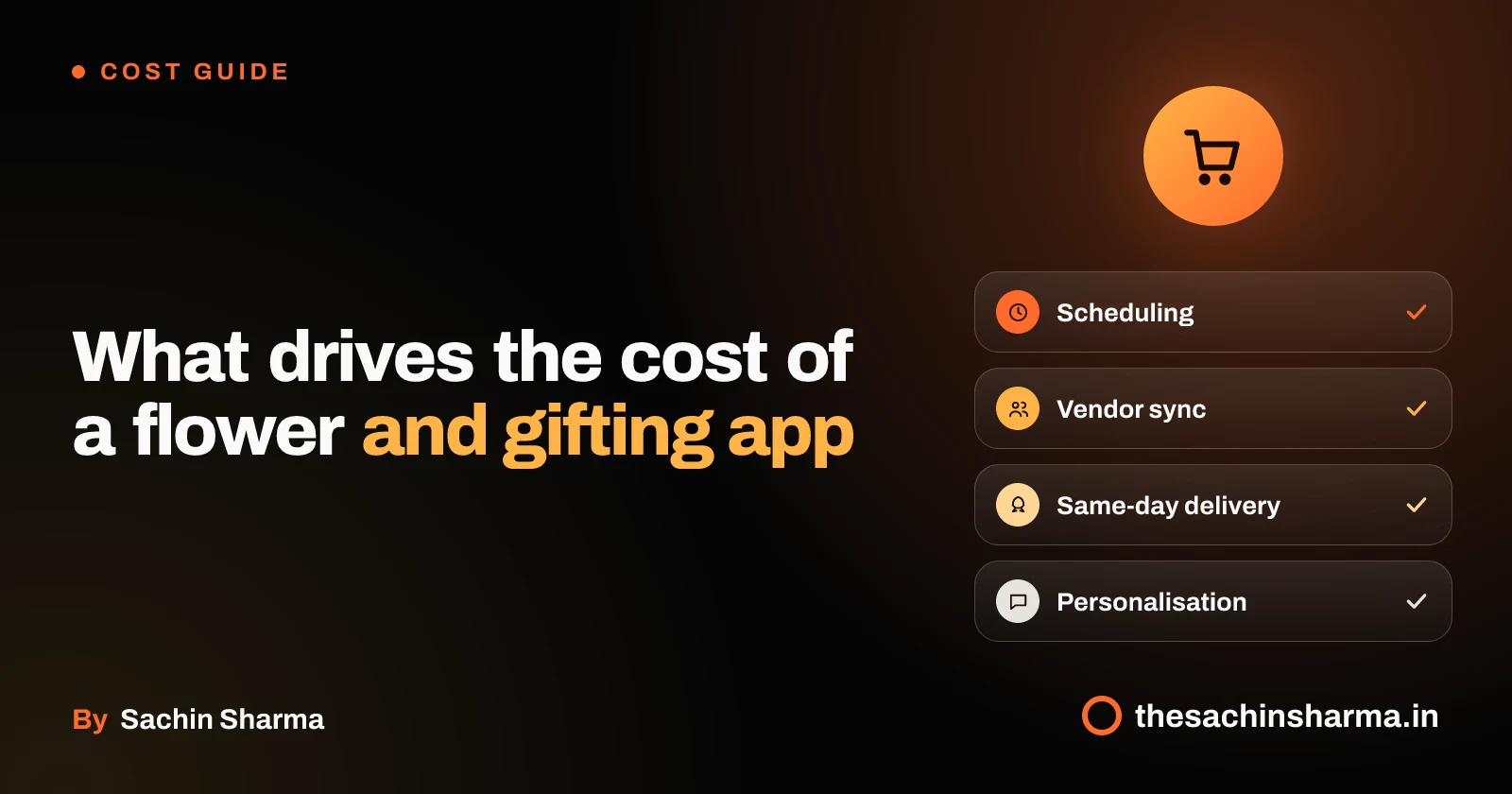
Scheduling and personalisation raise costs because they add logic layers that must work in real time. You need time slots that update as orders come in, and rules to block unavailable times. Each added personalisation, like custom messages, gift wrapping or photo inserts, needs form fields, preview logic and data passed to vendors. These features are not one-time builds. They need testing across devices and updates when user behaviour changes. As an estimate, real-time scheduling adds 3 to 4 weeks of development due to slot management and conflict handling.
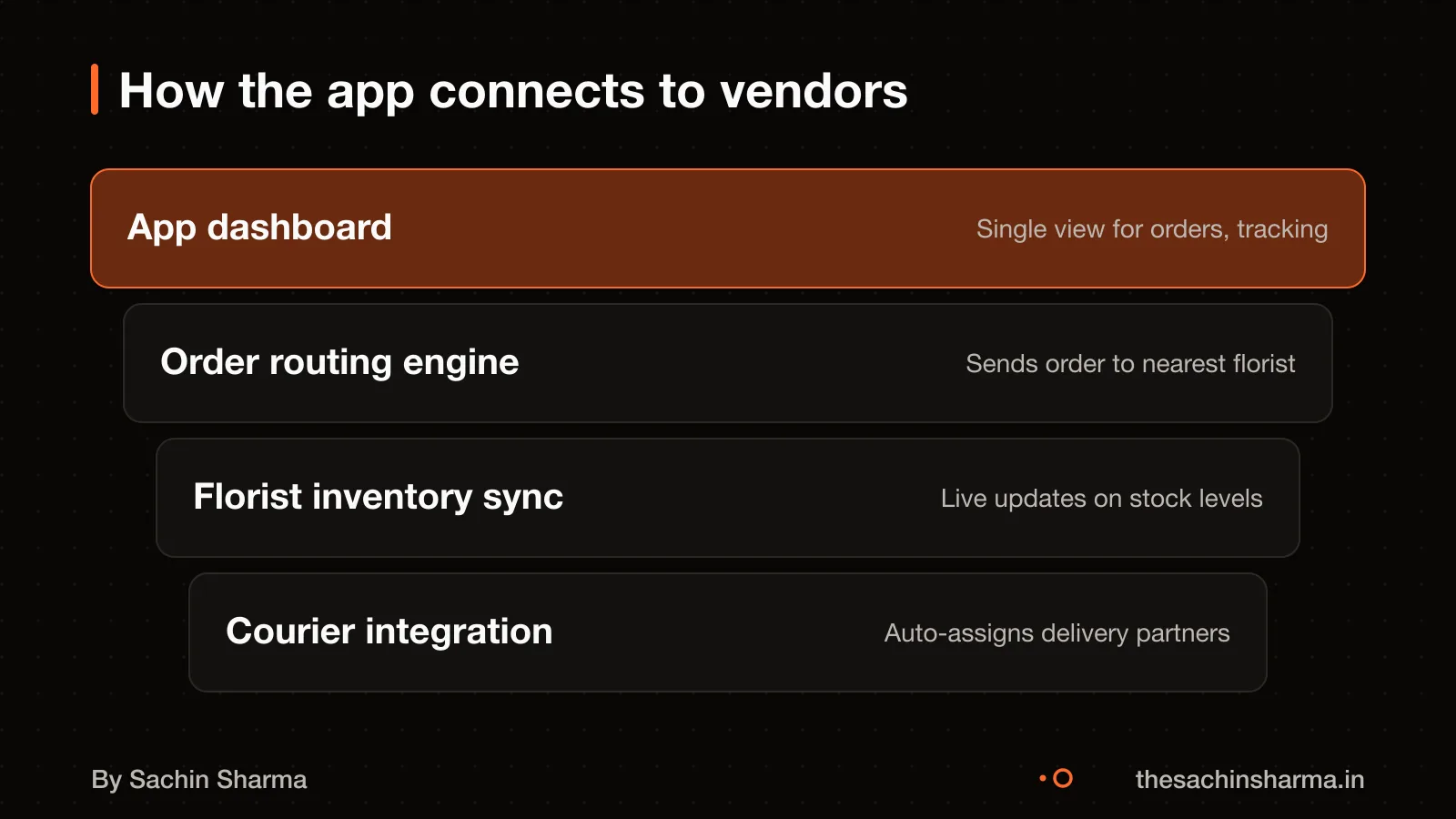
Same-day delivery is hard to build because it relies on live coordination between your app, vendors and couriers. The system must assign orders to the nearest florist with stock, then match with a delivery partner who can reach the recipient within hours. This needs GPS tracking, live status updates and fallback plans if a rider is delayed. As an estimate, same-day logic adds 3 to 6 weeks of work due to real-time routing and courier assignment rules.
Vendor network integration is expensive because each vendor may use different systems for inventory and orders. Your app must sync with them reliably, even if their internet is slow or their stock changes fast. This often means building custom connectors or using middleware to translate data formats. If you work with multiple vendors in different cities, you face multi-tenant complexity, keeping data separate but allowing central oversight.
AI personalisation and chat features also raise costs. These are not simple add-ons. They need training data, testing and ongoing maintenance to stay accurate. Each extra feature multiplies the testing load, especially if it interacts with scheduling or payments.
For most small businesses, the core value is in reliable delivery and clear communication, not every advanced feature. You can cut cost by starting with standard gifting options and adding personalisation later.
Want a number for your idea? Send one line on WhatsApp. I reply with what drives the cost and what to cut.
Message me on WhatsApp
How long does development take?
A flower and gifting app takes 8 to 16 weeks to build, depending on features and complexity. As an estimate, adding same-day delivery and live vendor sync can extend the timeline by 3 to 6 weeks. More complex logic, like real-time inventory updates or multi-city coordination, adds time because each rule must be tested under real conditions. For example, if a vendor cancels a booking, the app must free up the slot. Notify the customer, and adjust delivery routes, all without manual input. Delays often come from waiting on third-party services, such as payment gateways or logistics APIs. Or from late decisions on core features like gifting templates or delivery windows. Simple apps with pre-set bouquets and next-day delivery can be ready in 8 weeks. While those with customisation, scheduling, and vendor dashboards take closer to 16 weeks.
How does GST apply to app development?
Yes, GST is charged on app development fees in India. The standard GST rate for software development services in India is 18%. This applies whether you hire a freelancer or a company. You do not pay 40%, that rate appeared in a test environment on 21 September 2025. But was not enacted as law.
You need a GST invoice for input tax credit if your business is registered. The developer must quote their GSTIN and include it in the invoice. Without it, you cannot claim credit.
If your business has annual turnover over ₹5 crore, e-invoicing is required for B2B supplies under GST rules. App development fees to a registered business count toward this. Most small gifting businesses stay below this limit, so e-invoicing may not apply.
For compliance, always ask for a GST-compliant invoice with the developer’s details and the rate applied. If in doubt, consult your CA, they can confirm the right code and filing rules for your case.
Who owns the app code and design?
Ownership of custom apps transfers only if the contract specifies it. But if the developer does not hand over the code, you cannot switch developers or make changes. This risk is real if there is no clause requiring source code delivery.
To protect yourself, the contract must state that you own the final source code and design files. Without it, the developer may refuse to hand over the code, leaving you stuck. You can switch developers later only if you have full access to the code, documentation, and third-party accounts.
Always sign a contract that assigns full ownership to you before any work starts. Ask for the source code to be stored in a repo you control, even during development. This way, you can move the app to another developer anytime.
Can you move the app to another developer?
Yes, you can transfer your app to another developer or organisation. Apple and Google both let you move app ownership between accounts while keeping the app live on their stores. The process is built into App Store Connect and Play Console.
During the transfer, your app stays available for download. Users keep access and continue to get updates. Most importantly, your reviews and ratings stay with the app. This protects your reputation and trust with customers.
However, sales data splits at the transfer date. You, as the current owner, keep access to all historical sales and payment records up to the day of transfer. The new developer only sees sales and earns revenue from transactions that happen after the transfer completes.
No user data, order history or product catalog is lost during the move. But make sure the new developer has access to your backend systems, admin panels and any third-party services. The app store transfer only covers the listing, not your full tech stack.
What are the biggest risks in development?
Testing is 15 to 25% of a proper build. If a quote skips dedicated QA, you become the tester, after launch, in front of your users. Delivery tracking failures can cause missed deliveries and lost trust, especially with perishable items like flowers.
AI personalisation can go wrong if it suggests inappropriate gifts or messages, or if it relies on poor data. This harms your brand and may upset customers. To verify a developer’s work, check their GitHub commit history for regular updates and code quality. Ask for test coverage reports if they are willing to share them. As an estimate, look for at least 70% automated test coverage for core features.
Not sure if your project has this risk? Tell me the plan in two lines and I will say yes or no.
Message me on WhatsAppHow to check if a developer’s estimate is realistic
A good estimate includes design, development, testing, backend systems, and source-code ownership. If a quote seems too low, it likely leaves out key parts like quality assurance (QA), server maintenance, or legal rights to the code. Always ask what is excluded from the price.
Low quotes are suspicious because they may cut corners on security, scalability, or long-term support. For example, skipping automated testing saves money now but raises the risk of crashes during peak sales like Diwali. Indian development rates are 60 to 70% lower than in the US or UK for similar quality, so extreme discounts are a red flag.
To spot missing items, check if the estimate lists separate costs for UI/UX design, API development, admin panels, and post-launch maintenance. Ask whether the team will write automated tests and who owns the GitHub repository. A realistic quote breaks down each component, so you can see where your money goes.
Worked example: cost of a moderate flower gifting app
As an estimate, a moderate flower and gifting app starts at ₹8 lakh. This base covers core features like user accounts, a product catalog, payment integration, order tracking, and an admin panel. REMOVE
GST is charged on the development fee. However, this rate is not yet confirmed for app development services, which typically fall under 18% GST. Assuming the new rate applies, GST on ₹10 lakh would be ₹4 lakh. So, the total estimated cost would be ₹14 lakh (₹8 lakh + ₹2 lakh + ₹4 lakh GST).
Note: The 40% GST rate is based on a test environment update and may not reflect current tax law. Always confirm the applicable GST rate with a tax professional before finalising budgets.
When this advice is wrong
When this advice is wrong Do not build a custom app if your order volume is under 50 per month. At that scale, WhatsApp Business with a shared spreadsheet for delivery tracking is faster and costs nothing. A custom app starts to pay off only when manual coordination eats more than 10 hours a week.
If your budget is under ₹5 lakh, a custom app may not be feasible. Even simple apps cost ₹4 lakh to ₹8 lakh. Instead, use Instagram orders or a WhatsApp catalog with payment links. You can upgrade later when revenue supports the cost.
A third-party platform like Bluemoon or Ferns N Petals Pro may be better if you want instant reach. These platforms charge a commission per order but include delivery logistics and customer service. They suit businesses that want to test demand without upfront tech cost.
Related reading: Cost of a 10-minute delivery app, Timeline for a flower and gifting app.
Next step: message me on WhatsApp with what you want to build. No forms, no sales team.
Message me on WhatsAppAssumptions behind the numbers
- Default team size is 3 people (1 PM, 1 designer, 1 developer)
- Default hourly rate is ₹1,500
- Default GST rate is 18%
- Same-day delivery adds 3–6 weeks to the timeline
Work out your own number
I won't hand you a number that pretends to be the market. Instead, here is the working: set the weeks, the people and the rate, and see where the money goes.
Your working total
₹6,40,00016 weeks × 2 people × 5 days × ₹4,000- Scope and design13%
- UI/UX Design19%
- Build50%
- Testing and fixes13%
- Launch and stores6%
The weeks shown are an example of a small app, there to be changed. Fees you pay others (store accounts, cloud, SMS) are not in this total.
What moves the price
- More screens or roles
Each extra user type (customer, admin, rider) is close to another app.
- Real-time features
Live tracking and chat need more design and more testing.
- Many integrations
Every payment, SMS, maps or ERP link is its own piece of work.
- Same-day delivery
Vendor coordination and real-time sync add 3–6 weeks.
- Cutting to one platform first
Starting with one clear flow can be half the work.
- Using managed services
A managed backend for login and data removes weeks.
- A clear scope up front
Changes mid-build are the most expensive weeks.
Fees that go to someone else
Google Play developer account
A one-time registration fee, paid to Google. Check the current amount.
Apple Developer Program
A yearly fee paid to Apple. Check the current amount.
Cloud, SMS, maps, payments
Usage-based, billed by the provider to you.
Ask for these before you sign
- How many weeks per phase, and with how many people?
- What is not included?
- Which fees do I pay to others directly?
- What happens to the price when I change my mind?
- What does the first month after launch cost?
Questions people ask
01Which components drive the cost of a flower and gifting app?
The main cost drivers are app features, platform choice, UI/UX design, development team location, backend infrastructure, and testing. Inventory, packaging, logistics, and staffing also add major expenses. For small businesses, starting simple can reduce early costs.
02Where do estimates for a flower and gifting app usually go wrong?
Low quotes often exclude QA, backend development, or source code ownership. Always ask what is not included. Budget 15 to 20% of the build cost per year for maintenance, as this is often left out.
03What can be cut without hurting the product?
Start with WhatsApp Business and spreadsheets for order tracking to keep costs low. Delay AI personalisation and custom packaging. Over 60% of consumers prefer purchasing flowers through online platforms, so the core demand is met with basic tools.
04How much does real-time delivery tracking add to cost?
Real-time tracking needs GPS integration and backend support for live updates, which adds development and testing effort. It also increases server load, especially during peak orders. This is a high-effort feature with rising maintenance needs.
05Is Flutter worth it for a flower gifting app?
Yes, Flutter saves 30 to 40% in development cost by using one codebase for both iOS and Android. It compiles to native code and avoids performance issues from JavaScript bridges. This makes it efficient for apps with rich UI like gifting platforms.
06Do I need a developer for same-day delivery logic?
As an estimate, yes. Off-the-shelf tools may not handle local courier rules or dynamic slot assignment. This assumes custom logic is needed to block unavailable times and assign orders based on location and staff. Without this, delivery delays can hurt customer trust.
07How do I handle GST on digital services?
Register for GST using your PAN, which is mandatory. Use the correct HSN code for software services and generate e-invoices. Check the GST rate for your case with a chartered accountant.
08What legal documents do I need when hiring a developer?
Check what legal documents you need with a lawyer to ensure full compliance.
09Can I use Shopify for flower gifting?
Yes, Shopify works for basic flower sales and online orders. For subscriptions or scheduled deliveries, you may need custom apps or add-ons. Weekly subscriptions are commonly preferred in warmer climates where flowers remain fresh for shorter durations.
10How often should the app be updated?
As an estimate, update every 3 to 6 months. This assumes you are following OS updates, security patches, and user feedback cycles. Regular updates help avoid technical debt and keep the app stable for customers.