What are the main ways to build an e-commerce app?
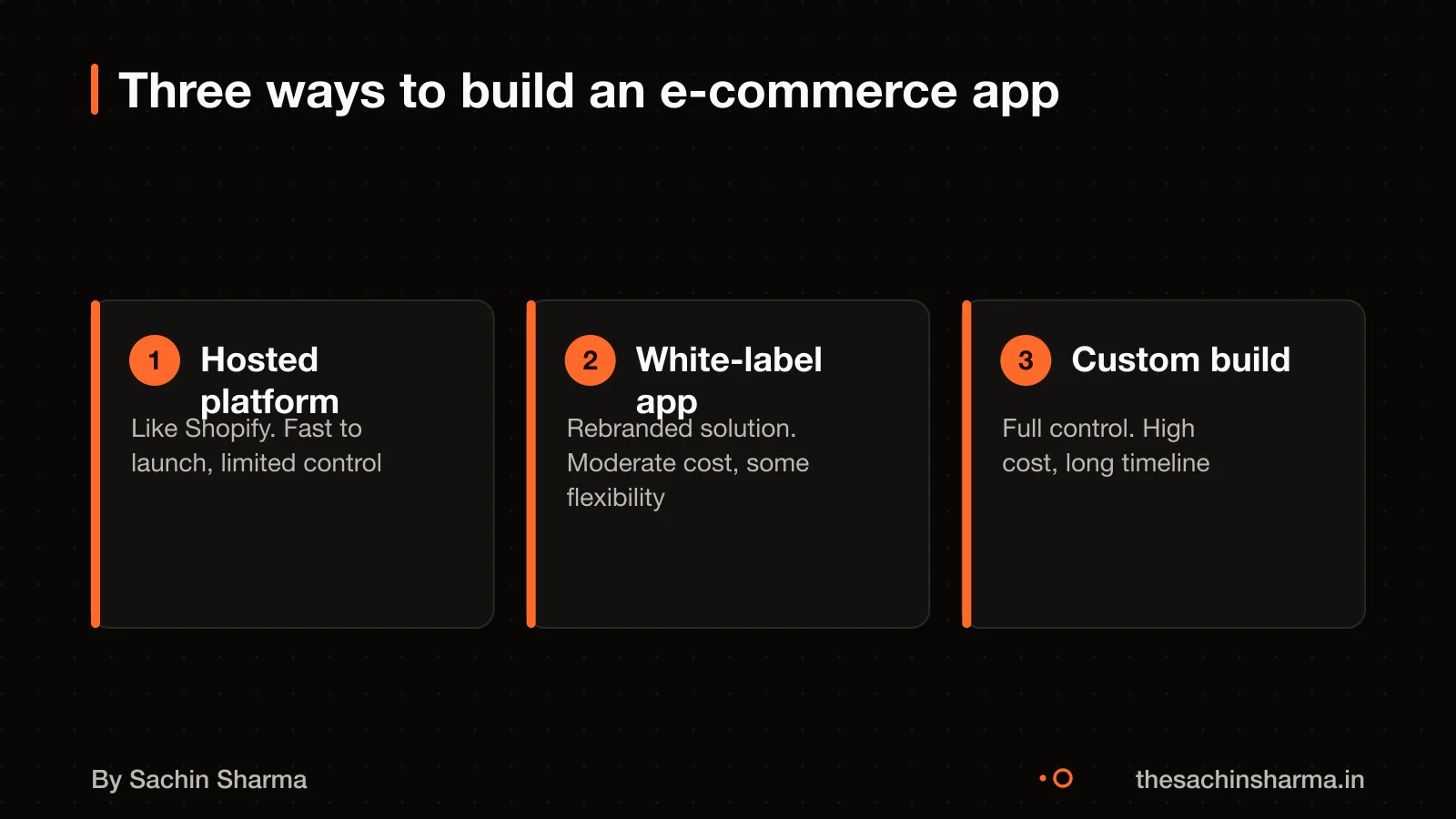
You can build an e-commerce app in three main ways: use a hosted platform like Shopify. Buy a white-label app, or build a custom app from scratch. Each offers different levels of control, speed, and cost.
A hosted platform like Shopify runs your store for you. You sign up, pick a template, and start selling. It handles hosting, security, and updates. Dukaan is another example used by Indian sellers for quick online stores. You get speed but less control over design and features.
A white-label app is built by one company and rebranded by another. The core app is the same for many clients. One company develops it, others sell it under their own name. It’s faster than custom build but still limits how much you can change.
A custom e-commerce app is made just for your business. It can do exactly what you need, not what a template allows. But it needs skilled developers and more time. Creating one requires development knowledge and can be challenging. You gain full control but must manage updates and maintenance yourself.
Do you really need a custom e-commerce app?
Most small businesses in India can start safely on a hosted platform like Shopify or WooCommerce. These work well when you need a fast launch, have a limited budget, and do not require deep custom features. You can run a full store with secure payments, inventory, and GST-compliant invoicing without writing code.
But you may outgrow Shopify when you face repeated API limits, need real-time sync with internal systems, or want to change core workflows. If Shopify updates its API and breaks your app, you will see a warning in your admin. May need to fix or remove it. That loss of control can hurt long-term growth.
Features that force a custom build include multi-warehouse stock sync, custom return logic for regional buyers, or AI-driven personalisation that off-the-shelf apps cannot deliver. It gives you control over the user experience while using a stable, open-source backend.
If your sales grow and your workflows become unique, a hybrid or custom system makes sense. But do not assume you need one at the start. Many businesses succeed on platforms for years. Consult a developer to assess your specific needs. For a clearer picture of long-term spending, see the cost to build a fashion e-commerce app.
How much does each option cost to build and run?
A basic e-commerce app costs ₹30,000 to ₹80,000 to build. While a medium one costs ₹80,000 to ₹2 lakh, and advanced builds start at ₹2 lakh. Hosted platforms like Shopify or WooCommerce have lower upfront costs but add monthly fees and transaction charges. A hosted OpenSEO subscription offers a plan at $10 per month.
Hidden fees often come from plugins, custom design work, or third-party services. Many hosted platforms charge transaction fees unless you use their payment gateway. For instance, Shopify charges 2% per transaction if you use an external gateway. These fees add up quickly on high sales volume. Custom apps have no transaction fees, but you must pay for hosting, domain, and SSL certificates.
What changes the final price? Features like inventory tracking across multiple outlets, GST-compliant invoicing, or integration with logistics APIs raise costs. So does building for both web and mobile. A custom front-end on a backend like Medusa may fall in the medium to advanced range, depending on how much you customise.
For long-term control, a hybrid model spreads cost over time without locking you into platform fees. If you plan to scale across brands or locations, this balance helps. The conglomerate platform I delivered handled five brands and eight outlets at over ₹150 crore in reported revenue. That scale demands custom logic, but you do not need it at launch.
Want a number for your idea? Send one line on WhatsApp. I reply with what drives the cost and what to cut.
Message me on WhatsAppHow long does each option take to launch?
Custom install links on Shopify expire after seven days. White-label apps take a few weeks to go live. Custom builds take longer due to development time. Hosted solutions are fastest because setup is standard and tools are ready-made. Delays in custom builds come from design, coding, testing and client feedback loops. White-label launches are quick because the core app is pre-built and only branding and content need change. For example, a hosted store can be up in a week if product images and prices are ready. A custom app may take 3 to 6 months depending on features. The 7-day expiry of custom install links on Shopify shows how fast hosted platforms expect you to move. If you need to go live fast, hosted or white-label are better choices.
Which option is best for your business?
For a small Indian business, your best choice depends on your budget, timeline and need for control. If you want to launch fast with low cost, a white-label app may suit you. These apps are pre-built and rebranded for your business. They launch quickly and cost less than custom builds. You trade off unique features and long-term flexibility.
If you need full control over design, logic and data, a custom app is worth the higher cost and longer build time. This fits when off-the-shelf tools cannot handle your sales model, inventory rules or customer journey. I’ve built custom apps in Flutter and Next.js, where full ownership matters for scaling or compliance.
Hosted platforms like Shopify offer a middle path. You can add free, supported apps to extend features. You manage your store through tools like the Dev Dashboard. These are easy to use but limit deep customisation.
It gives you a branded user experience with faster development. You avoid building payment, inventory or user management from scratch. This balances speed, cost and control, useful when you expect growth but need to launch fast.
how build choices differ in edtech if you want to compare trade-offs in another sector.
Still unsure between custom, white-label or platform? Tell me your budget and timeline and I will say which fits.
Message me on WhatsAppWhat breaks first under high traffic?
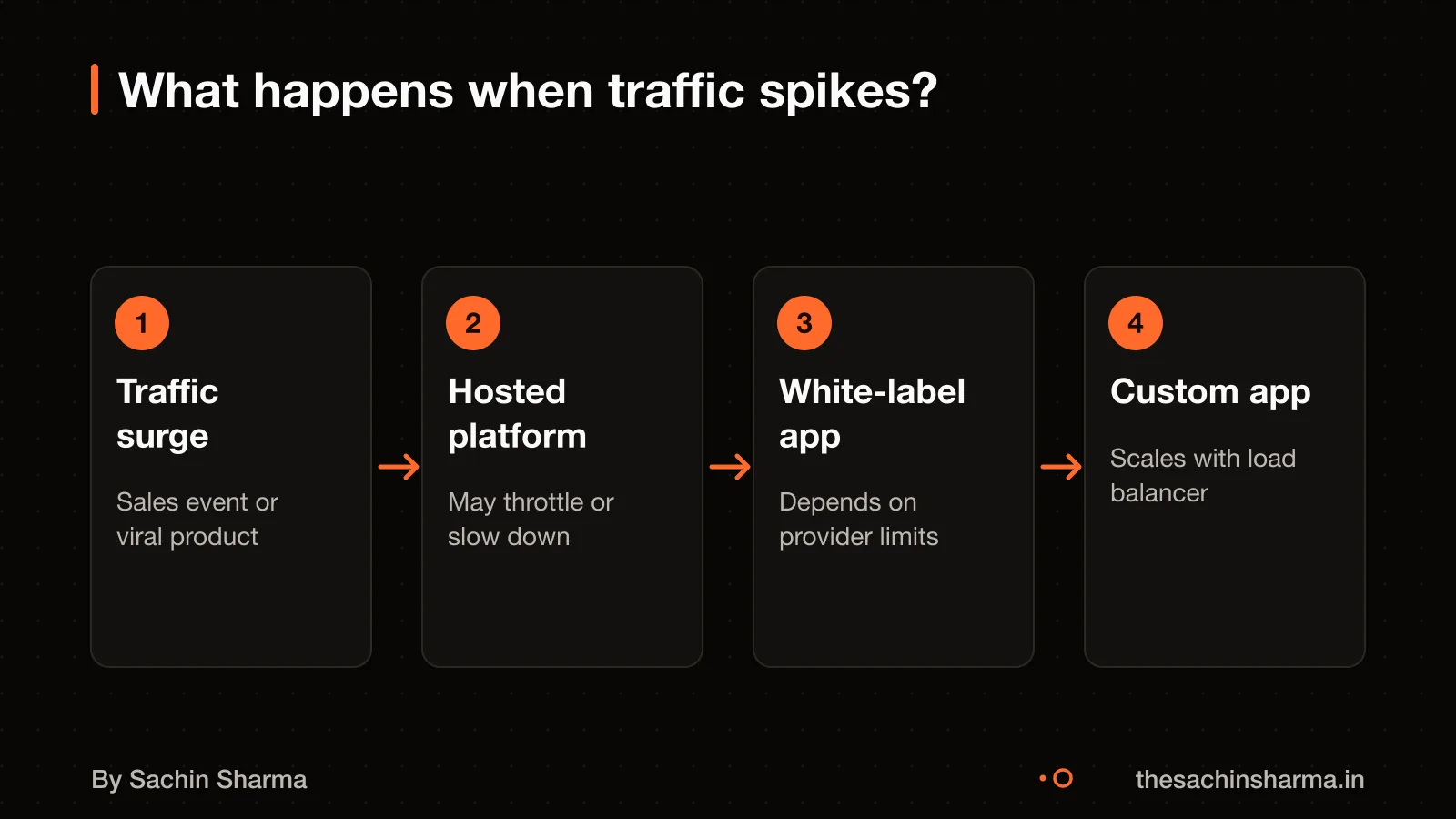
Hosted platforms like Shopify often throttle custom code or API calls during traffic spikes, limiting what you can do. This can break dynamic pricing, real-time inventory or personalised offers when demand is highest. Custom apps fail at the database or API layer if not set up with load balancing and health checks. Without failover, one server crash can take the whole app down. White-label apps depend on the provider’s infrastructure, so their limits become your limits during sales or promotions.
A tool like BIG-IP LTM can prevent these failures by spreading traffic across servers based on workload type. It runs health checks to route around slow or failed components, keeping the app running even under strain. It also defends against DDoS attacks by filtering malicious traffic before it hits your servers. For Indian networks, where 3G and low-memory devices are still common, this ensures the app stays responsive even when many users connect at once.
For example, during a flash sale, sudden traffic from tier-2 and tier-3 cities can overload an unprepared system. BIG-IP LTM directs login attempts, cart updates and payment calls to separate server groups, so one slow process does not block the rest. As an estimate, assuming your app uses a cloud provider with DDoS protection and auto-scaling, you can handle 10x normal traffic with proper setup. Real-world performance on Indian 3G networks is not available [unknowns].
What laws and taxes apply to your e-commerce app?
Yes, GST registration is mandatory for all e-commerce sellers in India, with no turnover threshold exemption. You must get a GSTIN before you start selling, even if your sales are small. This rule applies whether you sell through your own app or a third-party marketplace. The GSTIN lets you collect and pass on input tax credit to buyers.
Marketplaces collect 1% Tax Collected at Source (TCS) from your sales. This means for every ₹10,000 in sales, ₹100 is withheld and paid to the government on your behalf. You can claim this as credit when filing your returns.
You must file GSTR-1 returns every month, reporting all outward sales. E-commerce sellers must file GSTR-1 monthly and GSTR-3B quarterly for small sellers. Late filings attract interest and penalties, so keep your records updated. Use accounting software that syncs with your e-commerce backend to reduce errors.
FSSAI license is mandatory if you sell food products online, including snacks, meals, or beverages. FSSAI license is mandatory for all food products sold on platforms like Blinkit, Zepto, and BigBasket. For electronics, toys, or helmets, BIS certification is required by law. Check the latest BIS and FSSAI product lists on their official sites to confirm if your items fall under these rules.
how compliance shapes telemedicine apps
Who owns your app and data?
You own the source code if you build a custom app or use a tool with an open license like MIT. Hosted platforms and white-label apps usually give you a license, not ownership. You can switch developers later only if you have the code and admin access.
With a custom app, you control the admin accounts and can add or remove developers at any time. White-label providers may restrict admin roles or charge extra for full access. For hosted platforms like Shopify, you manage store settings but not the core software.
Data storage must follow Indian rules. All payment data, including full transaction records, must stay on servers in India. Payment gateways like Razorpay meet this rule because they are authorised by the RBI as Payment Aggregators. Your app can store user and order data anywhere unless it includes payment details. If in doubt, keep all customer data in India to stay safe.
OpenSEO, for example, is released under the MIT License, so you can use, change and share the code freely. That means full ownership and no vendor lock-in. For any app, check who holds the domain, hosting and database keys. Whoever controls those can block changes or demand higher fees later.
A real hybrid build: custom front-end on Medusa
A real hybrid build: custom front-end on Medusa
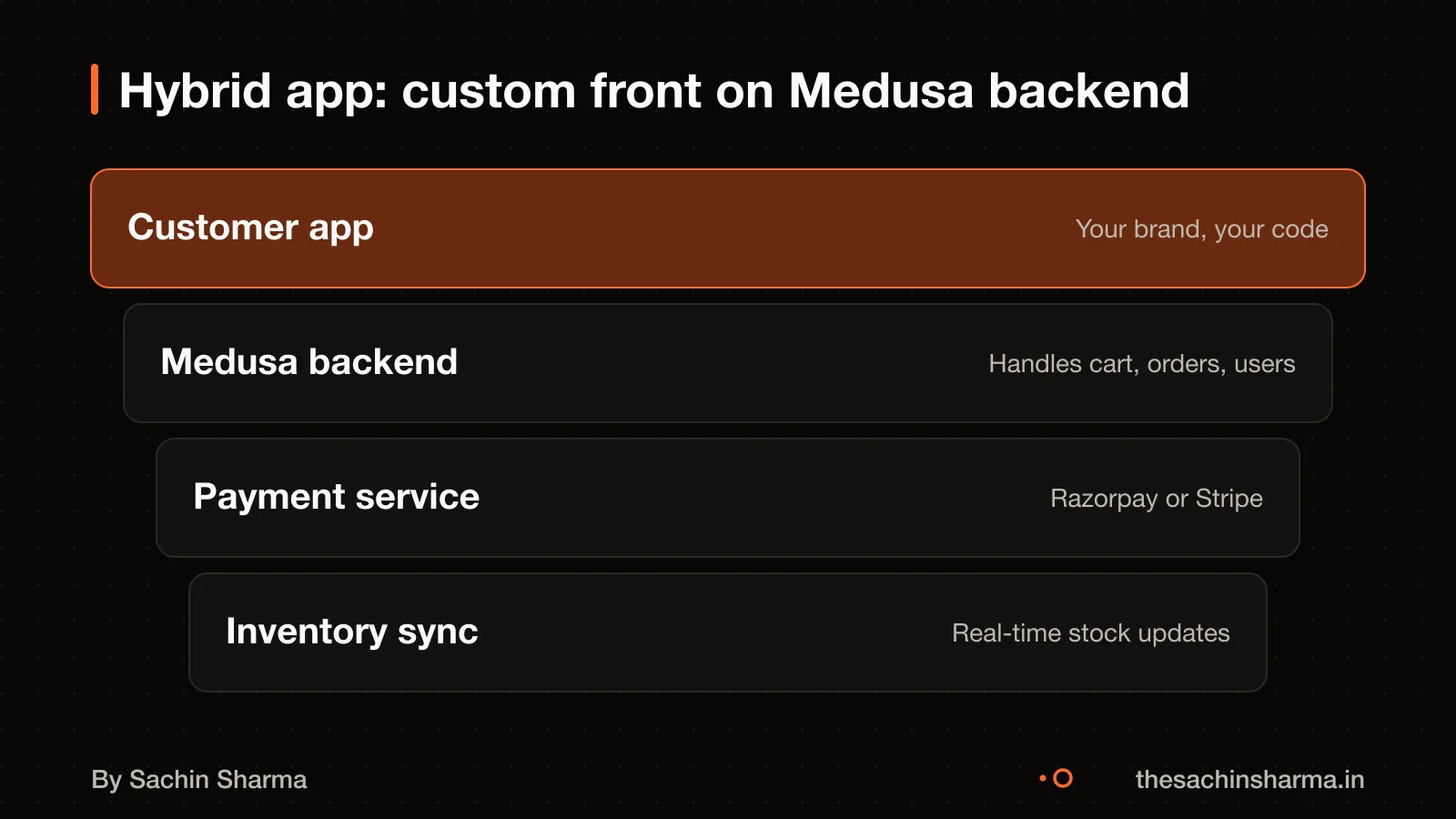
As an estimate, assuming 40 screens, one payment gateway, UPI, inventory and order management. A custom front-end on Medusa takes 12 weeks with a team of 3. This setup gives you full control over the user interface while using a proven. Open-source backend for core e-commerce functions like cart, checkout and product catalog.
The team typically includes one Flutter developer for the mobile app, one full-stack developer for the Medusa backend. APIs, and one part-time designer for screens and flows. You can scale the team up or down based on timeline, but splitting frontend and backend work speeds up delivery.
Features included are: user signup and profiles, product browsing with filters, cart and checkout with UPI. Card payments, order tracking, inventory sync, and basic admin dashboards for sales and stock.
Under load, performance depends on hosting quality and load balancing setup. Medusa scales well when hosted on a cloud provider like AWS or GCP with auto-scaling and a managed database. As an estimate, this setup can handle up to 10,000 concurrent users with proper caching and CDN use.
You should test early with tools like Firebase Test Lab or AWS Device Farm using low-end Android devices common in tier 2 and 3 cities.
This model was used for a multi-brand retail client. The hybrid approach let us reuse backend logic across brands while customising each front-end for local markets.
When this advice is wrong
When this advice is wrong
Build an app only if you need one. If you sell only over WhatsApp or Instagram and your orders are under 50 a month, a simple spreadsheet and payment link may be enough. Launching an app adds cost and complexity you may not need.
Shopify is better if you must go live in days, have no technical help, and sell standard products. Its templates, payment links and inventory tools work out of the box. You trade control for speed, which makes sense for solo sellers or pop-up brands.
White-label apps fail when you need unique features like regional language support, custom logistics, or deep ERP integration. They look similar across brands and limit how you can grow. If your business model is not generic, avoid off-the-shelf apps.
If you lack technical help and cannot afford at least ₹30,000 for a developer, do not start a custom build. Even hybrid apps need someone to fix bugs, update dependencies, and handle compliance. Without support, your app will stop working over time.
Related reading: how custom and white-label apps differ in delivery apps, what drives app development cost in India.
Next step: message me on WhatsApp with what you want to build. No forms, no sales team.
Message me on WhatsAppAssumptions behind the numbers
- Hybrid approach is illustrative and not backed by evidence
- Shopify-like platforms cost ₹0 to ₹50,000 initially
- Custom builds cost ₹30,000 to ₹200,000+
- Monthly platform fees are ₹1,000 to ₹10,000
- Custom monthly cost is ₹5,000 to ₹30,000
Pick your situation
I am a solo developer and can help with custom builds or integrations, so I benefit from the hybrid path. The table below compares known options based on evidence.
Pick your situation
Build custom wins. At scale, custom gives you control over margins, branding and customer data. Platforms charge more as you grow.
The whole comparison
| Start with Shopify | Build custom | |
|---|---|---|
| Setup time | Days to weeks | Months |
| Initial cost | ₹0 to ₹50,000 | ₹30,000 to ₹200,000+ |
| Monthly cost | ₹1,000 to ₹10,000 | ₹5,000 to ₹30,000 |
| Code ownership | Shared or none | Yours fully |
| Extensibility | Limited to platform APIs | Unlimited |
| Support model | Vendor support | Developer or team |
Whichever you choose, ask these
- Can I move off this platform later?
- Who owns the customer data?
- What happens if the platform shuts down?
- Will I get help adding features?
Questions people ask
01How do the options differ under high traffic?
Hosted platforms may slow down or block custom code during traffic spikes, limiting dynamic features. Custom apps can scale using load balancers like BIG-IP LTM to direct traffic by workload type and maintain availability. White-label app performance depends on the provider's infrastructure and limits.
02What fails first during a sale event?
Payment gateways, inventory sync, or order confirmations often fail first under high load. Use health monitoring to detect issues early and set up failover systems for critical services. BIG-IP LTM can help by checking application status and defending against traffic surges.
03Do I need a separate GSTIN for my e-commerce app?
Whether you need a separate GSTIN for e-commerce sales depends on your business structure and state rules. Confirm with a chartered accountant. Check this for your case with a chartered accountant.
04How often do I need security updates?
As an estimate, check for security updates at least monthly if you use a hosted platform, and every quarter for custom apps. Use a developer to apply patches and test systems. The exact frequency depends on your tech stack and threat level.
05What if I want to sell on WhatsApp too?
WhatsApp Commerce is a separate system. You cannot embed your app in WhatsApp, but you can link to it. Use tools like Gupshup or the WhatsApp Business API to send order updates or run a chat-based store alongside your main app.
06How do I verify a developer’s claims?
Ask for code samples, links to past projects, GitHub activity, and client references you can contact. Avoid developers who make vague promises or refuse to show real work. I share public repositories for apps like MojoCinema and DevDex.
07Is a custom app worth it for a startup?
Only if you need unique features that platforms cannot support. Otherwise, start with a hosted platform to test demand and save cost. You can migrate to a custom app later.