What a grocery delivery app is (and how it differs from food delivery)
A grocery delivery app lets you browse, order and pay for groceries, then tracks delivery from store to doorstep. Unlike food delivery, it must show real-time stock, handle missing items with substitutions, and charge correctly for goods sold by weight after picking. For example, if you order 500g of onions and the packer finds only 480g, the app must adjust the price and confirm with you.
Quick commerce apps promise delivery in 10 to 30 minutes. They use dark stores and limit SKUs to 2,000 to 4,000 for speed. A traditional grocery app may take longer but carries a wider range, often from existing stores. The core challenge is not the interface, but syncing live inventory, managing partial fulfilment and updating weights and prices after packing.
Where the money goes: backend complexity, not screens
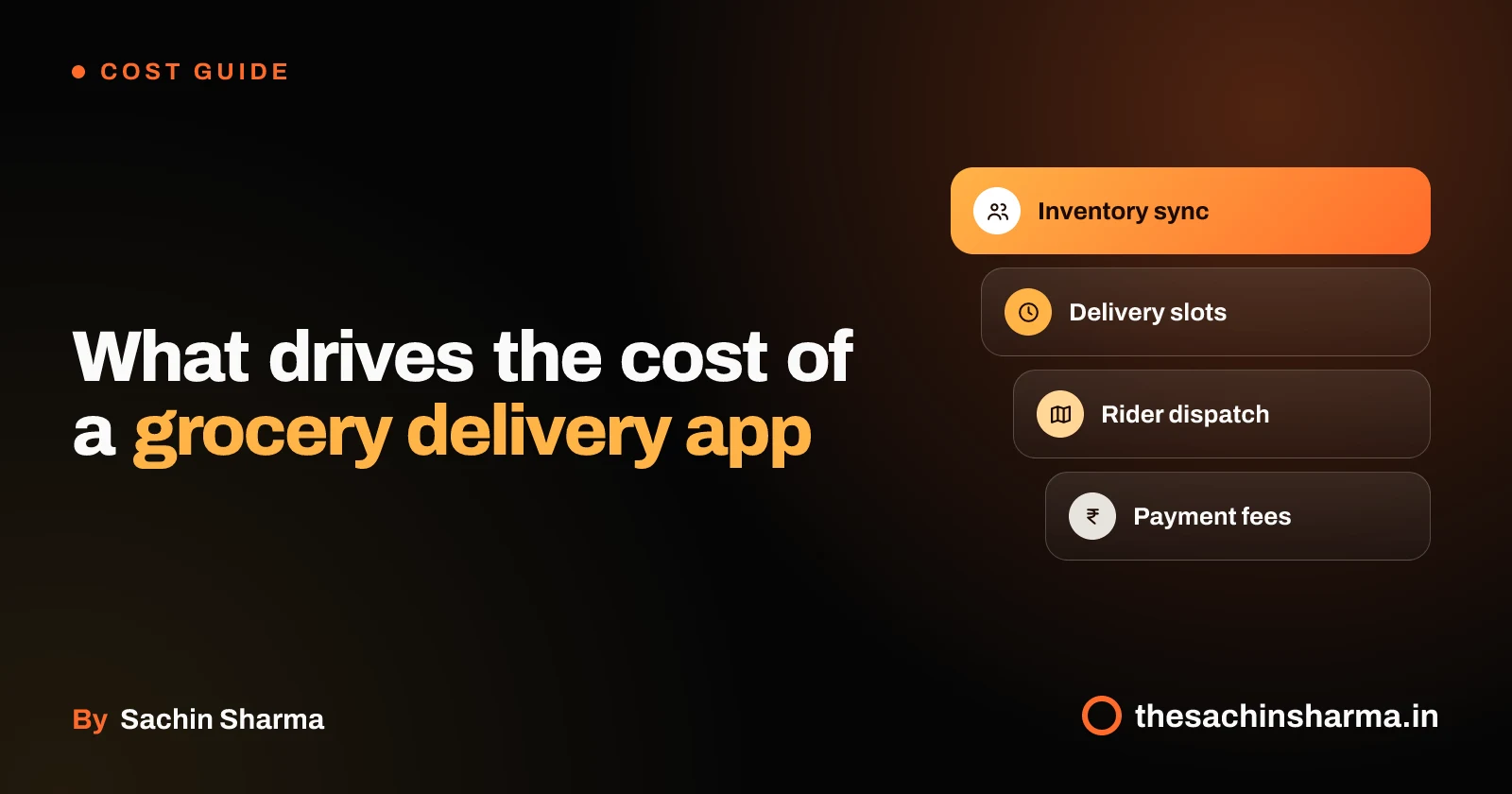
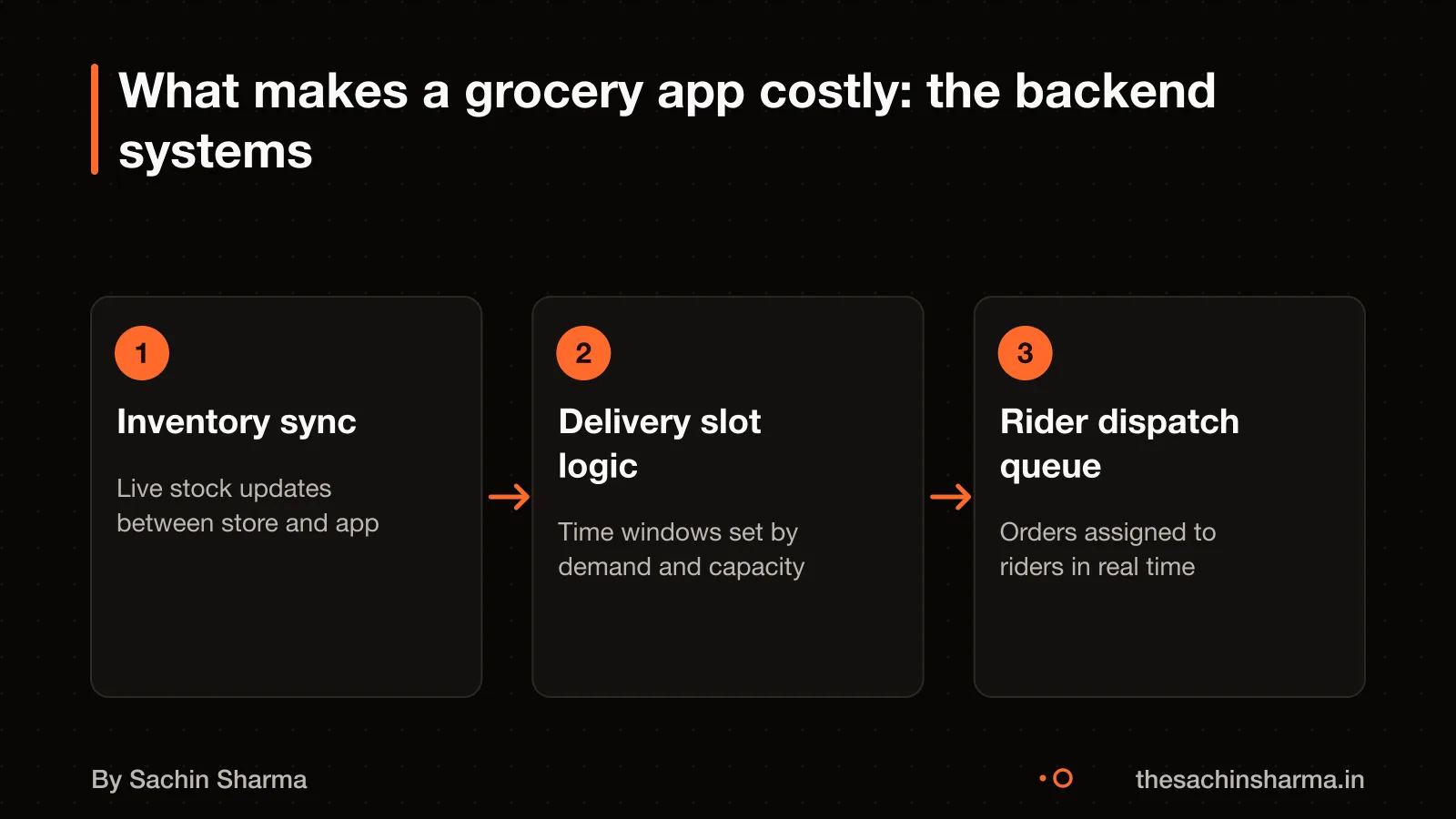
The cost of a grocery delivery app is driven by backend systems such as real-time inventory sync, delivery slot logic, and rider coordination. But the unseen backend can take 55 to 65 percent of your total budget in development labour.
Dark stores or micro-fulfillment centers carry 2,000 to 4,000 high-velocity SKUs. Every app user action, adding to cart, checkout, or cancellation, must instantly update stock levels to avoid overselling. If the system fails, platforms penalize sellers harshly for cancellations.
Delivery slots add load because they require dynamic allocation based on rider availability, traffic, and order volume. Each slot must be validated against real-time data: can a rider reach the store, pick the items, and deliver on time? This logic runs on the server for every user who views available slots.
Without accurate sync and smart slotting, your app will lose trust and money. These systems are not optional for a serious grocery delivery service.
Must-have features for a grocery delivery app
How much each major feature adds to the cost
A payment gateway integration costs ₹60,000 to ₹1.5 lakh, depending on the provider and whether you need UPI, cards, wallets and COD reconciliation. As an estimate, assuming ₹80 per dollar, this is based on standard market rates for secure, compliant gateway setup.
AI route optimization costs $15,000 to $35,000, which is approximately ₹12 to 28 lakh at ₹80 per dollar. This feature plans the fastest delivery paths for riders across live orders, traffic and delivery windows. It needs real-time data from maps and order inflow, and must update as new orders arrive.
A recommendation engine costs $8,000 to $20,000, which is approximately ₹6.4 to 16 lakh at ₹80 per dollar. It shows users items like “People who bought milk also bought bread” using their past orders and popular trends. This runs on a backend that processes user data and updates suggestions daily or in real time.
A substitution engine, which suggests replacements when items are out of stock, costs $10,000 to $25,000. It checks inventory at order time and matches items by category, brand or use.
Want a number for your idea? Send one line on WhatsApp. I reply with what drives the cost and what to cut.
Message me on WhatsAppThe cost of the rider app and delivery coordination
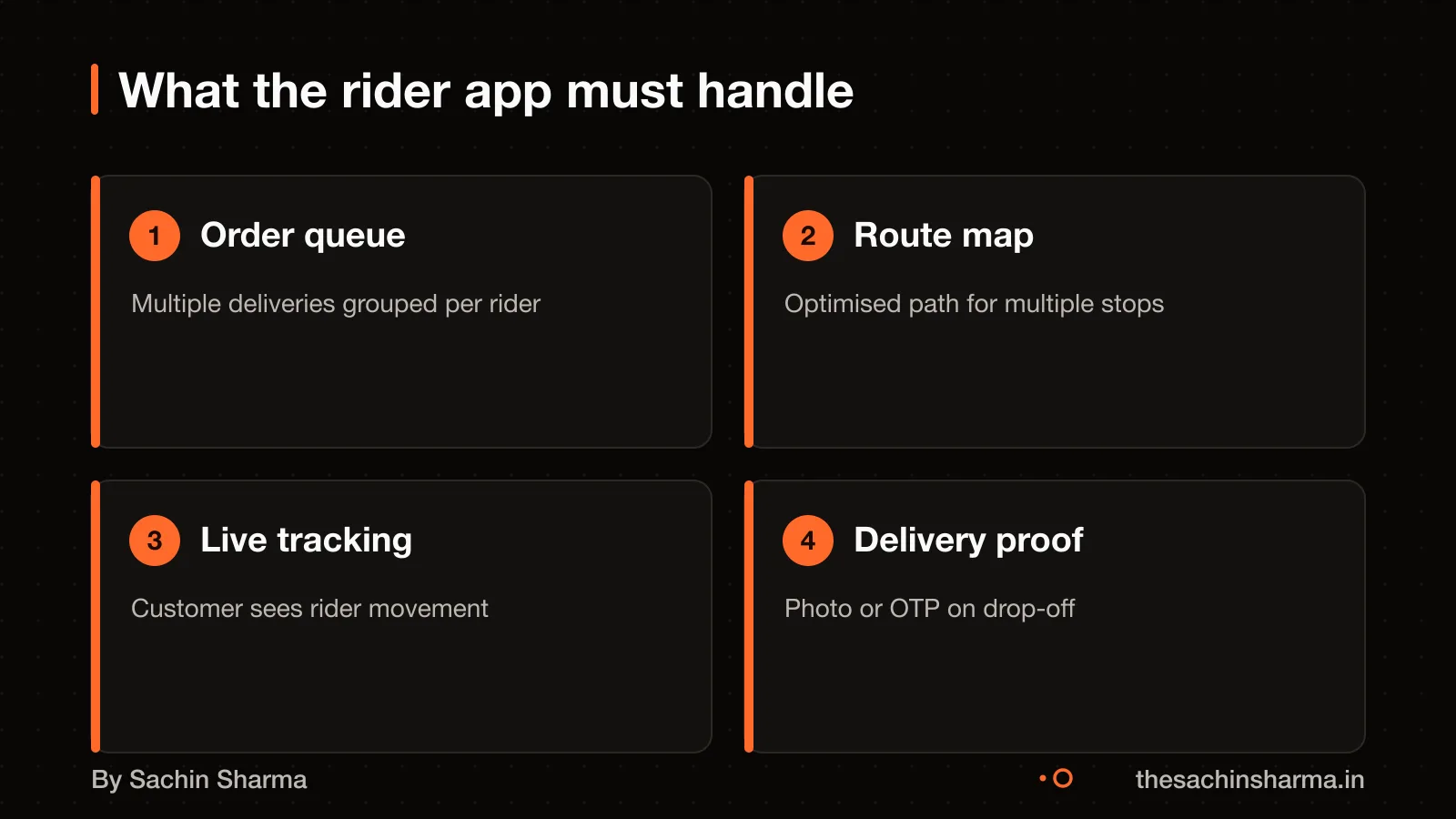
Yes, you need a separate rider app. It handles live delivery updates, navigation, and proof of delivery. Without it, coordination fails during peak hours.
Last-mile route optimisation adds significant cost. It requires a service that connects to real-time mapping APIs and groups orders by location and timing. As an estimate, this module can take 3 to 4 weeks of backend work for a city with 50 daily orders.
Rider coordination is complex because it must sync order batching, traffic delays, and rider availability in real time. Rider coordination must handle multiple orders per rider with different drop points and time windows. The system must re-route instantly if a rider is delayed.
For quick commerce, the delivery radius is small, 2 to 3 km, but speed is critical. This means more riders per area and tighter scheduling. Poor coordination leads to late deliveries and refund requests.
Rider app cost in quick commerce depends on how tightly you integrate real-time tracking and auto-assignment logic. Basic versions start lower but scale poorly.
Payment gateway and reconciliation costs
You pay 1.8% to 2.4% per transaction through a payment gateway. This fee applies to every online payment, including UPI, cards and digital wallets. As an estimate, on a ₹500 order, you pay ₹9 to ₹12 in gateway fees.
Partial refunds are complex because groceries are sold by weight or count, and items may be out of stock after packing. If a customer orders 1 kg of apples but only 700 g is available. Your system must refund the difference accurately and log it for accounting. This requires tight coordination between the order, inventory and payment systems.
Reconciliation means matching every payment and refund across platforms, your app, the gateway, bank statements and UPI networks. When cashbacks or promo refunds apply, the logic multiplies. You need custom backend code to track these flows and avoid mismatches.
Without proper reconciliation, you risk losing money or failing audits. This work is not visible to users but takes significant development time.
Monthly running costs: hosting, APIs and maintenance
Your app will cost ₹18,000 to ₹85,000 per month to run after launch, depending on order volume and features. This includes cloud hosting, third-party APIs like Google Maps, and basic monitoring.
Cloud hosting ranges from ₹8,000 to ₹40,000 monthly, scaling with traffic and storage needs. Higher order volumes need more server power and database capacity, which increases cost.
Google Maps API use costs ₹5,000 to ₹22,000 per month, especially if you track riders in real time. Live location updates are frequent and expensive at scale.
Annual maintenance should be budgeted at 15% to 20% of the initial build cost. This covers updates, minor bug fixes, and compatibility with new OS versions.
As an estimate, if your app was built for ₹50 lakh, expect to pay ₹7.5 to ₹10 lakh per year for maintenance. This retainer keeps your app secure and functional.
Have a quote in hand? Send it to me and I will mark what is missing.
Message me on WhatsApp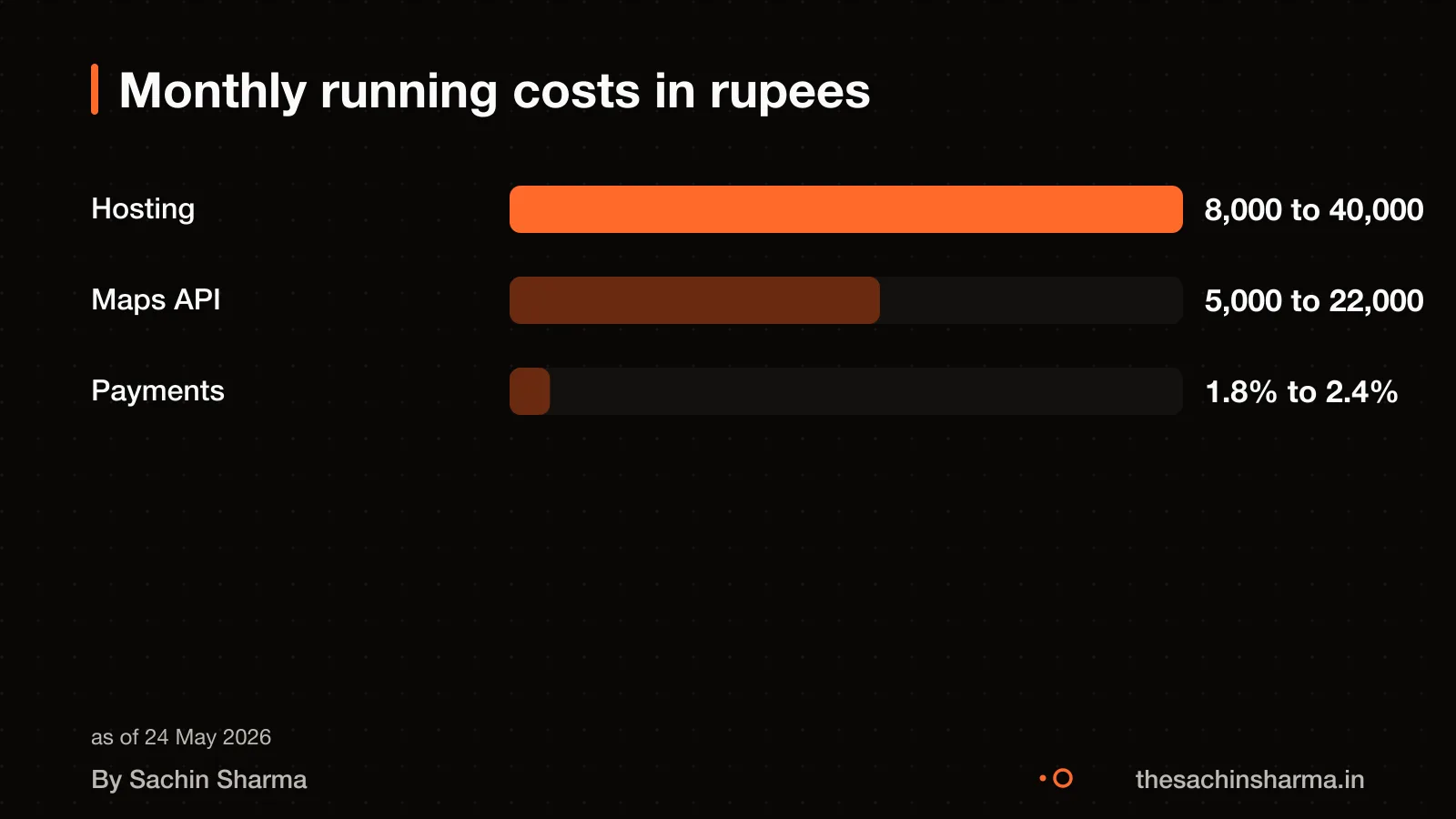
How long it takes to build
A basic custom grocery delivery app takes 12 to 16 weeks with an AI-first team. This includes core features like inventory sync, order management, and rider coordination. A white-label solution can go live in 4 to 8 weeks. These are pre-built platforms branded for your store. Adding AI features like demand forecasting or personalised recommendations adds 3 to 4 weeks to the development time. This is usually done after the MVP launch. For example, if you start with a working app, you can add smart restocking alerts in Phase 2.
Full timeline breakdown
Start simple: what to build first
Yes, you can launch with fewer features. A viable MVP for grocery delivery includes a product catalog, cart, checkout, payment gateway, and basic order tracking. This core setup lets you test demand and refine operations without high risk. For example, start with a single store and manual order picking, then add automation later. As an estimate, this MVP costs ₹3.5 to 6 lakh. If your order volume is low, use a white label app instead, these are 70% to 90% cheaper than custom builds. You can phase in advanced features like real-time inventory sync, auto-substitutions, or dynamic delivery slots once you have steady orders. This step-by-step approach cuts initial cost and lets you learn fast.
For a detailed process, see the Step-by-step build guide.
Features you can safely cut (and ones you cannot)
You can skip advanced AI features like an NLP chatbot or demand forecasting without breaking your app. These are optional and add high cost. For example, an NLP customer support chatbot costs $12,000 to $30,000. As an estimate, assuming ₹80 per dollar, that is ₹9.6 lakh to ₹24 lakh. Demand forecasting costs $20,000 to $50,000, or ₹16 lakh to ₹40 lakh at the same rate.
A recommendation engine is optional. You can start with simple rules like "frequently bought together" or "top sellers". True AI-driven suggestions need large data and add cost. Skip them at first.
AI route optimization is not worth it for small fleets. Basic GPS routing with time windows works fine for 10 or fewer riders. Only add AI when you have 50+ daily orders and delays are common.
Do not cut inventory sync, order tracking, or payment reconciliation. These are core. Without them, orders fail, trust drops, and refunds rise. Build these first, test them hard, and only then add extras.
When a custom grocery delivery app is the wrong choice
A white label solution can launch faster and cost 70 to 90% less.
For 90% of grocers, a white label grocery app platform delivers the same outcomes. If you run a small store with local delivery and under 20 daily orders, a white label platform meets your needs. These platforms offer ready-made apps with inventory, ordering, and rider tracking.
Better alternatives exist for small stores. Rent a white label app instead of building one. You save time and money, and still get a branded app. Use the savings to improve delivery speed or customer service.
Next step: message me on WhatsApp with what you want to build. No forms, no sales team.
Message me on WhatsAppAssumptions behind the numbers
- Assumed 5,000 SKUs as a baseline for inventory sync load.
- Assumed 100 daily orders for API and cloud usage.
- Assumed 3 km delivery radius based on q-commerce norms.
Work out your own number
I won't hand you a number that pretends to be the market. Instead, here is the working: set the weeks, the people and the rate, and see where the money goes.
Your working total
₹6,00,00015 weeks × 2 people × 5 days × ₹4,000- Scope and design13%
- Build67%
- Testing and fixes13%
- Launch and stores7%
The weeks shown are an example of a small app, there to be changed. Fees you pay others (store accounts, cloud, SMS) are not in this total.
What moves the price
- More SKUs or user roles
Each extra role (supplier, admin) adds backend logic.
- Real-time inventory sync
Required to prevent cancellations, especially in q-commerce.
- AI route optimisation
Adds $15,000–$35,000 to the build.
- Fewer delivery zones
Reduces map and rider-tracking load.
- Static menus or carts
Removes real-time stock checks and dynamic pricing.
- Pre-recorded substitutions
Avoids building an AI substitution engine [$10k–$25k,.
Fees that go to someone else
Google Play developer account
A one-time registration fee, paid to Google. Check the current amount.
Apple Developer Program
A yearly fee paid to Apple. Check the current amount.
Cloud, SMS, maps, payments
Usage-based, billed by the provider to you.
Ask for these before you sign
- What share of the cost is backend?
- How much do AI features add?
- What third-party fees do I pay monthly?
- Does real-time inventory sync matter?
- Can I start with fewer features?
Questions people ask
01Which components drive the cost of a grocery delivery app?
Real-time inventory sync, delivery slot logic, and rider coordination are the top cost drivers. Development labour for these backend systems takes 55 to 65% of the total budget. These features require complex logic and constant updates to match live stock and delivery status.
02Where do estimates for a grocery delivery app usually go wrong?
Estimates often miss the cost of real-time backend sync or hidden API fees for services like Google Maps. Lowball quotes may skip reconciliation work for cash on delivery and payment gateways. As an estimate, assuming ₹8,000 to ₹40,000 monthly cloud costs, underestimating infrastructure is common.
03What can be cut without hurting the product?
You can cut the NLP chatbot, demand forecasting, and AI recommendations first. These features add $12,000 to $50,000 in cost: $12,000 to $30,000 for an NLP customer support chatbot. $20,000 to $50,000 for demand forecasting. but are not essential for launch. Focus on core inventory and delivery logic before adding AI features.
04How much does real-time inventory sync cost?
Real-time inventory sync is not priced separately; it is part of the core backend effort. It affects the overall development cost because it must run reliably to prevent cancellations. As an estimate, assuming it drives 55 to 65% of labour, it shapes most of the budget.
05Is a white-label app worth it for a small grocery store?
Yes, for 90% of grocers, a white-label app is worth it. It is 70 to 90% cheaper than a comparable custom build. It covers standard needs like ordering, payments, and tracking without custom development.
06How do I handle out-of-stock items in the app?
You can offer substitutions or block out-of-stock items at checkout. If sync fails and an item is out of stock online, 54% of shoppers switch brands permanently. A substitution engine adds cost but reduces cancellations. Real-time sync is essential to avoid this risk.
07What legal rules apply to customer data in a grocery app?
You must collect data only for lawful purposes like service delivery and security. Do not sell or share personally identifiable information except as required by law. Check this for your case with a chartered accountant or lawyer.
08Who owns the code after the app is built?
The developer owns the code unless the contract says 'hereby assign' to transfer rights. Without this clause, you may not control updates or hosting. Ensure your contract includes this to own the software.
09How much does it cost to add a subscription model?
No direct evidence is available for subscription model costs. That project handled recurring orders and billing for a multi-outlet business.
10Can I integrate with my existing inventory system?
Yes, but only if your ERP supports API access. Confirm with your developer whether your system can push real-time stock updates. Without this, you will need manual sync or a new backend, which increases cost and risk of errors.