What parts of a Flutter app cost the most?
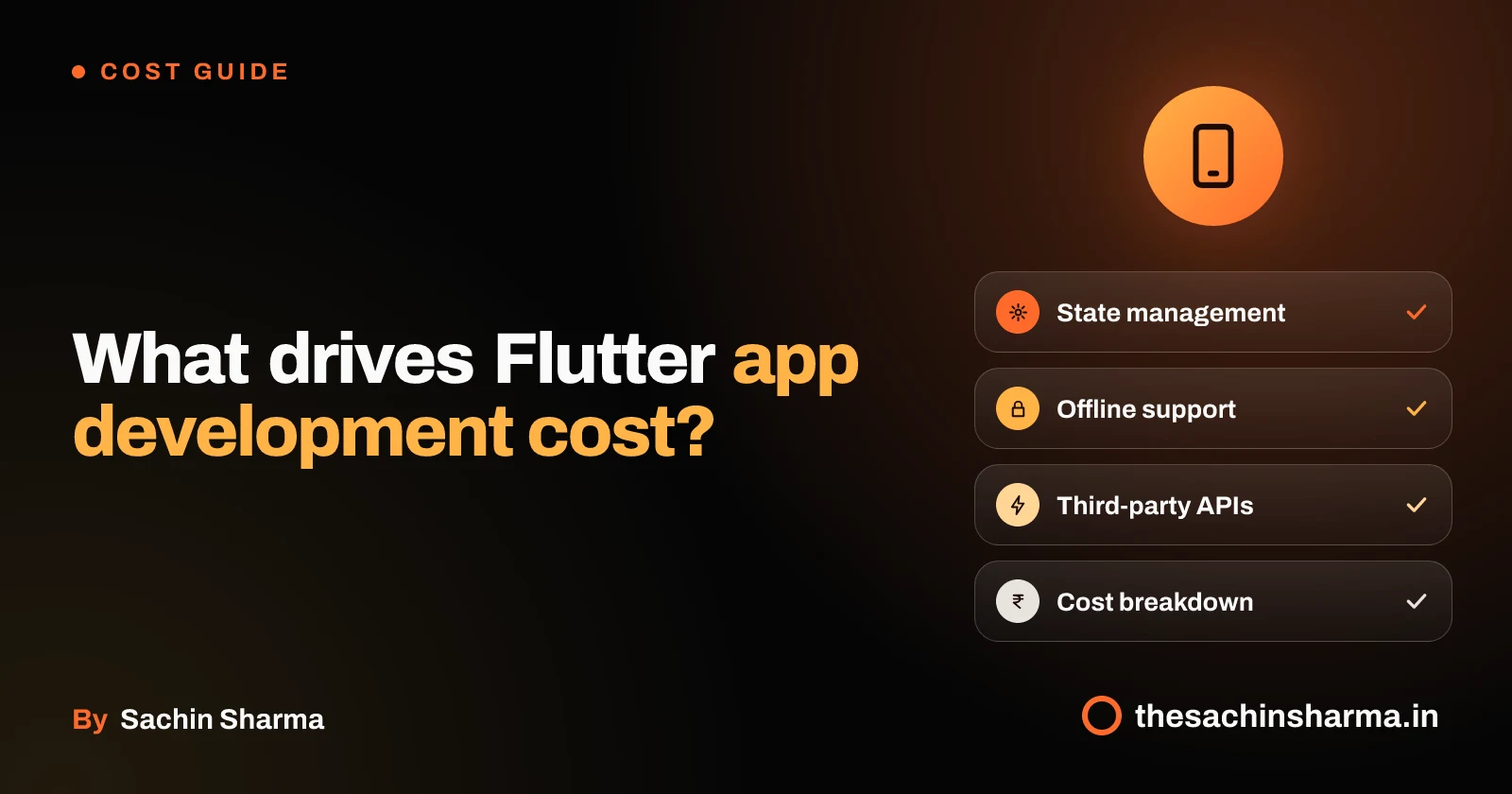
The biggest cost in a Flutter app comes from complex features like real-time sync, offline support, and third-party integrations, not the framework itself. Simple screens are cheap, but logic, state, and backend work drive most of the price. Loopin used offline-first design with Google Drive sync.
Three areas add the most cost: state management, backend systems, and integrations. State management keeps your app working smoothly as users move between screens and tasks. Poor state management is the silent killer of Flutter applications. Loopin used Hive for local state as part of its offline-first design.
Backend complexity matters because every user action that saves data, logs in, or sends notifications needs server support. A basic app with static content costs less. But if you need user accounts, live updates, or file storage, the backend grows fast. Aashwasan is a Flutter + Firebase gig and contract management app.
Integrations like payment gateways, SMS, or AI services add both setup and testing time. Each one must work on both Android and iOS, handle errors, and stay secure. Flutter helps write code once, but connecting to outside systems is custom work. Even with Flutter’s cross-platform strength, you pay for the logic that ties everything together.
UI/UX design, testing, and infrastructure also add cost, but they are more predictable. The surprise costs come from how features interact, like syncing data when the network drops, or updating multiple screens at once. These hidden tasks take time and skill.
Want a number for your idea? Send one line on WhatsApp. I reply with what drives the cost and what to cut.
Message me on WhatsApp
How long does it take to build a Flutter app?
An MVP in Flutter takes about 8 weeks, but a full app can take up to 7 months, depending on features and team size. Complex workflows, third-party integrations, and offline support slow delivery. So does redesigning after user feedback or adding AI features late in the cycle.
Flutter can cut development time by 30 to 50% compared to building two separate native apps. This saving comes from writing one codebase and using hot reload to fix UI fast. But the saving is real only if your team knows Dart and Flutter well. A new team may take longer at first.
For example, Blade shipped its MVP in 8 weeks using Flutter. In contrast, NotebookLM took 7 months to build and ship a full-featured app with high ratings. The difference lies in scope: Blade focused on core features, while NotebookLM added AI, real-time sync, and rich media.
Timeline depends on what you count as "done". An MVP with login, one key screen, and basic navigation can ship in 8 weeks. But adding offline sync, background tasks, or complex state management adds weeks. Testing on both iOS and Android also takes time, especially if platform-specific bugs appear.
What should an MVP include? to stay on track.

Is a Flutter app right for my business?
A Flutter app saves time and money when you need one app for both Android and iOS from day one. It works well for UI-rich, data-driven apps that must feel fast and responsive. For example, a habit tracker with real-time sync or a legal document assistant with AI forms fits this use case.
You should choose native instead when your app needs deep performance tuning. This includes use cases like gaming, augmented reality (AR), virtual reality (VR), or real-time video processing. These apps often push the limits of the device, and native code gives more control over memory and speed. Flutter may lag in these areas even with good optimisation.
Flutter is good for enterprise apps. It supports modular architecture, role-based UI, and advanced state management. Big companies like BMW, eBay, and Alibaba use it for scalable and secure apps. I delivered a multi-tenant platform for a family-run group with 5 brands and 8 outlets, handling over ₹150 crore in reported revenue. The lead-to-delivery time fell from 2 weeks to 4 days. This shows Flutter can handle complex, high-load business systems when built right.
Still unsure? 10 checks to pick a developer helps you compare options and avoid costly mistakes.
Flutter vs React Native: which costs less?
Flutter apps can run faster than React Native apps in some cases. This is because Flutter compiles to machine code ahead of time, while React Native interprets JavaScript at runtime. On iOS, Flutter’s Impeller rendering engine delivers consistent 120fps performance.
React Native projects usually cost 10% to 15% less than Flutter projects. The main reason is access to a larger talent pool. There are twice as many React Native job openings and a 3 to 4 times larger base of JavaScript developers. This makes hiring faster and reduces rates.
However, performance matters most for apps with heavy animations or real-time updates. Flutter’s speed advantage shows in apps like Legease: a Flutter AI app in production. For most business apps, the lower development cost of React Native may be more important.
If your app needs high frame rates or complex custom UI, Flutter is worth the extra cost. If you need to build fast on a tight budget and can use standard components, React Native may save money.
Still unsure between Flutter and React Native? Tell me your budget and timeline and I will say which fits.
Message me on WhatsAppHow do GST and platform rules affect cost?
If both are in the same state, you pay CGST and SGST. Each calculated as half of the taxable value multiplied by the tax rate. If they are in different states, you pay IGST calculated as the taxable value multiplied by the tax rate. HSN codes in chapter 99 are for services, so the 'Is Service' field should be 'Y'. For your exact liability, consult a chartered accountant.
App store rules can add cost if your app handles payments, loans, or user data. Apple restricts loan apps to a maximum 36% APR. This affects how you price and structure repayment plans. On Android, you must use Google Play’s Billing Library version 8 or later for in-app purchases by 31 August 2026. Upgrading may require extra development time and cost.
These rules mean you may need legal or compliance checks during development. They do not change the base cost of building the app, but non-compliance can delay launch or cause rejection. Always confirm your app meets store policies before investing in features that depend on them.
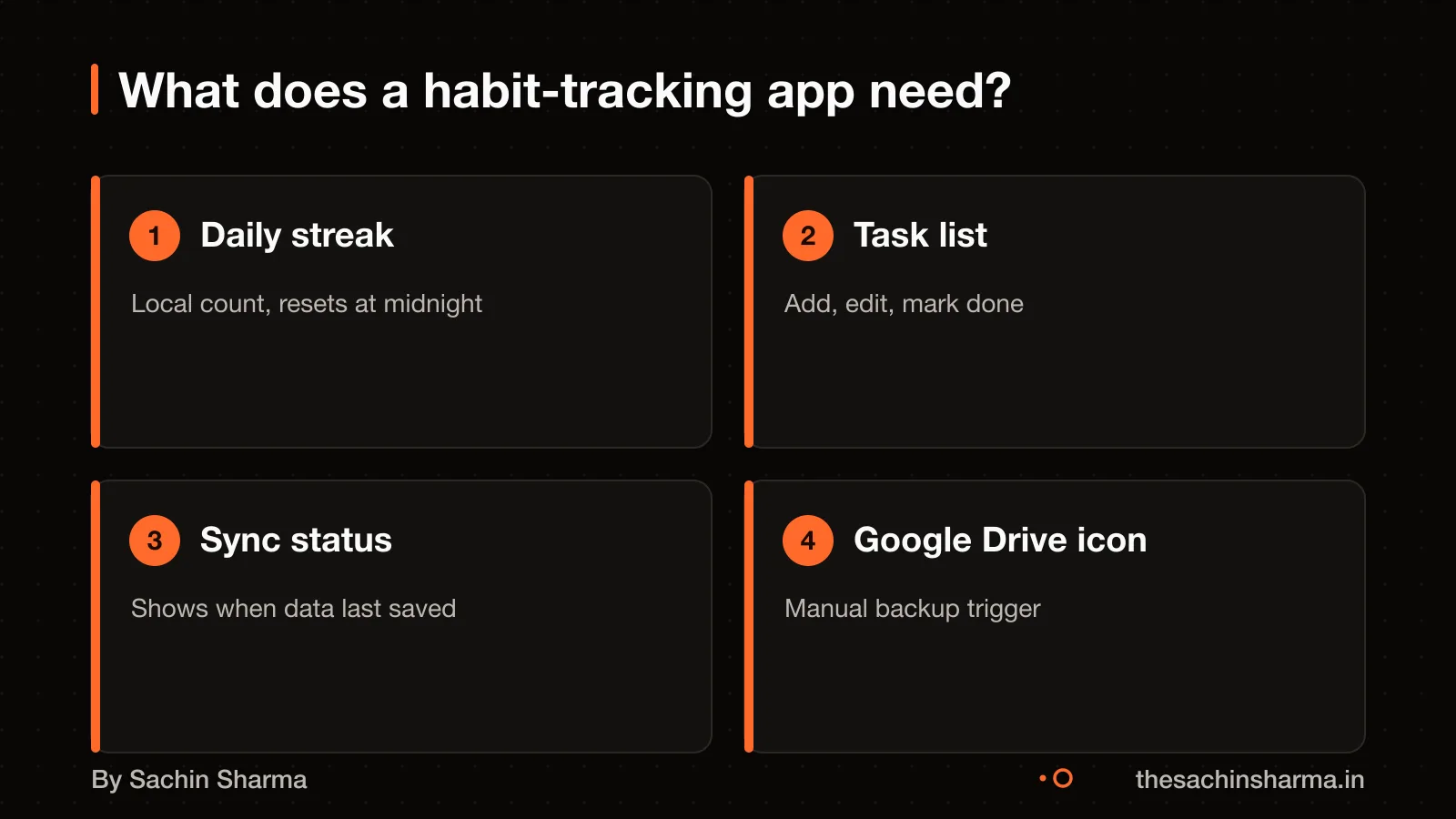
Worked example: cost of a habit-tracking Flutter app
As an estimate, a habit-tracking Flutter app with 40 screens, offline sync, and Google Drive integration could cost $15,000 to $40,000. Annual maintenance may add 15% to 20% of the initial cost each year.
The base cost comes from average Flutter MVP pricing. The range reflects differences in feature depth, testing, and project management. For example, if your app needs background reminders, data export, or social sharing, it will lean toward the higher end.
Offline support adds cost because data must be stored locally, synced safely, and conflicts resolved. That kind of work is not in basic quotes.
Third-party integrations also raise cost. Google Drive access needs OAuth setup, file parsing, and error handling. Each API has its own quirks. You may need to pay for API usage if your user base grows.
If you add AI features like smart suggestions, the cost rises further. That work is not well priced yet. Depends on the model used [unknown: "The cost impact of AI features in Flutter apps is not available"]. Platform-specific bugs on older Android devices can also add unplanned debugging time [unknown: "The real debugging cost for platform-specific bugs is not available"].
Maintenance includes updates for new OS versions, security patches, and dependency upgrades. Budget 15% to 20% of the initial cost each year. For a $25,000 app, annual maintenance may add $3,750 to $5,000 per year.
Compare this with Aashwasan: a Flutter app with Firebase, which manages gig workflows with real-time updates. Its backend complexity is similar but spread over more screens.
When a Flutter app is not the right choice
When a Flutter app is not the right choice
Avoid Flutter if your app needs deep OS integration, such as custom system-level services or hardware access beyond standard APIs. These cases often require native Android or iOS code, which can slow development and raise costs due to extra coordination.
Do not choose Flutter for AR/VR experiences or high-frame-rate gaming apps. Native platforms offer better performance control for graphics-intensive tasks. Flutter’s rendering layer adds overhead that may limit frame rates or increase battery use.
Cross-platform development can also hurt when platform-specific bugs arise. Though Flutter reduces duplicate code, debugging issues that appear on only one OS can take extra time. The real debugging cost is not known, but it can delay launch.
Flutter may not suit apps that rely on unstable third-party SDKs not yet ported to both platforms. If a critical native feature lacks a Flutter wrapper, you will need native development anyway.
Next step: message me on WhatsApp with what you want to build. No forms, no sales team.
Message me on WhatsAppAssumptions behind the numbers
- Base hourly rate assumed at ₹1,200 (≈$15/hr) for Indian developers.
- Component cost split is estimated based on typical Flutter app structure.
- Maintenance cost is 15–20% of initial cost yearly.
Work out your own number
I won't hand you a number that pretends to be the market. Instead, here is the working: set the weeks, the people and the rate, and see where the money goes.
Your working total
₹4,40,00011 weeks × 2 people × 5 days × ₹4,000- Scope and design18%
- Build55%
- Testing and fixes18%
- Launch and stores9%
The weeks shown are an example of a small app, there to be changed. Fees you pay others (store accounts, cloud, SMS) are not in this total.
What moves the price
- More screens or roles
Each extra user type (customer, admin, rider) is close to another app.
- State complexity
Large-scale app states increase both frontend and testing effort.
- Deep integrations
Custom ERP, finance or logistics links take extra backend and testing time.
- Fewer platforms
Launching on Android alone cuts cross-platform testing and tweaks.
- Prebuilt modules
Using ready-made UI or auth packages reduces custom coding.
- Clear scope upfront
Avoiding mid-project changes keeps cost drift in check.
Fees that go to someone else
Google Play developer account
A one-time registration fee, paid to Google. Check the current amount.
Apple Developer Program
A yearly fee paid to Apple. As of 2026, it is $99.
Cloud, SMS, maps, payments
Usage-based, billed by the provider to you.
Ask for these before you sign
- How many weeks per phase, and with how many people?
- What is not included?
- Which fees do I pay to others directly?
- What happens to the price when I change my mind?
- What does the first month after launch cost?
Questions people ask
01Which components drive the cost of Flutter app development?
The biggest costs come from backend work, third-party integrations, and complex state management, not the number of screens. UI/UX design, offline support, and real-time sync also add time and effort. For simpler apps, focus on core flows first.
02Where do estimates for Flutter app development usually go wrong?
Estimates often fail by ignoring post-launch costs like maintenance, app store fees, and updates. They also break down when scope is unclear or integration effort is underestimated. As an estimate, assuming 40 screens and one payment gateway, post-launch costs add ₹3 to 5 lakh yearly. Check your quote includes these.
03What can be cut without hurting the product?
You can reduce costs by using Firebase for backend services, which cuts server work by up to 40%. Avoid custom animations and defer AI features to later versions. This keeps the core product strong while saving time and money.
04How does offline support affect Flutter app cost?
Offline support adds cost due to data sync logic, conflict resolution, and local storage design. The exact fee is not published, but offline support can increase development time significantly. As an estimate, offline-first apps take 30% to 50% longer than online-only versions. Plan for this complexity.
05How does using AI features in a Flutter app change the cost?
AI features increase cost due to model training, integration, and ongoing tuning. The exact impact is not available, but in my experience with Legease, AI added development time; exact duration not specified. Use AI only where it solves a clear user problem. Link to <a href="/projects/legease/">Legease: a Flutter AI app in production</a>.
06What parts of a Flutter app can be cut to reduce cost?
Cut non-core features like social sharing, advanced analytics, or custom UI. Use managed services like Firebase for auth and storage. Prioritise core workflows, this keeps cost down without harming function. Link to <a href="/cost/mvp-development-cost/">What should an MVP include?</a>.
07How do I check if a Flutter developer is pricing fairly?
Ask for a breakdown by feature, not just a total. Compare phase-wise estimates and check if testing, backend, and post-launch costs are included. There is no standard rate, but hourly in India is $15 to $50 USD [numbers]. Link to <a href="/compare/best-app-development-company-how-to-choose/">10 checks to pick a developer</a>.
08Can I move my Flutter app to another developer?
Yes, if you own the code and it is well-documented. Ensure clean architecture and version control from the start. I use Git and write modular code so handover is smooth. Link to <a href="/services/mobile-app-development/">How I build Flutter apps offline-first</a>.
09Who owns the Flutter app code after development?
You should own the code, but only if it is in a written agreement. Without it, legal rights may stay with the developer. Always sign an IP transfer clause. Check this for your case with a lawyer.
10What if my Flutter app fails after launch?
Plan for monitoring, error tracking, and quick fixes. Include a maintenance budget, 15% to 20% of dev cost yearly [numbers]. I build with logs and crash reporting so issues are caught fast. Link to <a href="/projects/aashwasan/">Aashwasan: a Flutter app with Firebase</a>.