
What is an MVP, and how is it different?
An MVP, or minimum viable product, is a working version of your app with just enough features to test with real users and learn fast. It is not a sketch or a demo, but a real product that early customers can use.
A prototype, by contrast, is a mockup or model used to test design ideas, not market demand. A proof of concept (PoC) only checks if a technical idea works, it does not reach users. An MVP does both: it works and it tests your business idea.
For example, a *Wizard of Oz* MVP looks automated to users, but behind the scenes, tasks are done by people. This lets you test complex features like AI replies or booking systems without building the full logic. You validate demand before investing in code.
An MVP is different because it goes live. It collects real feedback, not just opinions on a screen.
What MVP means in plain words
What makes up the cost of an MVP?
The main cost drivers are design, frontend, backend, integrations, and testing. Complex, interactive designs demand more time and skill, raising costs. A simple, clean layout with standard navigation is faster to build and cheaper. For example, a habit tracker with offline sync (like Loopin) needs fewer design iterations than an AI legal assistant with dynamic forms (like Legease).
Frontend development cost depends on how many screens and interactions you need. A mobile app with 10 core screens and basic animations costs less than one with 30+ dynamic views. Flutter, used in apps like MojoCinema, can cut cross-platform costs if done right.
Backend and database work scale with data rules and user actions. A static content app needs minimal backend. But if you store user data, handle bookings, or sync across devices, you need secure APIs and a solid database. For example, Aashwasan needed Firebase for real-time gig updates, adding to setup and testing time.
Integrations with payment gateways, SMS, or third-party APIs add cost, especially if they require webhooks or error handling. QA testing also takes time, each screen and flow must be checked on real devices.
As an estimate, assuming a 10-screen app with one login, one form, and one payment flow. Total MVP cost could range from ₹8 lakh to ₹1.1 crore, based on a conversion of $10,000 to $150,000. This is only an estimate; actual cost depends on your flows and rules.
You can reduce cost by starting with a simpler design and delaying non-essential integrations. How design and functionality affect cost explains how trade-offs work.
How much does each feature add to the cost?
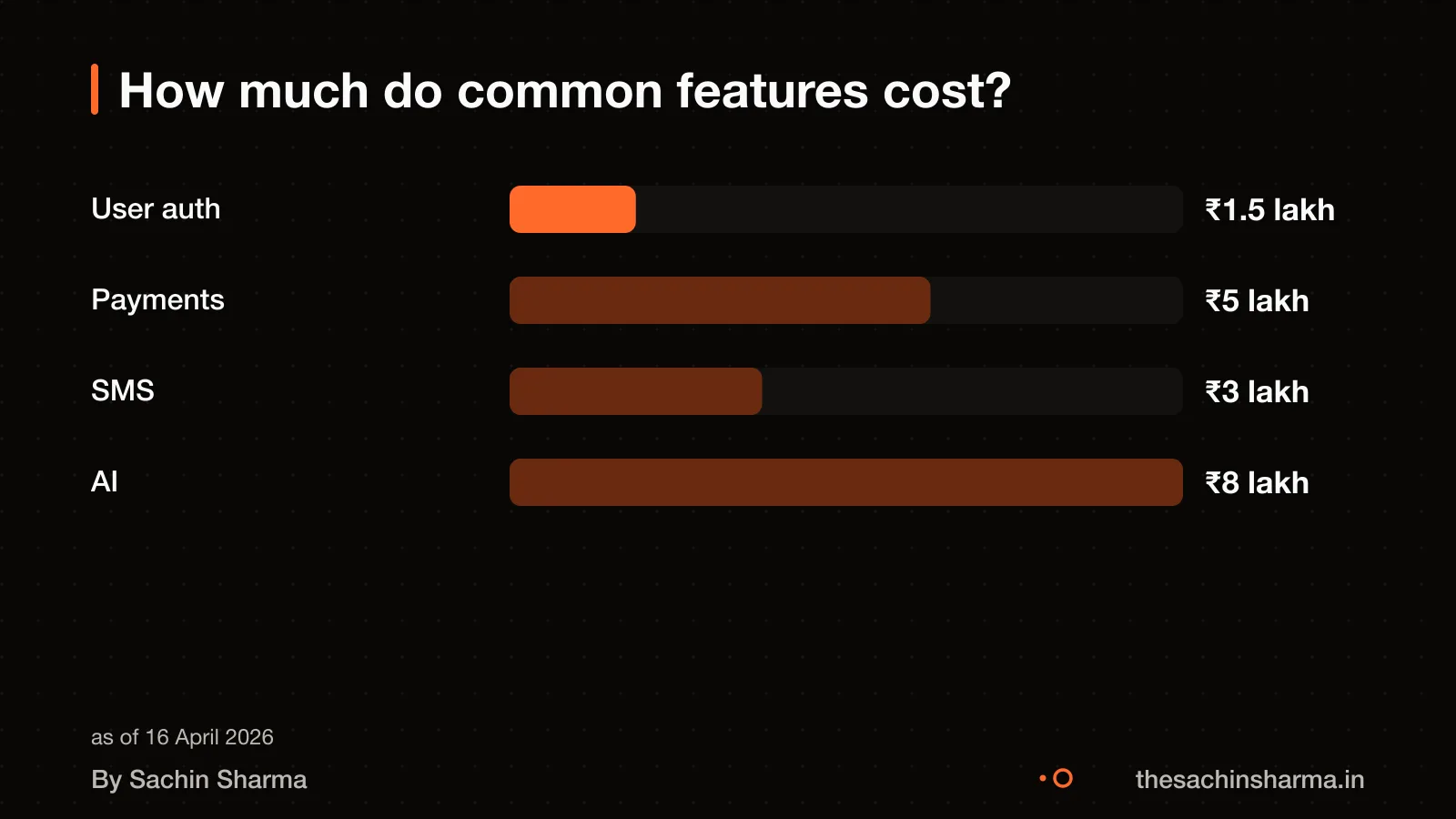
Each feature adds cost based on how it connects to data, users or outside systems. Simple screens cost less. Features that handle logins, money or AI raise the price. You pay more for logic, security and testing.
User authentication costs ₹1 to 5 lakh as an estimate, assuming standard login, password reset and role checks. This applies whether you use email, phone or social logins. The cost covers secure storage and session handling.
A payment gateway adds ₹1 to 5 lakh per integration as an estimate, assuming standard checkout and refund flows. For example, adding Razorpay or Stripe involves API keys, webhooks, invoice generation and compliance checks. You may need GST billing support, which adds work.
Third-party integrations cost ₹1 to 5 lakh each as an estimate, assuming standard APIs and error handling. Examples include SMS gateways, email services or calendar sync. Complex or unstable APIs take longer and cost more. You should confirm the API’s uptime and documentation before budgeting.
AI features add ₹2,00,000 to ₹8,00,000 to the MVP cost. This includes training data setup, model tuning and integration. For example, adding AI document analysis to extract clauses from legal files costs more than simple text summaries. The range depends on accuracy needs and input types. See the Cost to add AI document analysis for more.
How long does it take to build an MVP?
A focused MVP takes 6 to 12 weeks in India. This timeline applies to apps with core features only, such as user sign-up, one key action, and basic admin. For example, a clinic booking MVP with patient registration, slot selection and doctor view would fit this range.
A landing page with forms takes 2 to 3 weeks to develop. This includes design, responsive layout, form validation and connection to a lead-collection tool.
Simple marketplace or SaaS apps take 8 to 10 weeks. These have user roles, listings, search and payment setup.
The 6 to 12 week timeline is common for a focused MVP in India.
The factors that slow down MVP development are not known. You should ask your developer what risks could delay the project and how they plan to manage them.
How does tech stack affect cost?
Using a cross-platform framework like Flutter can save you 30 to 45% compared to building two separate native apps. This is because one codebase runs on both Android and iOS, cutting development time and effort. As a result, cross-platform tools like Flutter or React Native are cost-efficient and faster for initial deployment.
Flutter is cheaper than building natively for both platforms. If you need an app on Android and iOS, Flutter lets one team build for both at once. This reduces the hours billed and speeds up launch. For example, a login screen built once in Flutter works on both phones without rework.
But cross-platform has trade-offs. Some device-specific features may need custom native code, adding complexity. Also, apps with heavy animations or near-native performance needs might still require native development. Flutter saves money upfront but may limit fine control later.
Freelancer, agency, or in-house: which is cheaper?
A freelancer can build your MVP for as low as $10,000. An in-house team costs $80,000 to $150,000+. Freelancers are cost-efficient for small, focused builds but need more oversight from you. Agencies bring structure but at a higher price due to overheads. In-house teams are the most expensive option, best suited for long-term products with ongoing development. Each path has trade-offs in cost, control, and speed.
Hiring a freelancer saves money upfront but shifts project management to you. They may lack backup if they leave mid-project. Agencies offer process and teams but often overbuild, inflating cost. In-house gives full control but requires hiring, tools and space, making it slow and costly. Your choice should match your time, skills and long-term goals.
Do you own the code and accounts?
In most professional contracts, the client owns the code once the invoices are paid. You must have administrative access to these accounts.
You need administrative access to every service your application uses. Without admin access, you cannot switch developers or move your app later.
Handover takes a few days to complete and verify. This includes adding you as admin, transferring ownership, and testing access. It is not instant.
Who should own your Play Store account, this applies to all app store and cloud service accounts.

How can you verify a developer's estimate?
A good quote should list every feature, the tech stack, testing plans, and a buffer for changes. To spot missing scope, check if QA, integrations, compliance, and data rules are included. Ask: "What is not covered?" and "How are changes billed?"
QA and bug-fix cycles typically add 10 to 15% to your MVP budget. If the quote skips this, it is incomplete. Scope creep after the first demo can increase costs by 15 to 30%, so a credible quote must include a change-control process.
For example, a quote that says "₹18 lakh for a clinic booking app". But does not mention payment gateway testing or user role permissions hides risk. You should see line items for third-party APIs, security, and edge-case handling.
A strong quote also names the tools and frameworks, like Flutter or Next.js, and confirms who owns the code and accounts after delivery. If it does not, ask.
Have a quote in hand? Send it to me and I will mark what is missing.
Message me on WhatsAppWorked example: cost of a clinic booking MVP
Worked example: cost of a clinic booking MVP
A clinic booking MVP with 8 screens, one payment gateway, and two APIs (SMS and calendar sync) costs ₹7.5 lakh as an estimate. This includes ₹5,00,000 for core features like patient sign-up, doctor profiles, and appointment booking, based on average MVP cost range. ₹1.5 lakh for payment integration; ₹1 lakh for SMS alerts; and ₹1 lakh for QA testing, within 10-15% of core cost. The estimate assumes no AI features, a Flutter frontend for Android and iOS, and a Next.js backend.
Breakdown of costs:
| Component | Cost (₹) | Assumptions |
|---|---|---|
| Core app (8 screens) | 5,00,000 | Based on average MVP cost range |
| Payment gateway | 1,50,000 | One integration, within typical range |
| SMS API | 1,00,000 | One integration, within typical range |
| QA and testing | 1,00,000 | 13% of core cost, within 10-15% standard |
| Total | 7,50,000 | As an estimate, assuming no AI features or complex workflows |
This estimate does not include AI features, which could add ₹2 to 8 lakh. It also assumes you provide clear requirements and assets like clinic details and doctor photos. If you later add AI-based patient triage, expect the cost to rise by at least ₹2 lakh.
What a clinic booking app costs covers more details on long-term costs and feature trade-offs.
When should you not build an MVP?
Build a prototype or use no-code tools if your idea is still vague or you can test demand without code. A landing page that describes your solution can show interest through sign-ups or clicks, without writing a single line of code. This is enough when the risk is low and the core assumption is whether people care.
Use no-code platforms when your workflow is simple and does not need custom logic or deep integrations. Tools like Bubble or Glide let you mock up an app and share it with early users. You can even run a manual backend using spreadsheets or WhatsApp to test the service.
Do not build an MVP if your idea can be validated with a phone call, a PDF, or a social media post. Many problems can be solved with a checklist, a form, or a shared calendar. Code is the last step, not the first.
If your goal is to learn, start without building. Save development cost for when you are sure someone will pay.
How to start your MVP project
The steps to start your MVP are not in the evidence. To get an accurate quote, send a clear one-line idea and list the key user actions. For example: "A clinic booking app where patients pick a doctor, see free slots, and book with WhatsApp confirmation." This helps a developer map flows and data rules that drive cost.
Next step: message me on WhatsApp with what you want to build. No forms, no sales team.
Message me on WhatsAppWork out your own number
I won't hand you a number that pretends to be the market. Instead, here is the working: set the weeks, the people and the rate, and see where the money goes.
Your working total
₹4,40,00011 weeks × 2 people × 5 days × ₹4,000- Scope and design18%
- Build55%
- Testing and fixes18%
- Launch and stores9%
The weeks shown are an example of a small app, there to be changed. Fees you pay others (store accounts, cloud, SMS) are not in this total.
What moves the price
- More screens or roles
Each extra user type (customer, admin, rider) is close to another app.
- Real-time features
Live tracking and chat need more design and more testing.
- Many integrations
Every payment, SMS, maps or ERP link is its own piece of work.
- Cutting to one platform first
Starting with one clear flow can be half the work.
- Using managed services
A managed backend for login and data removes weeks.
- A clear scope up front
Changes mid-build are the most expensive weeks.
Fees that go to someone else
Google Play developer account
A one-time registration fee, paid to Google. Check the current amount.
Apple Developer Program
A yearly fee paid to Apple. Check the current amount.
Cloud, SMS, maps, payments
Usage-based, billed by the provider to you.
Ask for these before you sign
- How many weeks per phase, and with how many people?
- What is not included?
- Which fees do I pay to others directly?
- What happens to the price when I change my mind?
- What does the first month after launch cost?
Questions people ask
01Which components drive the cost of MVP development?
The main cost drivers are design, frontend, backend, third-party integrations, and quality assurance. Complex, interactive designs require more development time and skill, increasing costs. Simpler layouts and fewer integrations help keep the budget lower.
02Where do estimates for MVP development usually go wrong?
Estimates often miss quality assurance, scope creep, API fees, and compliance needs. These can add a budget increase. As an estimate, assuming 40 screens and one payment gateway, QA and scope changes are common overruns.
03What can be cut without hurting the product?
You can safely use manual processes instead of automation in areas not tied to revenue, security, or customer commitments. This is known as a Wizard of Oz MVP. Such shortcuts reduce cost and risk during early testing.
04Does GST apply to MVP development in India?
Yes, GST at 18% applies to all IT-related services, including MVP development. If you export the service under a LUT, it may be zero-rated. Check this for your case with a chartered accountant.
05How much does it cost to add a mobile app to an MVP?
A React Native mobile app adds ₹3 to 6 lakh to the MVP cost. Building native iOS and Android apps adds ₹8 to 12 lakh. Cross-platform development saves 30 to 45% in time and cost.
06What legal rules apply to MVPs in India?
Key rules include the DPDP Act 2025, GST compliance, company registration under the Companies Act 2013, and any industry-specific licenses. Even early-stage MVPs must have privacy policies and data deletion options. Check startup.gov.in for your stage.
07Can you build an MVP on a tight budget?
Yes, a landing page MVP can cost as little as ₹50,000 and test demand without full development. Non-technical founders can use no-code tools, manual services, or pre-sales to validate ideas first. This avoids high build costs for unproven ideas.
08What maintenance does an MVP need after launch?
Plan for 15 to 30% of the initial build cost each year for maintenance. This covers updates, security patches, and minor fixes. For the first 30 days, focus on watching user behaviour, not adding features.
09How do you know if your MVP is built well?
You have full access to the source code in a version-controlled repository like GitHub, along with documentation and admin rights. A zip file is not enough, it lacks change history. You should be able to hand over the project to another developer smoothly.
10When is a higher-cost MVP actually cheaper?
Skipping compliance or quality may lead to 3 to 5 times higher rework costs later. Technical debt can take up 21 to 40% of future IT spending. Building key features properly from the start avoids expensive fixes down the line.