What is a cross-platform framework and how does it work?
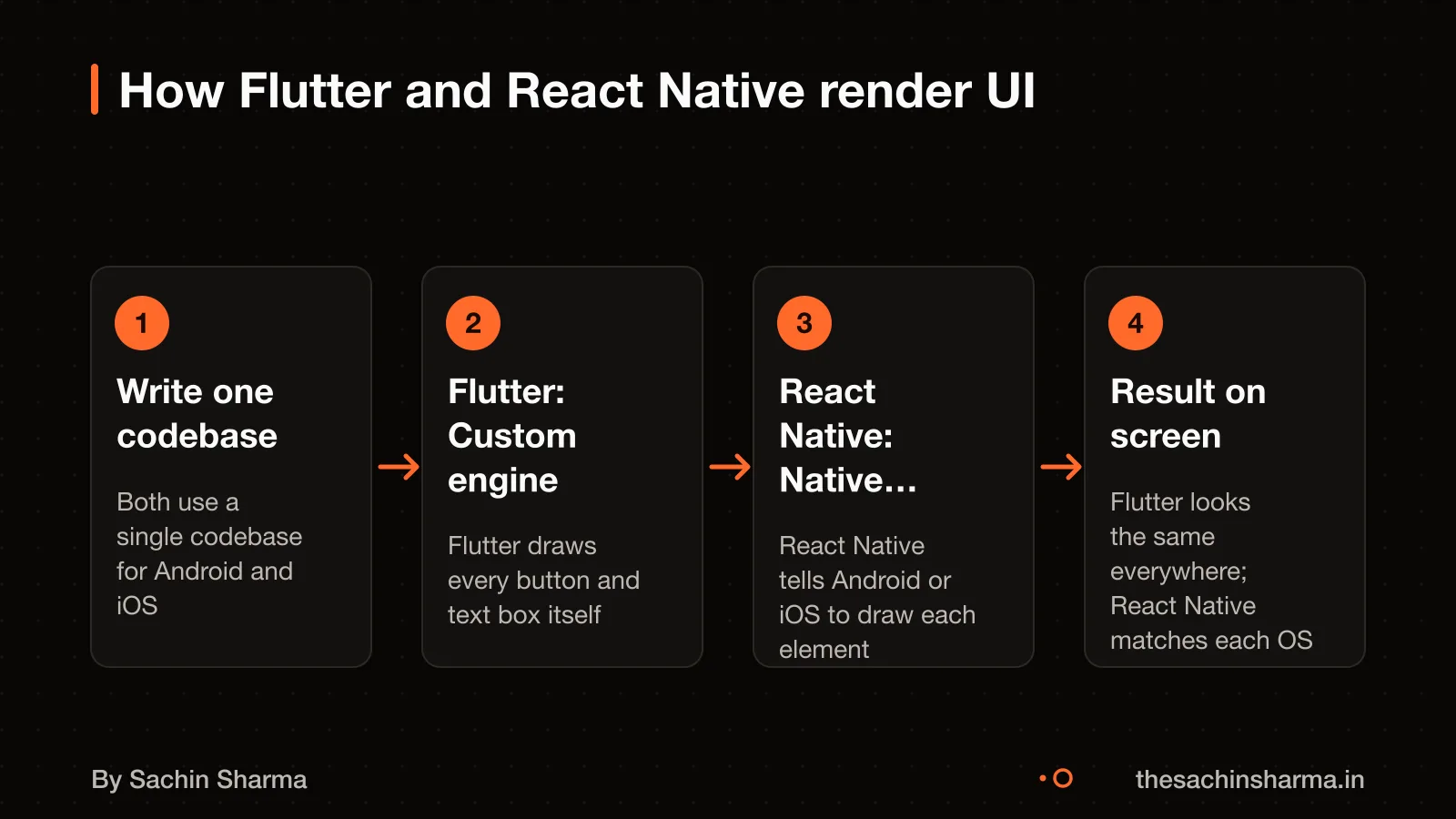
A cross-platform framework lets you build one app that runs on both iOS and Android using a single codebase. This cuts development time and cost compared to building two separate native apps with Swift or Kotlin. Flutter works by drawing every pixel on screen using its own engine, Skia, instead of using the phone’s built-in buttons and menus. It paints the whole UI itself, which gives more control and consistency across devices. React Native, on the other hand, uses real native components under the hood. A button in React Native becomes an actual iOS or Android button, styled with JavaScript. This links it closely to web development with React.js. As of 2025, Flutter has over 160,000 stars on GitHub, showing strong community support. Major apps like Discord, Shopify, and Microsoft Office use React Native in production. Flutter 3.41 was released in February 2026, and React Native’s latest stable version is 0.84 as of February 2026. Flutter’s consistent UI and performance on low-end devices may make it a strong choice for some small businesses in India. You can learn more about what a cross-platform app is here.
Is a cross-platform app the same as a hybrid app?
No, a cross-platform app is not the same as a hybrid app. Hybrid apps run inside a WebView, like a website in a box, and often feel slow or clunky. Cross-platform apps like those built with Flutter or React Native use real native controls for buttons, lists and navigation. They are compiled into native code, so they perform better and look like apps users expect. React Native is not a WebView app, it talks directly to the device’s operating system. Both Flutter and React Native apps can access device features like the camera, GPS, Bluetooth and notifications through native modules. For example, a delivery app can track location in real time and send local notifications when a package arrives.
When should I not use a cross-platform framework?
Choose native development with Swift or Kotlin if your app needs maximum performance or deep hardware access. Such as for augmented reality, high-frame-rate gaming, or system-level tools. These apps often rely on device-specific features that cross-platform frameworks cannot fully support. For example, a real-time AR measuring tool or a low-latency music synthesizer works best when built natively.
If you have complex business logic and want to share code between Android and iOS without sacrificing performance, consider Kotlin Multiplatform. It is not a full UI framework, but it lets you reuse core logic while building native interfaces. This fits apps like financial calculators or offline-first data processors where correctness and speed are critical.
For apps requiring deep hardware integration, like custom camera controls, Bluetooth peripherals, or background sensor monitoring, native is safer. Cross-platform layers can delay or limit access to new device features.
How much does it cost to build with Flutter vs React Native in India?
A 40-screen MVP with one payment gateway costs at least ₹75,000 in India as of mid-2026. Flutter developers charge ₹700 to ₹1,400 per hour, while React Native developers charge ₹600 to ₹1,300. React Native is typically 5 to 10% cheaper to build and staff in India. Because more Indian teams already have React.js web developers who can quickly adapt to it. This cost gap comes from faster hiring and less training time, not from lower code complexity. For a simple app, that 5 to 10% saving adds up when you scale the team. However, long-term maintenance and performance fixes can shift the balance, which we cover in later sections.
As an estimate, assuming a 40-screen MVP and one payment gateway, build cost is ₹75,000 to ₹2.5 lakh.
Want a number for your app idea? Send one line on WhatsApp. I reply with what drives the cost and what to cut.
Message me on WhatsAppHow long does it take to build a cross-platform app in 2026?
A simple MVP takes 4 to 6 weeks to build in India in 2026. This is faster than building two separate native apps. Cross-platform frameworks let you write one codebase for both iOS and Android, cutting development time by up to half. For example, a habit tracker with login, a dashboard and sync can be ready in 6 weeks using Flutter or React Native.
React Native 0.84 now ships with precompiled binaries for iOS by default, which speeds up iOS builds. This reduces setup time and avoids long compilation waits during development. As a result, teams can test changes faster on iOS devices.
Compared to native apps, cross-platform development is quicker for most use cases, especially when launching an MVP to test an idea. You can validate your concept sooner and with lower cost. However, complex features like real-time audio processing or deep device integration may extend the timeline.
How do Flutter and React Native differ on low-end Android phones?
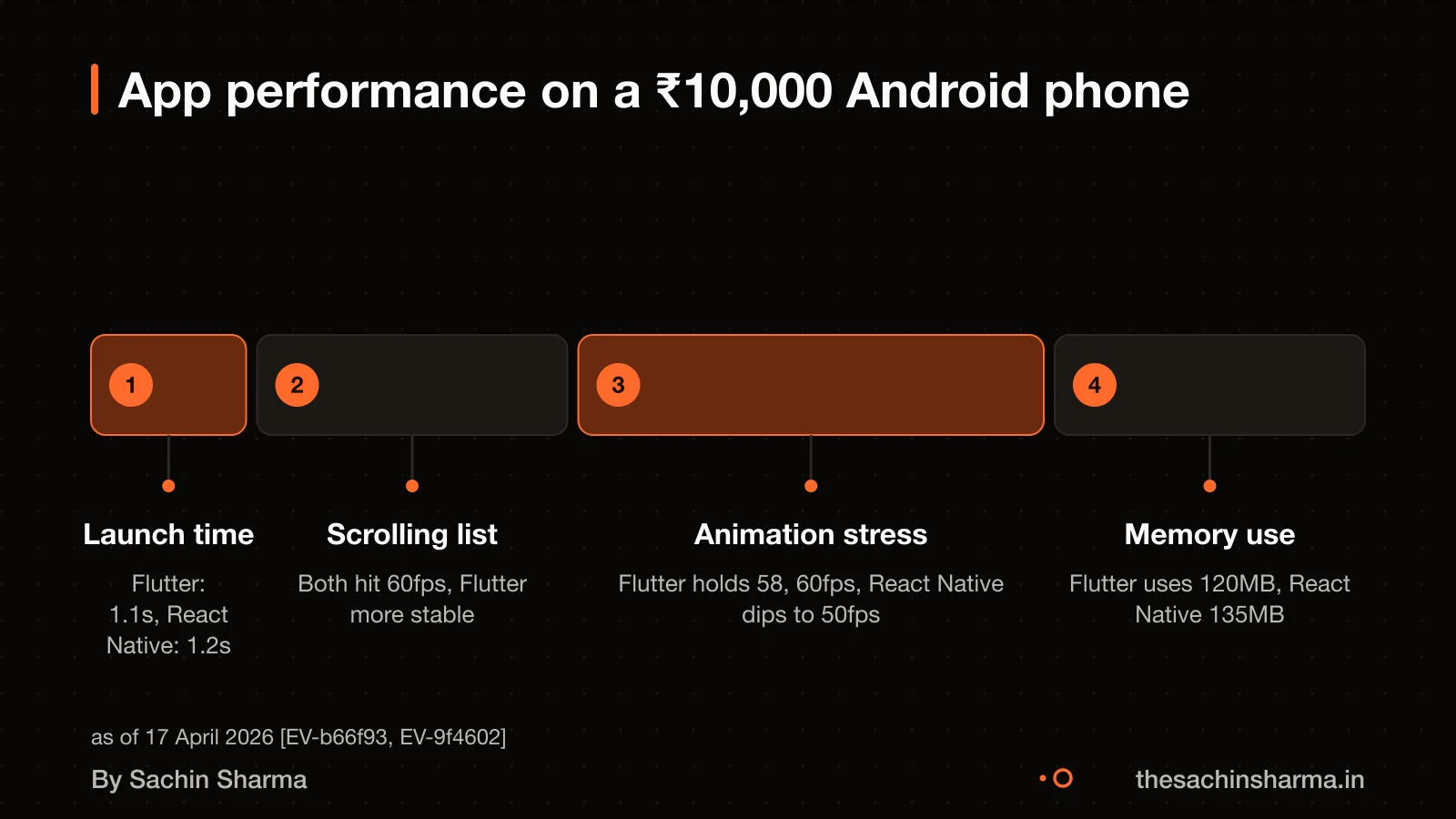
Flutter apps launch in about 1.1 seconds on low-end Android phones, slightly faster than React Native apps. Which take about 1.2 seconds when Hermes is enabled. This half-second difference helps in holding user attention during first use. Under stress, such as during heavy animations or multitasking, Flutter holds 59 to 60 frames per second (FPS). Flutter wins on 2GB RAM devices because it compiles directly to native ARM code. Manages its own UI rendering, reducing reliance on the JavaScript bridge that React Native depends on. For example, MojoCinema is a Flutter app for movie discovery with a local watchlist and Indian title support.
Flutter vs React Native: which one should I choose for your app?
Choose Flutter if your app needs custom design, smooth animations, or must run on mobile, web and desktop from one codebase. I used Flutter for apps like MojoCinema and Daily, where look, feel and offline performance mattered. Flutter hits 59 to 60 FPS in stress tests, so it handles complex UI well.
Pick React Native if you already have a React or Next.js web team, or need to hire developers fast in India. React Native developers are 3 to 4 times more available than Flutter ones here. This can speed up hiring and let web teams share logic with mobile.
The trade-off is control versus speed. Flutter gives more UI control and consistent performance across devices. React Native trades some polish for faster team scaling, especially if your tech stack is already JavaScript-based. For startups with strong design needs, Flutter wins. For those prioritising team growth, React Native may fit better.
You can pair either framework with a backend like Firebase or a custom API. See the Best tech stack for a startup in 2026 for how to choose.
Still unsure between Flutter and React Native? Tell me your budget and timeline and I will say which fits.
Message me on WhatsAppWhat does it cost to maintain a cross-platform app per year?
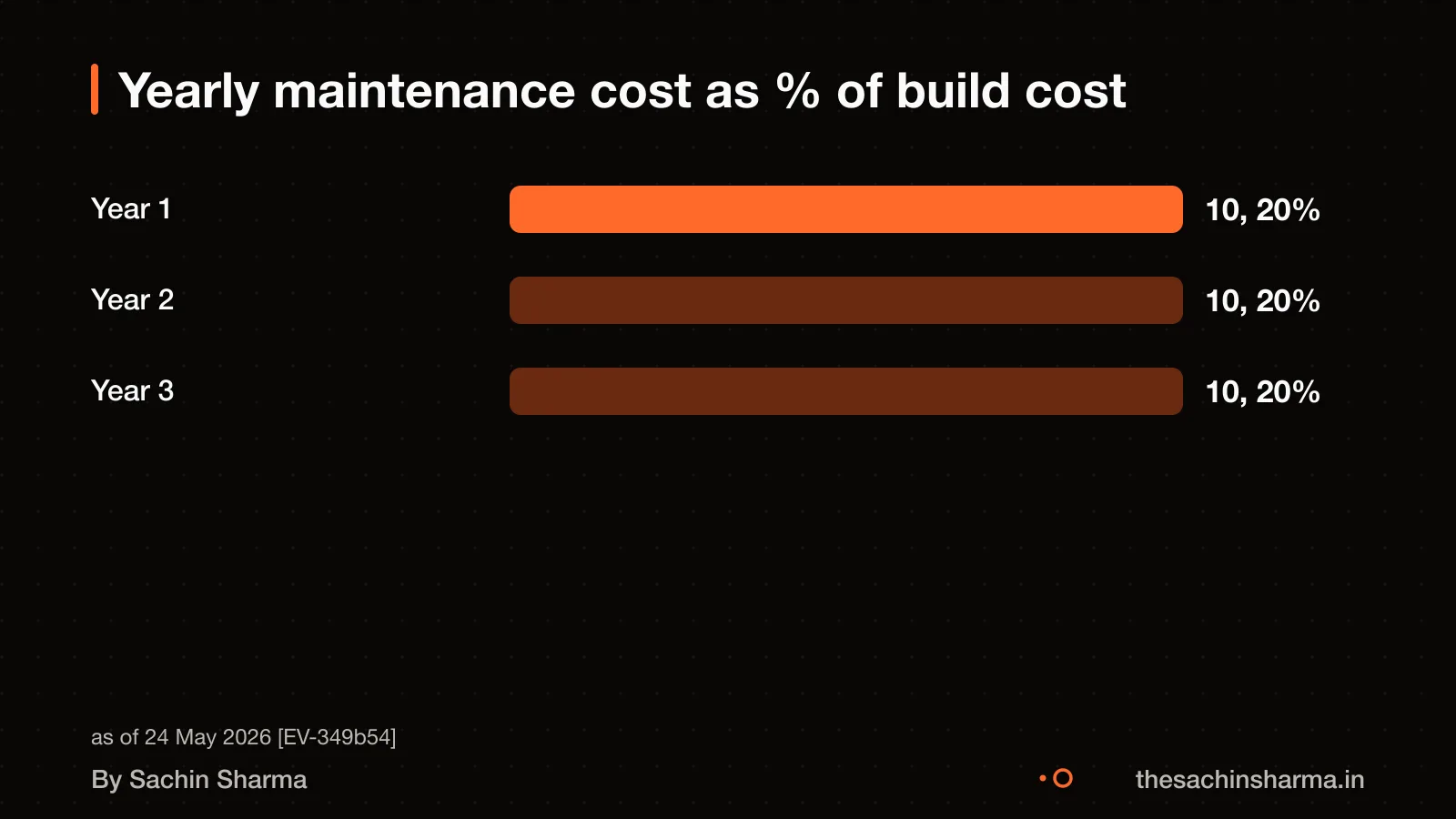
Maintenance costs 10 to 20% of the original build cost per year. Sources differ: one says 10 to 15%, another says 15 to 20%, likely rising over time. React Native may need more fixes because it depends on third-party plugins for native features. These plugins can break when iOS or Android updates arrive. Flutter apps bundle most code in the app itself, so they are less affected by OS changes. Plugin risks are higher in React Native if the plugin is not actively maintained. As a result, long-term upkeep can grow costlier, especially if your app uses many device-specific functions like camera, location or Bluetooth. For example, a ₹10 lakh app could need ₹1 to ₹2 lakh every year to stay stable and secure.
Is Flutter better than React Native for a small business in India?
Flutter can be better for small businesses in India if your app needs smooth performance on low-end phones or a custom design. But React Native has a clear cost and hiring advantage. This larger pool makes it easier and faster to staff your project, especially if you already have a React or Next.js web team. in India. I used Flutter for apps like MojoCinema and Daily. For most small businesses, the choice depends on your team and app type: go React Native to save money. Hire fast, but choose Flutter if performance and design control are your top needs.
What laws or platform rules apply to cross-platform apps?
App Store Connect helps manage app submissions and legal agreements. You are also responsible for complying with licenses for any third-party packages you use in your app.
App Store Connect is used to submit apps for distribution, manage apps, distribute beta versions using TestFlight. Accept legal agreements, enter tax and banking information, and view financial reports. It also supports setting an app age rating to inform users about content. App Store Connect provides Accessibility Nutrition Labels to summarise support for assistive features. The App Store Connect API can automate these workflows.
If your app collects personal data from users in the EU, GDPR applies regardless of your location. You must state what data you collect, why, and how it is stored. Always include a privacy policy in your app and on your website.
Third-party packages in your code, such as libraries for charts or authentication, often come with open-source licenses (like MIT or GPL). Some require attribution; others restrict commercial use. Use a license scanner during development to catch issues early.
As these areas involve legal risk, talk to a technology lawyer before launch. This advice does not cover all possible regulations, and rules may change.
What can go wrong in production and how to fix it?
However, migrating an app after launch is often more complicated than changing the framework before development begins. The amount of reusable work when switching frameworks depends on how the original app was designed. So, if performance or maintenance issues appear in production, a full rewrite may be needed, with little code carry-over.
Migration complexity and partial code reuse are real risks. If you start with one framework and later switch, you may lose most of your UI and business logic. This is why choosing the right framework at the start matters more than small differences in speed or cost.
When this advice is wrong
When this advice is wrong if you have a large existing JavaScript codebase. Rewriting it in Dart for Flutter adds cost and risk. Instead, use React Native to reuse your logic and team skills.
This advice is also wrong if your app needs 120fps animations or high-end gaming performance. Cross-platform frameworks add a layer that can limit frame rates. For such cases, native development with Swift or Kotlin gives better control and peak performance.
It is also wrong if you plan to go fully native later. Migrating after launch is often harder than choosing native upfront. If you expect to switch, consider Kotlin Multiplatform for shared logic or start with native to avoid rework.
Related reading: Best backend for a mobile app, Best database for your app: SQL, NoSQL or both?.
Next step: message me on WhatsApp with what you want to build. No forms, no sales team.
Message me on WhatsAppAssumptions behind the numbers
- Assuming 40 screens, one backend, and average complexity for cost and time estimates.
- Maintenance cost assumed at 10–20% of build cost yearly.
Pick your situation
I am a Flutter developer, so I benefit from recommending Flutter. However, I've laid out when React Native is the better fit based on team skills and hiring speed.
Pick your situation
Flutter wins. Flutter renders its own UI and performs better on older Android devices.
The whole comparison
| Flutter | React Native | |
|---|---|---|
| Performance on low-end devices | Better (59–60 FPS) | Good (slightly slower) |
| Hourly developer rates in India | ₹700–₹1,400 | ₹600–₹1,300 |
| Estimated MVP cost | ₹75,000–₹2.5 lakh | 5–10% cheaper |
| Build time for MVP | 4–6 weeks | 4–6 weeks |
| UI consistency across platforms | High (custom engine) | Medium (uses native components) |
| Developer availability in India | Fewer developers | 3–4x more |
| Code reuse with web team | None (Dart required) | High (JavaScript/React.js) |
Whichever you choose, ask these
- Can you show me a demo of both?
- What devices will my users mostly have?
- Do we plan to expand to web/desktop later?
- What skills does our current team have?
Questions people ask
01How do Flutter and React Native differ under load?
Flutter achieves 59 to 60 FPS in animation stress tests, while React Native achieves 54 to 58 FPS under the same conditions. This difference is most noticeable during complex animations or high UI load. Flutter achieves 59 to 60 FPS in animation stress tests, while React Native achieves 54 to 58 FPS under the same conditions.
02What does it cost to migrate from one framework to another?
Migration cost depends on how the original app was designed. You may need to rebuild the UI, integrations, state management, and tests. It is often more complex than choosing the right framework before development.
03What fails first in a cross-platform app under stress?
What fails first in a cross-platform app under stress is not known. Since this depends on app design and device, monitor logs and use profiling tools during testing. There is no single point of failure across all apps.
04Can I share code between mobile and web with these frameworks?
Flutter is better when you want one codebase across mobile, web, and desktop. React Native shares tooling with React.js web development and uses native UI components under the hood. Flutter is better when you want one codebase across mobile, web, and desktop. React Native shares tooling with React.js web development and uses native UI components under the hood.
05Do I own the source code if I use a cross-platform framework?
Yes, you own the source code unless your contract says otherwise. However, ownership of app store accounts and developer licenses must be verified separately. Always confirm this in writing with your developer.
06How often do I need to update a cross-platform app?
How often updates are needed for a cross-platform app is not known. Critical bugs or plugin failures may require faster fixes. Regular updates help avoid large, risky migrations later.
07What if a plugin stops working after an OS update?
Check for an updated version of the plugin first. If none is available, you may need to write native code or switch to a different plugin. It is not known how often plugins stop working after an OS update in React Native compared to other frameworks.
08How do I check if a developer really used Flutter or React Native?
How to verify a developer's claim about using Flutter or React Native is not known. Tools like React Native Detector or Flutter Inspector can verify the build. This helps ensure transparency and avoid misrepresentation.
09What happens when the framework version changes and breaks my app?
Use React Native Upgrade Helper to review code changes between versions. Always test updates in a staging environment before deploying. Sudden version jumps without testing can break core features.
10How do these frameworks handle offline use in poor internet areas?
Both support offline storage. Flutter uses Hive or SQLite for fast local data access. React Native uses AsyncStorage or SQLite. For apps in areas with unreliable networks, plan data sync strategies carefully.