What makes a pharmacy delivery app different from food or grocery apps?
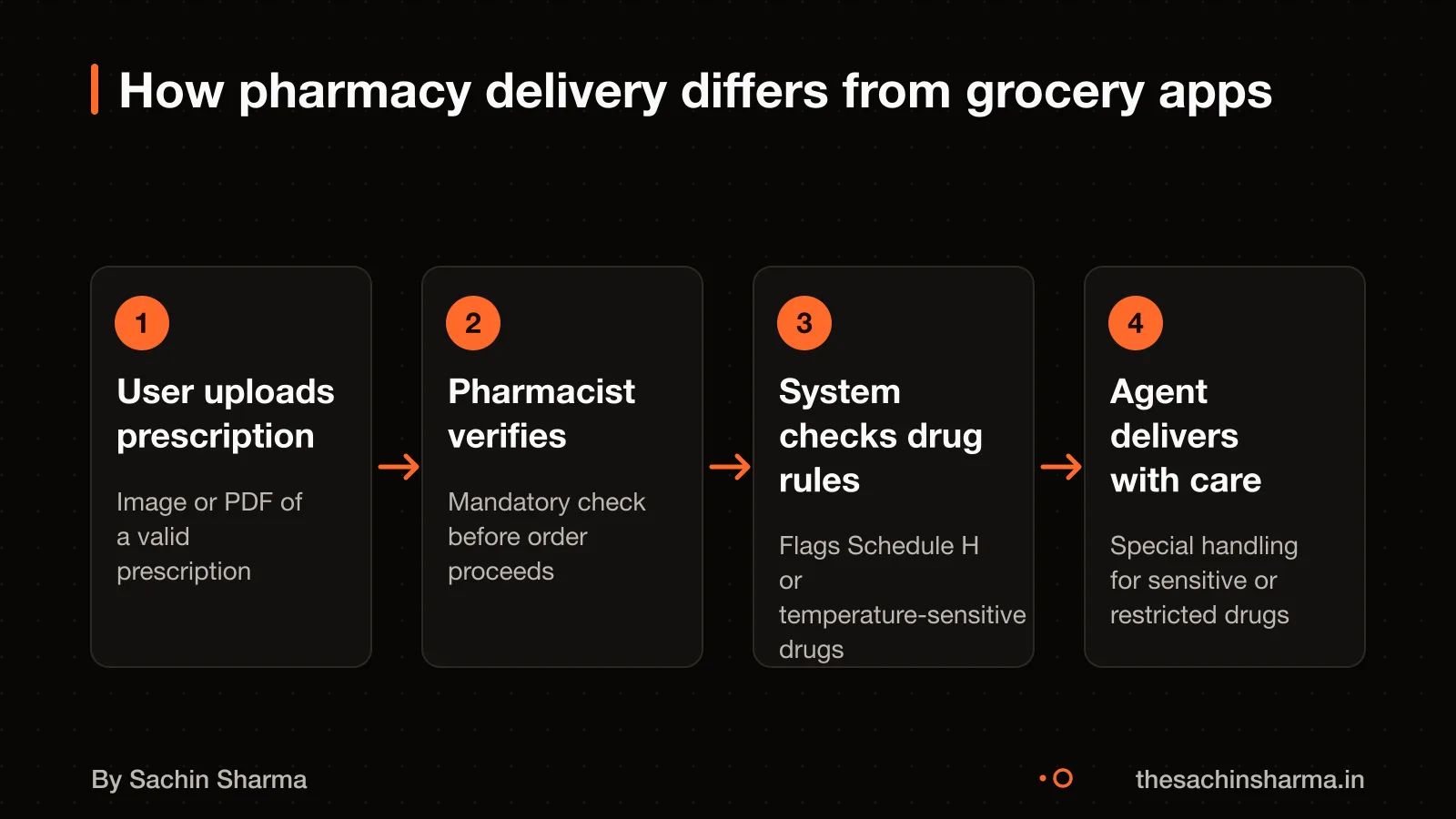
A pharmacy delivery app handles prescriptions, drug safety checks, and legal compliance. You must verify prescriptions for Schedule H and H1 drugs. This means building secure upload and review systems for prescriptions. Core components include a medicine catalog with dosage forms, a prescription scanner with AI-assisted text extraction, a doctor verification step, and integration with pharmacy inventory. Compliance increases effort because every transaction must meet drug sale laws and data privacy rules. For example, your app must log who viewed a prescription and when, to meet audit needs. These features add layers of validation, security and reporting that food delivery apps do not need.
Must-have features for a pharmacy delivery app
What are the main cost drivers in a pharmacy delivery app?
The most expensive parts of a pharmacy delivery app are the backend, third-party integrations, and compliance systems, not the front-end design. A medium-complexity app may cost around $120,600, or roughly ₹100 lakh at current rates. Backend development takes more time and skill than the user interface because it handles prescriptions, inventory sync, and delivery logic. Integrations with pharmacy licensing APIs, payment gateways, and drug databases add cost due to testing and security needs. Secure data handling raises cost due to the need for reliable backend systems. UI/UX design is a smaller part of the total; a basic designer cost is $4,200. However, complex workflows like prescription upload or medicine substitution need careful design to avoid errors.
The tech stack you choose also affects cost. A modern, maintainable stack like Flutter for the app and Next.js for the backend can reduce long-term effort. But deep integration with legacy pharmacy inventory systems may still take weeks of custom work, even with the right tools.
Best tech stack for a pharmacy delivery app in India
Want a number for your idea? Send one line on WhatsApp. I reply with what drives the cost and what to cut.
Message me on WhatsAppHow much does prescription upload and verification add to cost?
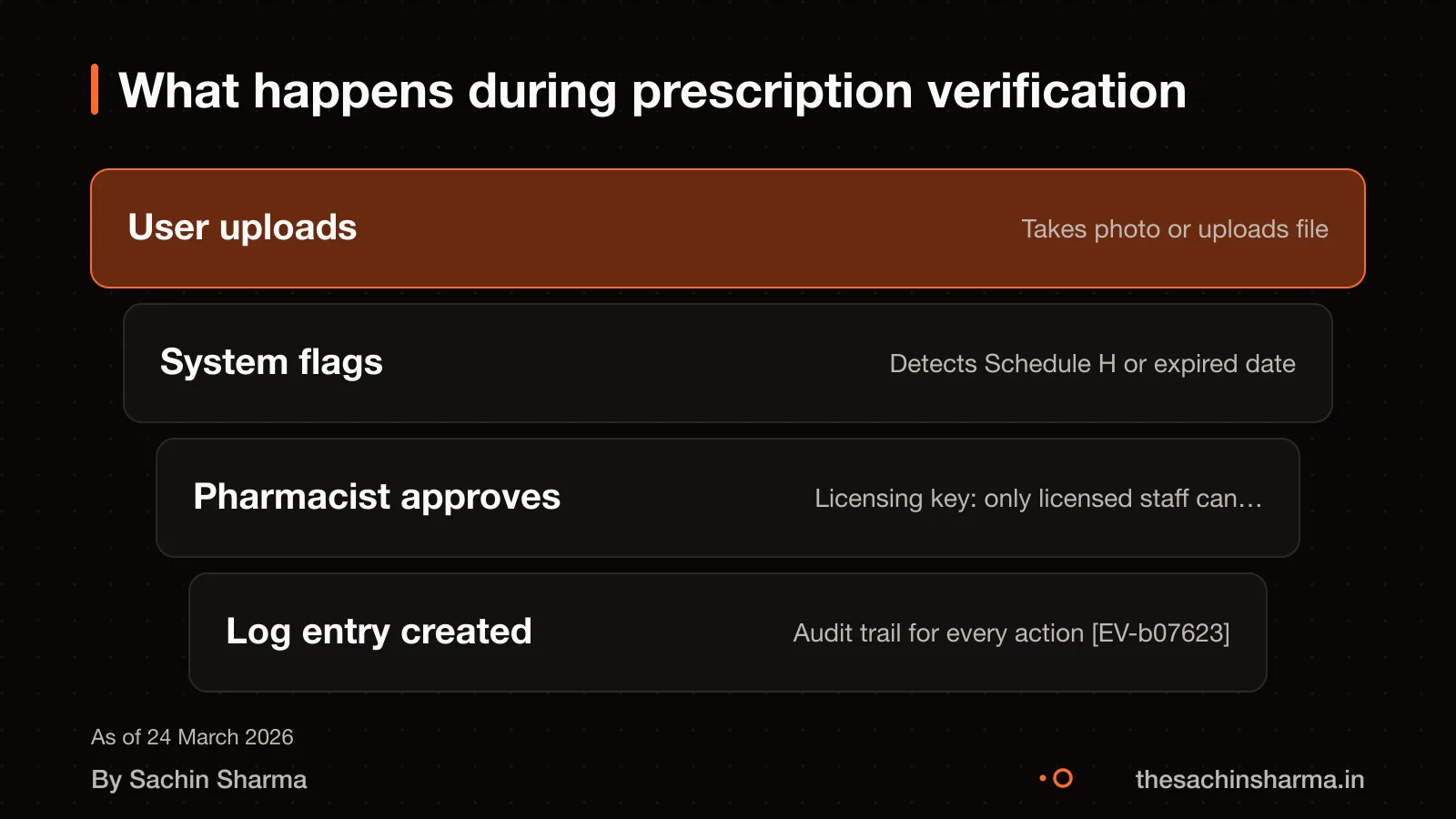
Prescription upload and verification is a core feature because Indian law requires it for Schedule H and H1 drugs. Without a valid, clearly dated prescription from a registered medical practitioner, the app must block the order. This is not optional for legal compliance.
If verification fails, the order is halted and the customer must upload a new prescription. The system should flag unclear, expired or incomplete prescriptions for manual review by a pharmacist. Automated checks alone are not enough, as image quality and handwriting vary.
Every action during verification must be logged securely for audits. This includes who uploaded the prescription, when it was checked, by whom, and the result. These logs help during regulatory inspections and must be stored with tamper-proof timestamps. As an estimate, assuming manual review by a pharmacist and audit logging, this feature can add ₹1.5 to ₹2.5 lakh to development cost. The exact cost depends on how many staff roles are involved and whether logs are stored on-premise or in a compliant cloud.
How do third-party integrations affect cost?
Third-party integrations add cost because each one must be tested, secured, and maintained. They also need error handling for failures and updates when the service changes.
Inventory sync increases development time because your app must integrate with pharmacy systems. This may involve custom work. Without real-time sync, you risk overselling out-of-stock medicines.
Payment and mapping services add cost due to setup complexity. You need at least one local payment gateway. Mapping APIs such as Google Maps or MapmyIndia are needed to track delivery staff in real time. Each requires API keys, usage monitoring, and fallbacks during outages.
Pharmacy database integration adds cost due to integration needs. The exact cost of this integration is not published.
The cost of secure prescription data transfer and audit trails is not published [unknowns]. You should ask your developer to show how they will log access and protect data during transfer.
What legal rules apply to online pharmacy apps in India?
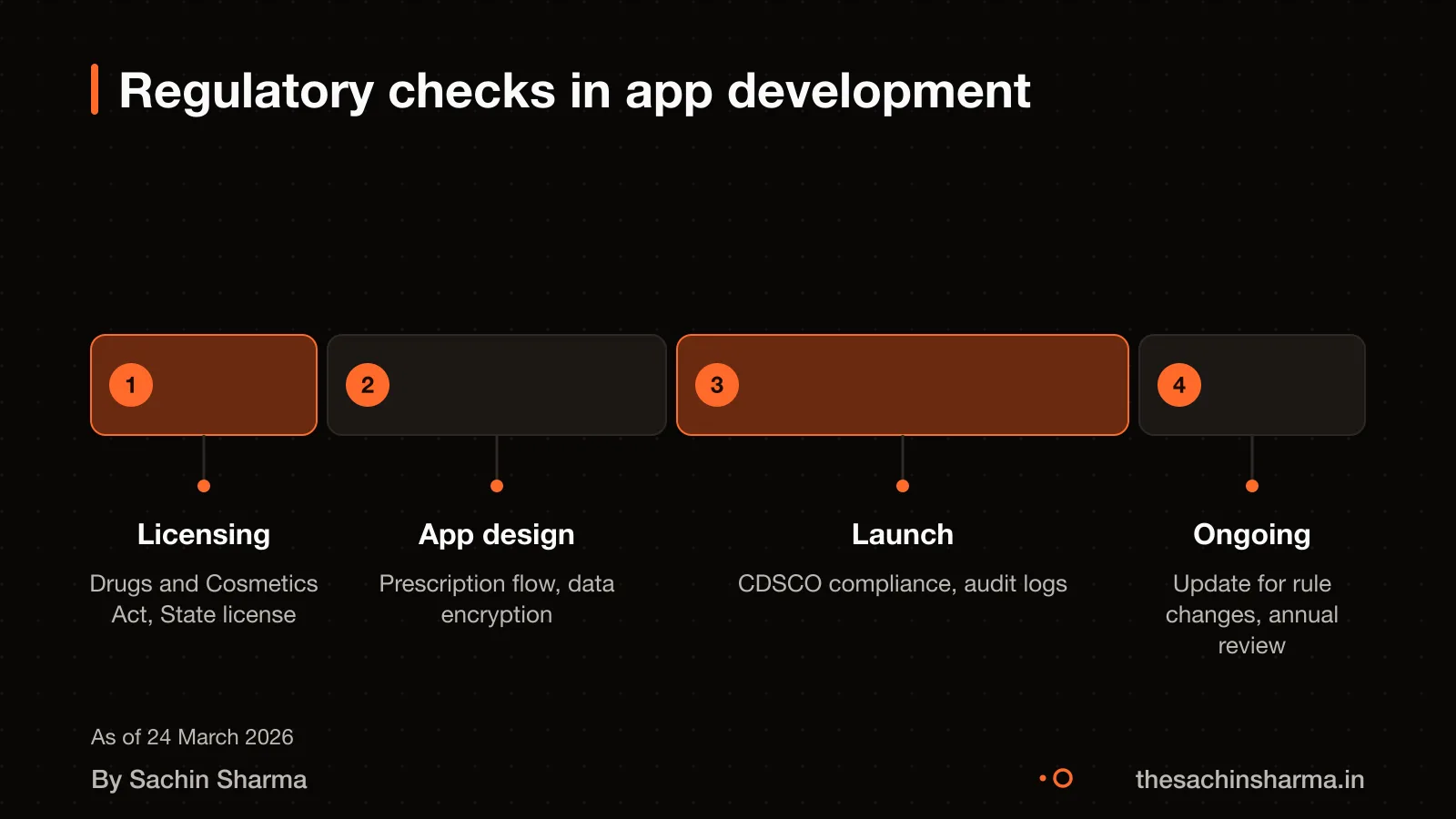
The main law for online pharmacy apps in India is the Drugs and Cosmetics Act. 1940, and its rules, as amended up to 31 December 2016. This law gives powers to both central and state regulators to control how drugs are sold and distributed, including online. You must follow these rules to legally operate an online pharmacy.
Yes, you need a licence to run an online pharmacy. The Drugs and Cosmetics Act requires that any business selling drugs, including over the internet. Must have a valid licence from the state licensing authority. This licence ensures that your pharmacy meets safety, storage, and record-keeping standards.
For compliance, you must submit documents like the licence application, proof of a registered pharmacist on staff, storage facility details, and drug inventory records. User manuals for submitting these documents are available on the State Drugs website. If you sell Schedule X drugs, such as strong painkillers or stimulants, these are banned for online sale under Indian law. You must build systems to block such orders and keep audit logs. Always consult a legal expert to confirm your compliance plan, as rules vary by state and can change.
What are the biggest risks in building a pharmacy delivery app?
Selling a restricted drug by mistake can lead to legal penalties and license cancellation. Online pharmacies in India cannot sell Schedule X drugs like narcotics or habit-forming sedatives. If your app allows such sales, even by error, regulators may treat it as non-compliance.
Data breaches are a serious risk because health data is sensitive. As an estimate, assuming such data is treated like protected health information, there may be compliance requirements.
Regulation is still evolving. A formal e-pharmacy framework is not yet in force. This uncertainty means today’s legal app might need changes tomorrow. You must plan for updates whenever new rules arrive.
The quick delivery model adds pressure on compliance. Fast order processing can skip checks, increasing the risk of errors. Build in time for manual review where needed, especially for high-risk drugs.
How to build a pharmacy delivery app: steps and timeline covers the full process, including how to stay compliant during development.
Who owns the app and can I switch developers later?
You own the code and app store accounts once the app is delivered and paid for. You can transfer the app to another developer at any time. The transfer keeps user reviews, ratings and download history intact. Sales data from before the transfer stays with you, but the new developer receives payment and sales reports only for transactions after the transfer.
You lose access to App Analytics data once the app is transferred. You also cannot generate new promo codes for the app after the transfer, even if they were active before. All app functionality, updates and user access continue without disruption during and after the move.
If you switch developers, the new team gets the source code, build tools and deployment access. You must provide them with app store account access or transfer ownership through Apple’s App Store Connect or Google Play’s equivalent. Data like user behaviour logs or server metrics stored in your tools will not move unless you share them. Keep backups of all analytics and logs before any handover.
What ongoing costs should I expect after launch?
App maintenance costs are not published in available sources. As an estimate, assuming 15% to 20% of the initial build cost, you should budget annually for updates, bug fixes, and server monitoring. This range covers routine work like patching security flaws, adapting to OS updates, and minor feature tweaks.
Regular updates include keeping the app compatible with new Android and iOS versions, renewing domain and SSL certificates, and updating third-party SDKs. Bug fixes are part of this cycle and depend on how often users report issues.
Server costs vary by user load and data storage needs and are part of maintenance. You should confirm the exact scope and rate with your developer before launch.
When should I not build a custom pharmacy delivery app?
When should I not build a custom pharmacy delivery app?
- Use a shared platform like PharmEasy Store or JioHealthHub instead, where setup is fast and costs are predictable.
- A white-label solution or partnership with an existing network may be more cost-effective than building from scratch.
- If you do not have a valid pharmacy licence or cannot verify prescriptions legally, you should not launch any online pharmacy app. Compliance is not optional under Indian law.
- If your team lacks support for audits, drug safety checks, or integration with state licensing systems, a custom build will carry high risk.
Related reading: Build vs buy: custom, white-label or platform?.
Next step: message me on WhatsApp with what you want to build. No forms, no sales team.
Message me on WhatsAppAssumptions behind the numbers
- Base cost assumes prescription upload and verification as per law
- Inventory sync assumed to be real-time unless toggled down
- Audit logs are included by default for compliance
- Team size and rate are set to conservative defaults
Work out your own number
I won't hand you a number that pretends to be the market. Instead, here is the working: set the weeks, the people and the rate, and see where the money goes.
Your working total
₹5,20,00013 weeks × 2 people × 5 days × ₹4,000- Scope and design15%
- Build62%
- Testing and fixes15%
- Launch and stores8%
The weeks shown are an example of a small app, there to be changed. Fees you pay others (store accounts, cloud, SMS) are not in this total.
What moves the price
- Prescription verification
Checking each prescription adds design and logic time.
- Deep inventory sync
Real-time stock across suppliers is complex.
- Audit logs for compliance
All actions must be traced for regulators.
- Basic inventory only
Static stock levels reduce backend effort.
- Manual prescription checks
Offloading checks reduces dev time but adds ops.
- Fewer integrations
Skipping maps or advanced SMS saves weeks.
Fees that go to someone else
Google Play developer account
A one-time registration fee, paid to Google. Check the current amount.
Apple Developer Program
A yearly fee paid to Apple. Check the current amount.
Cloud, SMS, maps, payments
Usage-based, billed by the provider to you.
Ask for these before you sign
- How many weeks per phase, and with how many people?
- What is not included?
- Which fees do I pay to others directly?
- What happens to the price when I change my mind?
- What does the first month after launch cost?
Questions people ask
01Which components drive the cost of a pharmacy delivery app?
The top cost drivers are the backend for secure data, third-party integrations, and prescription verification with audit logs. A basic app costs ₹15 to 25 lakh. Start with core features and add others later to manage cost.
02Where do estimates for a pharmacy delivery app usually go wrong?
Most quotes miss the effort for compliance, audit logging, and changes due to evolving regulations. A formal e-pharmacy framework is still in the works. Always budget for updates and legal reviews.
03What can be cut without hurting the product?
You can delay AI parsing, recurring orders, and health records integration without affecting core function. Focus first on prescription upload, inventory sync, and delivery tracking. Add advanced features in phase two.
04How do I check if a developer has built such apps before?
Ask for proof of work on prescription verification and compliance with the Drugs and Cosmetics Act. Check if they have built apps that handle Schedule H or H1 drugs. Review their past projects or request case studies.
05Can I start with a basic app and add features later?
Yes, start with prescription upload, inventory sync, and delivery tracking. These are core to legal operation. Add AI parsing and health records later. This keeps initial costs low and lets you test demand.
06Is GST included in the development cost?
GST on app development services depends on the provider and your state. The rate is not stated in available sources. Confirm with your developer and a tax professional. Check this for your case with a chartered accountant or lawyer.
07What happens if the app delivers the wrong medicine?
Failed prescription verification stops the order before dispatch. Every action is logged securely for audits and error tracing. This helps with error tracing and audit reporting.