What a milk and dairy delivery app really is
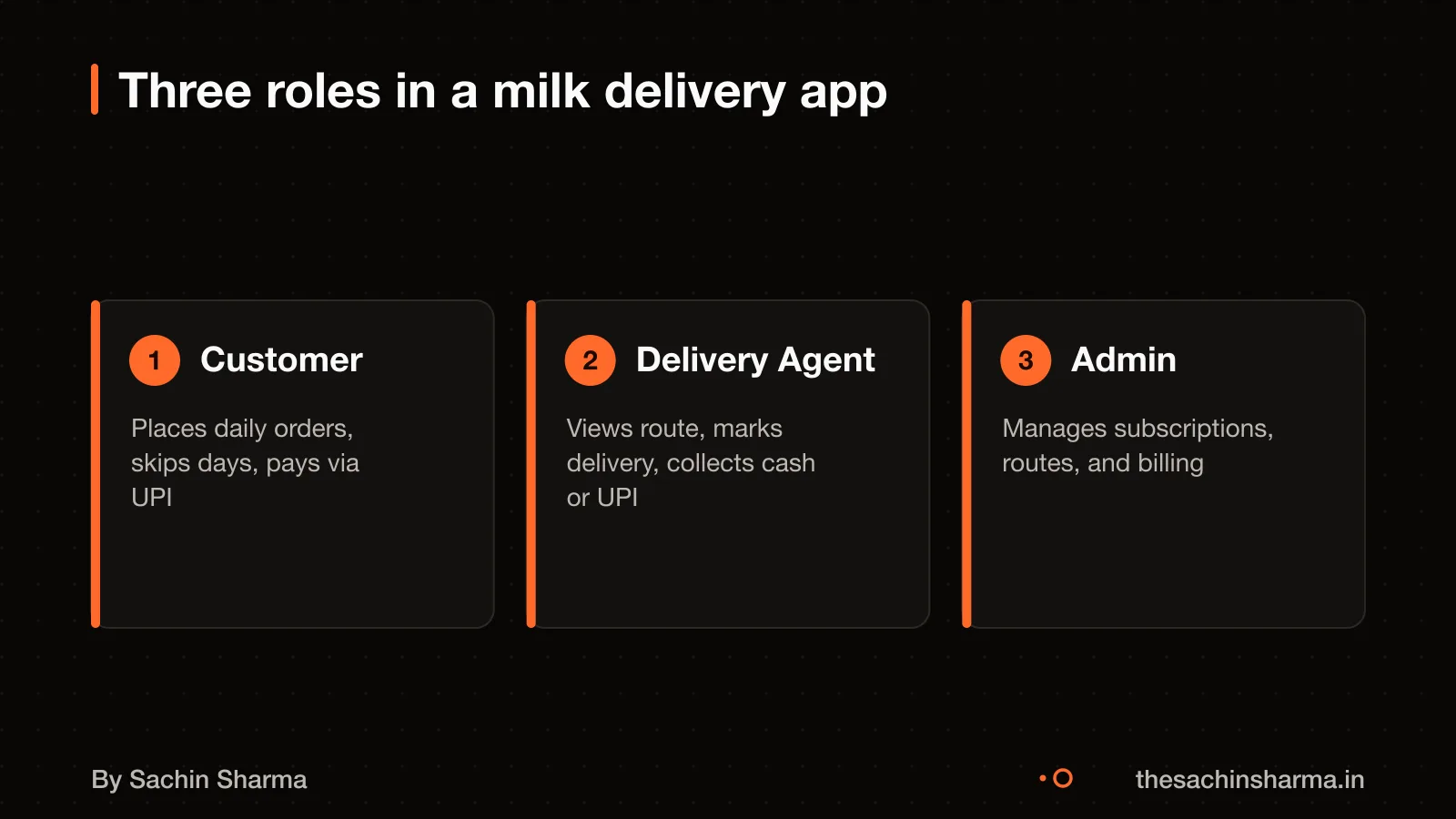
A milk and dairy delivery app is a system that manages daily or weekly milk subscriptions, tracks deliveries, and automates billing and payments. It serves three roles: customers, delivery agents (or farmers), and admins. For customers, it lets them subscribe to milk or dairy products, pause or skip deliveries, and pay via UPI or wallets. For delivery agents, it shows daily routes, delivery lists, and collects proof of delivery. For admins, it tracks sales, manages inventory, and generates bills automatically from delivery records. Unlike grocery or quick commerce apps, it focuses on recurring deliveries, not one-time orders. The app must handle daily changes like missed deliveries or route shifts, which adds complexity. For example, MilkMate is built as a full-stack platform that connects all three user types on one codebase. You can see the Must-have features of a milk delivery app to understand what each role needs.
Where the money goes: the real cost components
The main cost drivers in a milk and dairy delivery app are backend logic, integrations, and multi-platform support. Features like daily subscriptions, route planning, and auto-billing need custom code and raise the cost. Building for both iOS and Android from day one increases the budget by 40 to 60%. This is because each platform needs separate testing and design tweaks, even with cross-platform tools like Flutter.
Frontend development includes the customer, delivery agent, and admin dashboards and requires careful design for daily use. Backend logic handles subscriptions, order changes, and delivery routes, and requires significant development effort. Real-time delivery tracking using Google Maps adds complexity. So does role-based access for admins, farmers, and delivery staff.
Integrations are another major cost. UPI and payment gateways charge 2 to 3% per transaction. But the bigger cost is building auto-billing and wallet systems that handle daily deductions and refunds. These need secure, reliable code and audit logs. Testing and compliance also add time, especially for financial flows.
You can save by launching on one platform first or using a simpler tech stack. For example, using Supabase Auth can cut login development time. But real-time updates and offline sync for delivery agents still need extra work [unknowns].
Best tech stack for a dairy delivery app if you want to compare tools that affect cost.
Want a number for your idea? Send one line on WhatsApp. I reply with what drives the cost and what to cut.
Message me on WhatsAppDaily subscriptions: why they cost more than monthly plans
Daily subscriptions cost more to build because they require constant tracking, state checks. Daily sync with billing systems, which increases logic and database load. Each delivery day must be recorded, validated, and linked to payment, which increases the app’s logic and database load. Unlike a monthly plan that bills once, daily billing runs small charges every day, requiring tighter coordination between the app and the payment gateway.
Features like “pause” and “skip” add more complexity, though the exact cost impact is not known. These options let users suspend or miss a day, but the system must still remember their original schedule, adjust billing, and resume correctly. This means the app must manage many states, active, paused, skipped, resumed, and keep each user’s plan in sync across devices and servers.
As an estimate, daily subscriptions add complexity because each day must be tracked and synced with billing. You should ask your developer to explain how they handle state changes and billing gaps. If you do not need daily control, a weekly or monthly plan will be simpler and cheaper to build.
Route planning and delivery scheduling cost
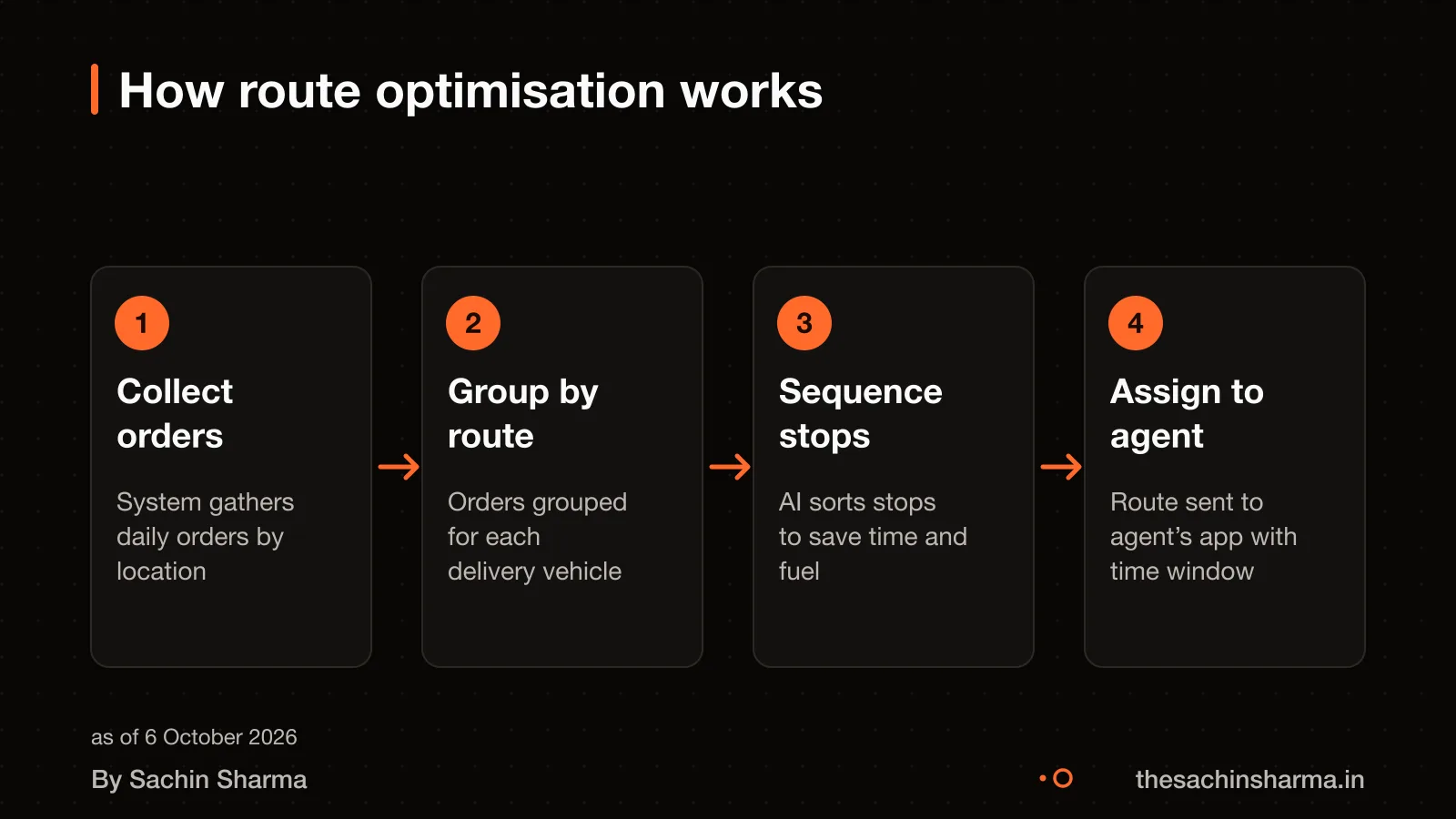
Building custom route optimisation adds significant cost to your app. As an estimate, developing a basic route planner from scratch can take 3 to 4 weeks of developer time. Adding ₹3 to 4 lakh to the project. This is because it must handle daily milk runs, missed deliveries, dynamic stop reordering, and driver assignments. You also need live tracking, route locking, and offline sync for areas with poor signal.
You can avoid this cost by using a third-party tool instead. Several tools offer ready-made solutions. Spoke Dispatch starts at $125 per month for up to 1,000 stops. Routific has a free tier for low volumes and charges $150 per month for 200 to 1,000 orders. RouteXL offers a free plan for up to 20 stops per route, with paid plans around $40 per month. Mid-tier tools typically cost $29 to $65 per vehicle each month.
Using a third-party service cuts your upfront cost and speeds up launch. For most small dairies, this is the smarter choice. Custom development only makes sense if you have unique routing rules, very high volume, or plan to resell the software. Otherwise, buy rather than build.
How to build a milk delivery app
UPI, auto-billing and digital wallet costs
A production-grade UPI integration costs ₹1,00,000 to ₹3,00,000, while a minimal checkout-only version starts at ₹30,000. The higher cost covers not just the payment button, but also webhooks, refund handling, transaction reconciliation, and admin views for tracking payments. UPI is the default payment method in India and must be added through licensed payment aggregators like Razorpay, PayU, Cashfree, or PhonePe. These platforms offer APIs that speed up integration and ensure compliance with NPCI rules.
A minimal integration only supports one-time checkout and lacks automation for recurring billing, which is not enough for a milk subscription model. For daily or weekly deliveries, you need auto-billing that triggers payments on schedule, retries failed UPI transactions, and logs each attempt. This requires backend logic, failure alerts, and customer notifications, all of which raise the cost.
Razorpay and Cashfree are the most common choices for startups because of their reliable APIs and faster onboarding. However, setting up any of them requires business KYC, which can take 3 to 10 working days before testing begins. Digital wallets like PhonePe or Google Pay are built on UPI and do not need separate integration.
The cost does not include ongoing transaction fees, which are typically 2-3% per successful UPI payment, charged by the payment gateway.
Cost of a quick commerce app with UPI
Have a quote for UPI integration? Send it to me and I will mark what is missing.
Message me on WhatsAppHow long does it take to build?
A milk and dairy delivery app takes 2 to 3 months for an MVP. 3 to 4 months for a standard version, and 4 to 6 months for an advanced platform. The timeline depends on how many features you include, especially around subscriptions, routing, and payments. An MVP focuses on core functions like user sign-up, order scheduling, and basic admin tracking. A standard app adds delivery agent tools and UPI payments. An advanced version includes route optimisation, pause/skip options, and multi-dairy support.
UPI integration alone adds 3 to 6 weeks to the schedule. This delay comes from technical work and approval steps. The development part, coding the payment flow, testing refunds, and handling failures, takes 2 to 4 weeks. On top of that, merchant KYC verification with the payment gateway takes 3 to 10 working days. You cannot skip this. The gateway must confirm your business details before enabling live transactions. Delays often happen if documents are incomplete or if there is back-and-forth with the provider.
For example, a standard app with UPI would take about 4 to 5 months: 3 to 4 months for the app plus 3 to 6 weeks for UPI, with some overlap. You should plan the UPI work early, even if you go live without it. Start the KYC as soon as you have your business registration and bank account.
Full timeline for a dairy delivery app
Legal and compliance costs
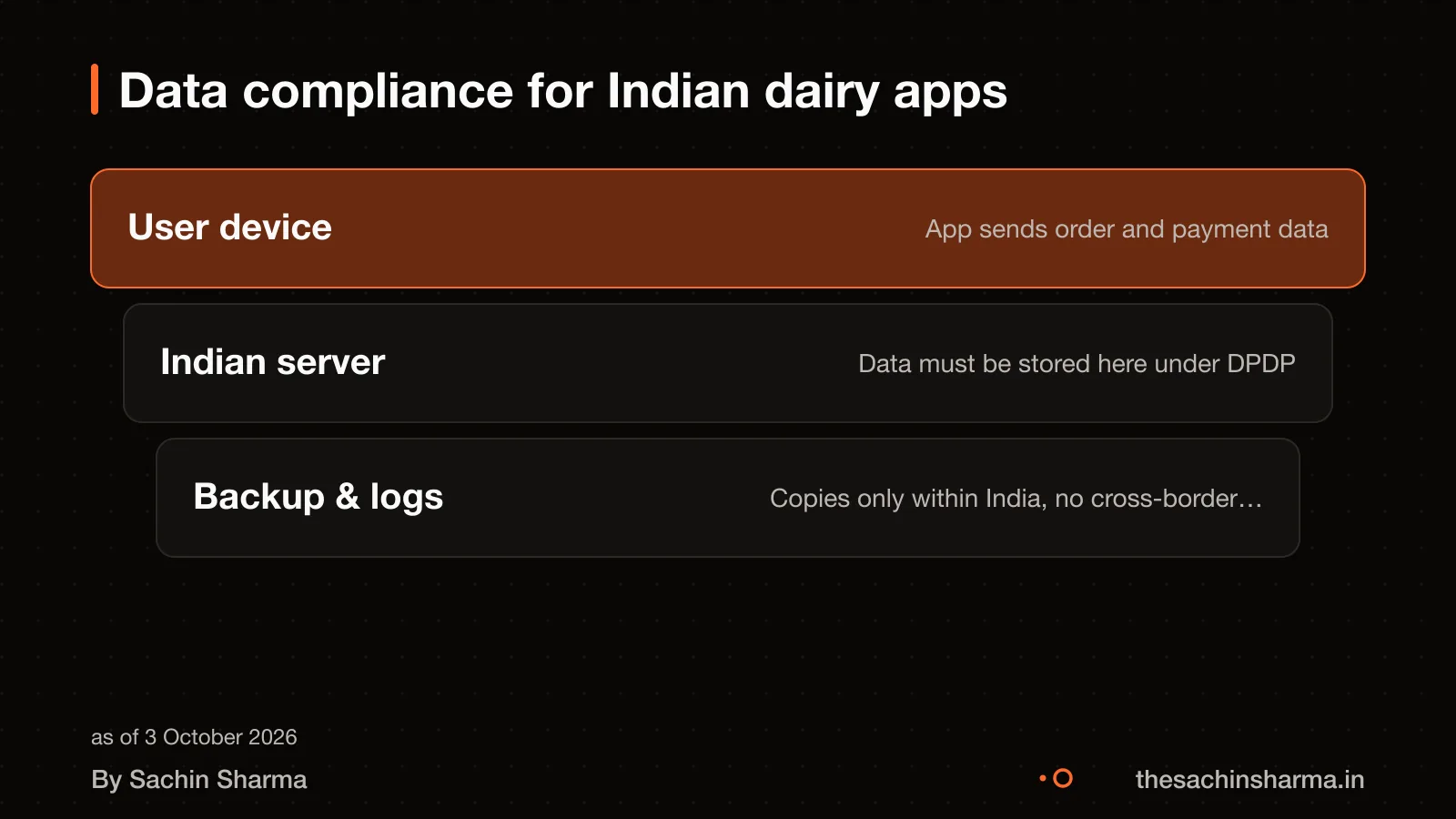
You must store all payment and transaction data within India and purge foreign copies within 24 hours. Non-compliance can lead to penalties up to ₹1 crore under the Payment and Settlement Systems Act, 2007. This rule applies to all digital payments in your app, including UPI, cards, and wallets.
PCI DSS v4.0.1 became fully enforceable on 31 March 2025, making strict security controls mandatory for any system that handles card data. If your app stores, processes, or transmits card details, you must meet these standards. Most dairy apps avoid this cost by using payment gateways like Razorpay or Paytm, which handle PCI compliance on your behalf.
For the Digital Personal Data Protection (DPDP) Act, there is no fixed cost for compliance. As an estimate, assuming 40 hours of developer and legal work to add consent logs. Data access forms, and breach alerts, the cost could be ₹80,000 to ₹1.2 lakh. This depends on your app’s size and how much user data it processes.
India-only data storage means your servers must be located in the country. Cloud providers like AWS, Google Cloud, and Azure offer Indian regions, but you must configure them correctly. Misrouting data, even briefly, can break compliance.
The cost of implementing FSSAI audit logs is not known. You should consult a legal advisor or compliance expert to determine what records you must keep and for how long.
App maintenance cost after launch
The annual maintenance cost is 15 to 20% of the app’s development cost. For example, if your app cost ₹10 lakh to build, expect to pay ₹1.5 to ₹2 lakh every year to keep it running smoothly.
You may also need a monthly retainer for ongoing support. In India, these range from ₹15,000 to ₹80,000 per month. This is useful if you want fast fixes or small feature updates.
Two key costs are fixed. Apple charges ₹9,500 per year for developer access. Google Play has a one-time registration fee of ₹2,400. You must budget for both if you publish on iOS and Android.
Apps must also keep up with platform rules. As of 31 August 2026, new apps and updates on Google Play must target Android 16 (API 36). Apps on older versions (API 34 or lower) are hidden from new users on newer Android devices. This means regular updates are not optional, they are required to stay visible.
When a custom app is not worth it
Start with WhatsApp or spreadsheets if you serve fewer than 200 customers or deliver to one locality. At this scale, a custom app is not worth the cost. Tools like Upper Solo can manage routes and deliveries for small dairies without custom software. You can track subscriptions, payments and delivery status manually or with shared sheets.
A custom app makes sense only when you cross 500 active subscribers or operate in multiple areas with complex delivery routes. Until then, the return on investment is low. White-label apps cost $5,000 to $15,000 and launch in 2 to 4 weeks. They offer basic subscription and routing features without the cost of custom development.
If your business is growing steadily but still under 500 users, consider a white-label solution instead of a custom build. It gives you an app faster and cheaper, with room to upgrade later.
Next step: message me on WhatsApp with what you want to build. No forms, no sales team.
Message me on WhatsAppAssumptions behind the numbers
- 500 daily orders
- 10 delivery agents
- Production UPI with server-side events
- Mid-tier route tool at $45/agent/month
- One admin panel and two user roles (farmer, customer)
- Android-only launch
- No offline mode
- Basic SMS alerts only
Work out your own number
I won't hand you a number that pretends to be the market. Instead, here is the working: set the weeks, the people and the rate, and see where the money goes.
Your working total
₹4,40,00011 weeks × 2 people × 5 days × ₹4,000- Scope and design18%
- Build55%
- Testing and fixes18%
- Launch and stores9%
The weeks shown are an example of a small app, there to be changed. Fees you pay others (store accounts, cloud, SMS) are not in this total.
What moves the price
- Subscription logic
Auto-renewals, pause/resume, prorated billing add backend scope.
- Route planning tool
Mid-tier plans cost $29 to $65 per agent monthly.
- Production UPI
Server-side events, reconciliation, fraud checks cost ₹1,00,000 to ₹3,00,000.
- iOS version
Adds 40-60% to base cost.
- Manual route planning
Skip the tool cost if agents call in daily routes.
- Staggered rollout
Start with billing only, add tracking later to save weeks.
Fees that go to someone else
Google Play registration
One-time ₹2,400 fee.
Apple Developer Program
Yearly ₹9,500. Needed only if iOS is built.
Payment gateway MDR
0.4% to ₹300 per transaction after ₹2,000. Billed by provider.
Ask for these before you sign
- Is subscription logic worth the extra cost?
- Can I start without route planning?
- What compliance do I need if I store no card data?
- How much does UPI integration really vary?
- Should I build iOS from day one?
Questions people ask
01Which components drive the cost of a milk and dairy delivery app?
The top cost drivers are route planning, UPI integration, and subscription logic. Custom route planning can add ₹3 to 4 lakh. A full UPI integration costs ₹1,00,000 to ₹3,00,000. Daily subscriptions need constant sync and state checks, increasing backend complexity.
02Where do estimates for a milk and dairy delivery app usually go wrong?
Estimates fail when exception paths, scope clarity, and compliance are missing. A developer who has not mapped escalation logic is quoting an incomplete system. A credible quote must list workflows, data sources, and post-launch support.
03What can be cut without hurting the product?
Start with minimal UPI integration from ₹30,000, use basic route tools like Routific (free under 100 orders/month), and delay non-core features. A white-label app can launch in 2 to 4 weeks for $5,000 to $15,000.
04How much does it cost to add pause and skip to subscriptions?
The cost impact is not known, but the complexity comes from state management and billing sync. Each change in subscription state must update delivery schedules and payment plans. You should ask your developer to break down this logic before agreeing to a quote.
05Is Flutter better than React Native for a dairy app?
No evidence shows a performance difference for dairy apps. Both Flutter and React Native are viable. The choice depends on your developer's team and experience. For a delivery app, focus on offline support and GPS tracking, which both frameworks can handle.
06Can I integrate regional languages into the app?
Yes, you can integrate regional languages. UPI processes over 13 billion transactions monthly. But adding languages increases translation and testing effort. Plan for extra time and quality checks.
07What happens if the app fails after launch?
Apps that crash on launch may be removed from the App Store. If flagged later, you have 90 days to update. Current users keep access and can make purchases. Test thoroughly before release to avoid removal.
08How do I check if a developer's quote is fair?
A fair quote defines what is built, what success looks like, and post-launch support. It lists workflows, system links, and data sources. If exception paths are missing, the quote is incomplete.
09Do I need to store GST invoices for every transaction?
Yes, you must auto-generate and store GST invoices for every transaction. Section 83 of the CGST Act, 2017, along with Rule 159 of the CGST Rules. 2019, provide provisions for the provisional attachment of property, including bank accounts. Check this for your case with a chartered accountant.
10Who owns the app after development?
Google requires an official tool for Play Store ownership changes starting May 27. Unofficial transfers like sharing credentials are not allowed. Confirm the transfer process in your contract.