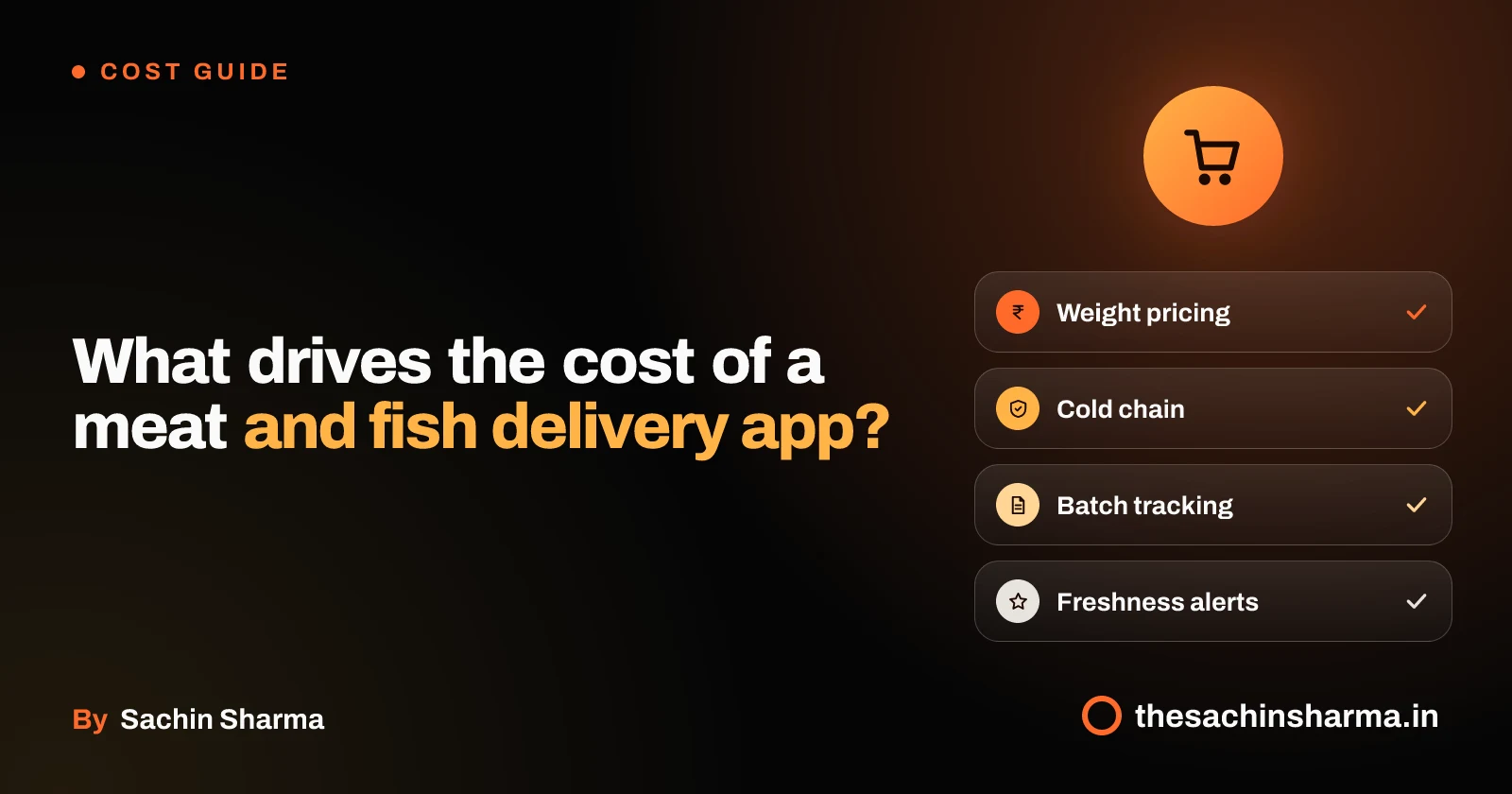
What is a meat and fish delivery app?
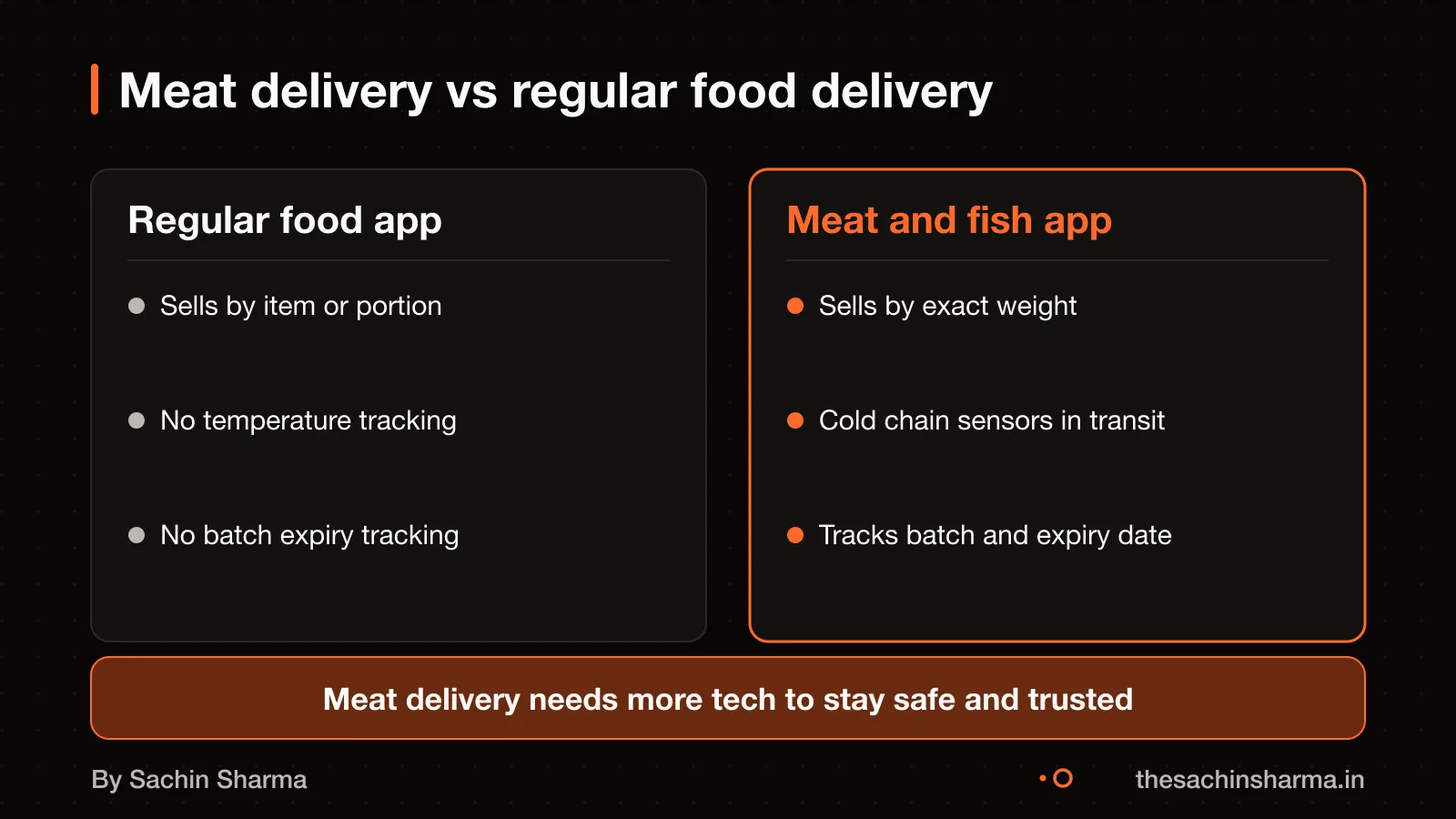
A meat and fish delivery app lets you sell fresh meat and seafood directly to customers through their phones or computers. Unlike regular food delivery, these apps handle perishable items that spoil quickly and vary in weight, making them harder to manage. Selling by weight is common for cuts like chicken or fish, as each piece differs in size. The app must track weight, freshness, and cold storage to ensure quality. It often links customers to local butchers or farms for fresh supply. This focus on freshness, accuracy, and speed makes it more complex than standard food delivery. For a full list of features, see the must-have features for meat and fish delivery apps.
Custom app vs white-label: what costs less?
A white-label app costs less and launches faster than a custom build, but may not handle weight-based pricing or cold chain tracking well. You can start for $5,000 and go live in 2 to 3 business days with a white-label solution. These apps include customer, partner, store, and admin modules, and support scheduled deliveries and subscriptions. However, most white-label systems are built for standard retail, not meat and fish, so selling by weight often needs workarounds. You can start simple and add cold chain features later, but retrofitting risks spoilage and customer complaints. Licious, TenderCuts, and FreshToHome are working examples in India that manage freshness, weight, and cold chain at scale. If you need full control over logistics and branding, a custom app is better, but more costly. For a faster, low-cost start, white-label is an option, but check if it supports your core needs. Compare your options before deciding build or buy a meat and fish delivery app.
What drives the cost up?
A meat and fish delivery app has features like cold chain tracking, batch inventory, and real-time features that add cost. These features make the app expensive because they require custom backend logic, sensor integration, and precise UI flows. For example, showing live weight and price during packing needs real-time sync between staff devices and customer screens.
Hidden costs come from design and real-time systems. Custom animations, branded design systems, and complex onboarding add 20 to 40% to the design budget. Real-time features like GPS tracking and live chat increase server costs by 25 to 50% because they need a more complex backend. A simple grocery app does not need this level of sync, so it stays cheaper.
This is not just due to features but also compliance, testing, and integration with cold storage systems. The cost of on-demand meat delivery app development ranges from $20,000 to $80,000 based on features, platform, and complexity.
The need for a detailed digital inventory also adds cost, as each batch must be tracked by expiry, weight, and storage conditions. This goes beyond standard stock management and requires custom workflows for staff and admins.
Want a number for your idea? Send one line on WhatsApp. I reply with what drives the cost and what to cut.
Message me on WhatsAppSelling by weight: why it adds cost
You cannot sell meat and fish by piece because sizes vary, so pricing by weight ensures fair cost for both you and the customer. Selling by piece would mean some customers pay less for more meat, and you lose money on larger cuts. To price by weight, your shop needs integrated digital scales that connect to the app and update prices in real time. These scales must record the net weight after subtracting the container’s tare weight, then send that data to the billing system.
This setup adds hardware and software cost. Off-the-shelf platforms like Shopify do not support tare-based weight pricing without custom plugins, which raises development time and testing. In the customer app, weight-based pricing means each order shows real-time cost based on actual cut weight, not a fixed price. For example, if a customer orders 500 grams of chicken thighs. The final price depends on the exact weight of the selected batch, shown just before checkout.
This transparency builds trust, but requires tight sync between scale, inventory and app. Any delay or error can lead to incorrect billing or stock mismatches. To see how this fits into the full build process, read how to build a meat and fish delivery app.
Batch inventory for perishables
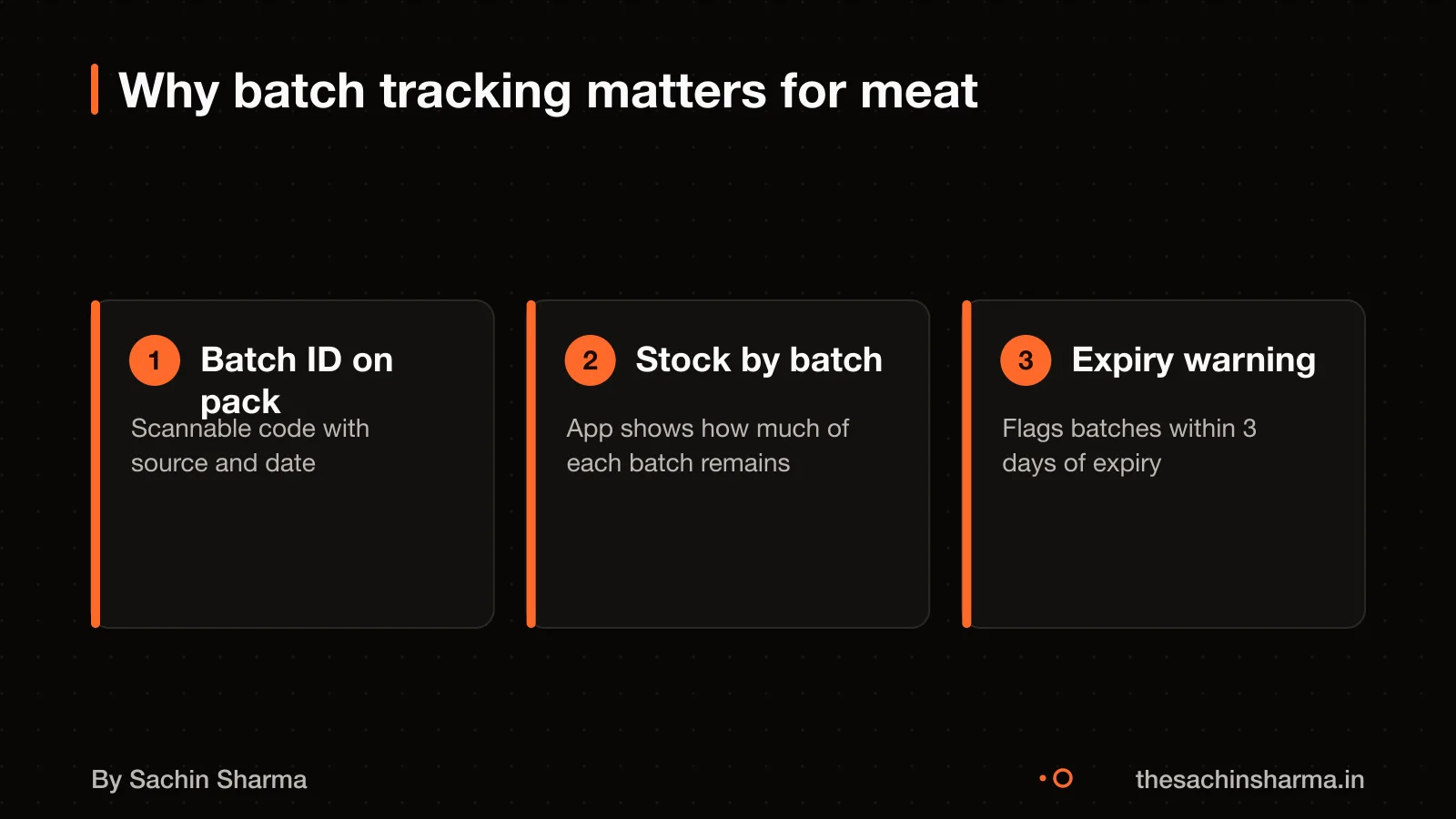
Tracking meat and fish inventory is harder than regular stock because each batch has a unique expiry date and decays over time. You must track not just how much you have, but which cut came from which delivery and when it expires. This is called batch inventory, and it helps you sell older stock first and avoid waste.
In practice, each incoming shipment is logged as a separate batch with a cut date, source, and expiry estimate. When a customer orders, the system assigns the oldest suitable batch, this is known as FIFO (first in, first out). Tracking inventory helps ensure accurate stock levels and easier fulfillment. For example, a batch of chicken delivered on 10 March with a 7-day shelf life should be flagged as unsellable by 17 March. Without this, your staff might pack it on 18 March, leading to a bad delivery.
Cold chain monitoring: sensors and alerts
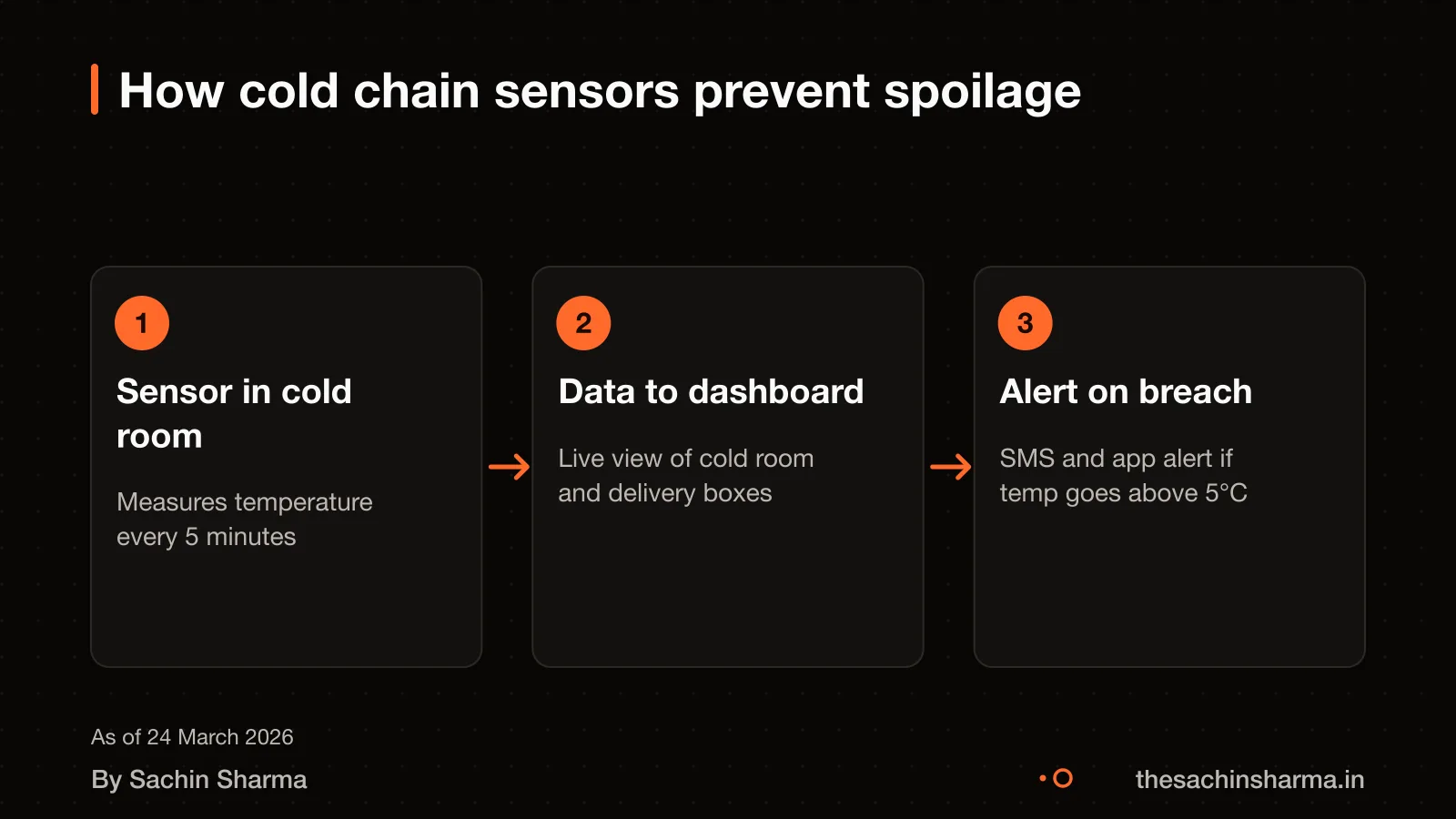
IoT sensors can help prevent spoilage of sensitive goods by maintaining stable moisture conditions during transport and storage. These sensors monitor humidity levels in storage and transit in real time. They help detect early signs of moisture imbalance that could lead to condensation, corrosion or microbial activity.
Alerts are built into the app by connecting the sensors to a central monitoring system via Wi-Fi or cellular networks. When readings go outside safe ranges, the system triggers automatic alerts to staff through the app, SMS or email. This allows quick action, like adjusting refrigeration or rerouting a delivery. Using resistive-type sensors keeps hardware costs lower than high-end alternatives.
For compliance with food safety codes like HACCP, logs from these sensors must be stored and reviewable. The app can display live data on a dashboard for managers and generate daily reports. While not all small sellers are legally required to have this today, having it builds customer trust and reduces loss from spoiled stock.
You can learn more about how cold chain tracking works as a feature in practice cold chain tracking feature.
Freshness tracking: time and temperature
Fresh fish must be placed in refrigerated chambers or freezers immediately after capture to maintain 0 to 5 °C. Frozen fish must remain at, 18 °C or colder. These ranges prevent spoilage and meet safety rules. Regulatory frameworks like HACCP, Good Manufacturing Practices (GMP) and Sanitation Standard Operating Procedures (SSOP) require documented temperature control and regular monitoring.
The app can show customers a freshness stamp. This stamp includes when the item was packed and its current temperature history. It builds trust by proving the cold chain stayed intact.
If the cold chain breaks, the system flags the batch at once. You can alert the customer, offer a refund or replace the order. Continuing delivery risks food safety and your reputation. Logs from sensors help you prove compliance if questioned.
Ongoing costs and maintenance
You should spend 15 to 20% of the original development cost each year on maintenance. This includes bug fixes, security updates, feature tweaks, and compatibility with new phone or OS versions. For example, if your app cost ₹10 lakh to build, set aside ₹1.5 to ₹2 lakh per year for upkeep.
App store fees are separate: Apple charges $99 per year for a developer account, and Google Play requires a one-time $25 fee. These are not included in the 15 to 20% maintenance range.
Simple apps take 4 to 6 weeks to develop in India. More complex enterprise platforms with full cold chain, batch tracking, and admin panels can take 4 to 6 months. A white-label app can go live in 2 to 3 business days but offers less control.
FSSAI, ownership and state rules
Yes, you need FSSAI registration for your meat and fish delivery app. It is mandatory for all food businesses to ensure safety and compliance. Without it, you cannot legally operate. The registration process is online and includes compliance checks and food safety training.
The current GST rate for meat and fish delivery is not specified in the evidence. You should consult a tax professional for your specific case.
Beef is banned in several Indian states. Delhi, Gujarat, Haryana, Himachal Pradesh, Jammu and Kashmir, Jharkhand, and Maharashtra all prohibit the slaughter, sale, or possession of beef to varying degrees. You must check local laws before offering beef, even if sourced from outside the state.
By default, the developer owns the app’s copyright, not you. This means they legally control the source code unless ownership is formally transferred in writing.
You should own seven things: the source code, Google Play and Apple developer accounts, the domain name. Backend servers and databases, third-party accounts and API keys, and the copyright or intellectual property.
To transfer an app on Apple’s App Store, turn off TestFlight beta testing and remove all Xcode Cloud data before starting. Google Play has a similar transfer process.
Have a quote in hand? Send it to me and I will mark what is missing.
Message me on WhatsAppWorked example: cost breakdown by feature
As an estimate, the total cost of a meat and fish delivery app is ₹4.5 lakhs. This includes a base app at ₹2 lakhs, cold chain tracking at ₹1 lakh. Weight-based pricing at ₹0.8 lakh, and batch inventory management at ₹0.7 lakh. These figures assume a single-platform MVP (Android or iOS), basic UI/UX, and no advanced real-time features beyond core functionality. Each feature adds cost because it requires custom development and integration with hardware or complex logic.
The base app cost covers user registration, product listing, cart, checkout, and order tracking. Cold chain monitoring may increase server-side costs by 25 to 50% due to real-time features like GPS tracking and notifications. Weight-based pricing increases cost due to scale integration, dynamic pricing logic, and precise billing systems. Batch inventory adds cost to track expiry dates, manage FIFO (first in, first out), and reduce waste from spoilage. Specific figures are not available in the evidence.
These are estimates based on typical MVP scopes for perishable goods delivery in India as of 2026. They do not include design customisations, multi-platform builds, or ongoing maintenance, which could add 15 to 20% annually. Real costs may vary based on team rates, location, and feature depth.
When this app is not worth it
Do not build a custom meat and fish delivery app if you sell under 50 kg per day or lack refrigerated storage and transport. The app’s cost is hard to justify at small scale, and spoilage risk rises without full cold chain control.
Using platforms like Blinkit or Swiggy Instamart may be better if your volume is low or you want to test demand first. These services already handle logistics, so you avoid upfront tech costs.
Many developers fail by treating this like a grocery app. They skip batch expiry tracking or assume weight is fixed, leading to losses. Ask any developer you hire: “How will your system track each cut’s weight, temperature history, and expiry?” If they do not mention batch-level tracking or sensor alerts, they do not understand the problem.
Next step: message me on WhatsApp with what you want to build. No forms, no sales team.
Message me on WhatsAppNext step
Next, define your core features clearly: weight-based pricing, batch tracking, cold chain alerts and FSSAI-compliant invoicing. Get at least three quotes from developers who have built perishable-goods apps. Test demand by offering pre-orders through a simple WhatsApp or Instagram catalog before building. This cuts risk and shows what customers really want.
Related reading: cost to build a grocery delivery app, timeline for meat and fish delivery app.
Next step: message me on WhatsApp with what you want to build. No forms, no sales team.
Message me on WhatsAppAssumptions behind the numbers
- MVP duration: 4–6 weeks
- Team location: India
- Core features included: cold chain, weight pricing, batch inventory
- Developer rate: as of 2026, Indian agency rates
- No third-party licensing beyond standard app store fees
Work out your own number
I won't hand you a number that pretends to be the market. Instead, here is the working: set the weeks, the people and the rate, and see where the money goes.
Your working total
₹4,40,00011 weeks × 2 people × 5 days × ₹4,000- Scope and design18%
- Build55%
- Testing and fixes18%
- Launch and stores9%
The weeks shown are an example of a small app, there to be changed. Fees you pay others (store accounts, cloud, SMS) are not in this total.
What moves the price
- Cold chain tracking
Real-time temperature monitoring adds design and backend work.
- Weight-based pricing
Integrating scales and dynamic labels increases complexity.
- Batch inventory
Perishable stock tracking needs custom logic and reports.
- Cutting to one platform first
Starting with one clear flow can be half the work.
- Using managed services
A managed backend for login and data removes weeks.
- A clear scope up front
Changes mid-build are the most expensive weeks.
Fees that go to someone else
Google Play developer account
A one-time registration fee, paid to Google. Check the current amount.
Apple Developer Program
A yearly fee paid to Apple. Check the current amount.
Cloud, SMS, maps, payments
Usage-based, billed by the provider to you.
Ask for these before you sign
- How many weeks per phase, and with how many people?
- What is not included?
- Which fees do I pay to others directly?
- What happens to the price when I change my mind?
- What does the first month after launch cost?
Questions people ask
01Which components drive the cost of a meat and fish delivery app?
Cold chain tracking, weight-based pricing, batch inventory, real-time GPS and custom design raise costs. Start with a white-label app to reduce initial spend.
02Where do estimates for a meat and fish delivery app usually go wrong?
Estimates often miss annual maintenance, marketing and real-time server costs. Plan for 15 to 20% of dev cost yearly for maintenance and add 25 to 30% for marketing and fees.
03What can be cut without hurting the product?
Use a white-label app instead of custom build, skip custom animations and delay subscriptions. These cuts save cost and time but keep core functions like delivery scheduling.
04How much more does a meat app cost than a grocery app?
The extra cost comes from cold chain, weight tracking and batch management.
05Do I need IoT sensors for cold chain?
IoT sensors can monitor humidity in real time to help prevent spoilage.
06Can I use Shopify for meat delivery?
Shopify is not built for weight-based sales and may require workarounds. Workarounds are complex. GrazeCart is built for butchers and farms selling by weight.
07What happens if the app fails to track freshness?
Spoiled meat can reach customers, causing complaints, lost trust and FSSAI non-compliance. Manual checks are slow and error-prone.
08How do I verify the app before launch?
Use real staff and equipment to catch issues early.
09Can I move the app to another developer later?
Yes, you can transfer the app if you own the source code and developer accounts. For iOS, turn off TestFlight and remove Xcode Cloud data before transfer.
10Is a meat delivery app suitable for a small business?
Using platforms like GrazeCart is an option for businesses not ready to build an app.