What is a bike taxi app and how is it different?
A bike taxi app helps you book a two-wheeler ride on demand, often for shorter, faster trips in heavy traffic. Bike taxis can move through traffic more easily due to their size.. Unlike car taxi apps, bike taxis are lighter, use less fuel, and can weave through jams.
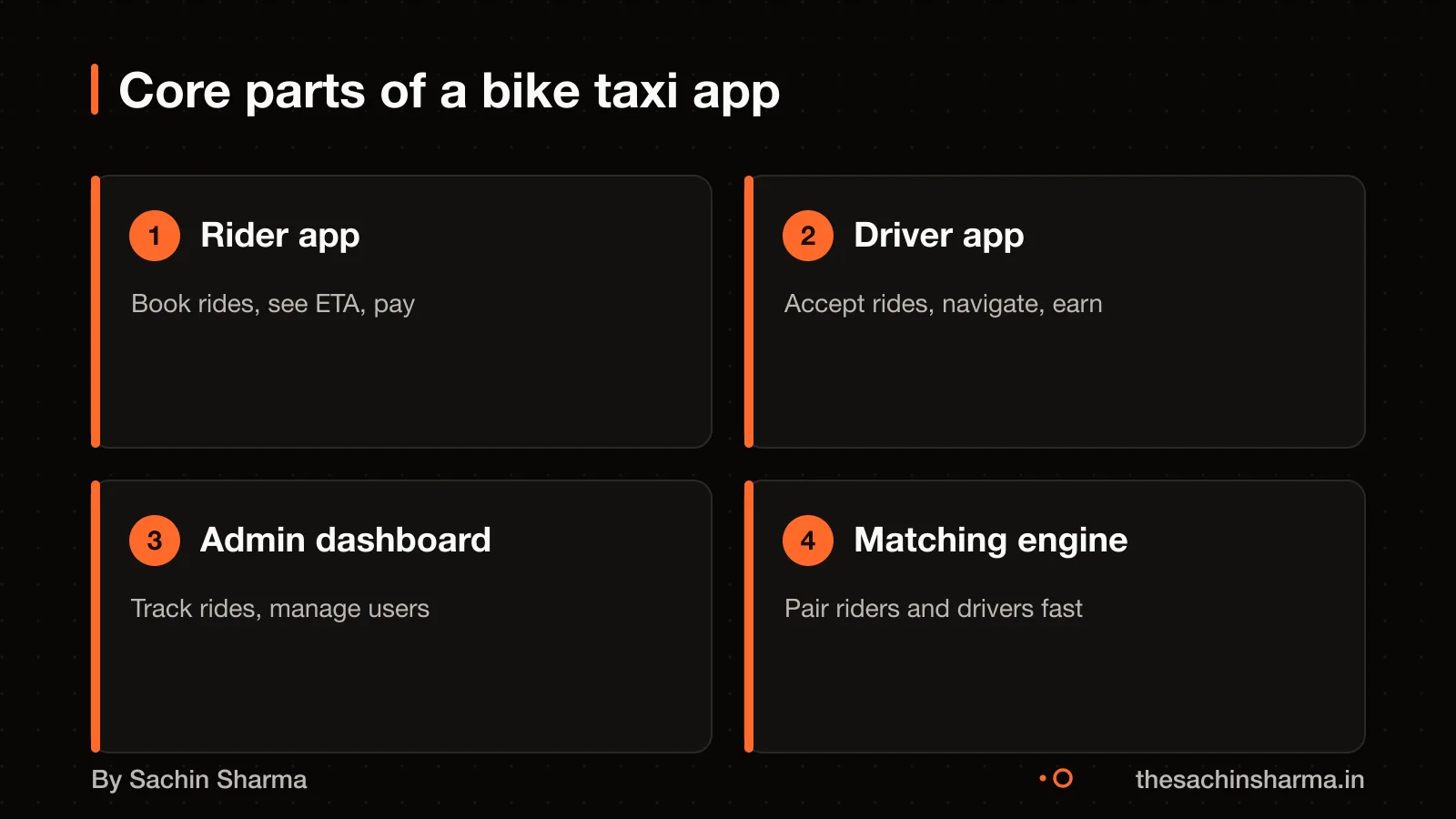
The core parts include a rider app, a driver app, and a backend system. Riders enter pickup and drop points, see an estimated fare, choose a ride, and track the driver in real time. Drivers get alerts, accept rides, and navigate to pickups. The backend matches rides, calculates fares, and manages trips. Some apps, like Bharat Taxi, offer outstation, round trips, and rentals..
Some apps support local transfers, one-way drops, and custom packages across cities..
What features does a bike taxi app need?
Build custom or buy a white-label app?
A white-label app is a ready-made bike taxi app that you brand as your own. It costs less and launches faster than a custom build. Custom apps are built from scratch for your exact needs. They offer full control over features and design.
White-label apps cost $20,000 to $60,000. Custom builds cost $100,000 or more, based on feature complexity.. The white-label option suits non-technical owners with tight budgets. You trade control for speed and lower cost.
Choose a white-label app if you want to start fast and keep costs low. It works well for testing demand in one city. Choose custom if you need unique features, want to scale across states, or plan to raise investor funds. Custom apps let you own the code and adapt quickly.
Both options use third-party services for maps, payments and SMS. These costs are similar in both models. The real difference is in control, long-term cost, and ability to change.
Build or buy a bike taxi app: custom, white-label or platform? compares all three options.
What features add the most cost?
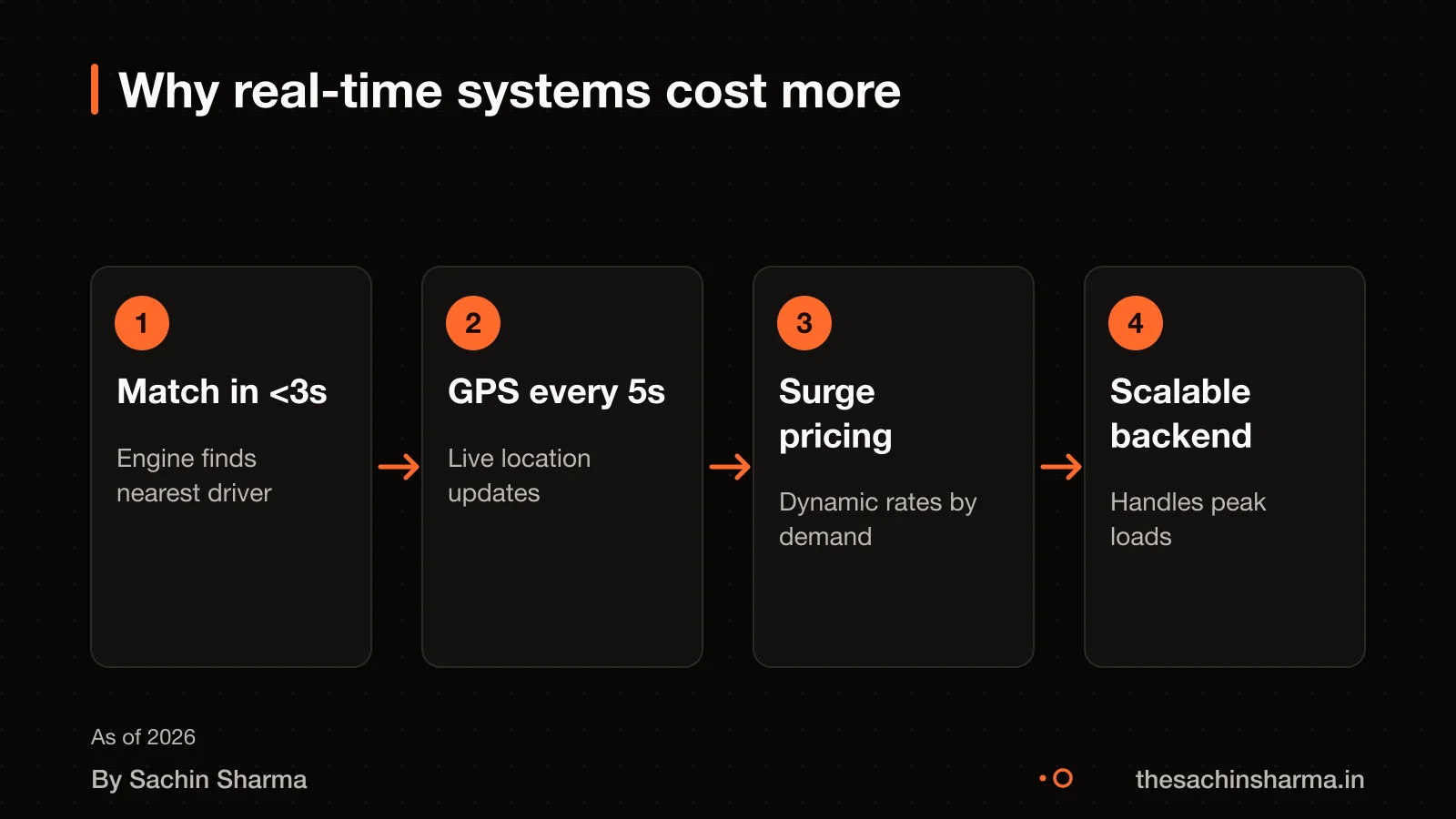
Real-time systems like driver matching, GPS tracking and dynamic pricing add the most cost. These features need complex backend services that must respond within seconds at scale. The matching engine decides in under 3 seconds.. This demands high-performance infrastructure and precise logic. Apps without core features risk 40% churn in the first month..
The pricing service calculates fares and applies surge logic based on demand, traffic and supply. This real-time pricing and surge system is part of what pushes mid-market platforms to cost between $55,000 and $95,000. At the enterprise level, with machine learning matching and full analytics, costs rise to $110,000 to $200,000. These systems are expensive because they run continuously, handle large volumes of data, and must be highly reliable.
For example, a rider booking a ride expects immediate confirmation, live tracking, and a fare that updates in real time. Delivering this means building six core services: matching, location, pricing, trip management, payments, and notifications. Each runs as a separate but linked system. This increases development and testing effort.
Skipping any of these risks poor user experience and high churn. A basic app without real-time systems may lead to poor user experience and high churn. As an estimate, real-time pricing and surge logic alone could make up 15 to 20% of a mid-market platform’s cost. This is roughly $8,250 to $19,000.
You can reduce cost by limiting cities or using simpler pricing models. But if you plan to scale, these systems are not optional. For a reliable, scalable app, real-time logic is essential.
Best tech stack for a bike taxi app in India
What do third-party services cost?
Third-party services add recurring costs. Maps, payments, and hosting are not one-time fees but ongoing expenses. Google Maps API costs about $5,000 per year for a mid-sized app. Hosting on cloud platforms like AWS or Google Cloud ranges from $500 to $2,000 per month for 10,000 users. Payment gateways such as Razorpay or Stripe charge 2 to 3 percent per transaction, which grows with volume.
These are recurring costs, not one-time payments. Hidden costs include scaling during peak demand, API overuse charges, and compliance updates. For example, if your app surges in usage during monsoon season, server costs may jump without auto-scaling controls. Annual maintenance for updates, security patches, and feature tweaks adds another 15 to 20 percent of the initial build cost each year.
GST at 18 percent applies to the development and maintenance services you pay to developers or agencies. You must issue GST-compliant invoices if you are registered. Retain all records for 72 months as per GST rules. For tax certainty, consult a chartered accountant familiar with software projects.
As an estimate, assuming a ₹50 lakh app build, annual third-party and maintenance costs could reach ₹12.5 lakh: ₹3.6 lakh for hosting. ₹6 lakh for maintenance, and ₹2.9 lakh for maps and transactions. These costs rise with scale.
Want a number for your idea? Send one line on WhatsApp. I reply with what drives the cost and what to cut.
Message me on WhatsApp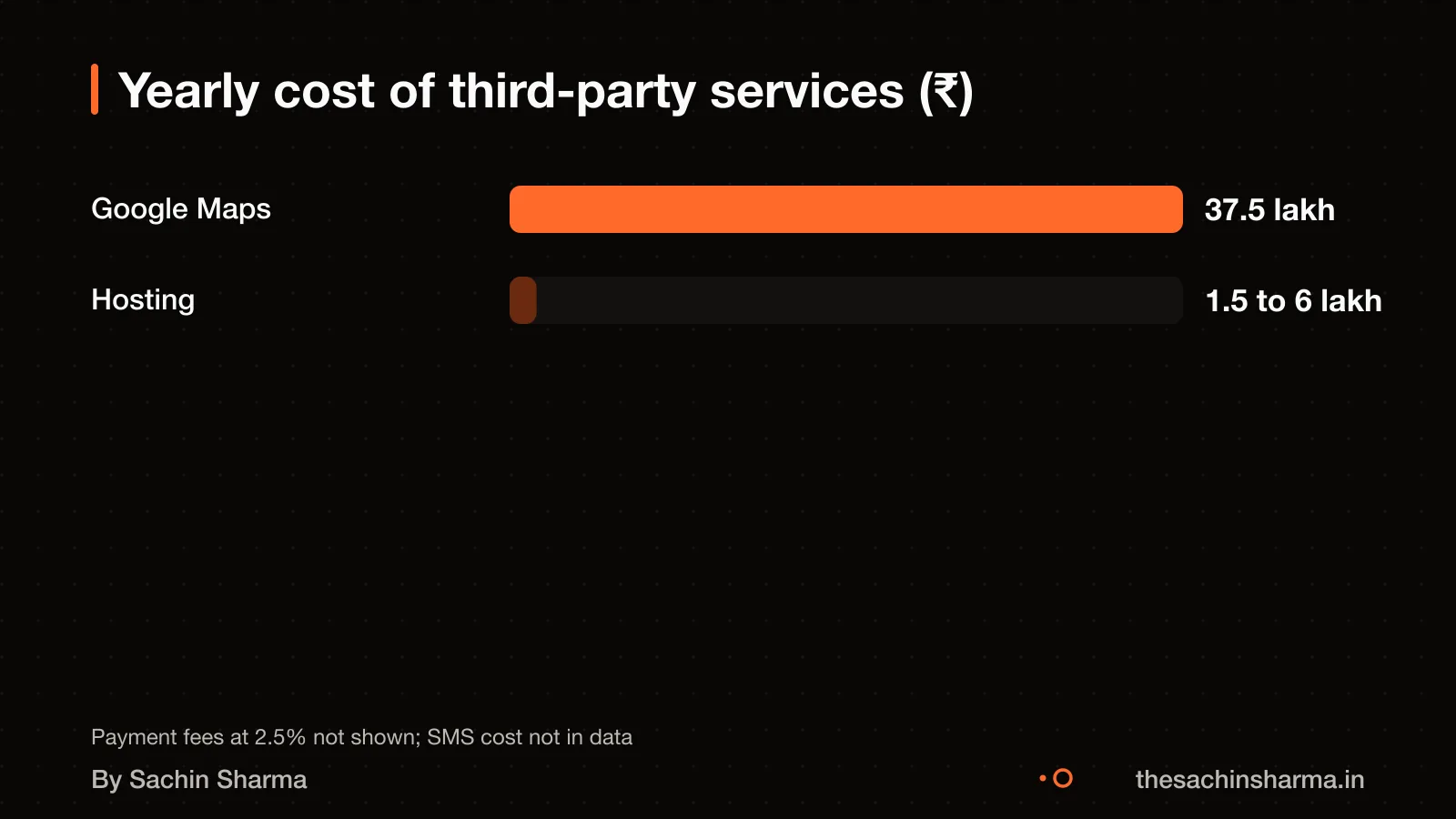
How long does it take to build the app?
A full custom app takes 6 months or more. White-label solutions can launch in 2 to 4 months. The timeline depends on whether you build from scratch or use a pre-built system. Custom development takes longer because every feature is built for your exact needs. White-label apps are faster as they reuse existing code and only need branding and minor tweaks. For example, a startup in tier-2 cities might choose a white-label solution to go live in 10 weeks. But if you need unique features like custom surge pricing or regional language support, expect 6 to 8 months. The complexity of real-time systems, like live tracking and driver allocation, adds the most time. Simple booking and payment flows can be ready sooner. An MVP can be launched in 2 to 3 months with core features only. How long does it take to build a bike taxi app?
Freelancer, agency or in-house team?
Hire a freelancer if your budget is under $30,000. The scope must be clear. You or someone on your team must manage the work. This cuts cost. It avoids agency markups. But you must handle coordination and quality checks yourself. For example, a single developer can build a basic booking app. You must provide exact screens and rules.
Choose an agency if you are a non-technical founder. Your budget is between $30,000 and $300,000. You need design, development, testing and project management done for you. Agencies reduce your workload. They bring tested processes. But they charge more. They are best when you lack time or technical skills to lead the build.
Build an in-house team only if your app is core to your business. You have raised funding. You plan to ship features for years. The first year costs $250,000 to $500,000 before any feature ships. This gives full control and faster iteration. But it only makes sense for long-term, funded ventures.
Each choice has risks. Freelancers may miss deadlines or quit. Agencies can over-promise and under-deliver. In-house teams are expensive and slow to set up. Match your pick to your budget, skills and timeline.
Freelancer or agency for a first app? Pick by situation
Have a quote in hand? Send it to me and I will mark what is missing.
Message me on WhatsAppWhat are the risks and ongoing costs?
Technical risks can break your app if not tested early. A driver-matching system that fails beyond 500 concurrent drivers will crash during peak hours. A GPS tracking system built with polling instead of WebSockets will drain batteries and fail under load. Test these with load testing that simulates real city-scale demand.
Business risks can kill the project even if the tech works. As of 2025, 67% of bike taxi app failures were due to poor liquidity. You can test this early by running a manual matching pilot in one neighbourhood before building the full system.
Ongoing maintenance includes updates and scaling. It typically costs 15 to 20% of the initial build cost per year. For a ₹25 lakh build, ongoing maintenance costs 15 to 20% of the initial build cost annually. This does not include marketing or new feature development.
To check if your real-time systems work, run stress tests with simulated riders and drivers. Use tools to mimic concurrent users. Monitor response times, error rates, and GPS update frequency under load. Fix bottlenecks before launch.
Not sure if your project has this risk? Tell me the plan in two lines and I will say yes or no.
Message me on WhatsAppWhat legal rules apply in India?
Motorcycles are recognised as transport vehicles under the Motor Vehicles Act and are eligible for contract carriage permits. Can be issued contract carriage permits. The Karnataka High Court ruled that an outright ban on bike taxis would be an unreasonable restriction on the constitutional right to carry on trade or profession. However, legality depends on state-level rules and active permits.
In Maharashtra, action has been taken against 60 vehicles with ₹22,000 in fines recovered. Karnataka allows operation under contract carriage rules but enforcement varies. No central law bans bike taxis, but the Supreme Court is reviewing their regulation, so rules may change.
Each state transport department sets its own conditions. You must check if your city’s RTO issues permits for two-wheeler contract carriage. Contact your state’s transport commissioner or review local government orders before launching.
The Digital Personal Data Protection Act, 2023 (DPDP Act) applies to personal data handling. It requires you to protect rider and driver data using methods like encryption, authentication, masking or virtual tokens. The rules come into force 18 months after the date of publication of the notification. Compliance timing depends on when the notification is issued.
To check if your city allows bike taxis, visit your state transport department’s website or contact the regional RTO directly. Rules differ even within states, so local verification is essential.
Worked example: cost for a 1-city MVP
This estimate is based on a minimal viable product (MVP) with core features like user. Driver apps, ride matching, GPS tracking and a basic admin panel. The build takes 2 to 3 months for an MVP.
Here is how the costs break down:
| Cost type | Amount | Source |
|---|---|---|
| Initial development | ₹3 to 6 lakh | |
| Google Maps API (annual) | $5,000 (≈ ₹3.7 lakh) | |
| Payment gateway fee | 2 to 3% per transaction | |
| Annual maintenance | 15 to 20% of build cost |
Assumptions in this example: - The app is built as an MVP with no advanced features like surge pricing, AI routing or multi-city support. - The development team is experienced and delivers on time. - No major redesigns or scope changes occur during development. - The $5,000/year maps cost is for moderate usage; high-volume apps may pay more. - Maintenance includes updates, bug fixes and minor feature additions, not full rewrites.
As an estimate, assuming a ₹5 lakh build cost, ₹3.7 lakh annual maps fee, and 18% maintenance. Your first-year cost after launch would be about ₹5 lakh (build) + ₹3.7 lakh (maps) + ₹0.9 lakh (maintenance) = ₹9.6 lakh. This does not include marketing, driver onboarding, insurance or office costs, which are not published [unknowns].
When this advice is wrong
When this advice is wrong
Do not build a bike taxi app if your budget is under ₹3 lakh. A basic MVP can be built for ₹3-6 lakh in 2-3 months.
Skipping the panic button is not advised, as it may be required for safety compliance. Helmet detection improves rider safety but its cost is not known.
A white-label app is better if you are a non-technical owner with a tight budget or want to test demand quickly. These apps launch faster and cost less than custom builds, though they offer less control.
Also, do not proceed if your city bans bike taxis. While an outright ban may be unconstitutional, some states restrict operations. Maharashtra will launch bike taxi services in August. Check your local transport authority before investing.
Next step: message me on WhatsApp with what you want to build. No forms, no sales team.
Message me on WhatsAppAssumptions behind the numbers
- Build cost is ₹3-6 lakh for core features in one city
- Maps API cost is ₹5,000/year
- Payment gateway fee is 2-3%
- Maintenance is 15-20% of build cost annually
- GST is added at 18%
Work out your own number
I won't hand you a number that pretends to be the market. Instead, here is the working: set the build cost, third-party fees and maintenance rate, and see how GST adds 18%.
Your working total
₹4,00,00010 weeks × 2 people × 5 days × ₹4,000- Build (₹3-6 lakh)60%
- Legal & Safety (extra cost)20%
- Run (15-20% of build cost/year)20%
The weeks shown are an example of a small app, there to be changed. Fees you pay others (store accounts, cloud, SMS) are not in this total.
What moves the price
- Adding a second city
Multi-city logic doubles the backend work.
- Surge pricing or offers
Needs a pricing engine and admin controls.
- Driver app with earnings view
Adds a second authenticated flow and reports.
- Skipping real-time tracking
Removes GPS syncing and map costs.
- Using OTP instead of wallet
Avoids payment gateway setup and fees.
- Launching in one city only
Reduces QA, data and legal complexity.
Fees that go to someone else
Google Maps API
₹5,000/year for rider and driver maps.
Payment Gateway
2–3% per transaction. Billed by provider.
Cloud Hosting
₹500–₹2,000/month depending on users.
Ask for these before you sign
- Is the legal cost included?
- Can I skip real-time tracking?
- What happens if I add a referral program?
- Do I pay GST on top?
- What’s the first month after launch cost?
Questions people ask
01Which components drive the cost of a bike taxi app?
Real-time systems like driver matching, GPS tracking, and dynamic pricing are part of the core services. These include matching, location, pricing, trip, payment, and notification services. Without them, apps risk 40% user churn in the first month.
02Where do estimates for a bike taxi app usually go wrong?
Estimates fail by missing real-time scale and underestimating annual maintenance. Fixing a flawed architecture later costs more than building it right the first time.
03What can be cut without hurting the product?
Skip multi-city support, loyalty programs, and deep analytics to save cost. Focus on core features: driver matching, booking, and live tracking. A basic MVP can be built for ₹3-6 lakh in 2-3 months.
04Can I start with a white-label app and switch later?
Yes, you can start with a white-label app to test demand quickly. But data and branding may not fully transfer to a custom build later. White-label costs $20,000-$60,000, much less than $100,000+ for custom.
05How do I know if my developer is overcharging?
Compare at least three quotes. Take the two highest quotes and average them. Then, take this number and halve it. If a quote is far above this, it may be too high. Developer rates vary by experience and project scale.
06What happens if my app has a data breach?
The Digital Personal Data Protection Act, 2023 (22nd of 2023) is referenced in official notification. Loss of user trust can follow, and in severe cases, the service may be suspended. Check this for your case with a data protection officer or lawyer.
07Do I need to verify driver documents?
Yes, for safety and legal compliance. Use background checks and real-time ID verification. Uber has prevented 3.5 million people from joining or remaining on the platform since 2017, mostly before they ever completed a first trip. Around 70% of rejected applications are rejected at this stage.
08How much does driver onboarding cost?
The exact cost is not known. But onboarding must be fast: if it takes over 15 minutes, drop-off rates rise above 35%. Speed and simplicity are critical to keep drivers from leaving during sign-up.
09Can I skip the panic button or helmet detection?
Skipping the panic button is not advised, as it may be required for safety compliance. Helmet detection improves rider safety but its cost is not known. These features build trust and may reduce liability in emergencies.
10What third-party APIs are needed?
You need maps (Google Maps API), payments (Razorpay or Paytm), SMS (Twilio or MSG91), and KYC (Onfido or Signzy). These add 20-25% to development cost in the form of GPS (Google Maps API: $5,000/year), payments (Stripe/PayPal: 2-3% transaction fees), and push notifications.