What is a car rental app, and how is it different from ride-hailing?
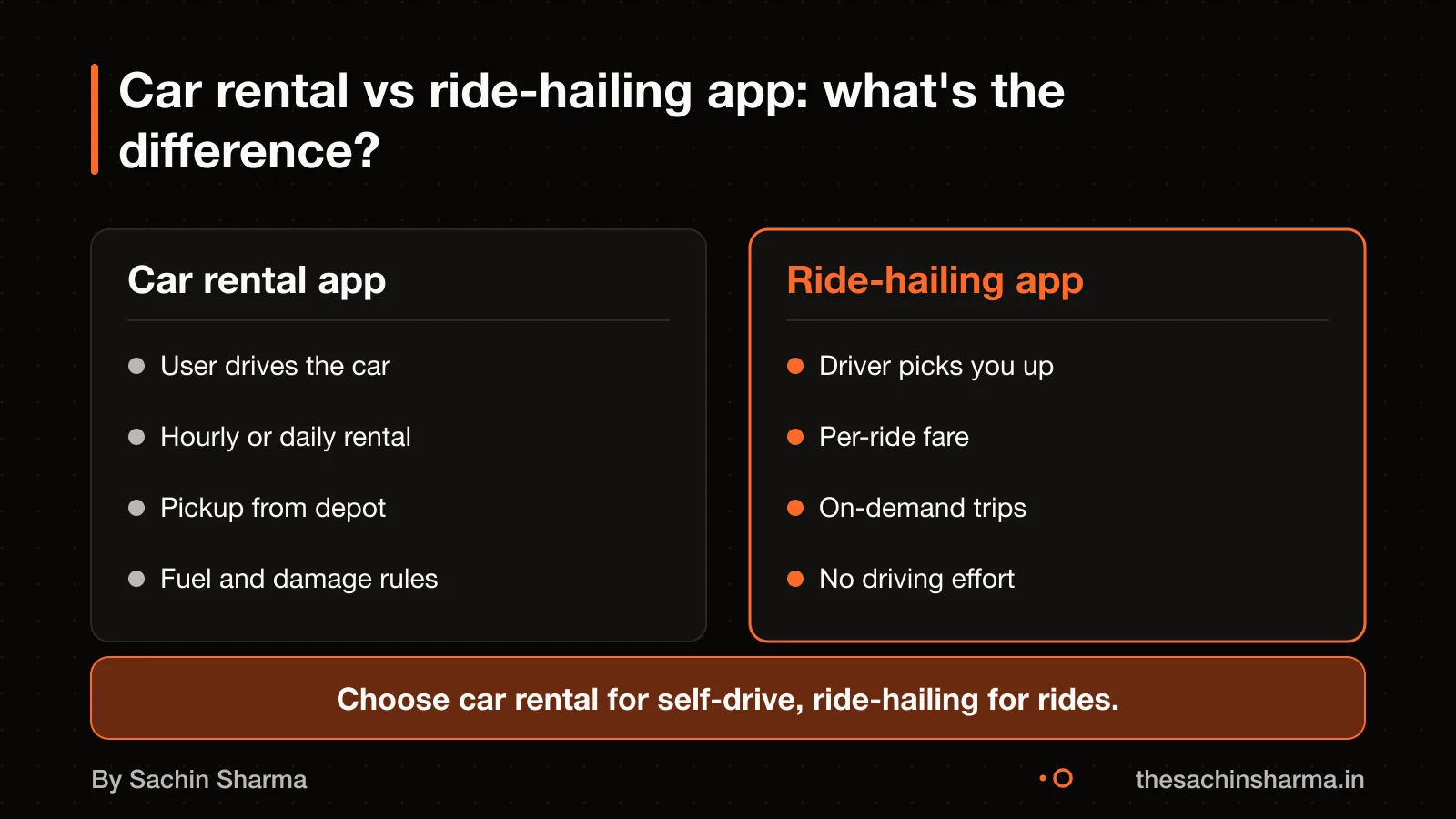
A car rental app lets you book a car for self-driving, unlike a taxi app where a driver comes to you. You pick the car, set the time and place, and drive yourself. The key difference is that you are your own driver, so the app must verify your licence and identity.
Core features include a user account with personal data, driver’s licence, address, and payment details. You must also see available cars, book one, and pay in the app.
This is not a ride-hailing service like Ola or Uber. There is no driver assigned. You open and drive the car yourself. For a full list of must-have features, see Must-have features for a car rental app.
Build or buy: custom, white-label, or platform?
A white-label car rental app is a ready-made product you rebrand and launch in 2 to 4 weeks. It is cheaper than custom development and cuts long-term maintenance costs. You get basic booking, fleet and user management out of the box.
Custom development is worth the cost if you need unique features like AI-driven damage checks, telematics, or deep insurance integrations. It suits large fleets or those entering a crowded market where differentiation matters. But it takes 6 to 12 months to launch.
With a platform, you lose control over data, design, and feature roadmap. You cannot add custom workflows or offline capabilities easily. Updates depend on the vendor, and your brand stays tied to their tech limits.
If you want full control and long-term scalability, custom is better. If speed and low cost matter most, white-label works. Platforms trade flexibility for convenience.
Build or buy a car rental app: custom vs white-label
What are the main cost drivers in a car rental app?
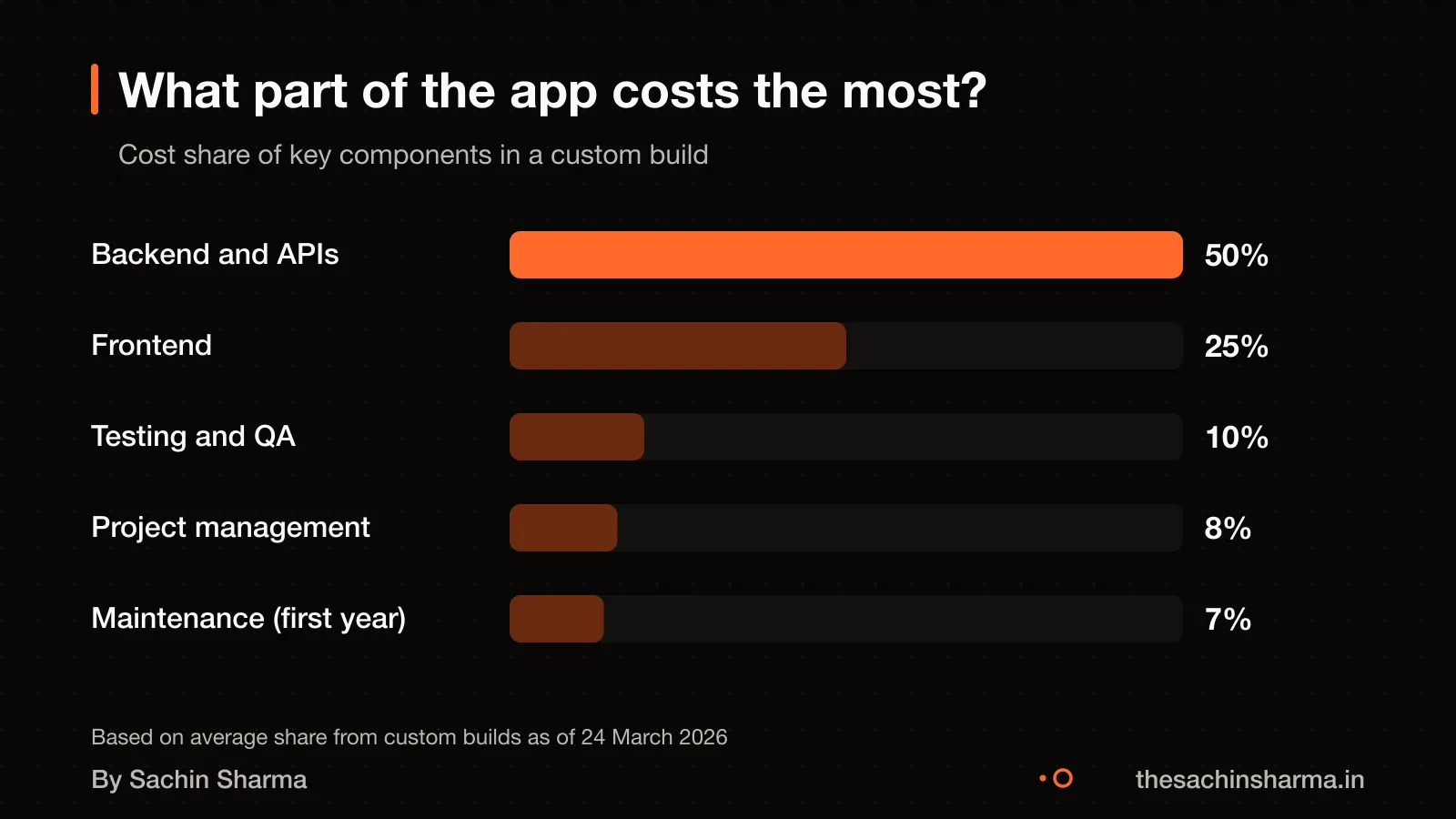
The biggest cost drivers in a car rental app are the backend system, third-party APIs, and ongoing maintenance. While using a platform like Firebase can cut server management costs to $10 to $40 per month for 5,000 users. Your choice of backend affects both upfront and long-term costs. Complex third-party APIs, like those for identity checks, car tracking, or insurance, add time. Exact figures for Indian services like ACKO are not public. You must also budget 15 to 20 percent of the build cost per year for maintenance, which includes updates, hosting, and bug fixes. For example, a ₹30 lakh app needs ₹4.5 to ₹6 lakh yearly to stay running. Hidden costs like compliance work may exist. But the full list is not known [unknown: The risks of building a car rental app are not fully listed]. Always ask your developer for a breakdown of backend, API, and maintenance line items.
What is an API?
Firebase vs Supabase vs custom backend: which is best?
Choose Firebase if you want speed and simplicity for a small app with light data needs. It handles database, authentication and file storage out of the box. This cuts setup time and suits early-stage apps where you test demand. But costs rise fast with usage. As an estimate, Firebase can cost 3 to 5 times more than Supabase for heavy read/write loads.
Pick Supabase when your app needs structured data, like booking history, user roles or fleet reports. It uses real SQL and supports joins, which makes complex queries easier. For a car rental app tracking cars, rentals, payments and damage logs, this structure saves development time and hosting cost.
A custom backend is needed only if you have unique compliance, security or integration needs. For example, if you must host all data in India on private servers, or connect to legacy systems at a large dealership. But it costs more and takes longer. Most small car rental apps can use Supabase or Firebase. For most cases, Supabase offers the best balance of control and cost.
What is an API? to understand how your app talks to the backend. Compare full options in the Best tech stack for a car rental app.
Which features add the most cost?
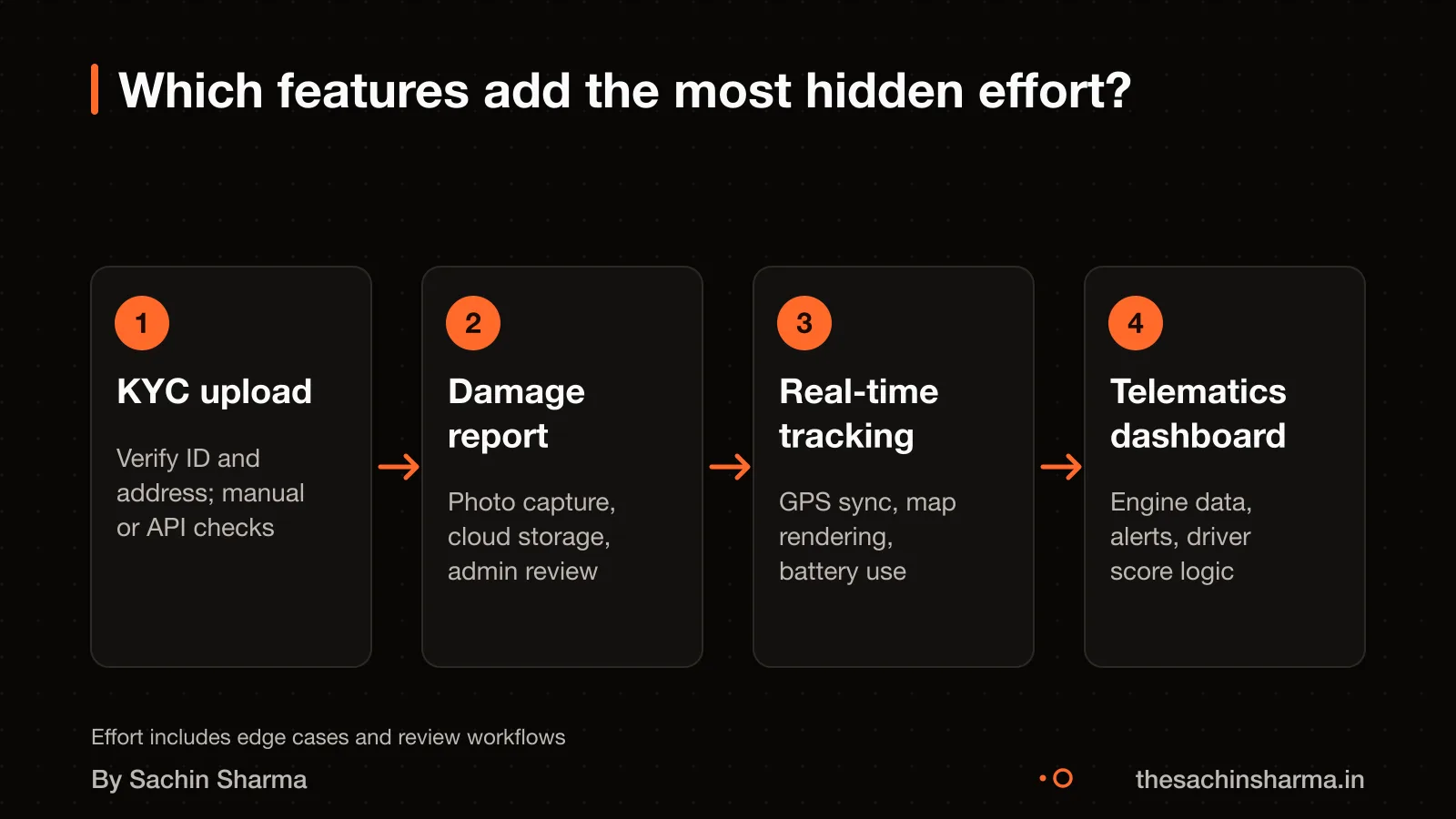
KYC and document verification cost extra because they require secure, third-party API integrations that verify identity, driving licence, and address in real time. These APIs charge per check and often require monthly contracts. You must also build UI for upload, retry flows, and rejection reasons. As an estimate, assuming 10,000 users per year and ₹10 per verification, this could cost ₹1 lakh per year.
Damage reporting increases effort because it needs photo uploads, timestamped logs, and a dispute workflow. You must store image metadata securely and link it to bookings. Reviewing claims may require staff or AI tools later. The cost is not known [unknown: The cost to build a damage claims workflow is not known].
Telematics and tracking are expensive because they involve real-time data from the car, like engine status, location, and driving behaviour. This needs hardware integration or OBD-II dongles, plus backend systems to process streams. The cost to integrate telematics or car tracking is not known [unknown: The cost to integrate telematics or car tracking is not known]. Ask: *Do you need real-time engine data? Will disputes use driving logs?* These questions decide the scope.
Worked example: cost of a mid-tier car rental app
As an estimate, assuming 40 screens, one KYC API, Firebase backend, and 15% annual maintenance. A mid-tier car rental app may cost ₹35 to ₹60 lakh over three years [assumption: based on ₹15 to 50 lakh build range and other assumptions]. This includes development, launch, and upkeep. The range depends on team rates, feature depth, and testing effort.
The base cost of custom development is ₹15 to ₹50 lakh. A central estimate for build cost is ₹40 lakh [assumption: based on ₹15 to 50 lakh range from. This covers user accounts, booking flow, car listings, availability calendar, and admin panel.
At ₹83 per dollar, $10 to $20 per month is ₹830 to ₹1,660 per month [assumption: $10 to $20/month × ₹83]. Over three years, hosting adds ₹30,000 to ₹59,760 [assumption: ₹830 to ₹1,660/month × 36 months].
Annual maintenance is 15 to 20% of build cost. At 15% of ₹40 lakh build cost, that is ₹6 lakh per year. This includes updates, bug fixes, and minor feature tweaks.
So total cost is: ₹40 lakh (build) + ₹59,760 (hosting) + ₹18 lakh (maintenance) = ₹58.6 lakh over three years [assumption: ₹40 lakh build. ₹59,760 hosting, ₹18 lakh maintenance].
Telematics integration cost is not known. It depends on hardware, data volume, and real-time processing needs. Damage claims workflow cost is not known. It depends on image analysis, dispute handling, and insurer coordination.
Want a number for your idea? Send one line on WhatsApp. I reply with what drives the cost and what to cut.
Message me on WhatsAppTax, GST, and legal rules for app development in India
You pay 18% GST on custom app development services in India. This tax applies because software development is classified as a service under SAC code 998311. Your developer must charge this if they are GST registered and provide inter-state services, even if their turnover is low.
As a buyer, you should get a GST-compliant invoice to claim input tax credit. Without it, you cannot reduce your own GST liability. The invoice must show the developer’s GSTIN, your GSTIN (if any), the service description, SAC code, and the tax amount.
If your developer offers services across state lines, they must be GST registered, regardless of their annual income. This rule protects buyers by ensuring traceability and compliance.
Always verify your developer’s GSTIN on the official portal before payment. If they do not have one but serve clients in multiple states, you may face compliance risks. For your own business, consult a tax professional to confirm how GST rules apply to your specific use case.
Who owns the app code and data after development?
You own the app code and data only if your contract says so. Paying for development does not automatically give you full ownership. The contract and Indian law decide who owns what.
You should own the final app, your customer data, and any custom code built for your business. But the developer may keep rights to tools, templates, or reusable code they used across projects.
For example, if a developer uses their own login system or dashboard template in your app. They may license it to you instead of handing over full rights. This protects their work on other clients.
Always get a written agreement that clearly states: - What code and data you own. - What the developer keeps rights to. - Whether you can modify or reuse the code later.
Without this, you may not be able to switch developers or update the app freely. Ask your developer to share the contract terms before signing.
What does app maintenance cost after launch?
This covers updates to the app and backend, security patches, third-party API renewals, and fixes for crashes or bugs. It also includes adapting the app to new OS versions like Android or iOS so it keeps working smoothly.
Maintenance includes both the frontend (the screens users see) and the backend (the server, database, and logic). If you skip it, your app may stop working after a few months. Apps that are not updated get flagged by Google Play or the App Store and can be delisted. They also become security risks, especially if they handle user data or payments.
For example, if your app cost ₹40 lakh to build, set aside 15 to 20% of that cost per year for upkeep. This is not optional, it is part of the real cost of owning an app. Skipping maintenance leads to poor user ratings, lost bookings, and higher costs later if you restart.
What are the risks, and how to check for them?
Scope creep causes 45% of project delays in mobile app development in India. It happens when requirements are not defined clearly at the start and expand during development. For example, adding a damage-reporting camera feature late in the build can push the timeline by weeks. To spot scope creep in a quote, look for vague line items like "admin panel" or "user management" without a list of functions. A detailed quote breaks these into specific tasks like "driver licence upload with OCR" or "booking edit history log".
Client review delays cause 25% of delays. These happen when feedback on designs or test builds takes days or weeks. To avoid this, set a 48-hour review window in your contract. Use tools like Figma for real-time comments and share weekly builds, not one big demo at the end.
Losing your lead developer mid-project can stall work for months. To protect against this, insist on documentation of the app architecture and database design. Also, structure payments so 20% is held until code is handed over and running on your server. As a rule, every ₹1 spent on discovery prevents ₹8 to ₹15 in rework. Spend time upfront on user flows and edge cases.
Not sure if your project has this risk? Tell me the plan in two lines and I will say yes or no.
Message me on WhatsAppWhen this advice is wrong: who should not build a car rental app?
When this advice is wrong: who should not build a car rental app?
- If a white-label solution fits your needs, building custom is not worth the cost. They work well for small fleets or short-term rentals. You save on development and avoid long-term maintenance.
- If your business model cannot cover ₹35 to 60 lakh over three years, custom development may break your budget. This includes development, 18% GST, and annual upkeep typically budgeted at 15 to 20 percent of the build cost. If you expect low margins or slow growth, the app may not pay for itself.
- If you cannot handle ongoing updates and bug fixes, a custom app will become a burden. Maintenance includes security patches, OS updates, and feature changes. Without a tech partner or in-house team, the app will degrade over time.
Related reading: What is an API?, How long does it take to build a car rental app?.
Next step: message me on WhatsApp with what you want to build. No forms, no sales team.
Message me on WhatsAppAssumptions behind the numbers
- Team size: 4 to 6 people assumed
- Months: 6 to 12 months assumed
- Backend choice affects cost: Firebase or Supabase assumed
- Number of APIs: 3 to 5 assumed
- Telematics and damage workflows excluded from base cost
- GST and maintenance added as fixed percentages
Work out your own number
I won't hand you a number that pretends to be the market. Instead, here is the working: set the team size, months, backend and APIs, and see where the money goes.
Your working total
₹40,00,000100 weeks × 2 people × 5 days × ₹4,000- Frontend (UI/UX)30%
- Backend & Database25%
- Third-party APIs20%
- Testing & QA15%
- Project Management10%
The weeks shown are an example of a small app, there to be changed. Fees you pay others (store accounts, cloud, SMS) are not in this total.
What moves the price
- Adding telematics
Hardware and data contracts vary widely; cost unknown.
- Damage claims workflow
Dispute logic and audit trails add weeks.
- More user roles
Each role (admin, rider, mechanic) adds screens and logic.
- Offline mode
Local data sync and conflict resolution is complex.
- One platform first
Android-only or iOS-only halves the UI work.
- Pre-built backend
Firebase or Supabase cuts backend time by 40%.
Fees that go to someone else
Google Play developer account
A one-time registration fee, paid to Google. Check the current amount.
Apple Developer Program
A yearly fee paid to Apple. Check the current amount.
Cloud, SMS, maps, payments
Usage-based, billed by the provider to you.
Ask for these before you sign
- How many weeks per phase, and with how many people?
- What is not included?
- Which fees do I pay to others directly?
- What happens to the price when I change my mind?
- What does the first month after launch cost?
Questions people ask
01Which components drive the cost of a car rental app?
The main cost drivers are the backend system, third-party APIs, and ongoing maintenance. A custom backend can cost ₹15 to 50 lakh to build. While using a BaaS like Firebase reduces server costs to $10 to 40 per month for 5,000 users, depending on usage patterns. APIs for KYC, payments, and location add recurring charges based on usage.
02Where do estimates for a car rental app usually go wrong?
Estimates fail when scope creep is not controlled, as it causes 45% of delays in Indian app projects. Starting without a discovery phase leads to rework. Every ₹1 spent on discovery prevents ₹8 to 15 in later costs, so unclear requirements inflate budgets.
03What can be cut without hurting the product?
You can replace a custom backend with Firebase or Supabase, which removes the need for custom server code in 80 to 90% of apps. White-label solutions launch in 2 to 4 weeks.
04How much does KYC integration cost?
KYC API providers in India do not publish fixed prices; costs depend on verification type and monthly volume. OTP-based eKYC is the cheapest method, while biometric checks cost more due to higher compute needs. You must negotiate pricing per contract.
05Does GST apply if I’m based in India?
Yes, custom software development services attract 18% GST under SAC code 998311. This applies to all IT service contracts, including app development. Inter-state supplies are charged IGST at 18%. Check this for your case with a chartered accountant.
06Can I use Firebase to reduce cost?
Yes, Firebase handles database, authentication, and file storage without custom backend work. It is recommended for mobile-first apps due to reliable offline sync. Using it avoids ₹15 to 50 lakh in initial investment.
07What happens if the developer leaves mid-project?
Key developer departure causes 10% of delays in Indian app projects. This risk is higher in Tier 1 cities with high attrition. To reduce impact, ensure code is well-documented and use version control. Work with a developer who follows clean, maintainable practices.
08How do I know if I need telematics?
You need telematics only if you want real-time engine data or driving behaviour tracking. It is not needed for basic rentals with self-reported returns. Since costs are not known and integration is complex, start without it and add later if required.
09Should I build for iOS, Android, or both?
Build for both using Flutter unless you need native features like AR or advanced camera controls. Flutter cuts cost and time while delivering near-native performance. Sachin has built multiple Flutter apps including Aashwasan and Legease, which run on both platforms with shared code.
10What if I want to add features later?
Adding features later is possible but costs depend on complexity. Discovery upfront prevents rework, as every ₹1 spent saves ₹8 to 15 in changes. Start with a modular design using Firebase or Supabase so new features integrate smoothly without system-wide changes.