What is an outstation cab booking app?
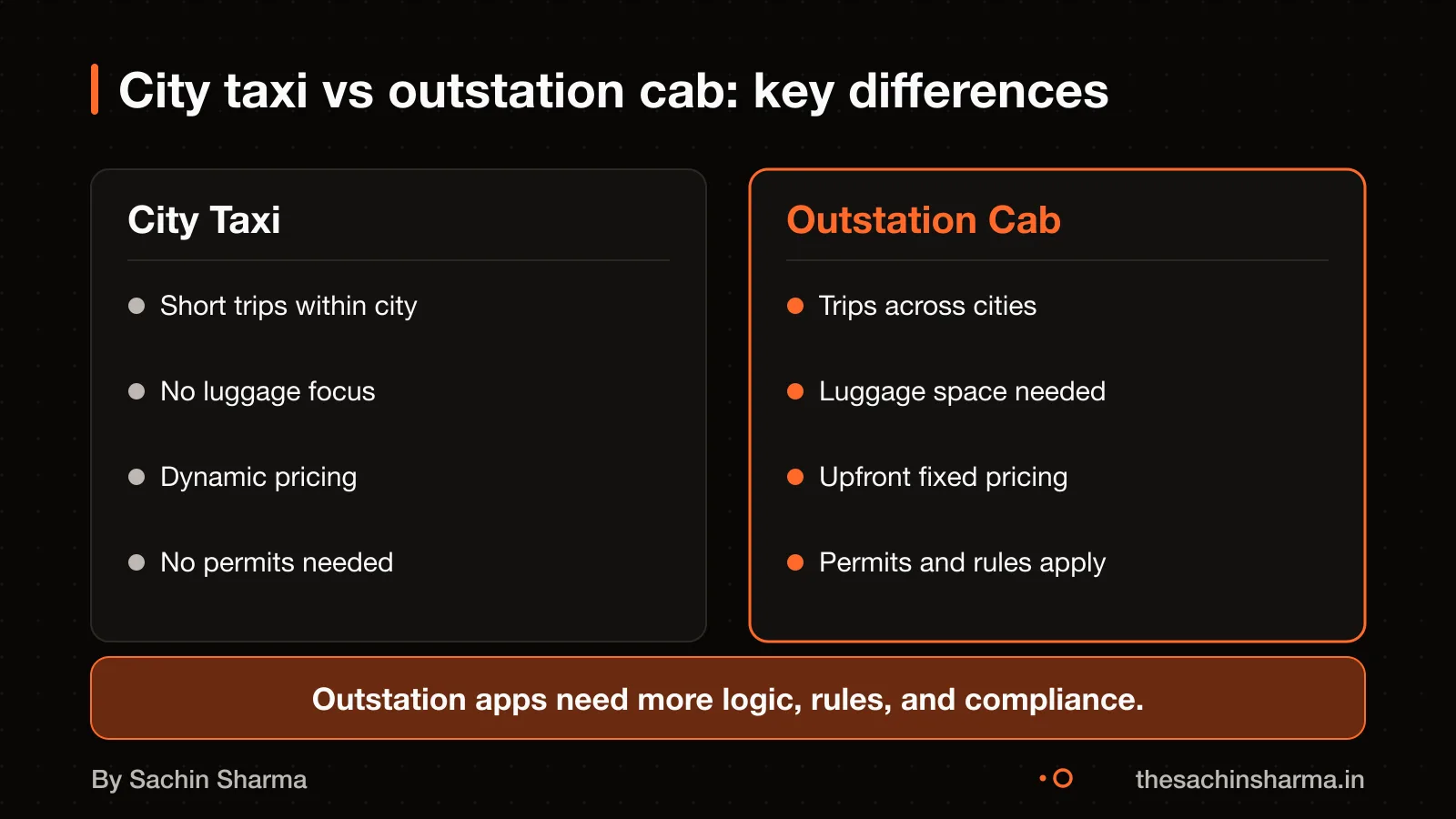
An outstation cab booking app helps you book a taxi for trips outside your city. Unlike a city taxi app which focuses on short, local rides. It supports one-way travel, such as moving from Bangalore to Mysore, Coorg, Ooty or Tirupati, and is ideal for relocations or family visits. The core services include 24/7 booking, upfront pricing for estimated fares, and real-time tracking of your ride.
Real-time tracking builds trust by letting you see your driver’s location, while upfront pricing removes surprise costs, you know the fare before booking. These apps do not support ride-sharing; they offer private, one-to-one trips, making them costlier than shared options but more reliable for long-distance travel. For a full list of features, see the must-have features for an outstation cab app.
Custom app vs white-label: which do you need?
Choose a custom build if your rules for pricing, routing or driver assignment do not fit standard models. A custom app can take up to 12 months to develop and allows full control over logic and compliance. This suits operators with complex outstation rules or multi-state plans.
A white-label solution gives you a proven foundation if your business model and operating requirements are clear. Launch timelines and costs vary by vendor. These apps use pre-built templates in React or Flutter, so they work on both Android and iOS.
The trade-off is speed and cost versus control. White-label apps go live in less than a week or even 48 hours, but you cannot change core logic. Custom apps let you adapt to state laws or add unique pricing, but cost more and take longer.
If you expect to change routes, fares or compliance often, custom is better. If you want to test demand fast, start with white-label. For a full comparison, see how to build or buy an outstation cab app.
What features are must-have vs nice-to-have?
The four must-have features for a taxi booking app in 2026 are one-tap booking, fare estimate before booking. Live driver ETA and real-time tracking, and in-app payment with saved cards. These features boost conversion by reducing steps and building trust. One-tap booking cuts friction and lifts conversion by 22 to 38% for returning users. Showing a fare estimate before booking increases conversion by 18 to 32%. In-app payment with saved cards boosts checkout success by 40%. Real-time tracking and driver ratings are features that customers expect.
You can cut non-core features in version one to save money. Avoid advanced options like group rides, loyalty programs, or AI-based dynamic pricing at launch. Skip voice commands, social sharing, or multi-language support if your audience is local. Link to a third-party option that provides travel insurance up to ₹5 lakh. Pre-booking is expected but can be basic: a calendar picker without complex route logic.
What drives the cost: features, integrations and logic
Adding features like multi-stop rides, ride sharing and ride insurance each add between ₹50,000 and ₹3,00,000 to the cost. Multi-stop rides cost ₹50,000 to ₹1,50,000. Ride sharing adds ₹1,00,000 to ₹3,00,000. Ride insurance costs ₹1,00,000 to ₹2,50,000. These features increase complexity in routing, pricing and user coordination, which raises development time and testing needs.
Third-party integrations also add cost. Google Maps API integration costs ₹20,000 to ₹1,00,000. Payment gateway setup costs ₹30,000 to ₹1,50,000. SMS gateway for OTP and alerts costs ₹15,000 to ₹50,000. Each integration needs secure setup, error handling and ongoing usage fees.
Route pricing and driver payout logic raise costs because they must handle variable distances, waiting charges, tolls and state-specific rules. You need custom logic to calculate fares for outstation trips, which often include return journeys, multiple stops and idle time. Driver payouts must account for fuel, maintenance and commission splits. This logic is harder than in-city pricing, which uses fixed zones or time-distance meters. Errors here affect trust and margins.
Worked example: cost per feature
| Feature | Cost Range | Source |
|---|---|---|
| Multi-stop rides | ₹50,000 to ₹1,50,000 | |
| Ride sharing | ₹1,00,000 to ₹3,00,000 | |
| Ride insurance | ₹1,00,000 to ₹2,50,000 | |
| Google Maps API | ₹20,000 to ₹1,00,000 | |
| Payment gateway | ₹30,000 to ₹1,50,000 | |
| SMS gateway | ₹15,000 to ₹50,000 |
These costs are one-time development fees. Ongoing API usage and transaction fees are extra. A standard app with core features and a few integrations can cost ₹6 to 12 lakh. Compare this with the cost to build a ride-hailing app, which may not include outstation logic.
Want a number for your idea? Send one line on WhatsApp. I reply with what drives the cost and what to cut.
Message me on WhatsApp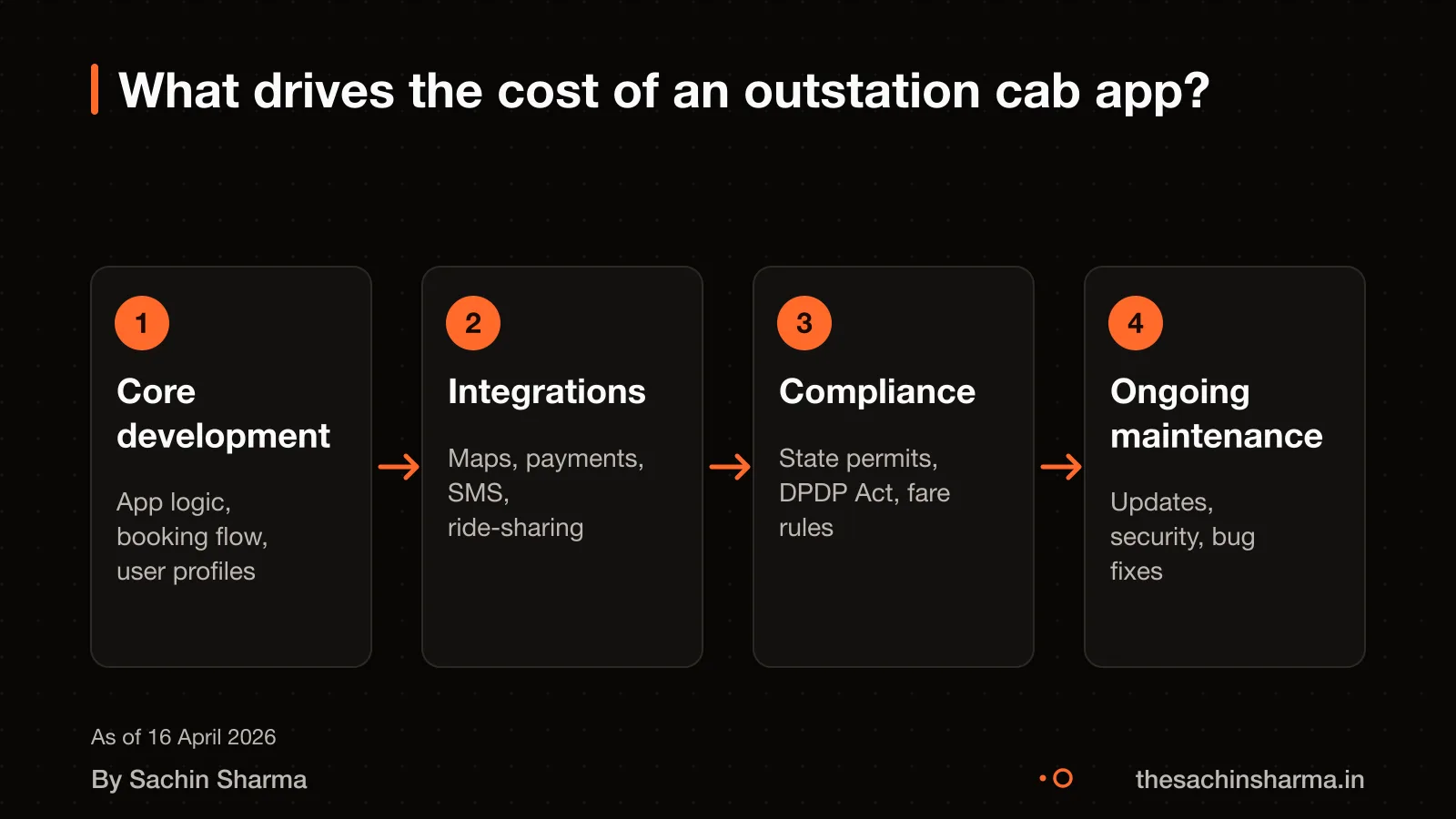
Legal rules: transport, DPDP Act and state laws
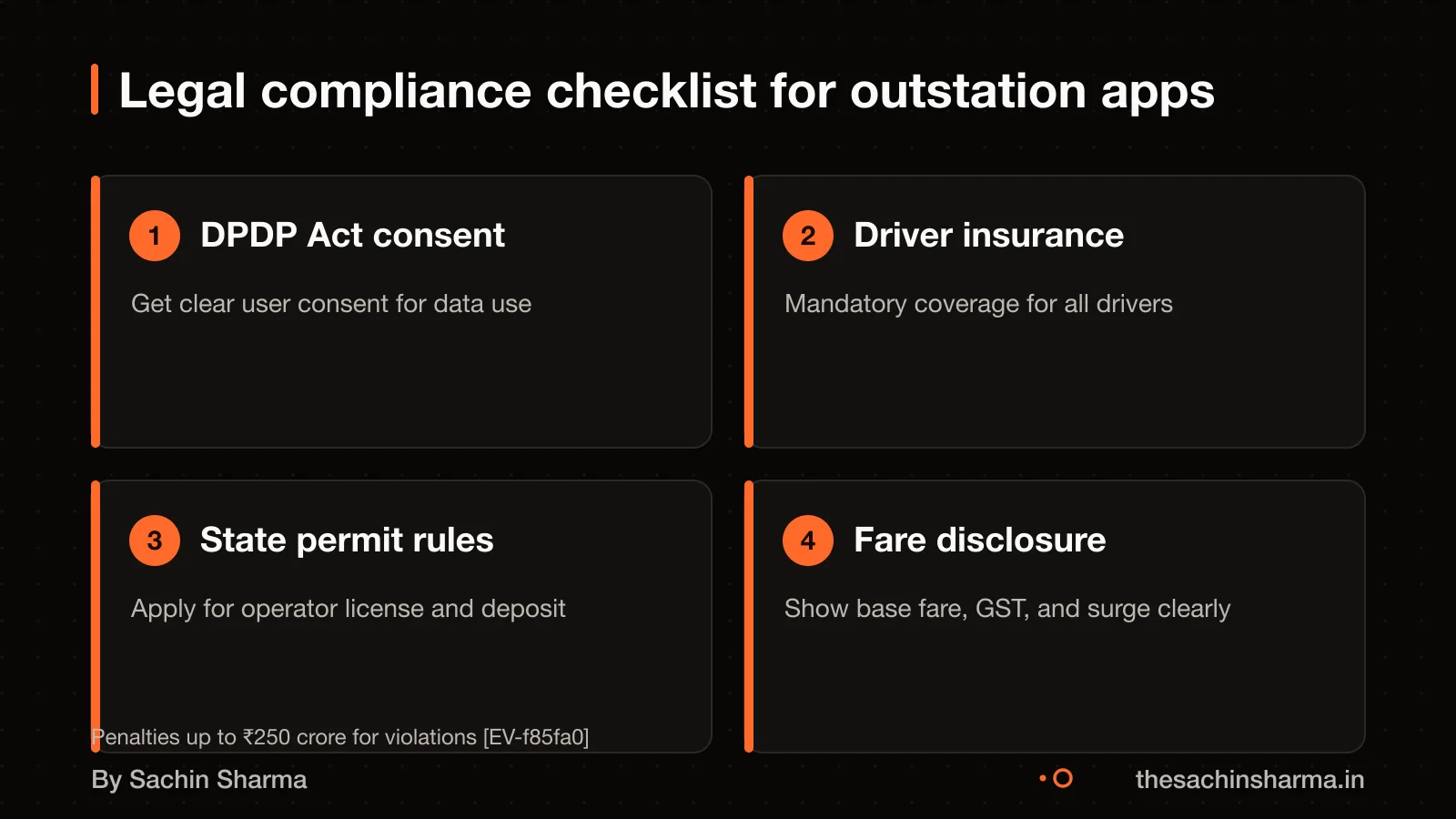
You must follow national transport rules, the DPDP Act 2023, and state-specific laws like those in Uttar Pradesh and Maharashtra. Under the Motor Vehicle Aggregator Guidelines, your app must ensure every driver’s vehicle has a valid registration, permit (where applicable), and fitness certificate. This applies across India as an aggregator is defined under section 2(1A) of the Motor Vehicles Act, 1988.
The DPDP Act 2023 requires clear, informed consent before collecting user data. You must allow users to access their data, inform them quickly if a breach occurs. Follow seven core principles including data minimisation and storage limitation. Non-compliance can lead to penalties: up to ₹250 crore for failing to protect data and up to ₹50 crore for other violations. The DPDP Rules, 2025, notified on 14 November 2025, give organisations 18 months to comply.
In Uttar Pradesh, you must obtain a license under the 2026 rules for app-based cab services. The exact license fee and security deposit are not publicly listed. In Maharashtra, the 2026 aggregator rules apply to any app operating in the state. You must verify driver documents and vehicle permits as part of your system checks. The cost of meeting UP or Maharashtra rules beyond licensing is not known. For your case, consult a legal advisor familiar with transport and data laws in the states you plan to operate.
Ongoing costs after launch
You should budget between ₹1,00,000 and ₹8,00,000 per year for maintenance and support. This covers hosting, regular updates, bug fixes and security patches. The exact cost depends on app usage, the number of features, and how often you update it. For example, an app with live tracking and payment processing will need more frequent security updates than a basic version.
Hosting costs are part of this range and depend on the number of active users and data storage needs. Updates to the operating system or third-party tools (like payment gateways) require code changes and testing, which add to the cost. Security patches must be applied quickly to protect user data and avoid fines under India’s DPDP Act.
App store fees also apply every year. Google Play charges a one-time ₹250 registration fee, but Apple charges an annual ₹11,900 fee for the Apple Developer Program. These fees are mandatory if you want to publish on either store. Both stores may also take a commission on in-app payments if they apply. Though most outstation apps process payments directly and are not subject to this.
As of April 2026, no evidence breaks down the cost of hosting, updates or patches beyond the total annual range. The split between labour and infrastructure is not published. You should ask your developer for a breakdown based on your app’s design.
Can you start simple and add features later?
Yes, you can launch with only the four must-have features and add more later. This reduces both cost and risk. These form the core of what users expect and will use most. Build this first version in 4 to 8 weeks using a proven platform.
Once live, add features based on real user demand. For example, introduce multi-stop rides only if customers ask for them. This phased method avoids spending ₹1 to 3 lakh on unused features. It also lets you test pricing, driver rules, and route logic with real data before expanding.
A simpler launch means fewer bugs, faster compliance checks, and quicker feedback. You can then plan phase two, like ride sharing or insurance, based on actual usage, not guesses.
step-by-step guide to build the app
Have a quote in hand? Send it to me and I will mark what is missing.
Message me on WhatsAppWorked example: cost for a standard outstation app
This includes core booking, tracking and payment features plus advanced functions like multi-stop support and driver performance analytics. The estimate assumes a team of four to six developers working over 3 to 5 months.
The cost breaks down into development and integration phases. Development takes a majority of the budget. The exact split between development and integration is not published. Integrations make up the rest.
Ongoing costs start after launch. Annual maintenance and support range from ₹1,00,000 to ₹8,00,000.
Assumptions: the app is built for Android and iOS using a cross-platform framework like Flutter; it includes real-time tracking. Fare calculation and in-app payments; and third-party APIs are used for maps, payments and SMS. The team is based in India and works full time on the project.
Next step: message me on WhatsApp with what you want to build. No forms, no sales team.
Message me on WhatsAppWhen building this app is not worth it
When building this app is not worth it
- If demand is not proven, building the app may not be worth it. A paid booking or deposit shows real interest more than a survey response. Without early customer commitment, the app could fail even if it works well.
- If you do not control the drivers or vehicles, you may face legal and service risks. The Motor Vehicle Aggregator Guidelines require you to ensure valid permits and fitness, which is hard without direct oversight.
- If your market is small or already served by big platforms like Ola or Uber, joining them may be cheaper and faster. Build only if you have a unique route, pricing model or customer need they do not cover.
Assumptions behind the numbers
- Design complexity increases cost by 20–40%
- Each integration adds ₹20k–1.5 lakh
- Team size and hourly rate are editable inputs
- GST toggle affects displayed totals
Work out your own number
I won't hand you a number that pretends to be the market. Instead, here is the working: set the weeks, the people and the rate, and see where the money goes.
Your working total
₹4,40,00011 weeks × 2 people × 5 days × ₹4,000- Scope and design18%
- Build55%
- Testing and fixes18%
- Launch and stores9%
The weeks shown are an example of a small app, there to be changed. Fees you pay others (store accounts, cloud, SMS) are not in this total.
What moves the price
- More screens or roles
Each extra user type (customer, admin, rider) is close to another app.
- Real-time features
Live tracking and chat need more design and more testing.
- Many integrations
Every payment, SMS, maps or ERP link is its own piece of work.
- Cutting to one platform first
Starting with one clear flow can be half the work.
- Using managed services
A managed backend for login and data removes weeks.
- A clear scope up front
Changes mid-build are the most expensive weeks.
Fees that go to someone else
Google Play developer account
A one-time registration fee, paid to Google. Check the current amount.
Apple Developer Program
A yearly fee paid to Apple. Check the current amount.
Cloud, SMS, maps, payments
Usage-based, billed by the provider to you.
Ask for these before you sign
- How many weeks per phase, and with how many people?
- What is not included?
- Which fees do I pay to others directly?
- What happens to the price when I change my mind?
- What does the first month after launch cost?
Questions people ask
01Which components drive the cost of an outstation cab booking app?
The top three cost drivers are route logic, compliance, and third-party integrations. Route logic for one-way trips with tolls and state permits adds complexity. Compliance with state transport rules and the DPDP Act 2023 requires legal and security work. Integrations with payment gateways, maps, and messaging raise costs further.
02Where do estimates for an outstation cab booking app usually go wrong?
Estimates fail by missing route pricing logic, state permit costs, and driver payout rules. Developers often assume flat rates but real pricing includes tolls, parking, and dynamic state permits. Driver payouts, like the 80% minimum in Uttar Pradesh, affect settlement design. These hidden rules add time and cost not in early quotes.
03What can be cut without hurting the product?
You can cut ride-sharing, multi-stop routing, and AI features in version one. Focus on the four must-have features: one-tap booking, fare estimate, live tracking, and in-app payment. These deliver core value. Add advanced features only after validating demand with real users.
04How does GST affect the app development cost?
GST does not apply to the developer's fee unless reverse charge applies to your contract. However, 5% GST applies to the passenger fare on outstation trips. This affects your pricing model but not development cost. Check this for your case with a chartered accountant.
05What are the risks of not following DPDP Act 2025?
The DPDP Act 2023 imposes penalties of up to ₹250 crore for failure to maintain reasonable security safeguards. ₹50 crore for any other violation. Risks include unauthorised access, poor consent design, and insecure storage. These apply to any app collecting personal data, including cab bookings.
06How much does it cost to integrate WhatsApp for booking updates?
As an estimate, assuming SMS gateway cost, WhatsApp integration may cost ₹20,000 to ₹50,000. The actual cost depends on the WhatsApp Business API setup, message volume, and template approvals. SMS gateway alone costs ₹15,000 to ₹50,000.
07Can I use a white-label app for outstation bookings?
Yes, you can use a white-label app if it supports outstation rules like tolls, state permits, and driver allowances. Pre-built solutions can launch in 4 to 8 weeks and cost from $8.5k. But check that the logic matches your operating states.
08What is the driver payout model in outstation apps?
Driver payouts use split settlements, where a single payment is divided between driver and platform. In Uttar Pradesh, a rule requires drivers to get at least 80% of the fare. Tools like Razorpay Route automate this logic and support multi-vendor payouts.
09How do I validate demand before building the app?
Run a manual pilot in one city with real bookings and measure repeat use. A paid deposit is stronger proof than a survey. If 25% or more of users book again within 30 days, demand is likely valid.
10What ongoing costs should I expect after launch?
As known, first-year maintenance costs ₹1,00,000 to ₹8,00,000. This covers updates, bug fixes, and security patches. Hosting, app store fees, and SMS or map API usage are additional but not priced in evidence. Budget for these separately.